What RV transport actually involves
Kawartha RV Transport & Services is a family run RV and trailer transport company based in Beaverton, Ontario. We haul travel trailers, fifth wheels, park models, toy haulers, pop-up trailers, boats, gooseneck trailers and livestock trailers weighing up to 30,000 pounds, using our own one-ton dually trucks. We move units for dealerships, private owners and insurance companies, one way or return, short haul or long distance.
Local tows start at $400 within 45 kilometres of our base, and anything further is priced per kilometre or per job. We carry $2 million in liability, $150,000 in cargo coverage and $150,000 in non-owned trailer coverage, we operate under Ontario CVOR 204-617-206, and we have moved roughly 1,800 trailers in the last five years.
RV transport means somebody else does the towing. You do not need a truck rated for the load, you do not need to learn how a fifth wheel behaves on the 115, and you do not spend a Saturday backing a 32 foot trailer down a lane you have never driven. You tell us where the unit is and where it needs to be, and we take it from there.
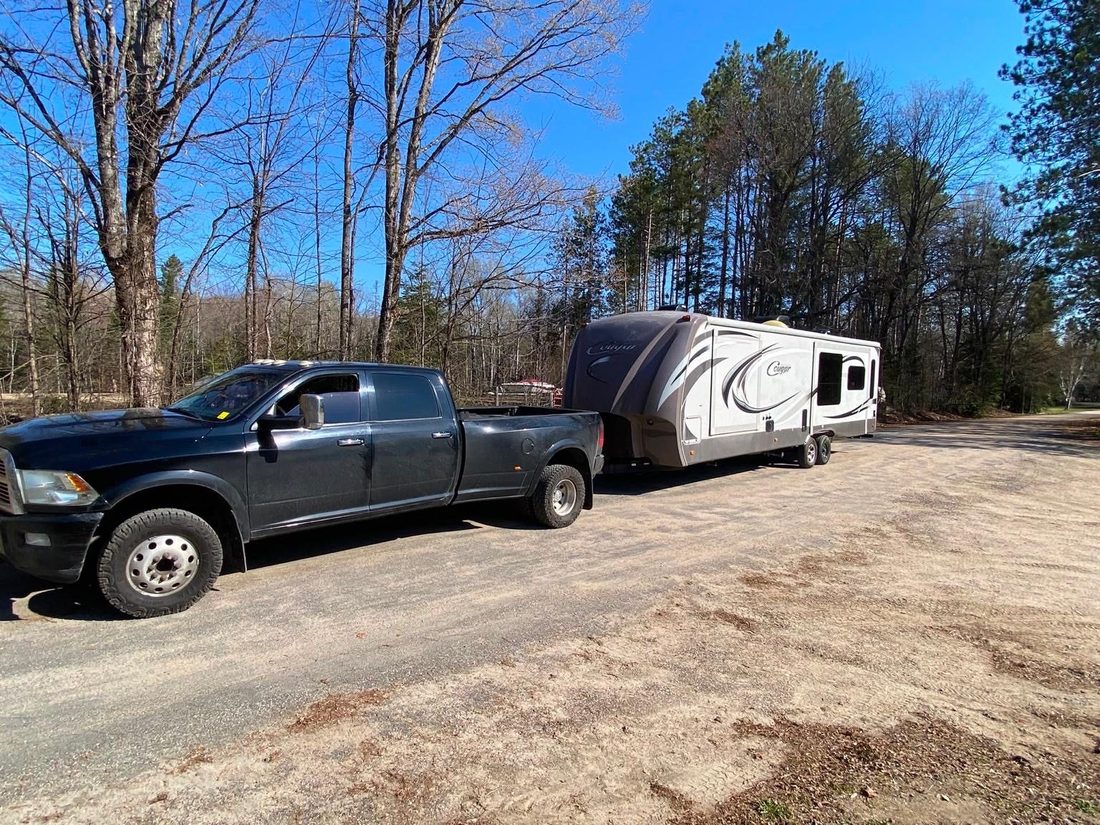
Most of the time that means we hitch your trailer to one of our trucks and tow it, exactly the way you would tow it yourself if you had the truck for it. Some jobs are better on a deck, so we run a gooseneck trailer as well. Either way the job is the same from your end: we show up, we do a walk around, we check that the unit is fit for the road, we haul it, and we put it down where you want it.
People call us for all kinds of reasons. Somebody buys a trailer three hours away and has no way to get it home. A seasonal site changes hands and the unit has to come off the lot by the end of the month. A dealership needs a fifth wheel delivered to a customer. An insurance company needs a damaged unit brought in. A park model needs to go onto a new pad. A camper has been sitting behind a barn for six years and the owner finally wants it gone. None of that is unusual for us, and none of it needs an explanation on your part beyond what it is and where it is going.
Where a lot of transport companies stop at the driveway, we keep going. Once your unit is on site we can level it, block it, and set it up so it is solid and ready to use. That is a genuine part of the business rather than something we tack on, and it is covered in detail on our levelling and blocking page.
What we haul
If it rolls and it weighs 30,000 pounds or less, there is a good chance we can move it. Here is what comes through most often.
| Unit | What you should know |
|---|---|
| Travel trailers | Our most common job by a wide margin. Most travel trailers sit inside Ontario's legal road width, so no permits are needed and the move is straightforward. Bumper pull, single or tandem axle, 16 feet or 35 feet. |
| Fifth wheels | Towed from the pin with a fifth wheel hitch in the bed of the truck. Heavier and taller than a travel trailer, with more pin weight, which is exactly why we run one-ton duallys rather than half tons. |
| Park models | A park model inside Ontario's 2.6 metre legal width tows like a long trailer. Anything wider is an oversize move that needs permits and escorts, which we arrange through a contractor. See park model and mobile home moving. |
| Toy haulers | Heavier again once there is a side by side or a pair of bikes in the garage. Tell us what is loaded in it so we can plan the weight properly, or empty it before we come. |
| Pop-ups and tent trailers | Light and easy, and often the ones that have been sitting the longest. Old tires and seized bearings are the usual holdup, so give the tires a look before we arrive. |
| Boats and boat trailers | On the trailer, off the water. Marina to home, home to storage, or a private sale two hours away. |
| Gooseneck trailers | Equipment trailers, flat decks and dump trailers. If you have a gooseneck that needs to get somewhere and no truck to pull it, that is a normal call for us. |
| Livestock trailers | Empty, moved between farms, properties or a buyer. We do not haul live animals. |
Weight is the one hard limit worth stating plainly: 30,000 pounds. That covers effectively every recreational trailer built for the consumer market, and most utility and equipment trailers too. If you are unsure what your unit weighs, look for the manufacturer's plate near the front left corner of the frame. The number you want is the GVWR, which is the most the unit is allowed to weigh fully loaded. Tell us that number and we can size the job in about a minute.
What does RV transport cost in Ontario?
Local tows start at $400 within 45 kilometres of our base in Beaverton. Past that we price per kilometre or per job, whichever is fairer for the trip. There is no deposit, quotes are free, and you can pay by cash, credit card, debit or e-transfer when the work is finished.
We do not publish a full rate card, and we would rather explain why than pretend a number applies to every job. Two moves that look identical on paper can be an hour apart in real life. A trailer sitting on a paved pad beside a wide gate is not the same job as the same trailer sitting on grass behind a shed with a hydro line over the only way out. What we can do is tell you exactly what moves the price, so nothing on the invoice is a surprise.
What changes the price
- Distance. The single biggest factor. Short local hops run off the $400 starting rate. Longer runs are priced per kilometre or as a flat job price.
- One way or return. A one way drop is cheaper than a job where we bring the unit somewhere and come back for it later. We do both.
- Size and weight. A 16 foot bumper pull and a 40 foot fifth wheel are not the same tow, and the fuel and time show it.
- Access at both ends. How tight the site is, what the ground is like, whether we can turn around, and how much has to be worked around. This is where a couple of photos with your quote request saves everybody time.
- Condition of the unit. Flat or cracked tires, seized brakes, a rusted hitch or a unit still sitting on blocks all add time. If we have to do that work, it is an added charge, and we will tell you the number before we do it.
- Levelling and blocking at the far end. Starts at $799 as a local flat rate, and most people have us do it while we are already on site rather than book a second trip.
- Timing. Spring and fall are the busy stretches. Same-day and emergency work is available, but a job booked with a couple of days of notice is easier to price well.
Getting an accurate quote in one message
Send us the type and length of the unit, the pickup address, the drop address, and two or three photos: one of the unit, one of the way in, and one of where it has to end up. That is almost always enough for a firm number without a site visit.
Where do you transport RVs?
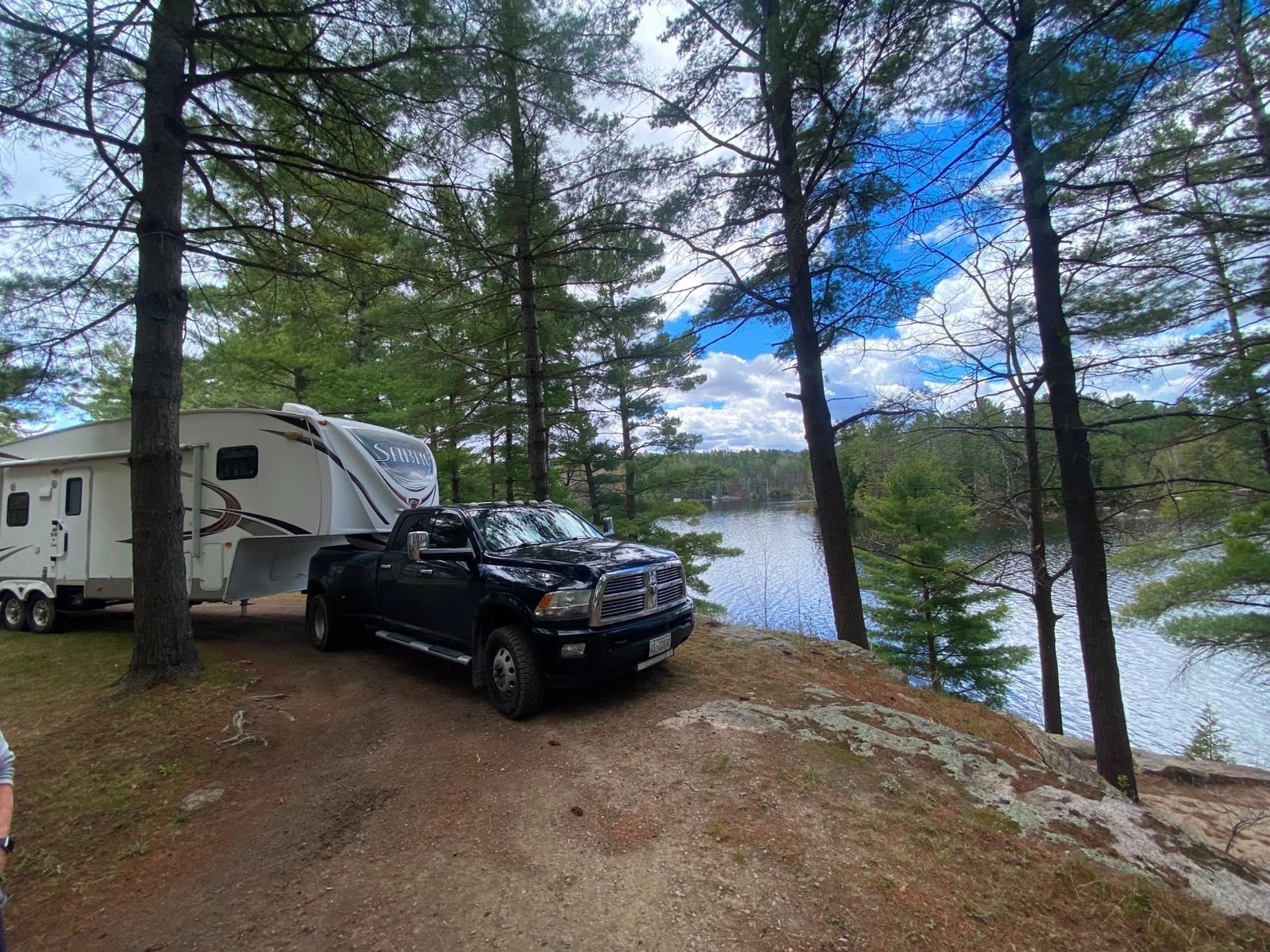
We are based in Beaverton, Ontario, at the top of Lake Simcoe and right on the edge of the Kawarthas. That puts us within an easy run of Durham Region, the Kawartha Lakes, Peterborough County, Simcoe County, Muskoka, the Quinte area and the north end of the GTA. Most weeks we are somewhere in that ring.
We try to keep the work in Ontario, because that is where most of it is. That said, we will go coast to coast, and long distance moves are a normal part of what we do. There are no areas we refuse. If it is on a road in this country, we will give you a price for it.
Towns and areas we work in regularly:
Do not see your town? It almost certainly does not matter. Send us the two addresses and we will price it.
Who we haul for
Private owners
The biggest share of our work. People who bought a trailer out of town, people moving a unit to or from a seasonal site, people who need a camper taken to storage for the winter and brought back in the spring, and people who own a perfectly good RV and simply do not own a truck that can pull it. There is nothing unusual about hiring this out. Half the units on the road were towed there by somebody other than the owner.
Dealerships
Lot to lot, lot to customer, auction to lot, and trade-in pickups. Dealers care about two things: that the unit arrives on the day it was promised, and that it arrives in the condition it left in. That is straightforward work when it is done properly and we are set up for it.
Insurance companies
Damaged and claimed units brought in for assessment or repair, and units delivered out after. These jobs often have awkward access and a unit that is not in great shape, which is exactly the sort of thing we deal with weekly.
Seasonal parks and campgrounds
Site changes, new units coming in, old units going out, and repositioning within a park. We know how tight seasonal lots get once the decks and sheds go up, and we plan for it rather than turning up and hoping.
What do you tow with?
We run three one-ton dually pickups and a gooseneck trailer. That is the whole fleet, it is ours, and it is what shows up when you book.
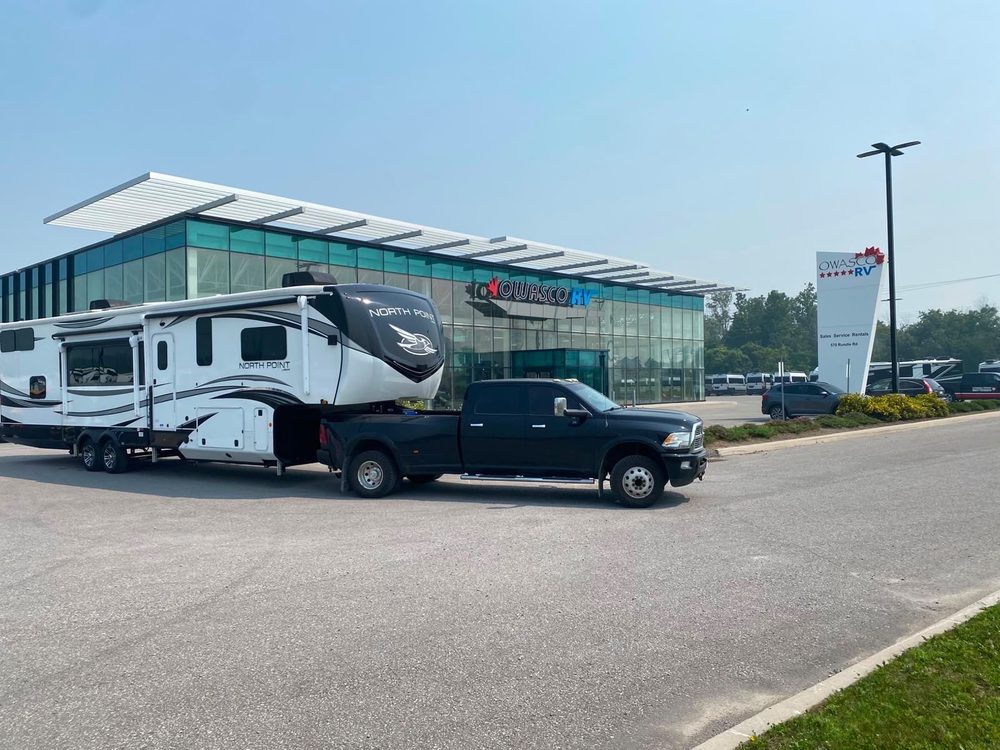
The dually part matters more than people expect. A one-ton dually carries four tires on the rear axle instead of two, which gives a wider footprint at the back of the truck, more load capacity over that axle, and far better stability with a heavy trailer behind it or a fifth wheel pin loaded into the bed. It is also the difference between a truck that is comfortably inside its ratings and a truck that is technically towing your RV while quietly overloaded. Plenty of trailers on Ontario roads are being pulled by trucks in that second category. None of ours are.
The gooseneck trailer covers the jobs that want a deck rather than a hitch: units that are not roadworthy, smaller structures, and anything that is safer riding than rolling. We also have machinery available on request when a site needs more than a truck to sort it out, which comes up more often than you would think on wooded and off-road properties.
Are you insured, and what does that actually cover?
Yes, fully insured. We carry $2,000,000 in liability coverage, $150,000 in cargo coverage and $150,000 in non-owned trailer coverage, and we operate under Ontario CVOR 204-617-206. We will send proof of insurance on request, before you book, no questions asked.
Those three numbers are not interchangeable, and it is worth knowing what each one is for.
- Liability covers damage or injury we cause to other people and their property while we are working. Two million is the figure most dealerships and commercial clients want to see before they hand over a unit.
- Cargo coverage covers the thing we are hauling. If your trailer is damaged while it is in our care, this is the coverage that responds. A lot of people never think to ask about it, and it is the one that matters most to you.
- Non-owned trailer coverage covers trailers we are pulling that we do not own, which is nearly every job we do. Without it, a policy can look complete on paper and still leave your unit exposed.
What a CVOR number tells you
A CVOR is a Commercial Vehicle Operator's Registration, issued by Ontario's Ministry of Transportation. Any operator running a truck with a registered gross weight over 4,500 kilograms in Ontario is required to hold one, and the ministry uses it to track that operator's collisions, convictions and inspection results over time. In other words, it is a public safety record attached to the business, and an operator who is careless with it does not stay in business long.
Ours is CVOR 204-617-206. We put it on the site, in the footer of every page, for the same reason we put the insurance figures up: you should not have to take our word for it. You can read the province's own explanation of the program on ontario.ca.
When does a move need an oversize permit?
Ontario sets legal limits on how big a vehicle and load can be before a permit is required. As published by the Ministry of Transportation, the general limits are:
| Dimension | Ontario legal limit without a permit |
|---|---|
| Width | 2.6 m (about 8 feet 6 inches) |
| Height | 4.15 m (about 13 feet 7 inches) |
| Length, single vehicle | 12.5 m |
| Length, combination | 23 m |
Go past any of those and the load is legally oversize. That brings in permits, bright red or orange warning flags of not less than 40 centimetres square on the extremities of the load, OVERSIZE LOAD signage, and once a load reaches 4 metres wide, escort vehicles running with it. The full rules are set out in the province's guide to oversize and overweight vehicles and loads.
For most of our work this never comes up. Travel trailers, fifth wheels and toy haulers are built to be towed by consumers on public roads, so they are almost always inside the legal width. Park models are where it changes. Park model trailers are built in Canada to the CSA Z241 series standard, which permits a floor area of up to 50 square metres, or 538 square feet, including any loft. A park model narrow enough to sit inside the 2.6 metre legal width tows like a long trailer and needs no permit. Plenty of them are built wider than that, and the moment a unit is over 2.6 metres it is an oversize move, full stop, with permits and escorts whether anybody likes it or not. If you are not sure which one you have, measure the widest point of the body, not the roof overhang, and tell us the number.
How we deal with oversize work
We do not run oversize permits ourselves. When a job needs them, we bring in a contractor who specialises in it and they handle all of it: the permits, the routing and the escorts. You still deal with us, and we still stand behind the job. We would rather tell you that plainly than have you find out halfway through.
Tight sites, wooded lots and remote properties
This is the part of the job we are actually known for. Anyone with a truck can pull a trailer down a highway. The work starts when the trailer has to come out of a spot it was never really meant to fit into.
Tight seasonal lots, wooded properties where the canopy is lower than the roof of the unit, back lots with soft ground, long narrow laneways, sites with a septic bed in the only sensible line of approach, hydro lines strung across the entrance, sloped ground that wants to push a trailer sideways. Those are the calls we get, and we have machinery available on request for the ones that need more than a truck.
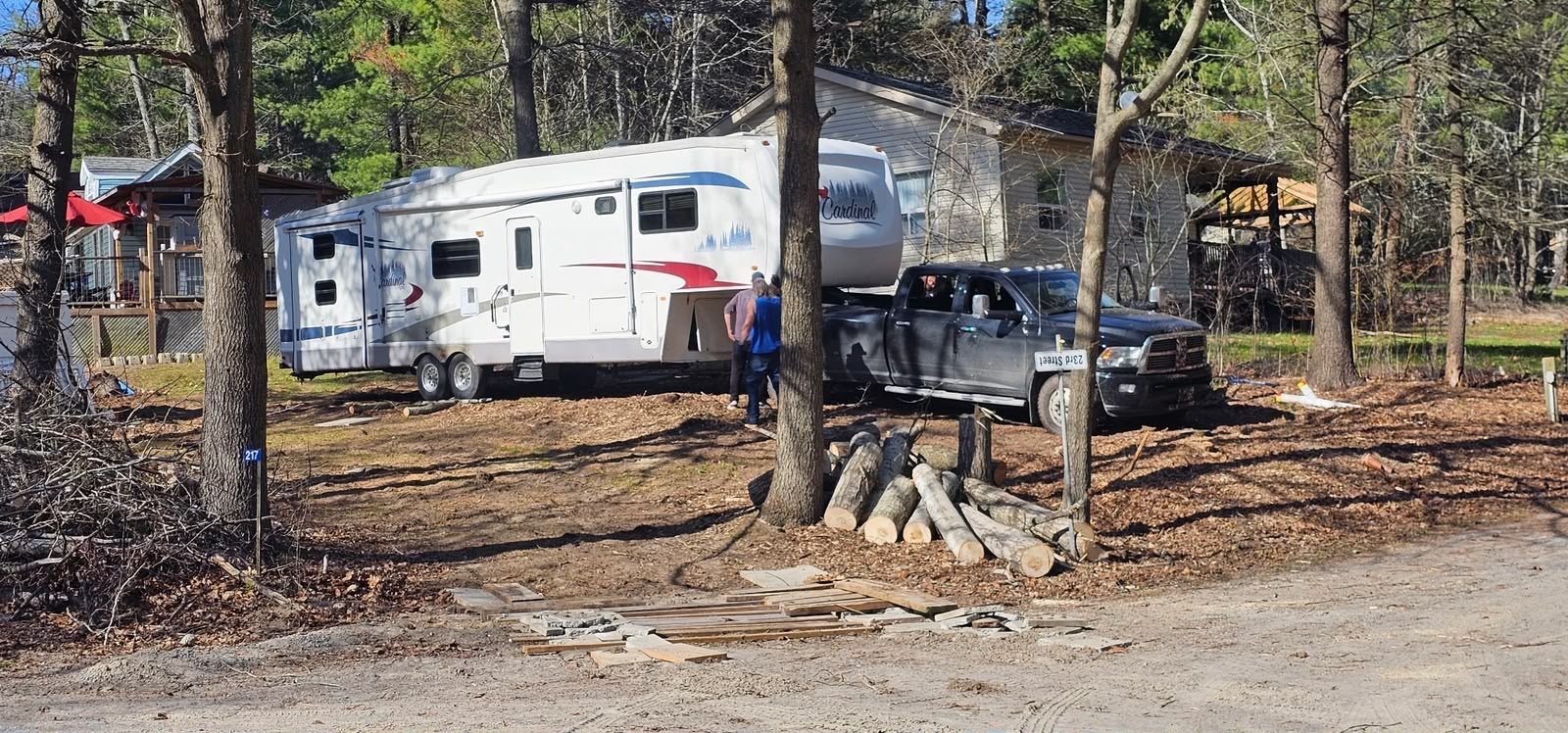
What we do first is look. Before we commit to a date we want to know how wide the gate is, what the ground is like after rain, what the turning room looks like at the far end, and what is overhead. Photos usually answer all of it. If a site genuinely cannot be done safely, we will say so rather than turn up, take a run at it and damage your unit or your property in the process.
How do I get my RV ready for transport?
Three things, and they are the ones we ask every customer for: have the unit unblocked, move anything in the way such as a deck, shed or skirting, and make sure the tires are properly inflated and not cracked. If you would rather not deal with any of it, we can do it for an added charge. Just tell us when you book.
What we ask you to do
- Unblock the unit. Get it down off its blocks and sitting on its own wheels, with the stabilisers and jacks up. A unit still resting on blocking is not ready to hitch, and sorting it out on the day costs time.
- Clear the way out. Decks, sheds, skirting, fire pits, planters, patio stones, parked cars, boats. If it is between the unit and the road, it needs to move. Skirting in particular gets forgotten until we are standing there looking at it.
- Check the tires. They need to hold air and they need to not be cracked. RV tires almost always age out before they wear out, so a set with plenty of tread can still be unsafe. Look at the sidewalls in good light. If you can see fine cracks running around the wall, that tire is done, whatever the tread looks like.
Worth doing, even though we do not require it
- Bring in the slide-outs and the awning, and check that both are properly latched.
- Close and latch every window, vent and roof hatch, and lock the exterior compartment doors.
- Disconnect the power, water and sewer, and coil the hoses and cords away inside.
- Secure anything loose indoors. Anything that can slide will slide, and cupboards that were fine in a driveway will empty themselves on a gravel road.
- Take a few photos of the unit before we hitch up. We are careful and we are insured, but a dated set of photos is good practice for anything valuable that is being moved.
- Have the keys and, for a private sale, the ownership sorted before we arrive.
Mistakes we see, and what they cost
We get called in after other people's moves often enough to have a short list. None of this is meant as a lecture. It is the honest version of what goes wrong.
Not levelling properly
The most expensive mistake on the list, and the most common. An RV frame is designed to carry its load evenly. Set it down out of level or badly blocked and the frame carries that load in a way it was not built for. Over a season or two, doors stop closing square, slide-outs bind and stop sealing, and the plumbing, which relies on gravity for drainage, stops draining the way it should. By the time you notice, you are not fixing levelling, you are fixing damage. This is exactly why we do levelling and blocking as its own service rather than as an afterthought, and why we handle plumbing and levelling together on the sites that need it.
Towing with an underrated vehicle
The trailer is rated, the hitch is rated, the truck is rated, and the number that matters is the lowest of the three. People routinely look at the trailer's dry weight, decide their half ton will manage, and never account for water, gear, propane or the tongue weight sitting on the back axle. In Ontario, a trailer with a gross weight of 1,360 kilograms or more is required to have its own brakes, and a trailer over 4,600 kilograms needs a higher class of licence than a standard G. The province's MTO Driver's Handbook towing section sets it all out. If you are near any of those lines, hiring the tow out is cheaper than finding out the hard way.
Skipping the safety basics
Safety chains crossed under the tongue so the tongue cannot hit the pavement if the hitch lets go, hooks with working latches, a properly adjusted brake controller, a lighting check before rolling, and blocking that sits on solid ground rather than soft soil or a single stack of scrap wood. Nobody ever gets away with skipping these forever. Safety is the first thing on our list, not the last, and it is the reason we run the equipment we do.
How booking works, start to finish
- You get in touch. Call or text (647) 961-9257, email transport@kawartharvrentals.ca, or fill in the quote form. Tell us the unit, the two addresses and roughly when you need it done.
- We ask a few questions. Usually about access, ground conditions and whether the unit is roadworthy. Photos answer most of it faster than a conversation does.
- You get a price. Per kilometre or per job, whichever is fairer for that trip, with anything extra spelled out up front. Quotes are free.
- We book the date. No deposit. We normally need 24 to 48 hours of notice, and same-day and emergency work is available when we can fit it in.
- Job day. We walk the unit, check the tires, lights and hitch, hook up, and go. If we spot something that makes the unit unsafe to move, you hear about it on the spot rather than after.
- We place it. Not just dropped at the end of the driveway. Put where you want it, and levelled and blocked if you have asked for it.
- You pay when it is done. Cash, credit card, debit or e-transfer.
Our 30 day guarantee
Every job we do is backed by a 30 day guarantee. If something is not right, we come back and redo the work at no charge. That is the whole policy, and there is no fine print under it.
It exists because of how this business started. We got into it because we like helping people get outdoors and make memories, and because the moving and setup part of that is the bit most people dread. Taking the stress out of it is the actual product. That means being safe, being reliable, and keeping you informed from the first phone call to the moment the unit is sitting level on site. We have been in transport and logistics for fifteen years, we started this business in 2020, and we have moved somewhere in the region of 1,800 trailers in the last five years. Every one of them belonged to somebody who cared about it.