
What we move, and what we do not
Kawartha RV Transport & Services lifts, moves and resets decks up to 30 feet long, along with sheds, bunkies and small outbuildings, anywhere in our Ontario service area. Structures get moved in one piece wherever the access and the build allow it, set back down on proper support, and brought level before we leave.
Quotes are free, there is no deposit, and the work carries a 30 day workmanship guarantee. We run under Ontario CVOR 204-617-206 and carry $2 million in liability with $150,000 in cargo coverage. What we do not do is pull your building permit. That is your municipality's call and we explain below why it is not a question anyone can answer for the whole province at once.
Most people who call us about a deck are not really calling about a deck. They are changing sites at a seasonal park, selling a unit, putting a bigger trailer where a smaller one was, or finally admitting that the shed went in the wrong spot eleven years ago. The structure is in the way of something else, and it has to move.
The good news is that a lot of what people assume has to be demolished does not. A sound deck, a solid shed and enough room to work add up to a lift and a shift rather than a teardown and a rebuild. The difference in cost between those two is not small.
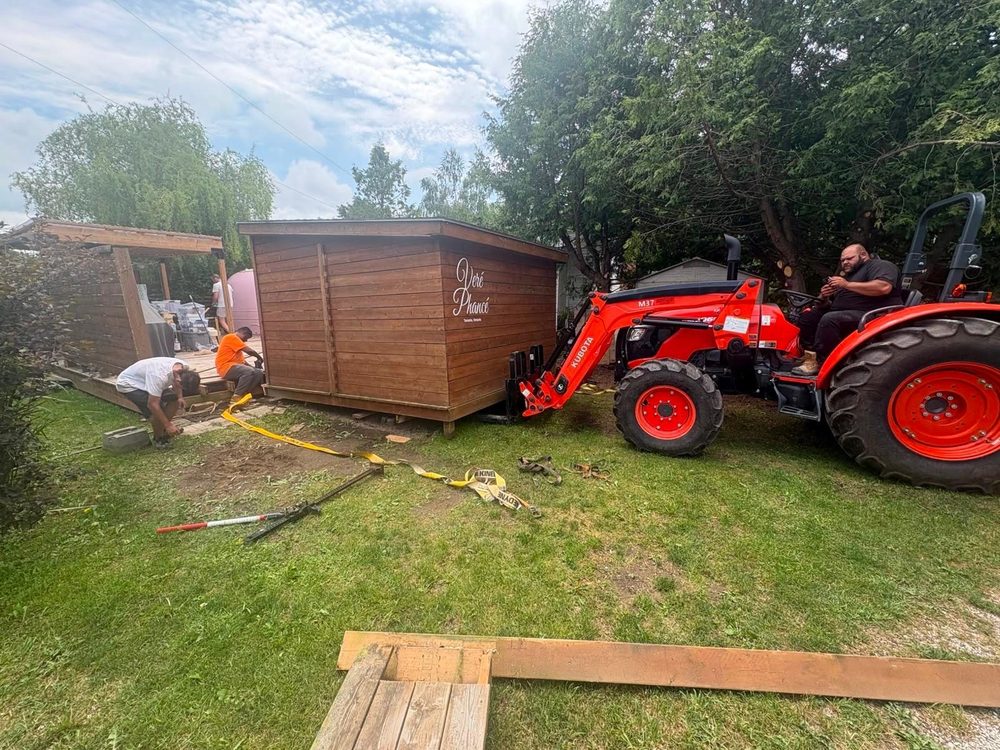
Moving a deck
A deck is a floor with no walls to hold it square, which is the whole problem in one sentence. Everything that keeps a deck rigid is in the framing underneath it, and the moment it comes off its supports it wants to rack.
So the work starts before anything gets lifted. The deck gets detached from whatever it is attached to, usually the trailer or the park model. It gets looked at underneath, because the underside is where you find out whether this is a move or a rebuild. Where it needs bracing to survive the lift, it gets braced. Then it comes up on straps at points that will carry it rather than at points that happen to be convenient.
Where it is going matters as much as where it has been. A deck that has spent ten years sitting on soft ground has usually settled into a shape, and setting it down on a properly supported spot is the point at which it goes back to being level. That is a good thing, but it does mean the deck is being asked to change shape slightly, and old fasteners sometimes have opinions about that.
Decks attached to a trailer or park model
Most of the decks we move are attached to a unit, and that changes the order of operations. If the unit is going too, the deck comes off first, the unit goes, then the deck is set to the unit in its new position rather than the other way round. Building the deck to the unit is always easier than making the unit fit a deck that is already in place, and the finished result is better.
If the unit is staying and only the deck is moving, it is a simpler day, but the ledger and the flashing where the deck met the unit still need dealing with properly. A hole left in the side of a trailer is how water gets into a wall.
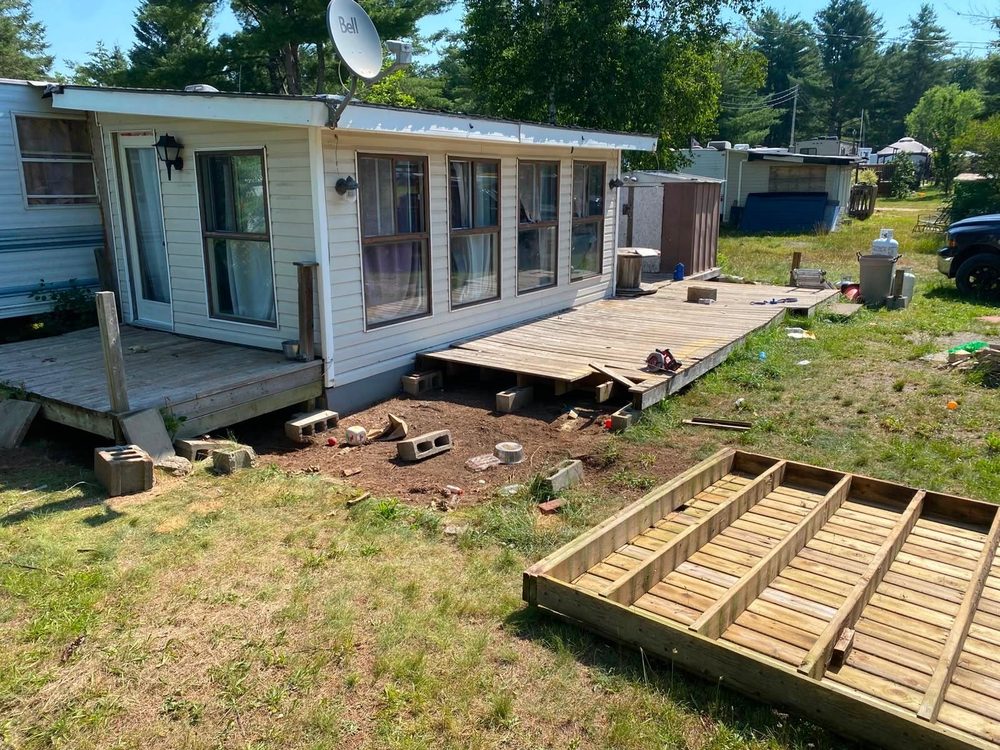
Moving a shed or bunkie
Sheds move more easily than decks do, for the obvious reason: a shed has walls and a roof, so it is already a box that holds its own shape. A well built shed can be lifted, carried and set down without complaint.
The ones that give trouble are the ones that were never built to be moved twice. A shed assembled in place, on the ground, without a proper floor frame under it has nothing to pick it up by. Those get looked at carefully and sometimes get a frame built under them before anything happens, because the alternative is watching it come apart in the air.
Bunkies are their own category. They are heavier than a shed, often better built, and frequently in the least accessible corner of the property, because that was the appeal of putting a bunkie there in the first place. They are very movable. Getting to them is the work.
- Sheds moved within a property, to a new pad or a new corner
- Sheds loaded and taken to another property entirely
- Bunkies and small outbuildings shifted to clear space for a unit
- Structures moved off a seasonal site at the end of a lease
- Everything set back down on proper support and brought level
How it was built decides everything
Two sheds the same size, sitting side by side, can be a straightforward morning and a flat no. The difference is underneath, and it is worth understanding before you ring anybody for a quote.
What we look for under a deck
A deck that moves well has a proper frame: beams the joists actually sit on, joist hangers where they are needed, and fasteners that have not given up. What ages badly is nails. Nails work loose over years of the wood swelling in July and shrinking in February, and a deck held together with nails that have backed out a quarter inch is a deck that will loosen further the moment it is off the ground. Screws hold better, though old thin galvanized screws have a habit of shearing rather than pulling. The ledger where the deck met the building or the trailer is the other place we look hard, because it carries a lot and it is the first thing to rot.
Decking material matters less than framing, but it is not nothing. Composite boards are heavier than cedar or pressure treated wood, which changes what is hanging off the straps, and they mark more easily when something is dragged across them. Old pressure treated boards that have gone grey and checked will usually survive a move perfectly well. It is the frame under them that decides.
What we look for under a shed
Sheds fall into roughly three groups. The easiest are the ones built on skids or runners, because somebody already decided this thing might move one day and gave us something to pick it up by. Next are sheds with a plywood floor over a framed joist deck, which lift fine as long as the floor frame is sound. The difficult ones are sheds assembled directly on patio stones, gravel or a slab, with the wall bottoms sitting on the ground and no floor frame tying the whole thing together. There is nothing there to lift. Those get a frame built under them first, or they get taken apart.
Metal and resin sheds are their own conversation. They are light, which sounds helpful, but they get their rigidity from being bolted together in place and they do not enjoy being picked up as a unit. We will look, but do not be surprised if the honest answer is that unbolting it is faster and safer than lifting it.
The 30 foot limit, and why there is one
We move decks up to 30 feet long. That number is not arbitrary. Our gooseneck is a 30 foot gooseneck, and a structure that fits on the trailer travels as one piece. Past that length it has to be sectioned, which is a different job with a different price, and it is worth knowing that before you get a quote rather than during one.
Length is only one of the three dimensions that matter. Width decides whether the load can travel on the road at all and whether it can get down your driveway. Height decides whether it goes under the wires and the branches between where it is and where it is going. Plenty of structures that are well inside 30 feet long are a problem because of the other two.
| What we ask about | Why it matters |
|---|---|
| Length | Up to 30 feet moves as one piece on the gooseneck. Longer means sectioning. |
| Width | Decides the route, the gate, the driveway and whether the load is legal on the road. |
| Height | Decides what it fits under. Wires and low branches end more jobs than weight does. |
| How it was built | A framed floor can be picked up. A structure assembled flat on the ground often cannot, not without work first. |
| Condition | Soft joists, a rotten ledger or failed fasteners turn a move into a rebuild. |
| The approach | The single most common reason a job costs more than the customer expected. |
Permits, and who actually decides
This is the part of the page worth reading properly, because it is where most of the bad information online lives.
Building permits in Ontario are issued and enforced by your municipality, not by the province. The provincial Building Code sets the framework, and then each municipality administers it. That is why you can get two confident, contradictory answers from two neighbours who live twenty minutes apart, and both of them can be right about their own address.
The provincial starting point is broad. Ontario's own citizens' guide to land use planning says a building permit is needed to construct any new building over ten square metres in area, or to place another structure, such as a mobile home, on your property. Note the second half of that. Placing a structure counts, not just building one.
Say it plainly
We are not a permit service. We do not apply for permits, we do not pull them on your behalf and we do not give advice on what your municipality will decide. Call your local building department before the move. It is a five minute phone call and it is considerably cheaper than the alternative.
Three municipalities, three different answers
Rather than tell you what the rule is, here is what three building departments inside our own service area actually publish. All three are within an hour of each other. All three word it differently.
City of Kawartha Lakes
Kawartha Lakes' detached residential accessory building guide takes the accessory building question in two parts. Any accessory building over 10 square metres, about 107 square feet, needs a permit unless it meets their definition of a shed. A shed up to 15 square metres, about 161 square feet, is exempt provided it is not more than one storey, is not attached to a building or any other structure, is used only for storage ancillary to a principal building on the lot, and has no plumbing. Four conditions, all of them required.
City of Peterborough
Peterborough's residential deck guide is stricter on decks than most people expect. It treats a permit as required for deck construction, including for a floating deck. What being under 600 millimetres in height, unattached, not supporting a roof and within their stated area limit buys you there is relief on the foundation requirements, not relief from the permit itself.
Town of Georgina
Georgina's decks and porches page splits it a different way again. A deck of any size attached to a building needs a permit, as does one of any size that forms part of a building's exit. A freestanding deck comes into permit territory when it is over 10 square metres and part of its perimeter is more than two feet above grade, or when it is over 10 square metres and sits beside ground that slopes away steeply.
Three sources, three structures, one shared theme: the height above grade figure that keeps appearing across the region is around 600 millimetres, roughly 24 inches, and attachment to a building tends to matter more than size does. That is a useful thing to know before you call. It is not a substitute for calling.
Zoning is a separate question, and it catches people
Here is the trap. A structure can be exempt from a building permit and still be in a place the zoning by-law does not allow it to be. Those are two different approvals answering two different questions, and clearing one does not clear the other.
Kawartha Lakes states this outright in its own accessory building guide: where a building permit is not required, you are still required to comply with the applicable zoning by-law for things like location, height and how many accessory structures the lot is allowed to have. Setbacks from lot lines, distance from a septic bed, distance from water, and total lot coverage are all zoning questions.
This matters most when a shed is moving from one spot to another on the same property. The shed has not changed. Where it is sitting has, and where it is sitting is exactly what zoning cares about. A shed that was compliant beside the garage may not be compliant three metres from the lot line.
Does moving an existing structure need a permit?
People assume that because a shed already exists, moving it is a non event. Sometimes that is right. Often it is not, and the honest answer is that it depends on your municipality and on where the structure ends up.
Two things push it toward needing approval. The first is that provincial guidance treats placing a structure on a property as a permit trigger in its own right, not just constructing one. The second is that municipalities generally treat relocation as a change worth reviewing, which is why building departments publish moving alongside construction rather than as an afterthought.
What we tell every customer is the same thing: ring the building department, describe what is moving and where it is going, and get the answer from the people who will be enforcing it. If they say no permit needed, wonderful, the job gets easier. If they say a permit is needed, you have found that out before the structure is sitting in the wrong place rather than after.
A new grade can change what the deck needs
This one surprises people, and it is worth a paragraph of your attention before you pick a destination.
A deck's obligations are largely set by how far its walking surface sits above the ground beneath it. Move the same deck to a spot where the ground falls away and you have not changed the deck at all, but you have changed that measurement, and the measurement is what the rules are written around.
The City of Peterborough's residential deck guide is the clearest published example inside our service area. It sets a guard where the walking surface is more than 600 millimetres, about 23 5/8 inches, above grade, with the guard at a minimum height of 900 millimetres, about 35 7/16 inches. Where the walking surface is more than 1800 millimetres above grade, roughly 5 feet 11 inches, the minimum guard height goes up to 1070 millimetres, roughly 42 inches. Guards are also required on flights of stairs at a minimum of 900 millimetres. For wooden guards the guide points to the Ontario Building Code supplementary guideline SB-7, Guards for Residential Decks.
The same guide sets out stair geometry: uniform rise and run on every step, a minimum stair width of 860 millimetres, about 2 feet 10 inches, a level landing at the top and the bottom of each run, a handrail once there are more than three risers, rise between 125 and 200 millimetres and run between 255 and 355 millimetres.
Georgina, for comparison, ties its permit trigger to a similar idea from a different direction. A freestanding deck over 10 square metres comes into permit territory once any part of its perimeter is two feet above grade.
The practical version
Stairs built for the old grade almost never fit the new one. If the destination sits lower or higher by even a few inches, the stairs are a rebuild even when the deck itself moves in one piece. Budget for that, and check with your building department whether the new height brings a guard into play. Those are code and permit questions, and we are not the building department.
Access, ground and what actually stops a lift
Almost every deck and shed move that goes badly goes badly for the same reason, and it is never the structure. It is the route.
What we look at before quoting is the whole path from where the truck can stop to where the structure has to end up. Gate widths. The turn at the top of the driveway. The tree that has grown since the shed went in. Overhead wires. Soft ground that will hold a truck in June and swallow it in April. A septic bed that nothing heavy can cross. The neighbour's fence that is three inches inside the line.
- Overhead wires and branches. The most common hard stop. Height is measured from the ground the load will cross, not from where it is now.
- Gate and driveway width. Including the swing needed to get through, which is always more than the gap itself.
- Ground bearing. Wet ground, fresh fill and recently disturbed soil all behave differently under a loaded machine.
- Septic beds and wells. Nothing heavy crosses a bed. Tell us where it is and we plan around it.
- Slope. A moderate slope is workable. A steep one changes the method and the price.
- Where it has to land. The destination needs to be as accessible as the origin, and people forget to check that half.
This is not a list designed to talk you out of anything. It is the list we work through, and the reason we ask for photos of the approach rather than just the structure. Tight, wooded and remote sites are normal for us. We would just rather know about them in advance than discover them with a shed in the air.
Machinery, and when we bring it
Machinery comes when the job needs it. That is a real assessment rather than a default. Plenty of shed moves are done with straps, skates, a truck and people who know where to stand. Plenty of others need a machine, and on those we bring one.
Bringing gear onto a property is not free of consequence, which is the other half of the decision. A machine leaves marks on a lawn. It compacts ground. It needs room to get in and out. If a job can be done without one, that is usually the better outcome for the property as well as the invoice, and we will say so.
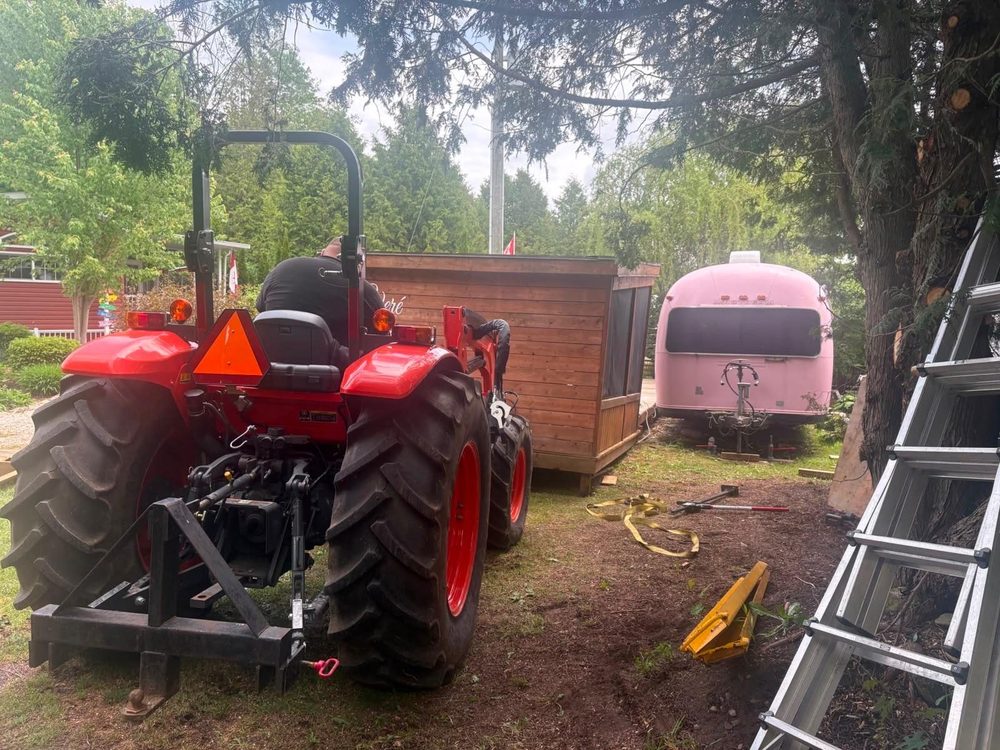
In one piece, or in sections
Our preference is always one piece. A structure that moves whole is back in service the same day, keeps its own geometry and does not need a carpenter afterwards. A structure that gets cut into sections becomes a partial rebuild, and rebuilds are slower and dearer than moves.
What forces sectioning is usually one of four things: it is longer than the 30 feet we can carry, it is too wide or too tall for the route, the access will not allow a whole structure through, or the build itself will not survive being picked up as one unit. Only the last of those is about the structure. The other three are about everything around it.
When sectioning is the answer we say so before we start and we quote it as what it is. What we will not do is start a one piece move we do not believe in, get halfway, and turn it into a sectioning job with the customer watching and the price climbing. If we think your deck needs to come apart, you will hear it at the quote.
When moving is not the right answer
We move things for a living, so it would be easy to tell everybody their structure is movable. It is not always true, and saying so costs us one job and saves the customer a great deal more than that.
There are four situations where we will tell you to build new instead.
- The framing has gone. Soft joists, a rotten ledger, a floor frame you can push a screwdriver into. Lifting that does not relocate a structure, it disassembles one in mid air.
- There is nothing to lift it by. A shed built flat on the ground with no floor frame can be given one, but that is carpentry on top of a move, and on a small shed the two together can pass what a new shed costs.
- The access costs more than the structure. If getting a machine to it means taking out a fence, dropping a tree and repairing a lawn, and the thing being rescued is a basic garden shed, the arithmetic has stopped working.
- It has to be sectioned and it is already tired. Cutting a sound deck into sections is a real option. Cutting one that was near the end of its life is paying move money for rebuild results.
The reverse is far more common, for what it is worth. Most people who assume their deck is beyond moving are wrong, and they find that out only after they have already torn it down. A structure in decent shape, with reasonable access, is almost always cheaper to move than to replace.
Setting it back down, and levelling it
The lift gets the attention. The set down decides whether the job was any good.
A structure that goes back onto whatever happens to be under it will move, and it will move unevenly, because the ground under a corner is never the same as the ground under the opposite corner. What that does to a shed is rack the frame, which puts the door out of square, which is why so many moved sheds have a door that stops closing within a year. What it does to a deck is worse, because a deck has no walls to resist the twist.
So the destination gets prepared, the structure goes onto proper support at the points it was built to be carried at, and it gets brought level and checked. The method is the same one we use on trailers and park models and it is set out in detail on our levelling and blocking page. Support under the frame, pads sized for what the ground can carry, level in both directions, and a second check once it has settled onto its own weight.
If the ground where it is going is soft, sloped or freshly filled, that gets dealt with first. Blocking spreads load. It does not create bearing capacity that was never there.
What the old spot looks like after
Nobody thinks about this until the shed is gone and they are standing there looking at where it used to be. It is worth a minute at the quote stage, because it is easier to plan for than to be surprised by.
What gets left behind is usually three things. The old support, which might be blocks, patio stones, poured footings or a slab, and which does not walk away on its own. A rectangle of ground that has been in the shade and out of the rain for years, so it is bare, compacted and a different colour from everything around it. And, if the ground was soft and a machine was needed, marks where the machine worked.
Blocks and patio stones we can lift and stack, or move to the new location if they are the right thing to reuse. Poured footings and slabs are a different job and a different trade, and we will say so rather than pretend otherwise. The bare patch fills in on its own over a season if you leave it, faster if you level it and seed it. Ruts are the one worth planning around: they are far more likely in a wet spring than in a dry August, and choosing the right week is the cheapest form of ground protection there is.
We are movers rather than a landscaping company, and we would rather be straight about where the job ends. We tidy up after ourselves, we take our own material away, and we leave the site safe. Restoring a lawn to how it looked before is somebody else's trade, and if that matters to you, say so early so we can plan the approach around it.
Seasonal parks and lot changes
A large share of this work happens at seasonal parks and resorts around the Kawarthas, Durham and Simcoe County, and it clusters hard into spring and fall because that is when sites change over.
The typical version goes like this. Somebody is moving from one lot to another within the park, or a unit is being replaced with a bigger one, and the deck and shed that were built for the old arrangement now do not fit the new one. The unit moves, the deck moves, the shed moves, and all three want to happen in a sensible order on the same day rather than across three visits.
That is a booking we are happy to take as one job. If the trailer is being towed anyway, the deck and shed cost less to move at the same time than they do separately, because the callout is already paid for. Our RV and trailer transport page covers the towing half, and the park model and mobile home moving page covers the larger units.
Parks have their own rules about who works on site and most want proof of insurance before the gate opens. We carry $2 million in liability, $150,000 in cargo and $150,000 in non-owned trailer coverage, and we run under Ontario CVOR 204-617-206. Ask and we send it.
What you need to do before we come
None of this is difficult and all of it saves time on the day, which is another way of saying it saves money.
- Empty it. Everything out of the shed. A shed full of tools weighs a great deal more than a shed, and the contents move around in the air.
- Clear the deck. Furniture, planters, the barbecue, the propane tank, anything screwed to the railings.
- Disconnect services. Power run out to a shed, a light on the deck, a hose bib. Anything live gets dealt with before we lift.
- Clear the route. Move vehicles, open gates, and take down anything temporary in the path.
- Mark the hazards. Septic bed, well, buried lines, the sprinkler system you forgot about. Mark them, do not describe them.
- Know where it is going. Have the destination decided and, if it is a permit or zoning question, answered.
- Send photos. The structure, the underside if you can get to it, the route in and the spot it is going to.
If you cannot do some of it, say so and we will handle it as part of the job for an added charge. What does not work is nobody doing it and everybody discovering that on the morning.
What goes wrong, and how
Assuming it has to be demolished
The most expensive mistake on this page, and the most common. People tear down a perfectly sound deck because they assume moving it is not an option, then pay to rebuild it thirty feet away. Ask first. The worst case is we tell you it is not movable, and you are back where you started having lost a phone call.
Lifting without checking underneath
The top of a deck tells you almost nothing. The joists, the ledger and the fasteners tell you everything. A deck that looks fine from above and is soft where it matters will come apart when it is picked up, and that is a discovery best made on the ground.
Setting it down on nothing
Blocks that were fine under the old position get reused in the new one without anybody checking what the ground is like there. Then the structure settles unevenly, the frame racks and the door stops shutting. Not levelling properly is the single most common failure we see across everything we do, and it is not confined to trailers.
Skipping the permit conversation
Moving a structure into a spot that turns out not to be allowed is an expensive way to learn about setbacks. The call to the building department costs nothing. Moving the same shed twice does not.
Underestimating the route
Owners measure the shed. They rarely measure the gate, the turn or the wire over the driveway. It is the route that stops jobs, not the structure.
What it costs
Deck and shed moving is quoted per job. We are not being cagey about that, it is that the structure is only half of what sets the price. Two identical sheds, one on an open lawn and one behind a stand of cedars on a slope, are not the same job and it would be dishonest to publish one number for both.
| What moves the price | Why |
|---|---|
| Size and weight | What it takes to lift it and whether it fits the gooseneck in one piece. |
| How it was built | A framed, liftable structure is a straightforward day. One that needs a frame built under it first is not. |
| Condition | Bracing a tired structure so it survives the lift is real work and it gets quoted. |
| Distance | Across the yard, across town or onto a trailer for a longer run are three different prices. |
| Access at both ends | The origin and the destination both have to work. People remember to check one of them. |
| Machinery | Brought when the job needs it, quoted when it is. |
| Sectioning | Cutting and reassembling is a rebuild in the middle of a move and is priced as such. |
| Bundling | Adding a deck or shed to a trailer move you are booking anyway is the cheapest way to get it done. |
Quotes are free. There is no deposit. You pay when the job is finished, by cash, credit card, debit or e-transfer.
Booking, and how the day runs
We usually want 24 to 48 hours of notice. Same day and emergency work happens when we can fit it in, so if something has gone wrong and you need a structure out of the way, call and ask rather than assuming. Spring and fall book up first.
To quote it accurately first time, tell us:
- What it is, and rough dimensions if you have them
- Whether it is attached to anything and what
- Where it is now and where it is going
- What the ground and the approach are like at both ends
- Whether a trailer is moving as part of the same job
- Photos, including the underside and the route
- Whether you have spoken to the building department, if a permit may apply
On the day we walk it with you first, agree the plan out loud, prepare the structure, move it, set it on support, level it and check it. Then we walk it with you again before we leave, because the time to raise something is while we are still standing there. Reach us at (647) 961-9257 or transport@kawartharvrentals.ca. Our hours are monday to Saturday, 7:00am to 7:00pm. Sunday closed, by appointment only.
Our 30 day guarantee, and what it does not cover
The guarantee, in plain words
If a unit we set up shifts or moves because of our workmanship, we come back and redo the job at no charge. Weather and ground conditions are outside that, and we say so up front.
What we control is the workmanship. Where the support went, how the structure was picked up and braced, whether it was set down properly and brought level. If any of that is why something shifts within 30 days, we come back and redo it and it costs you nothing.
What nobody controls is the ground and the weather. Ontario ground freezes, heaves, thaws and settles, and it does not do it evenly under a shed any more than it does under a trailer. A wet autumn changes what the soil will carry. We would rather tell you that at the quote than have you read it in fine print afterwards, and the practical answer to ground movement is a look every spring rather than a longer promise on paper.
Where we do this work
We work out of Beaverton, Ontario, which puts the Kawarthas, Durham Region, Simcoe County, Northumberland and the run north into Muskoka all within comfortable reach. Deck and shed work tends to cluster around the seasonal parks and cottage properties, which is most of that map.
Not sure whether your property is inside our range? The service areas page has the detail, or call and ask. If we cannot get to you we will tell you rather than string it out.