
The Georgina and Sutton area we cover
Kawartha RV Transport & Services moves RVs, park models, mobile homes, decks and sheds throughout the Town of Georgina, including Keswick, Sutton, Jackson's Point, Pefferlaw, Udora, Virginia Beach, Willow Beach and the whole Lake Simcoe shoreline down to Ravenshoe Road. We are a family run outfit based in Beaverton, Ontario, which is the next stretch of the same shoreline north east of the Town line. Local tows start at $400, we tow up to 30,000 lb on a 30 foot gooseneck, we carry Ontario CVOR 204-617-206, and there is no deposit to book a date.
Georgina is the top corner of York Region, and it is a strange piece of ground to haul in. It has the same seasonal shoreline economy as the Kawarthas, with rows of trailers and park models on small lots between Jackson's Point and Pefferlaw, but it sits inside a regional municipality that runs its own road network, its own weight restrictions and its own permit system on top of the Town's. Then there is a single provincial highway through the middle of it. Three road authorities, three sets of rules, and in many cases all three inside the same twenty minute drive.
That is the reason this page reads the way it does. Most RV transport pages for a town like this would say "we serve Georgina" and move on to a phone number. What actually decides whether your trailer moves on the date you booked is narrower than that: it is which body owns the last three hundred metres of road in front of your lot, what that body allows on it in the month you picked, and whether the unit needs a permit that nobody has published an application form for. We have gone through the Town of Georgina's own pages, York Region's, the province's and Ontario Parks' and written down what they actually say, including the places where they contradict each other or say nothing at all.
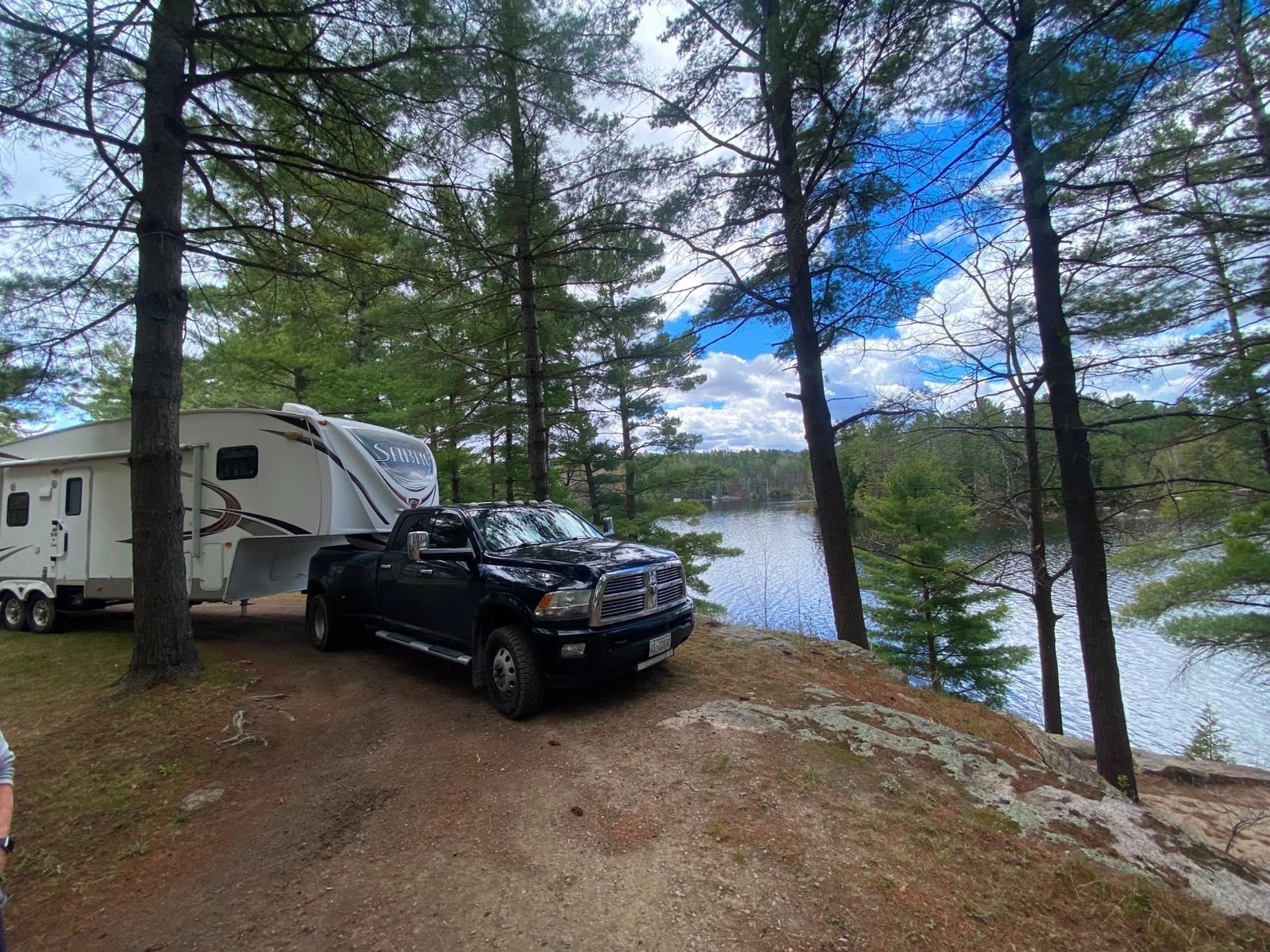
The towns and hamlets we run into regularly inside the Town of Georgina: Keswick, Sutton, Sutton West, Jackson's Point, Pefferlaw, Udora, Virginia, Virginia Beach, Willow Beach, Port Bolster, Duclos Point, Island Grove, Roches Point, Belhaven and Baldwin. If your address is inside the Town boundary and a truck can physically reach it, we work there.
Eleven roads restricted every day of the year
Start here, because it is the fact that most often changes a Georgina booking, and almost nobody knows about it until they are told. Most municipalities in this part of Ontario restrict axle weights for a season in the spring and leave the roads open the rest of the year. Georgina does that too, but it also carries a permanent list. In the Town's own words, certain roads within the Town have year round load restrictions.
Here is the list the Town publishes, with the limits at the boundaries it names:
| Road | From | To |
|---|---|---|
| Clarlyn Drive | Metro Road (YR 78) | westerly to Lake Drive |
| Hedge Road | Lake Drive | easterly to Park Road (YR 18) |
| Lake Drive | Church Street | northerly to Metro Road (YR 78) |
| Lake Drive | Metro Road (YR 78) | easterly to Dalton Road (YR 9) |
| McDonough Avenue | Baseline Road (YR 8A) | to Dalton Road (YR 9) |
| Old Shiloh Road | Victoria Street (YR 82) | to Park Road (YR 18) |
| Prout Road | Ravenshoe Road (YR 32) | to Old Shiloh Road |
| Queen Street | St. James Street | northerly to King Street |
| Riveredge Drive | Woodbine Avenue (YR 8) | westerly to The Queensway (YR 12) |
| Riverglen Drive | Woodbine Avenue (YR 8) | westerly to The Queensway (YR 12) |
| St. James Street | River Street | easterly to Queen Street |
Source: the Town of Georgina's summer road maintenance page, which publishes both the seasonal restriction and the year round list together.
Read the road names again if you own a trailer on the lake. Lake Drive appears twice. Hedge Road is on it. Clarlyn Drive is on it. Those are shoreline roads, and shoreline roads are exactly where the seasonal trailers, park models and cottage decks are. It is not a coincidence. These are older, lighter roads built on ground that sits close to the water table, and the Town has decided they cannot take heavy axle loads at any time of year, not just during the thaw.
York Region adds two more segments inside Georgina to the year round column, on its own roads: Metro Road between Station Road and Station Road, and Ravenshoe Road between Victoria Road and Durham Road 23. Ravenshoe Road matters disproportionately, because it is the road most loads coming north off Highway 404 use to get into the Town at all.
The rule we work to
Before we quote a Georgina job we look up the actual street, not the town. If the address sits on one of the eleven Town roads or the two Regional segments above, the conversation changes from scheduling to permitting, and it has to happen before the date rather than the morning of. We do that lookup at quote time so there are no surprises on the day.
What a permanent five tonne axle limit means for your RV
People hear "five tonnes per axle" and picture a scale under their trailer. That is not what is being measured, and the distinction is worth two minutes because it decides whether your move is routine or a paperwork job.
The limit applies to the axles of the vehicle on the road, which in our case means the truck and the loaded trailer together. Five tonnes is 5,000 kilograms, or about 11,000 lb, per axle. An empty one ton dually is comfortably under that on every axle. A dually with a heavy fifth wheel or a park model on a gooseneck behind it is a very different calculation, because a large share of the load transfers onto the truck's rear axle and onto the trailer's own axles. That is the point at which a perfectly legal truck on a normal road becomes an over limit vehicle on a restricted one.
Two practical consequences follow. First, the same unit can be movable on Tuesday and not movable on Wednesday if the route changes, because the constraint is the road and not the trailer. Second, a smaller unit is often movable on a restricted road when a larger one is not, which is why we ask for the make, model and loaded weight rather than just "a travel trailer" when we quote a Georgina address.
It is also why we would rather do the permit than dodge the road. A five tonne per axle posting is a threshold, not a prohibition. The legal route over it is an exemption or permit from whoever owns the road, and both York Region and the Town have a mechanism for that. What we will not do is put a loaded gooseneck onto a posted road and hope nobody is looking, because the liability for road damage in Ontario sits with the mover, and because the roads on that list are on it for a reason.
Half load season on Town roads, March 1 to May 15
On top of the permanent list, Georgina runs a seasonal restriction like everyone else. The Town states it directly: from March 1 to May 15, half load restrictions of five tonnes per axle are in effect on all Town owned roads.
Note the words "all Town owned roads". This is not a posted route list where you look for a sign. During that window the restriction is the default condition of every road the Town owns, and the eleven road list above is what stays restricted after May 15 rather than a separate thing.
Why March to May specifically. Frost goes into the ground through the winter and comes out in the spring from the top down, which traps meltwater in the road base underneath a still frozen layer. For a few weeks the base is effectively saturated and has a fraction of its normal bearing strength. A heavy axle load in that window does not just leave a rut, it can push the base out laterally and shorten the life of the whole road. Every municipality from here to the Ottawa Valley runs a version of the same restriction for the same reason.
For an RV owner in Georgina the takeaway is a scheduling one. If you are trying to get a unit out of winter storage and onto a seasonal site for the May long weekend, the last two weeks before that weekend are inside the restriction window on Town roads. That is the busiest fortnight of our spring and the one with the least room to manoeuvre. Book it in March for a May date and we can plan around the restriction. Call us on the Thursday before the long weekend and we are working with whatever is left.
York Region roads, a different set of dates
Here is where Georgina gets genuinely different from a single tier municipality like Kawartha Lakes. The Town does not own the main roads. York Region does, and York Region publishes its own restriction period with its own dates.
The Region's spring weight restriction period runs March 1 to April 30. That is two weeks shorter than the Town's March 1 to May 15. The Region also states the rule on both sides of the threshold clearly: commercial vehicles that weigh over five tonnes per axle need a Load Exemption Permit to travel on roads with year round weight restrictions, and during the spring thaw those heavy vehicles are not permitted at all on roads carrying spring weight restrictions.
Read that second half carefully, because it is stricter than the Town's regime. On a Regional road under a spring restriction, the Region's published position is not "get a permit", it is "not permitted". The permit route is written for the year round roads. Practically, that means the first half of May is a window where Regional roads have reopened and Town roads have not, and the back half of March and all of April is a window where the Regional roads are the hard constraint rather than the easy one.
The Regional segments inside Georgina, with the periods the Region publishes for each:
| Regional road | From | To | Restriction period |
|---|---|---|---|
| Kennedy Road | Ravenshoe Road | Metro Road | March 1 to April 30 |
| Metro Road | Station Road | Station Road | Year round |
| Metro Road | Woodbine Avenue | Dalton Road | March 1 to April 30 |
| Park Road | Highway 48 | Hedge Road | March 1 to April 30 |
| Ravenshoe Road | Victoria Road | Durham Road 23 | Year round |
| Victoria Road | Ravenshoe Road | Lake Ridge Road | March 1 to April 30 |
| Warden Avenue | 700 metres north of Ravenshoe Road | Baseline Road | March 1 to April 30 |
| Weir's Sideroad | Ravenshoe Road | Old Homestead Road | March 1 to April 30 |
Source: York Region's road weight restrictions page.
Two calendars, one trip
Put the two together and you get a situation that does not exist in most of the places we work. A single trip from a Keswick driveway to a Sutton seasonal site can start on a Town street, run along a Regional road, and finish on a Town street again. In the first half of May the middle section is legal and both ends are restricted. In late March all three are restricted, and the middle section is the one where a permit is hardest to get.
| Road authority | Seasonal restriction | Year round restriction | Route over the limit |
|---|---|---|---|
| Town of Georgina | March 1 to May 15, all Town owned roads | Eleven named roads | Permit from the Director of Operations Infrastructure under the traffic by-law |
| York Region | March 1 to April 30, listed segments | Two segments in Georgina | Load Exemption Permit for year round roads; not permitted during spring thaw |
| Province of Ontario | Reduced load period designated under the Highway Traffic Act, March 1 to April 30 where imposed | None in Georgina | MTO oversize or overweight permit, King's highways only |
For the record, provincial reduced loads are not automatic every year on every designated highway. Ontario's public seasonal load listing showed no active seasonal load restrictions at the time we checked, alongside the standing note that the ministry will impose reduced load limits for designated parts of the King's Highways listed in Schedule 1, when appropriate, between March 1 and April 30. That is the frame: the province reserves the power and uses it selectively, while the Town and the Region run theirs on a fixed calendar.
What we do with this
We plan the route as three segments rather than one line, and we check each one against the authority that owns it. If a March or April date only works with a permit that the Region says it will not issue during the thaw, we will tell you that and suggest a date in May instead of taking a deposit and finding out later. There is no deposit anyway, which is part of the point.
Whose road are you on in Georgina
This is the single most useful thing to be able to work out for yourself, so here is the short version.
The Town of Georgina is responsible for 333 kilometres of roads, 140 kilometres of sidewalks and 25 municipal parking lots. That is the residential street network, the shoreline drives and the rural sideroads. York Region owns the numbered Regional roads, and in Georgina the ones you will actually drive are Dalton Road (YR 9), The Queensway (YR 12), Woodbine Avenue (YR 8), Metro Road (YR 78), Park Road (YR 18), Ravenshoe Road (YR 32), Baseline Road (YR 8A) and Victoria Street (YR 82). The Town states that York Region plows the major roads in the Town such as Dalton Road, High Street, Ravenshoe Road and Baseline Road, which is a handy tell: if the Region plows it, the Region owns it.
A naming trap worth knowing
Regional Road 12 in Georgina is The Queensway. It is not Dalton Road, which is Regional Road 9. To make it worse, in neighbouring Durham Region, Regional Highway 12 is a different road entirely. If someone quotes you a rule for "Regional Road 12" without naming the street, ask which one they mean. We name the street.
Why it matters in practice: a permit from one authority is not a permit on another authority's road. A York Region Load Exemption Permit does not authorise anything on a Town street, and a Town approval does not put you on Ravenshoe Road. On a job that crosses all three, you need each piece, and the lead times are not the same. That is administrative work rather than driving, and it is included in what we do rather than billed as an extra.
Highway 48, and the Highway 404 assumption we have to correct
We get asked about the 404 constantly, so let us deal with it directly. Highway 404 currently ends at Ravenshoe Road. That is Georgina's southern boundary. North of Ravenshoe the extension exists as a planned corridor in provincial and municipal planning documents, described in the environmental assessment as a new 45 km four lane extension with controlled access running northerly from Davis Drive to Durham Road 23, plus a 9 km transition section between Durham Road 23 and Highway 12. Planned is not built. You cannot drive a load on a planned corridor.
What the Town says about provincial highways inside its boundary is unambiguous: the Ministry of Transportation of Ontario operates only one highway within Georgina, and Highway 48 from Ravenshoe Road to Lakeridge Road is maintained by the MTO. One highway. Everything else is Regional or Town.
The routing consequence is the whole reason this section exists. A load coming north up the 404 gets a fast, unrestricted run to Ravenshoe Road and then immediately transitions onto the road classes where every restriction on this page lives. The last fifteen minutes of a Georgina delivery is almost always the constrained part of the trip, and it is the part that determines whether the job happens in April or in May. When we quote, we are quoting that last fifteen minutes far more than the hour before it.
Mossington Bridge, and why we do not take it
Mossington Bridge comes up in Georgina conversations because it is a local landmark and because, on a map, it looks like a shortcut between two shoreline roads. It crosses the mouth of the Black River where it meets Lake Simcoe and connects Hedge Road and Lake Drive East.
Here is what the Town's own documents establish, and where they stop. The deck is about 3.8 metres wide between curbs, given in one Town document as a 3.83 metre wide deck. A Town engineering review found the structure to be in poor condition, with a Bridge Condition Index of 58.5, cracks on the east abutment and wingwall which also showed spalling, and a bridge coating observed to be peeling and completely gone in certain areas.
On the load limit, the Town's documents do not agree with each other. A heritage description of the bridge states that it is posted with a 10 ton load limit. A 2025 engineering review states that at present there is no load restriction. Those cannot both be the current posting, and we could not resolve which one is: the Town's project page for the bridge returned an error when we tried to read it.
The rule we work to
We will not publish a load limit for Mossington Bridge, in either direction, because the Town publishes two different answers and we cannot tell you which is current. What we can tell you is that a 3.8 metre width between curbs and a poor condition rating are enough on their own. A truck and a wide trailer do not belong on that structure regardless of what the posting says today, so we route around it and we build the extra minutes into the quote.
The provincial limits underneath all of it
Municipal by-laws sit on top of the Ontario Highway Traffic Act, which sets the dimensions and weights that apply everywhere in the province unless a permit says otherwise. These are the numbers that decide whether your unit is "oversize" in the first place.
| Limit | Figure | Where it comes from |
|---|---|---|
| Width | 2.6 m | Highway Traffic Act s.109(1) |
| Height | 4.15 m, or 4.3 m where prescribed | s.109(14) and s.109(14.1) |
| Single vehicle length | 12.5 m | s.109(6) |
| Recreational vehicle length | 12.5 m, extendable to 14 m if prescribed requirements are met | s.109(11) and s.109(11.1) |
| Combination length | 23 m | s.109(7) |
| Semi trailer length | 14.65 m | s.109(10) |
| Reduced load period axle weight | 5,000 kg per axle on a designated highway | s.122(1) |
| Penalty range for a dimension offence | Not less than $200 and not more than $20,000 | s.109(15.1) |
Two details in there are worth pulling out for RV owners specifically. Section 109(6.1) states that the 12.5 metre single vehicle limit does not apply to a fire apparatus, a trailer, a bus, a recreational vehicle or a road service vehicle, which is why a long fifth wheel is not automatically an over length vehicle. And section 109(11) then puts a 12.5 metre cap on a bus or recreational vehicle specifically, with section 109(11.1) allowing up to 14 metres where prescribed requirements are met. A towed travel trailer or fifth wheel is handled as part of a combination, under the 23 metre figure.
On the reduced load side, section 122(1) is the source of every five tonne figure on this page: during a reduced load period, no commercial motor vehicle or trailer, other than a public vehicle or a vehicle referred to in subsection (2), shall be operated or drawn on a designated highway where the weight on an axle exceeds 5,000 kilograms. Section 122(2) sets a higher 7,500 kilogram figure for a narrow set of two axle vehicles carrying heating fuel, livestock feed or live poultry, and section 122(4) exempts municipal highway maintenance vehicles, milk transport, fire apparatus, municipal waste vehicles and public utility emergency vehicles. An RV on a gooseneck is in none of those categories.
Section 122(7) is the provision that hands the calendar to the municipality: the municipality or other authority having jurisdiction over a highway may by by-law designate the date on which a reduced load period shall start or end. That is precisely why Georgina can run to May 15 while York Region runs to April 30 on roads that touch each other.
Oversize permits in Georgina, and the page that does not exist
This is the part of the Georgina picture where we have to tell you what is not published as well as what is, because the gap itself is useful information.
The authority is clear. The Town's traffic and parking by-law, By-law 2023-0087, referred to as TR-1, provides at section 2.0(e) that the Director of Operations Infrastructure is appointed as the officer of the Town to issue permits respecting the movements of vehicles, loads, objects or structures in excess of the dimensional or weight limits. So a Town level oversize permit exists as a legal instrument and somebody at the Town is named to issue it.
What we could not find, following the Town's own navigation and by direct URL, is any published application page, online form, lead time or fee for that permit. Several neighbouring municipalities publish all four. Georgina publishes none of them that we could reach.
The rule we work to
We are not going to print a Georgina oversize permit fee or turnaround time, because the Town has not published one and a number we made up would be worse than no number. What we do instead is call Service Georgina at 905-476-4301, extension 3001, on the specific job, get the answer from the person who issues the permit, and build the real lead time into your date. If you want to confirm anything on this page yourself, that is the number to use.
The by-law does publish some things that bear on a move. Section 1.0(l) defines a heavy truck as a commercial motor vehicle for the carriage of goods having a weight, when not loaded, of more than 4.6 tonnes. Section 17.0 prohibits heavy trucks on the highways listed in Schedule XXVI unless signed otherwise. That is a routing restriction that exists independently of any weight restriction, and it is another reason we look at the actual street rather than the town name.
The Road Occupancy Permit, which does exist
In contrast to the oversize permit, Georgina publishes its Road Occupancy Permit clearly, and it explicitly names trailers.
The Town requires a Road Occupancy Permit any time the Town's right of way will be affected or disturbed by activities that are not the Town's own. The published scope covers the parking of construction vehicles, trailers and disposal bins; materials placed on the roadway or boulevard; road closures; and disruption to traffic. Applications go to the Operations Division, with the roadsadmin address and a phone number of 905-476-4301, at 26557 Civic Centre Road, Keswick, ON L4P 3G1. The details are on the Town's utilities and permits page.
When does this actually come up on an RV job? More often than you would think. If a unit has to be staged on the street overnight because it cannot get onto the property until a tree is cut or a pad is poured. If we have to occupy part of a narrow shoreline road for an hour to swing a park model onto a lot. If a crane or a tractor has to sit on the boulevard. Any of those is occupying the right of way, and the Town has a permit for it. It is a small piece of paper that turns an argument with a bylaw officer into a non event.
The York Region Load Exemption Permit
On the Regional roads, the instrument has a name and the Region publishes what it does. Commercial vehicles that weigh over five tonnes per axle need a Load Exemption Permit to travel on roads with year round weight restrictions. That is the mechanism for getting a heavy load onto Ravenshoe Road between Victoria Road and Durham Road 23, or onto the Metro Road segment at Station Road, at any time of year.
The limitation is equally clear and it is the one that catches people. During the spring thaw, the Region states that these heavy vehicles are not permitted to travel on roads with spring weight restrictions. The exemption permit is written for the year round list. It is not a way to buy your way onto a Regional road in late March.
So the Regional picture for a heavy RV move breaks down like this. Between May 1 and the end of February, a Regional road with a seasonal restriction is simply open, and a Regional road with a year round restriction needs a Load Exemption Permit. Between March 1 and April 30, the seasonal roads are closed to over limit vehicles rather than permittable, and the year round roads still run on the exemption permit. That asymmetry is why we push heavy Georgina work into May rather than April whenever the customer has any flexibility at all.
What a provincial permit covers
If the load is genuinely oversize, over 2.6 metres wide or over the height and length limits above, there is a provincial permit as well, and its scope is narrower than most people assume. The MTO's position on its oversize and overweight permit page is that these permits are valid for Ontario's King's highways only, and that if you want to drive on municipal roads you may be required to get additional permits or permission directly from that municipality.
In Georgina that sentence has teeth, because the only King's highway inside the Town is Highway 48 from Ravenshoe Road to Lakeridge Road. A provincial oversize permit covers you for that stretch and for the run up the 404 to Ravenshoe. It covers you for none of Dalton Road, none of Metro Road, none of The Queensway, and none of the street your trailer is actually parked on.
The Highway Traffic Act sets out what a permit is and what it carries with it. Section 110(1) is the permit power. Section 110(2) allows the ministry to require a bond or security and to limit the permit to a route and a time. Section 110(4) allows the ministry to issue one permit covering multiple municipalities. Section 110(5) keeps the mover liable for damage to the highway regardless of the permit. Section 110(6) requires that the original of the permit be carried in the vehicle. Section 110(7) sets the penalty range at $200 to $20,000.
Section 110(5) is the one worth reading twice if you are hiring a mover. A permit is authorisation, not indemnity. If a loaded combination damages a road, the liability stays with the operator. That is a large part of why we take the restricted road list seriously rather than treating it as advisory, and it is why we carry commercial coverage and a CVOR rather than running a trailer behind a personal pickup.
One more provincial detail with a local edge: section 109(12) permits a municipality that was a city on December 31, 2002 to prohibit combinations over 15.25 metres by by-law. Georgina is a town, not a city, so that provision is not in play here, but it is in play on some of the routes a long distance load takes to get here.
Storing an RV at your house in Georgina, in detail
Georgina publishes more detail on residential RV storage than any other municipality we work in, and because it publishes it, we can be specific instead of vague. The rules live in Zoning By-law No. 500, at sections 5.27A and 5.27B, added by amending by-laws 500-2017-0002 and 500-2017-0003, both passed on the 17th day of May, 2017. The Town also publishes a plain language guide to leisure vehicle storage.
Before any of the numbers, the definition. Section 2.110 defines a leisure vehicle, and the definition includes travel trailers, motorhomes, boats, personal watercraft, snowmobiles, all terrain vehicles and the trailers designed to carry them. It ends by stating that it does not include a park model trailer or a manufactured home. Hold onto that sentence, because it comes back later and it is the single biggest trap on this page.
The rules apply to lots or properties zoned to permit a single family dwelling, semi detached or townhouse. Section 5.27A covers the general case and section 5.27B covers the smaller lot, semi detached and townhouse case.
How many you can keep, and where
The counts are tied to lot area, and this is where the Town's guide and the Town's by-law describe the same rules using different numbers, which is the source of most of the confusion we hear.
| Lot area | Maximum leisure vehicles stored outdoors | How many may sit in a front yard or exterior side yard driveway |
|---|---|---|
| 4,000 square metres or more | Six | Two |
| 270 to 4,000 square metres | Three | One |
| Under 270 square metres | Three, rear yard only | None |
| Small lots, semi detached and townhouse under s.5.27B | Three, rear yard only | None |
Now the trap. The by-law's six and three are totals for the whole lot. The two and the one are sub limits describing how many of that total may sit out front. The Town's guide quotes the front yard figures prominently, so people read "two" and conclude that a large property is limited to two units in total. It is not. On a lot of 4,000 square metres or more the by-law permits the outdoor storage of a maximum of six leisure vehicles, two of which may be located on a parking area in a front yard driveway or exterior side yard driveway. Six total, two out front.
For a lot between 270 and 4,000 square metres, which is most residential Georgina, the equivalent reading is a maximum of three, one of which may be in the front yard or exterior side yard driveway. Under 270 square metres, the by-law language changes shape: the outdoor storage of a maximum of three leisure vehicles is only permitted in a rear yard. No front yard allowance at all on the smallest lots.
Setbacks, height and length limits
Section 5.27A sets the physical constraints, and they are the ones that most often decide where we can actually place a unit on the property.
| Requirement | Section 5.27A general | Section 5.27B small lots and townhouses |
|---|---|---|
| Setback from front or exterior side lot line | Minimum 6.0 metres | Rear yard storage only |
| Setback from interior side or rear lot line | Minimum 1.2 metres | Rear yard storage only |
| Maximum height | 4.0 metres | 3.0 metres |
| Maximum length | 13 metres | 7 metres |
| Required parking spaces on the lot | Minimum of 3 | Not stated in the same terms |
| Driveway width | Minimum 5 metres, and not more than 55 per cent of the lot frontage | Not stated in the same terms |
| Municipal road allowance and boulevard | No storage permitted | No storage permitted |
The 13 metre length cap under 5.27A is about 42 ft 8 in, which accommodates most travel trailers and a good many fifth wheels but not the largest ones. The 7 metre cap under 5.27B is about 23 ft, which is a small trailer only. If you are on a townhouse or semi detached lot in Keswick and you are shopping for a unit, that number should be part of the purchase decision rather than a discovery you make afterwards.
A conversion error in the Town's own guide
The Town's plain language guide converts the 6.0 metre front setback as 26 ft. That is a typo. 6.0 metres is about 19 ft 8 in. We publish the metric figure from the by-law, because the by-law is the enforceable document and the metric number is the one it uses. If you are measuring a driveway, measure 6.0 metres, not 26 feet.
The April 1 to October 31 front yard window
Of everything on this page, this is the item most likely to affect an ordinary Georgina RV owner in an ordinary year.
Front yard and exterior side yard storage of a leisure vehicle is permitted from April 1 to October 31. From November 1 to March 31 of the following calendar year, the only leisure vehicle permitted in those yards is a snowmobile, at a 1.0 metre setback, with an additional temporary allowance around specified holiday weekends.
So the trailer that has sat in the driveway all summer has to be somewhere else by the end of October. There are three real options and each of them has a lead time. Move it to the rear yard, which requires access down the side of the house and often requires us rather than a homeowner with a hitch. Put it into off site storage, which needs to be booked. Or move it to a property where the setbacks work, which is a transport job.
The practical result is that the second half of October is one of the two busiest windows in our year around Georgina, along with the run up to the May long weekend. If you know your unit is coming off the driveway by October 31, call in September. The last week of October is the week when everyone who did not plan calls at once.
What you have to park it on
Where storage is permitted in the front yard or exterior side yard, the by-law requires it to be on a hard surfaced driveway, and it defines that inclusively: gravel, paved, concrete, interlock or a similar hard surface. Gravel counts, which is more permissive than some neighbouring municipalities, and grass does not.
This overlaps with something we care about for our own reasons, which is whether the unit will sit level and stay level. A gravel pad that satisfies the by-law is not automatically a pad that will hold a loaded park model through a freeze thaw cycle without settling. Those are two different tests and only one of them is written down. Our levelling and blocking work is aimed at the second one, and where the ground is not going to hold, we say so before we set the unit rather than after.
The word that is missing from the by-law
Back to section 2.110, which defines a leisure vehicle and then states that the definition does not include a park model trailer or a manufactured home.
Everything in the three sections above, the six and three unit counts, the 13 metre and 7 metre length caps, the 6.0 metre and 1.2 metre setbacks, the April 1 to October 31 front yard window, is written for leisure vehicles. If your unit is a park model trailer or a manufactured home, those provisions are not describing it.
What does describe it? We went looking, and the honest answer is that we could not find a Georgina page that says. The Town's building permit pages do not mention trailers, park models, mobile homes or manufactured homes anywhere in either of their permit required or permit exempt lists. We checked that specifically and confirmed it on the live pages rather than relying on notes.
The rule we work to
We are not going to guess what Georgina requires for a park model or a mobile home, and we would rather say so than publish something plausible. If a park model or a manufactured home is what you are placing on a Georgina property, phone the Building Division at 905-476-4301 before the unit arrives and get the answer for your specific lot and zone. We will still do the move and the set up. We just will not tell you it is permit free when the Town has not said that.
Building permits, sheds and the 10 square metre line
Sheds and accessory buildings come up on almost every seasonal site job, because a shed is usually sitting next to the trailer and has to move with it or be worked around. Georgina publishes a threshold for these, and it is 10 square metres.
The Town's garages and sheds page states that building permits are required for most accessory buildings including garden sheds, garages and gazebos that contain plumbing regardless of size, exceed 10 square metres in area, or are attached to another structure with a combined area that exceeds 10 square metres. It adds two useful lines: a tent garage under 60 square metres which is not attached to another building does not require a building permit but must be at least 3.0 metres from another structure, and any accessory building that does not require a permit is still required to comply with the Town's zoning by-laws and other applicable law.
That last line is the one people skip. Permit exempt is not the same as put it wherever you like. A 9 square metre shed still has to respect setbacks.
Two things we will not do with this number
First, we will not publish a separate 15 square metre storage shed threshold for Georgina. An older version of the Town's page carried a parenthetical to that effect and the current live page does not. Since we cannot verify it as current, it does not go on this page.
Second, use the metric figure. The Town converts 10 square metres as 107 square feet on the garages and sheds page and as 108 square feet on its main building permits page. Both are roundings of the same 10 square metres, which is about 107.6 square feet. Measure in metres and the ambiguity disappears.
Decks, where Georgina publishes two different answers
We move and rebuild a lot of decks, because a deck is usually the thing standing between a park model and the road. In Georgina the permit question for a deck has two published answers on two Town pages, and they do not agree.
The Town's decks and porches page says a permit is required for a deck or porch that is of any size and attached to a building; of any size and forming part of a building's exit or egress; greater than 10 square metres where any part of the perimeter is 2 ft above grade; or greater than 10 square metres where any part of the perimeter is adjacent to ground that slopes away at more than a 2 to 1 slope.
The main building permits page says something different. It lists, as requiring a permit, constructing a detached deck greater than 2 ft, or 600 mm, from the ground to the walking surface of the deck. And it lists, as not requiring a permit, constructing a detached deck less than 2 ft, or 600 mm, above grade at every point. No area threshold at all.
| Deck | Under the decks and porches page | Under the main building permits page |
|---|---|---|
| Detached, 6 square metres, 3 ft above grade | No permit. Under the 10 square metre area trigger. | Permit required. Over 600 mm to the walking surface. |
| Detached, 20 square metres, 1 ft above grade | No permit. Over the area trigger but under 2 ft at the perimeter. | No permit. Under 600 mm at every point. |
| Attached to the building, any size | Permit required. | Permit required if over 600 mm. |
| Forms part of an exit or egress, any size | Permit required. | Not addressed in the same terms. |
The rule we work to
Where a municipality publishes two answers, we publish both and we take the stricter one as the working assumption. On a Georgina deck we plan as though a permit is required and we tell the customer to confirm with the Building Division at 905-476-4301 in writing. That call costs nothing. An unpermitted deck discovered at the point of sale of the house costs a great deal more.
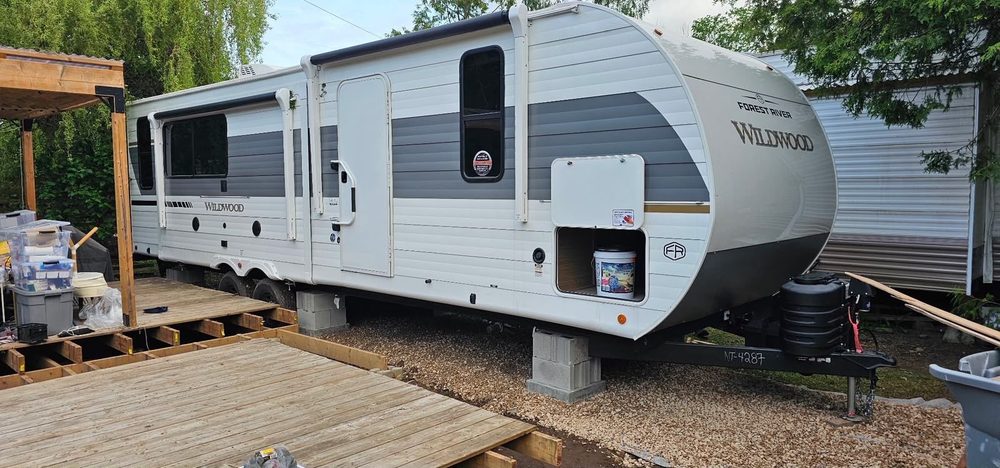
Sibbald Point Provincial Park, Sutton West
Sibbald Point is the camping anchor of this part of the lake and a regular destination for us, so here is what Ontario Parks publishes about it.
| Detail | As published |
|---|---|
| Address | 26071 York Regional Road 18 (Park Road), Sutton West, ON L0E 1R0 |
| Phone | (905) 722-8061 |
| Size | 225.01 hectares |
| Established | 1957 |
| Classification | Recreational |
| 2026 camping season | May 8, 2026 to October 26, 2026 |
| Car camping sites | 577, across ten campgrounds |
| Electrical sites | 270 |
| RV pull through sites | 61 |
| Trailer dump and fill stations | 1 |
| Radio free campsites | 285 |
| Group campsites | 6 |
| Comfort stations | 12 |
Two published rules matter if you are bringing a trailer. Trailers are not permitted on the group campsites, stated plainly by the park. And sites 200 to 381, 402 to 440, 501 to 586 and the group camping area are audio device free zones, which is worth knowing before you book a site with a generator.
On the question we get asked most, the maximum trailer length at Sibbald Point, Ontario Parks does not publish a park specific figure and we are not going to invent one. What exists is a system wide booking convention: camping sites across Ontario Parks can be reserved by trailer size, up to 18, 25, 32 and over 32 feet. That is a reservation category rather than a Sibbald Point rule, and the way to get a real answer for a specific site is to phone the park at the number above before you commit. Ontario Parks also notes system wide that park roads can be narrow and winding, which is the practical constraint we plan around when delivering into any park.
For context on the wider system, Ontario Parks publishes that there are over 19,000 car camping sites province wide and over 3,000 with electrical service at 15 and 30 amp. Sibbald Point's 270 electrical sites are a meaningful share of the total for a park this size, which is part of why it fills.
Keswick, Sutton, Pefferlaw and the run to the highway
Georgina is not one driving problem, it is four or five, and they sort roughly by community.
Keswick is the largest settlement and the one with the most subdivision streets. The constraints here are suburban rather than rural: driveway width, the 55 per cent of lot frontage cap on driveways, overhead wires on residential streets, and parked cars on both sides. A long fifth wheel coming out of a Keswick driveway is usually a manoeuvring job rather than a weight job. Riveredge Drive and Riverglen Drive, both on the year round restricted list, are here.
Sutton and Sutton West have the older village street grid, and Queen Street and St. James Street are both on the year round restricted list, between the specific limits named earlier. If your address is in the village core, that list is worth checking before anything else.
Jackson's Point, Willow Beach, Virginia Beach and the Lake Drive shoreline are the hardest and the most interesting. Narrow roads, mature trees close to the pavement, small lots, short driveways, and the year round weight restrictions concentrated exactly here. Lake Drive appears twice on the Town's restricted list and Hedge Road and Clarlyn Drive appear once each. This is where we do the most repositioning work, because a unit often cannot be pulled straight out and has to be walked around in stages.
Pefferlaw, Udora, Port Bolster and Baldwin are the rural east end, closer to us in Beaverton than to Keswick. Rural sideroads, some gravel, longer driveways with more room to work but softer surfaces in spring. Weir's Sideroad and Old Homestead Road are in this end of the Town.
The common thread on the way out is Ravenshoe Road, and it carries a year round Regional restriction between Victoria Road and Durham Road 23. Most Georgina loads are heading for the 404 at Ravenshoe or across to Highway 48, and that is the segment where the weight question gets decided.
Winter in Georgina, and the April 15 line
Georgina publishes its maintenance calendar precisely, and the dates are more useful than they look.
The Town's summer maintenance season begins April 15 at midnight and the winter maintenance season begins November 15 at midnight. A winter maintenance event can be declared from November 15 of each year to April 15 of the following year. Details are on the Town's winter maintenance page.
Two service standards the Town publishes are worth knowing if you are planning a winter access. The Town anticipates all sidewalks will be plowed at least once within 24 hours after a typical winter event. Windrow clearing, the service that deals with the ridge of snow a plow leaves across the end of a driveway, applies after a minimum 7.5 centimetre snowfall event and within 24 hours after the plowing of roads and sidewalks is completed.
The Town also publishes how it sets priority: primary roads within the routes were determined by emergency vehicle routes and fire stations, traffic volumes, transit routes, steep hills, common gathering locations, connectivity of the road network and staff knowledge of difficult maintenance areas. Notice what is not on that list. Seasonal shoreline drives with a dozen occupied houses on them are not high priority routes, and they should not be. If your unit is on Lake Drive in February, plan for the road to be plowed later rather than sooner.
The April 15 line is the one to circle. Between April 15 and May 15 the Town is in its summer maintenance season while its roads are still under half load restriction. Summer maintenance season does not mean the restriction has lifted. Those are two separate calendars run by the same department, and only one of them decides whether we can put a loaded gooseneck on your street.
When a Georgina booking actually moves
Put every date on this page onto one calendar and the Georgina year takes a clear shape.
| Window | What is happening | What it means for a move |
|---|---|---|
| November 15 to March 1 | Winter maintenance season. No half load restriction yet. | Roads are legal but conditions decide. Good window for a planned move on a clear week. |
| March 1 to April 30 | Town and Regional restrictions both on. Regional roads not permittable during thaw. | The hardest window of the year. Heavy units usually wait. |
| May 1 to May 15 | Regional restriction lifted. Town restriction still on. | Regional roads open, Town streets still restricted. Case by case. |
| May 15 to the long weekend | Everything except the eleven year round roads is open. Peak demand. | Book in March for a date here or take what is left. |
| June to September | Open season. Only the year round list applies. | Easiest window. Mid week dates are usually available on short notice. |
| Late September to October 31 | Front yard storage window closes October 31. Seasonal sites closing. | Second peak. Call in September, not the last week of October. |
What we do around Georgina and Sutton
Six services, all run by the same family with the same trucks, all available anywhere inside the Town of Georgina.
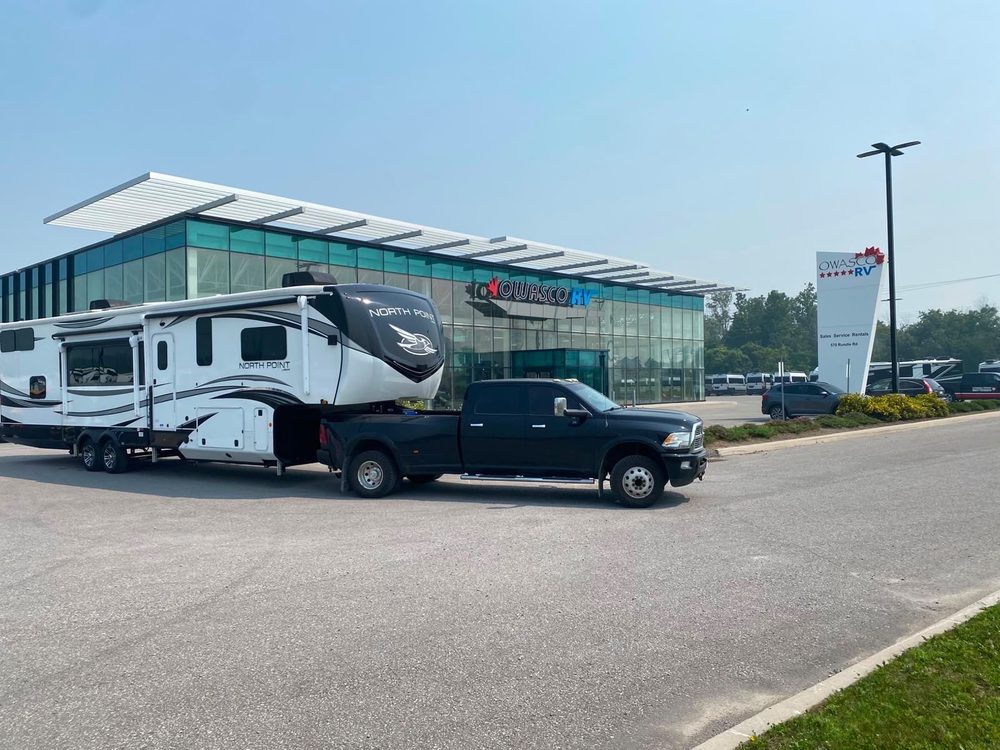
- RV transport. Travel trailers, fifth wheels, toy haulers, tent trailers and motorhomes that cannot drive themselves. Driveway to driveway, dealer to site, site to storage, storage to site. Up to 30,000 lb on a 30 foot gooseneck, local tows from $400.
- Park model and mobile home moving. The permit heavy end of the work, because these units are usually over 2.6 metres wide, which is the width that triggers an oversize permit almost everywhere. We handle the permits and the route planning across all three Georgina road authorities.
- Levelling and blocking. $799 for a full set up. Getting a unit level and keeping it level on ground that moves, which around Lake Simcoe is most ground.
- Deck and shed moving. Moving a deck or shed out of the way so a unit can come out, and putting it back after. Also full deck removal and rebuild on seasonal sites.
- RV storage. $85 to $125 a month depending on size. The obvious answer to the October 31 front yard cutoff when the rear yard is not accessible.
- RV rentals. Delivered and set up on a site of your choosing, which for Georgina customers usually means a seasonal site or a family property rather than a campground.
If you are new to any of this, the guide to preparing an RV for transport covers what to do to the unit before we arrive, and it applies whether we are the ones moving it or not.
Levelling and blocking on Lake Simcoe ground
Ground around Lake Simcoe is not the ground you get twenty kilometres inland, and it is worth being blunt about that before we set a unit rather than after.
The shoreline strip between Jackson's Point and Pefferlaw is largely sand and fill sitting close to a water table that rises and falls with the lake. Some of the older seasonal lots have been built up over decades with whatever was available. That kind of ground drains well, which is good, and it also moves seasonally under a point load, which is not. A stack of blocks that is dead level in June can be visibly out by the following spring on a lot like that, and the reason has nothing to do with how the blocking was built.
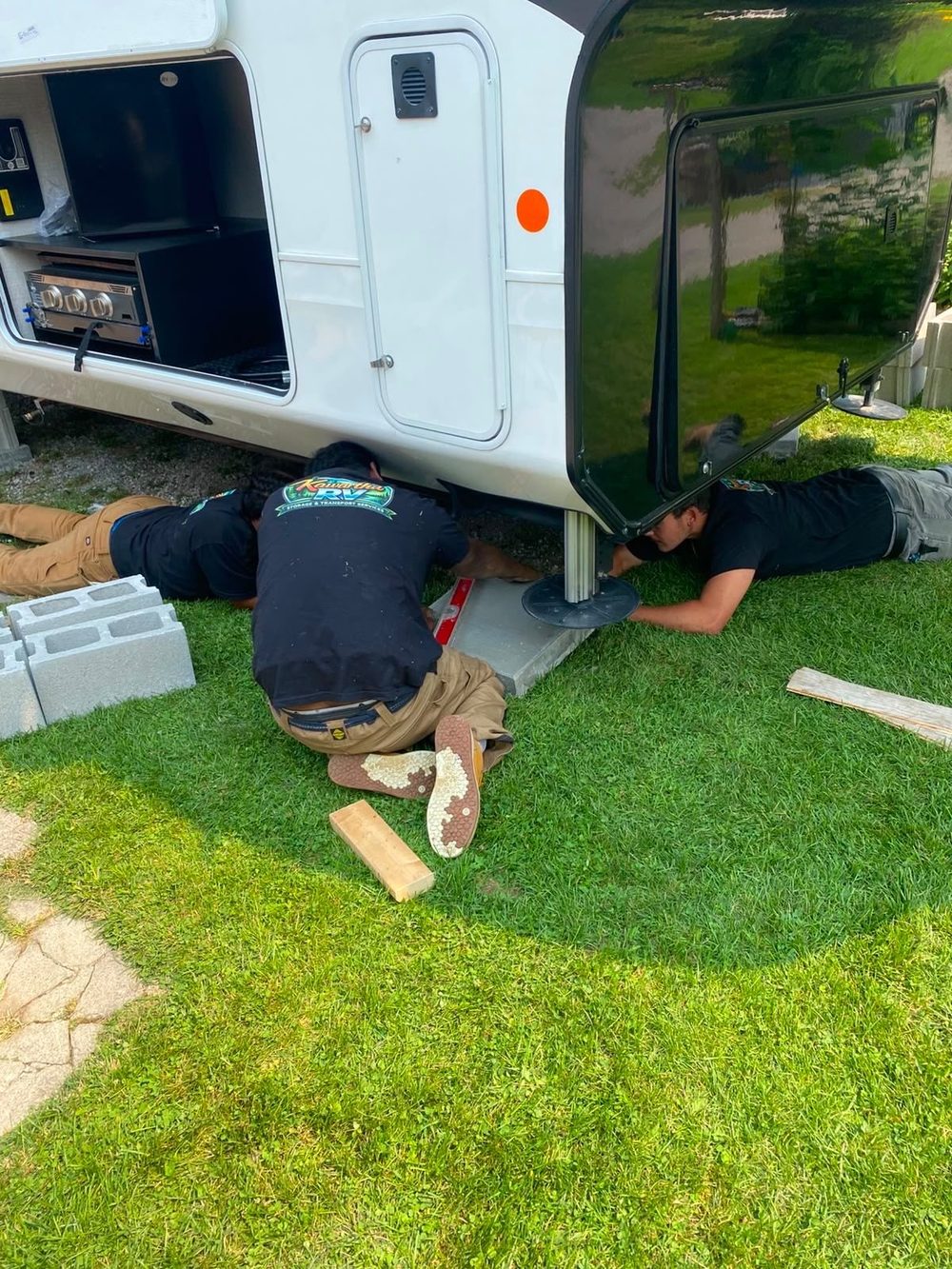
What we do about it: spread the load over more area rather than fewer points where the ground is soft, use full pads rather than stacked cribbing where we can, set the unit with the frame carrying the weight rather than the axles or the tongue jack, and check it with a string line along the frame rail rather than a level on the floor, because a floor can be out of true independently of the frame. Where the ground is not going to hold, we say so at the time, in writing, before we set the unit.
Storage when the driveway will not take it
The October 31 front yard cutoff and the 13 metre and 7 metre length caps are the two reasons Georgina customers end up in storage, and they are both zoning reasons rather than space reasons. Plenty of people have room for the trailer and still cannot legally keep it where it is.
Our storage runs $85 to $125 a month depending on the size of the unit. What it removes is not just the parking problem: it also removes the compliance problem, the neighbour problem and the question of what the unit is sitting on over the winter. We can collect from your driveway in October and deliver back to a seasonal site in the spring, which turns two separate transport jobs and a storage search into one arrangement.
Details of what we offer are on the RV storage page, and the winter storage checklist covers what to do to the unit itself before it sits for five months, which is the part people skip and then pay for in the spring.
Book the October collection in September. The last week of October is the week everybody remembers at once.
What a Georgina move costs
Our published numbers, the same everywhere we work:
| Service | Price |
|---|---|
| Local tow | From $400 |
| Levelling and blocking, full set up | $799 |
| Storage | $85 to $125 a month depending on size |
| Deposit to book a date | None |
| Maximum tow weight | 30,000 lb on a 30 foot gooseneck |
What moves the number in Georgina specifically is not distance. The Town is compact and most local runs are short. It is these four things, in rough order of how often they come up:
- Whose road it is. An address on one of the eleven year round restricted roads turns a scheduling question into a permit question, and that is time rather than mileage.
- Access. A shoreline lot with no turning room, or a unit that has to be repositioned in stages before it can be hitched properly. This is the most common one on Lake Drive and Hedge Road.
- Width. Anything over 2.6 metres is oversize, which brings in a permit and sometimes a route change.
- Crossing authorities. A twenty minute drive that touches Town, Regional and provincial road needs paperwork from more than one office, and their lead times are not the same.
Levelling and blocking is quoted separately at $799 for a full set up, and storage runs $85 to $125 a month depending on size. There is no deposit to book. The RV transport cost guide breaks the pricing down across the whole of Ontario if you want the full picture before you call.
When to book
Three to four weeks in the peak windows gets you a specific week. The peak windows in Georgina are the run up to the May long weekend and the last five weeks before October 31. Outside those we can often be there inside a week, and mid week dates in July and August are usually available on short notice.
If the move is oversize or the address is on a restricted road, work backwards from the paperwork rather than the calendar. On a Regional road that means allowing time for a Load Exemption Permit, and remembering that during the March to April thaw the Region's published position is that heavy vehicles are not permitted on spring restricted roads at all rather than permittable. On the Town side the honest answer is that the lead time is whatever the Operations Infrastructure office tells us on the day, because the Town does not publish one.
There is no deposit to hold a date. Booking early costs you nothing and gives you room to move if the weather or the paperwork does.
How to get the quote right the first time
Send these six things and we can usually quote without a site visit:
- The exact street address at both ends, not the town. In Georgina the street decides the rules, not the municipality.
- Make, model and year of the unit, and its loaded weight if you know it.
- Overall length and width, particularly whether the unit is over 2.6 metres wide, because that is the figure that turns a tow into a permitted move.
- Two photos. One taken from the road looking at the unit, and one from the unit looking back at the road. The second one tells us more than the first.
- Whether anything has to come off or move first: a deck, a shed, an awning, a skirt, a tree limb, a fence panel.
- Your date, and how much flexibility there is either side of it.
If the unit has not moved in several years, say so. Tires, bearings and a frame that has settled into soft ground are all things we would rather know about before we arrive than discover with a truck hooked up.
Our 30 day guarantee
If a unit we set up shifts or moves because of our workmanship, we come back and redo the job at no charge. Weather and ground conditions are outside that, and we say so up front.
Plainly: if a unit we levelled and blocked shifts within 30 days because of how we did the job, we come back and redo it at no charge. Weather and ground conditions sit outside it.
We draw that line where we draw it because on this shoreline the ground genuinely does move on its own, and pretending otherwise would mean either refusing legitimate claims later or refusing to work on soft lots at all. What we do instead is tell you at the time, before we set the unit, if we think the ground is going to settle regardless of how well we block it, and we write it down. Nobody gets a surprise in April.
Nearby areas we also cover
Georgina sits at the meeting point of four different jurisdictions, and we work in all of them. If your move starts or ends outside the Town line, these are the pages for the areas next door.