
The short answer
Our local RV tows start at $400, levelling and blocking is a $799 local flat rate, and outdoor storage is $85 to $125 a month. There is no deposit to book. Beyond that, an honest price depends on seven things: distance, the size of the unit, whether it rolls, access at both ends, permits, season and how much of the work you have already done. This page walks through every one of them with real numbers, including the government fees, and it says plainly where we could not verify something.
Most pages about RV transport costs in Ontario do one of two things. They print a per-kilometre rate that no company actually charges, or they refuse to say anything at all and tell you to call. We are going to do neither. We run RV and trailer transport out of Beaverton, and the numbers below are the ones we quote from and the ones the province and the municipalities publish. Where a figure exists, we print it and say where it came from. Where it does not, we say that too.
| What | Our price |
|---|---|
| Local RV or trailer tow | From $400 |
| Levelling and blocking, local | $799 flat rate |
| Outdoor winter storage | $85 to $125 a month by size |
| Deposit to book a date | $0 |
| Government permits, where a route needs them | Billed at cost, no markup |
Then there are the numbers that are not ours. These come from the Ministry of Transportation, from individual municipalities and from 407 ETR, and they are the ones that turn a simple tow into a bigger invoice. A single trip oversize permit from the province is $66.25. A municipal permit in Peterborough is $172.00. In Hamilton Township it is $50.00. Oshawa is $154.50 plus tax. Those are not our prices and we do not mark them up, but they are part of what a move costs and you deserve to see them before you get an invoice.
- Under 2.6 metres wide, road ready, local. A straightforward tow. Our starting price applies and no permit is involved.
- Over 2.6 metres wide. Provincial permit, warning flags, an oversize sign, and probably municipal permits on top. Different job, different number.
- Does not roll. Goes on the deck or gets tire work first. Tell us before the day.
- Sitting on cribbing. Unblocking is real work and it is priced as work.
- Deck or shed in the way. That is a service in its own right and it goes on the same day if we know in advance.
- Spring or fall peak. Same job, tighter calendar. Book early rather than pay for somebody else's cancellation.
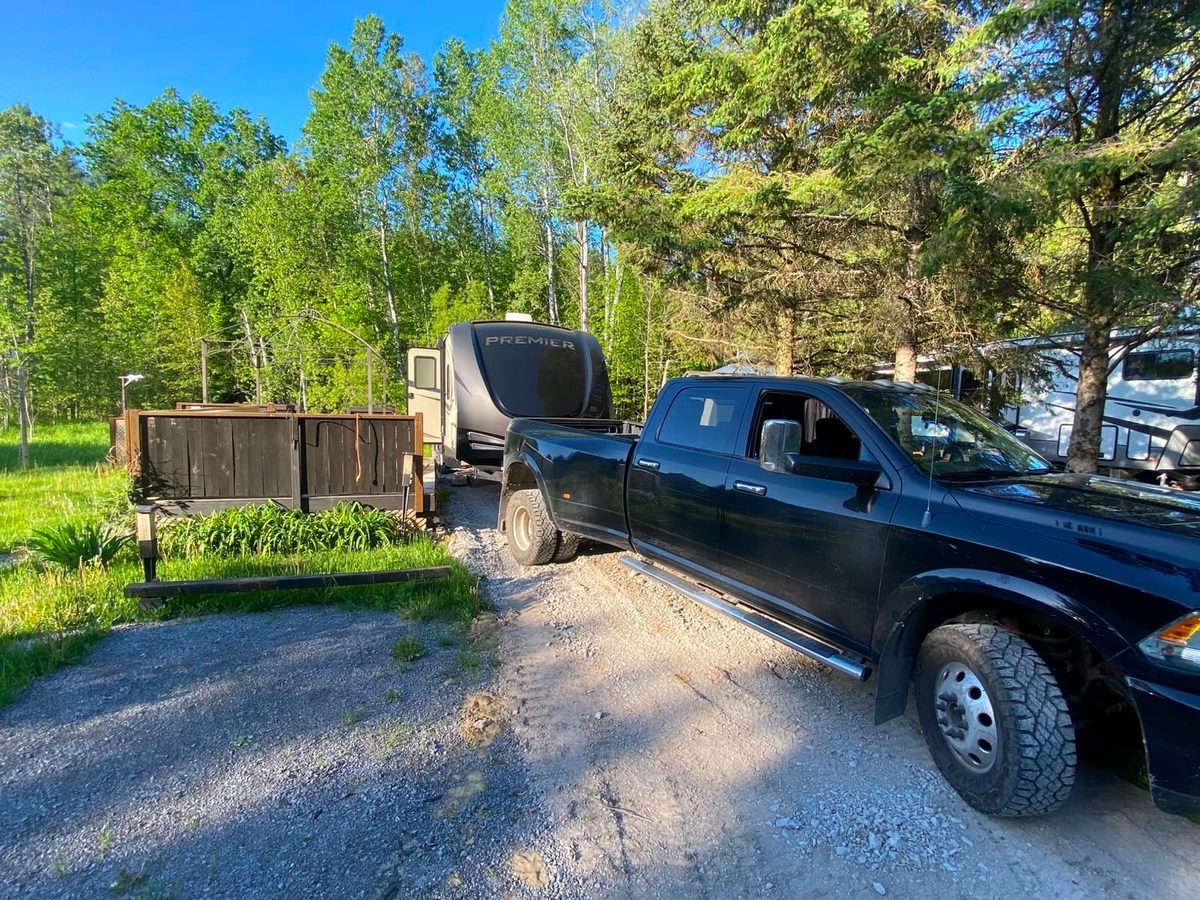
If you want the fastest route through this page, read the seven things that move a quote, then how to get an accurate quote in one phone call. Everything in between is the detail behind those two sections, and the sources section at the bottom lists every government page we read and, more usefully, the ones we could not.
What we actually charge
Local tows start at $400, levelling and blocking is $799 as a local flat rate, and storage runs $85 to $125 a month. There is no deposit to book a date. Permits are billed at cost with no markup. Everything else on your invoice is time and equipment, and we tell you what it is before we do it.
We would rather publish our starting numbers and explain them than make you phone to find out whether we are in your range. Here is what each of those figures actually covers.
The $400 local tow
That is where a local move starts for a road ready unit. Road ready means it is down on its own wheels with the jacks and stabilisers up, the tires hold air and are not crazed, and there is a clear path from where it sits to the road. Local means inside the area we already work, which for us means the ring of towns around Beaverton: Kawartha Lakes, Brock, Georgina, Uxbridge, Ramara and the near parts of Durham. Our service areas page lists the whole footprint.
What raises it from there is not mysterious. Distance is the obvious one. Beyond that: size, because a 40 foot fifth wheel is a different tow than an 18 foot travel trailer; condition, because a unit that does not roll goes on the deck; access, because a driveway we have to inch out of costs time; and prep, because everything you have not done, we do.
Why we publish a starting price and not a rate per kilometre
Because a per-kilometre rate is dishonest for short moves. Every job has a fixed cost that exists whether the trailer travels 5 km or 50: getting the truck to you, hooking up, checking the unit, and getting the truck home afterwards. Spread that over 5 km and a per-kilometre rate looks absurd. Spread it over 500 km and it looks like a bargain. A starting price plus distance is closer to how the work actually behaves.
The $799 levelling and blocking flat rate
This is a separate service and a separate number, because plenty of people need one without the other. Levelling and blocking is the work of getting a unit sitting level, evenly supported and solidly blocked so it stays that way. It is what makes doors close, slide-outs seal and frames stop twisting. It is also the job most often done badly, because from a distance a unit on four piles of patio stones looks exactly like a unit that has been blocked properly.
The flat rate applies locally and to a normal setup. What takes it beyond a flat rate is ground that will not hold, which is the usual culprit. A site that is soft, sloped badly, or built on fill that has never settled needs more material and more work, and we would rather see it and tell you than quote blind. If we are doing the tow and the levelling in the same visit, that is one trip instead of two, and it is priced accordingly.
Storage at $85 to $125 a month
Outdoor seasonal storage on a fenced property, priced by the footprint of the unit. A small travel trailer sits at the bottom of that range and a big fifth wheel at the top. Our storage page covers what we take and what we do not. Most customers add the tow at both ends, in at the end of the season and out in spring, because it removes the one trip nobody enjoys and it means the unit arrives somewhere it is going to be looked at rather than forgotten.
The guarantee, in the owner's words
If a unit we set up shifts or moves because of our workmanship, we come back and redo the job at no charge. Weather and ground conditions are outside that, and we say so up front. We put that in writing on every page of this site because it is the part of a price that actually matters. A cheap setup that shifts in eight months was not cheap.
What we do not do
We do not take a deposit. We do not mark up a government fee. We do not quote a number and then find reasons for it to grow, which is the single most common complaint people bring us about the last company they used. And we do not give a firm price for a permitted move before we know the route, because the permit cost genuinely depends on which municipalities the route crosses. For those we quote the transport firmly and the permits at cost, and we tell you the likely permit total before you commit.
The seven things that move a quote
Seven things change the price of an RV move in Ontario: distance including the empty leg, the size of the unit, whether it rolls, access at both ends, permits, the season, and how much prep is already done. Six of the seven are things you can find out or influence before you call. That is why a five minute phone call produces a better price than a web form.
Every quote we give is these seven inputs and nothing else. There is no hidden eighth factor and no premium for the colour of the trailer. If you want to know why one company quoted $450 and another quoted $1,400 for what sounds like the same move, the answer is almost always that they weighted these seven differently or one of them never asked.
| Factor | What it does to the price |
|---|---|
| Distance and deadhead | Sets the floor. Includes the empty leg, which is why short moves do not scale down linearly. |
| Size and weight | Decides whether it tows behind the ball, rides the gooseneck deck, or needs a permit at all. |
| Condition | Rolls or does not roll. Flat tires, seized bearings and rotted axles change the method. |
| Access at both ends | The most underestimated line. Soft ground, tight turns, low branches and overhead wires all cost time. |
| Permits | Zero for most consumer RVs. Real money once the unit is over legal width, height or length. |
| Season | Spring and fall peaks compress the calendar. Winter adds frozen ground and reduced load rules. |
| Prep already done | Unblocking, tires, decks and skirting. Everything you have not done, we do, and it is billable. |
The order they matter in
For a typical local move of a normal travel trailer, the order is: access, prep, distance, then everything else. People expect distance to dominate and for local work it usually does not. A 25 km move out of a tight seasonal site with a deck built against the door will cost more than a 90 km move off a gravel pad with nothing around it, every time.
For a long haul or an oversize unit the order flips. Distance and permits dominate, and access becomes a smaller share of a bigger number. That is worth knowing when you are deciding whether to sort out the yard before we come. On a short local job, clearing the yard is the highest-value hour you will spend. On a haul to Thunder Bay it barely moves the needle.
The one factor most people get wrong
Width. Not length, not weight. Length and weight are printed on paperwork most owners have. Width is the number nobody has, and it is the number that decides whether a move needs a provincial permit, warning flags, an oversize sign and possibly a municipal permit for every town on the route. We cover it in full under the 2.6 metre line. Measure the widest point of the body, not the box on the brochure.
The rest of this page takes those seven in order, with the real figures behind each. Where the figure is a government fee we print it and link the page it came from. Where it is ours, we print it. Where nobody publishes one, we say so.
Distance, and why a 40 km move is not 40 km of driving
Every RV move contains at least one empty leg, and that empty leg costs the same fuel and the same hours as the loaded one. A 40 km move is typically 80 km of truck movement at minimum, and often more once the truck has to get to you from base and home again afterwards. This is the reason short moves do not scale down the way people expect them to.
Picture the simplest possible job. We are in Beaverton. Your trailer is in Sunderland and it is going to a seasonal site near Port Perry. On a map that is a short move. In truck hours it is Beaverton to Sunderland empty, Sunderland to Port Perry loaded, Port Perry back to Beaverton empty. Three legs, two of them with nothing behind the truck, and the trailer only travelled on one of them.
That arithmetic is why our price starts where it does rather than at some notional per-kilometre figure. It is also why the single best thing you can do to get a lower price on a short move has nothing to do with negotiating. It is flexibility on the date. If your trailer can wait a week and ride along on a day we are already going that direction, one of those empty legs disappears from the equation and you are no longer paying for it.
Corridors, and why some routes price better
We run certain corridors constantly. Beaverton down through Brock and Uxbridge into Oshawa and Durham Region. East through Kawartha Lakes toward Peterborough. North on the 11 into Muskoka. West toward Barrie and on to Collingwood and Wasaga Beach. A job that sits on one of those lines is cheaper for us to do and we price it that way.
Further out, the same logic applies at a different scale. Cobourg and Port Hope and Belleville and Quinte West are regular runs for us but not daily ones, so a move down there prices better if it can pair with another job. Long hauls across the province or across the country are quoted individually, because at that distance the question stops being kilometres and becomes hours of service, overnight costs and what is coming back.
| Move type | What actually drives the price |
|---|---|
| Local, under about 50 km | Fixed costs dominate. Access and prep matter more than the distance itself. |
| Regional, roughly 50 to 250 km | Distance starts to lead. Corridor and date flexibility can move the number meaningfully. |
| Long haul, beyond 250 km | Hours, fuel, overnights and the return leg. Permits if the unit is oversize on any part of the route. |
| Out of province | Quoted individually. Route, permits and what is available for the return trip decide it. |
The return trip nobody asks about
When you ask three companies for a quote and one comes back dramatically lower, one likely explanation is that they already have a load coming back and you are the cheap half of a round trip. That is legitimate and it is good for you. Another explanation is that they have not thought about the return leg at all, and that number gets revisited later. Asking "are you coming back empty?" is a fair question and the answer tells you which kind of quote you are holding.
Size: the 2.6 metre line that decides everything
Ontario's published legal maximum width for a vehicle including its load is 2.6 metres. Under that, a move is a normal tow. Over it, the move needs a permit, warning flags and an oversize sign, and usually a municipal permit for every town on the route. Width is the single most expensive variable in RV transport and it is the number almost nobody has measured.
The province's own Guide to Oversize/Overweight Vehicles and Loads sets out the dimensions plainly. It gives the maximum width as "Vehicle including load - 2.6 m (metres)", the maximum height as "Vehicle and load - 4.15 m (metres)", the maximum length for a "Single vehicle including load - 12.5 m (metres)", and for a "Combination of vehicles and load - 23 m (metres)". Those four figures decide whether your move is routine or permitted.
| Dimension | Ontario limit | Highway Traffic Act section |
|---|---|---|
| Width | 2.6 m | s.109(1) |
| Length, single vehicle | 12.5 m | s.109(6) |
| Length, recreational vehicle | 12.5 m, extendable to 14 m where prescribed | s.109(11) and s.109(11.1) |
| Length, combination of vehicles | 23 m | s.109(7) |
| Length, semi-trailer | 14.65 m | s.109(10) |
| Height | 4.15 m, 4.3 m for prescribed configurations | s.109(14) and s.109(14.1) |
| Penalty for contravening s.109 | Not less than $200 and not more than $20,000 | s.109(15.1) |
What is under the line and what is over it
Almost every consumer travel trailer and fifth wheel is built to sit under 2.6 metres on purpose, because a manufacturer that builds wider is building something its customers cannot tow home. So if you have a normal travel trailer, a normal fifth wheel or a toy hauler without flares, you are almost certainly under the line and no permit is involved.
What goes over the line is a shorter list and it is exactly the list of things we get called about. Park models. Single wide mobile homes. Some destination trailers. Anything with an addition, a bump-out that was built on site, or a roof extension. If you are moving one of those, read our park model and mobile home moving page as well, because the whole job is different, not just the paperwork.
How to measure so the number is right
Measure the widest point of the body with a tape, at the widest place, and include anything permanently attached that sticks out past it. Awning rails count. A ladder counts. Flared fenders count. Do not use the number on the brochure, because brochure widths are frequently the box width and not the actual widest point, and the difference is exactly where people get caught. If your tape reads 2.55 metres, measure it twice, because you are four and a half centimetres from a different kind of job.
Why we ask twice
Because the consequence of getting it wrong lands on us, not on the person who guessed. A unit that turns out to be over width on the morning of the move is a job that cannot legally leave the property. The permit takes days, not hours. Nobody enjoys that phone call, so we would rather be the company that asked an annoying question a week early.
Flags and signs, when you are over
Being over width is not just a fee. The province's Guide requires the load to be marked. Its wording is specific: "Vehicles and/or loads in excess of dimensions prescribed under Section 109 of the Highway Traffic Act shall be marked with bright red or orange warning flags of not less than 40 cm square and shall be mounted to the extremities of the vehicle or load." There is an oversize sign requirement on top of that, with "OVERSIZE LOAD in black letters at least 200 mm high" on a yellow background, visible from 150 metres. The Guide also says "The signs must be removed or covered when not required", which matters more than it sounds: a truck running an oversize sign on a legal load is its own problem.
We carry all of that. It is part of what you are paying a licensed carrier for rather than a person with a pickup. But it is worth knowing it exists, because it is one of the tells when you are comparing a low quote against a real one.
What a provincial permit costs
Ontario's oversize and overweight permit fees are published by the Ministry of Transportation. A single trip oversize only permit is $66.25. Single trip overweight permits run $127.50, $204 or $265.25 depending on distance, for loads up to 120,000 kg. An annual permit is $448.75, enhanced annual $744.50, and a project permit $291.75. These are provincial fees for provincial highways. Municipal roads are billed separately by each municipality.
Every figure in this section comes from the Ministry's Get an oversize/overweight permit page, read directly. We are printing them because permit cost is the part of an oversize quote people most suspect of being inflated, and the simplest cure for that suspicion is to publish the government's own number next to ours.
| Permit type | Fee |
|---|---|
| Annual | $448.75 |
| Enhanced annual | $744.50 |
| Project | $291.75 |
| Enhanced project | Fees vary depending on the number of trips |
| Single trip, oversize only | $66.25 |
| Single trip overweight, up to 120,000 kg, up to 100 km | $127.50 |
| Single trip overweight, up to 120,000 kg, 101 to 500 km | $204 |
| Single trip overweight, up to 120,000 kg, over 500 km | $265.25 |
| Single trip overweight, greater than 120,000 kg (superload) | $714 |
| Special vehicle configuration | Varies depending on the permit type |
Which permit a job needs
The type of permit is decided by how far over the limits the unit is and how often it is moving, not by how big your budget is. The Ministry publishes the thresholds for each. An annual permit covers a "weight up to 63,500 kg", a "width up to 3.85 metres on multi-lane highways and up to 3.7 metres on 2-lane highways", a "length up to 25 metres" and a "height up to 4.26 metres". An enhanced annual permit lifts that to a "weight up to 78,000 kg" and a "length up to 32 metres".
A project permit covers a "weight up to 70,000 kg", a "width up to 4.3 metres" and a "length up to 36.75 metres". An enhanced project permit goes to a "width up to 4.99 metres" and a "length up to 45.75 metres". A single trip permit that is not a superload covers a "weight up to 120,000 kg", a "width up to 5 metres" and a "length up to 45.75 meters" [sic, the Ministry's page prints the US spelling in that one row]. Above 120,000 kg gross vehicle weight, above 5 metres in width or above 45.75 metres in length, the move is a superload and a different process.
For an RV owner, this list is mostly reassurance. A park model is not going to trouble a 63,500 kg weight threshold. What it can trouble is width, and that is why the width figures in the table above are the ones worth reading twice.
Lead times, which cost more than the fee
Plan around these, not the money
The Ministry states that annual permits "take up to 15 business days to be issued", project permits "take up to 15 business days to be processed", and that the "turn around time for a single trip permit is 5 business days". A special vehicle configuration permit "can take 15 business days or more to process". Superload permits "can take longer than other oversize/overweight permits (at least 5 business days and up to 6 months)". Fifteen business days is three calendar weeks. That is the real cost of a permit for most people, not the $66.25.
Applications go in online or by mail. The Ministry's page notes that fax was accepted "until January 1, 2026", which has now passed, so online is the practical route. We file these ourselves as part of the job. What we need from you to do it is the exact dimensions and the addresses, which is why we ask for a tape measure reading rather than a brochure figure.
Seasonal restrictions on permits
There is a seasonal restriction in Ontario that catches annual and project permits during the spring thaw window. We checked directly whether it also catches single trip permits, and it does not. That distinction matters for RV owners more than it might seem, because spring is exactly when people want park models moved onto seasonal sites, and a single trip permit remains available in that window when an annual one may not be.
Reduced load periods on municipal roads are a separate matter again, and they are set locally rather than by one province-wide regulation. We looked for a single regulation fixing province-wide half-load dates and there is not one. Each road authority sets and posts its own. We cover what that means for the spring calendar under season.
What the permit does not do
A provincial permit authorises the move on provincial highways. It does not authorise the municipal roads at either end, and almost every RV move begins and ends on a municipal road. The Highway Traffic Act does allow one permit to cover more than one municipality, under s.110(4), but that is a mechanism, not an automatic outcome. In practice a permitted move through several towns means several conversations. The next section is what those cost.
Two more provisions worth knowing, both in s.110. Under s.110(5) the mover remains liable for damage to the highway, which is a good reason to care whether your carrier is insured properly rather than nominally. And under s.110(6) the original of the permit has to be carried in the vehicle. Not a photograph of it, not a copy on a phone. We mention it because it is the kind of detail that separates a carrier who does this weekly from one who does not.
What a municipal permit costs, town by town
Municipal oversize permit fees across our service area range from $50.00 in Hamilton Township to $300.00 for an annual permit in Belleville, and some municipalities publish no fee at all. A permitted move that crosses three municipalities needs three permits. Every figure below was verified on the municipality's own material during the build of the area page it also appears on, and each links back there so you can see it in context.
This is the part of RV transport pricing that nobody explains, so here it is laid out. When a unit is over legal dimensions, the province covers the provincial highways and each municipality covers its own roads. Your driveway is on a municipal road. So is the seasonal site. So, usually, is most of the route in between. The fees are individually small and collectively the reason an oversize quote looks the way it does.
| Municipality | Published oversize fees | Area page |
|---|---|---|
| City of Peterborough | $172.00, at least 5 business days notice | Peterborough |
| Peterborough County | $50.00 single move with 5 business days notice, $85.00 with less, $250.00 annual first vehicle plus $25.00 each additional | Peterborough |
| City of Oshawa | $154.50 plus tax, 10 to 15 business days | Oshawa and Durham |
| Region of Durham | No fee published on the application page. Ten business days. Deposits from $1,000 | Oshawa and Durham |
| City of Barrie | Per permit $119.19 in 2026, annual $476.70 in 2026 | Barrie |
| Town of Collingwood | $175.00 annual, $100.00 single trip, 5 business days | Collingwood |
| Town of Midland | $116 single trip, $232 annual | Collingwood |
| Township of Tay | $300 a year | Collingwood |
| Town of Bracebridge | $200 annual, $150 project, $60 single trip | Muskoka |
| Town of Gravenhurst | No fee amount published | Muskoka |
| Hamilton Township | $150.00 annual, $50.00 single trip | Cobourg and Port Hope |
| Municipality of Port Hope | No oversize permit published. Road occupancy permit $206.00 | Cobourg and Port Hope |
| Town of Cobourg | Nothing road related published | Cobourg and Port Hope |
| City of Belleville | $300.00 annual, $200.00 seasonal, $75.00 single trip, plus a $10 administrative fee | Belleville and Quinte West |
| City of Quinte West | $50.00 one month, $100.00 six months, $200.00 one year | Belleville and Quinte West |
| City of Kawartha Lakes | Online through Permit Central. Annual or trip permit | Kawartha Lakes |
| Township of Scugog | Fee set in Schedule E of the Fees and Charges By-law, through Permit Central | Port Perry and Scugog |
What the spread actually tells you
Two things. First, that a single trip across the wrong three municipalities can add several hundred dollars in fees alone, before anybody has driven anywhere. Second, that the cheapest permit is not the cheapest move. Hamilton Township at $50.00 for a single trip is the lowest published figure anywhere in our service area, and that is genuinely useful to know if a route can be planned through it. But routing a move to chase a $100 saving in permit fees while adding an hour of driving is not a saving.
The ones that publish nothing
Three entries in that table are refusals rather than figures, and they are the most useful rows in it. The Region of Durham does not publish a fee on its application page. The Town of Gravenhurst publishes no amount at all. The Municipality of Port Hope does not publish an oversize or overweight permit of any kind, only a road occupancy permit at $206.00. Cobourg publishes nothing road related on the pages we could read.
We are not going to guess at those. On our Muskoka page we say plainly that Gravenhurst publishes no figure and we give the Public Works number so you can ask. That is a worse answer than a number and it is the only honest one available. If another site shows you a confident dollar figure for Gravenhurst, ask them where it came from.
Insurance requirements, which are not fees but behave like them
Several municipalities set insurance minimums as a condition of the permit, and they are higher than people expect. Oshawa requires $5,000,000 automobile and $5,000,000 commercial general liability with the City as additional insured. Barrie requires $2,000,000.00 motor vehicle plus $2,000,000.00 comprehensive general, $4,000,000.00 in total, with the City named as additional insured and a letter naming the designated signing officer. Midland requires $2,000,000.00 general commercial and automobile liability with the Town as additional named insured. Quinte West's By-law 00-143 requires public liability and property damage insurance not less than Two Million Dollars ($2,000,000.00).
Why this matters when you are comparing quotes
A carrier who cannot meet a $5,000,000 requirement cannot legally do a permitted move in Oshawa. Not "would rather not". Cannot. When you are weighing a cheap quote for an oversize move, the insurance condition on the permit is a hard filter that a lot of low quotes quietly fail. We cover our own coverage under insurance below.
Timing, again
Municipal lead times run from 24 hours in Quinte West to ten business days in Durham Region and up to 15 in Oshawa. Peterborough wants at least five business days for its $172.00 permit and Peterborough County charges $85.00 instead of $50.00 if you give it less than five. That is a $35.00 penalty for being in a hurry, published openly, and it is a fair summary of how the whole system treats late applications. Some municipalities also require the permit to be carried in the vehicle, which Peterborough County states explicitly.
The practical upshot for anybody planning an oversize move: start three weeks out. Not because any single step takes three weeks, but because the provincial permit can take 15 business days and the municipal ones sit on top of it, and the whole thing has to be sequenced.
Escorts, and why they cost more than the permit
Ontario does not require an escort for most oversize RV moves. The province's Guide sets out no escort requirement for widths from 2.61 to 3.99 metres, lengths from 23.01 to 36.75 metres, or heights from 4.16 to 4.86 metres. Private escorts start at 4 metres of width, 36.76 metres of length or 4.87 metres of height. That means a typical park model move needs a permit but not a pilot vehicle.
This is the section where we get to deliver good news, which does not happen often on a page about costs. The escort thresholds in the Ministry's Guide sit well above where most RV and park model work lands. A unit that is 3.5 metres wide is over legal width, needs a permit, needs flags and needs an oversize sign, and needs no escort at all.
| Dimension | Escort requirement per the Ministry's Guide |
|---|---|
| Width 2.61 m to 3.99 m | None |
| Width 4 m and greater | Private escort, varying by highway type |
| Width 5 m and greater | Certified superload escorts |
| Length 23.01 m to 36.75 m | None |
| Length 36.76 m and greater | Private escort |
| Length 45.75 m and greater | Certified superload escorts |
| Height 4.16 m to 4.86 m | None |
| Height 4.87 m and greater | Private escort |
| Any dimension, on request | Certified superload escorts upon the weight and load engineer's request |
A note on that last category: the Ministry's own document prints the heading as "Certifed Superload Escorts", with the typo. We are reproducing it as published rather than tidying it, because if you go looking for the section you will find it spelled that way.
Where municipalities set their own escort line
Municipalities can and do impose their own escort conditions, and they are not identical to the province's. The City of Peterborough requires escorts over 4 metres wide, 36.76 metres long or 4.87 metres high, which tracks the provincial thresholds closely. The Region of Durham requires a police escort over 5.00 metres wide or 45.75 metres long, which is a different animal entirely, because a police escort is arranged on the service's schedule and not on yours.
What an escort actually costs
We are not going to publish a figure for this, and here is why. Private escort rates are set by private escort companies, they vary by region, by duration and by how far in advance you book, and no government body publishes a schedule for them. Any number we printed would be an average of quotes we have received rather than a rate anybody is bound by, and it would be out of date within a season. What we will tell you is the shape of it: an escort is a second vehicle and a second driver for the whole duration of the move, which means it is priced like labour and not like a fee. That is why it costs more than the permit.
What we could not verify
We found no Ontario government schedule of private escort rates, and we are not aware of one existing. If you need a firm escort cost, the answer is to get quotes from escort operators for your specific route and dates. We will tell you whether your move needs one, and we will help you find operators, but we will not invent a rate to put on a web page.
For almost every reader of this page, none of this applies. If you are moving a travel trailer, a fifth wheel or a standard park model, you are under every escort threshold in that table. It matters for wide mobile homes and for units with additions, and it is worth knowing the line exists so that a company quoting you an escort for a 3.6 metre wide unit can be asked a pointed question.
The 407, and the toll nobody budgets for
If your move crosses the Greater Toronto Area, Highway 407 is a real line on the invoice, and a truck pulling a loaded trailer is not billed at car rates. 407 ETR publishes three separate rate charts: light vehicles, heavy single unit vehicles and heavy multiple unit vehicles. As those charts stood on 28 July 2026, the flat trip toll charge alone was $1 per trip for a light vehicle, $2 for a heavy single unit and $3 for a heavy multiple unit, and that is before a single kilometre of the per kilometre rate is counted. We pass tolls through at cost and we ask before we use the road.
This is the most common surprise on a long distance quote through the GTA, and it is the easiest one to prevent. Almost nobody minds paying a toll. People mind finding out about it afterwards. So here is what 407 ETR actually publishes, which part of it applies to a transport truck, and the part we will not guess at on your behalf.
Which class a truck and trailer falls into
407 ETR sorts vehicles into classes and charges each class differently. The definitions printed on the rate charts are short and worth reading in full. On the light vehicle chart: "A light vehicle is a car, van, SUV, or small truck (under 5,000 kg) that is less than 6.09 metres long (20 feet) and less than 2.03 metres high (6.66 feet)." On the heavy single unit chart: "A heavy vehicle is any heavy single-unit truck, tractor or bus, with a gross weight or registered weight of over 5,000 kg."
Read those two together and the gap in the middle is obvious. A one ton truck with a 30 foot gooseneck under a park model is neither a car nor a single unit. It is a combination, and 407 ETR maintains a third chart for exactly that case, the heavy multiple unit chart. The word doing the work is multiple: more than one unit, which is what a truck plus a trailer is.
What we will not do is tell you which chart your own rig sits on. Classification on the 407 happens on the road, from overhead equipment, and it is applied per trip. Whether a half ton truck towing a 24 foot travel trailer bills as light, heavy single or heavy multiple is not something we can answer from a web page for every combination on the highway, and guessing wrong would cost you money in one direction or embarrass us in the other. If you are towing yourself and you want a firm answer, ask 407 ETR. If we are doing the towing, the toll lands on our invoice at cost and you will see the actual charge, not an estimate of it.
The flat charges, which are where the money hides
Everyone thinks about the per kilometre rate. Almost nobody thinks about the flat charges, and on a short crossing the flat charges can be larger than the distance component. All three of these charts carried an effective date of January 1, 2026 when we read them on 28 July 2026.
| Charge | Light vehicle | Heavy single unit | Heavy multiple unit |
|---|---|---|---|
| Trip toll charge | $1 per trip | $2 per trip | $3 per trip |
| Camera charge | $5.30 per trip | $60 per trip | $60 per trip |
| Unrecognizable plate charge | $60 per trip | $120 per trip | $180 per trip |
| Transponder monthly lease fee | $5 plus taxes | $5 plus taxes | $5 plus taxes |
| Transponder annual lease fee | $31.50 plus taxes | $31.50 plus taxes | $31.50 plus taxes |
| Transponder replacement fee | Not listed on that chart | $50 per transponder plus taxes | $50 per transponder plus taxes |
| Account fee | $5 per month, no transponder | $5 per month | $5 per month |
| Return payment fee | $35 each | $35 each | $35 each |
| Enforcement fee | $25 | $25 | $25 |
| Dispute appeal fee | $100 | $100 | $100 |
The row to stare at is the camera charge. On a light vehicle it is $5.30 per trip. On either heavy chart it is $60 per trip. That is the charge that applies when there is no transponder in the vehicle and the trip has to be billed from a photograph of the plate instead. Sixty dollars per trip is more than most of the short GTA crossings we do would cost in distance tolls, which is the entire reason a working truck carries a leased transponder at $31.50 a year rather than paying by camera.
The unrecognizable plate charge is the one nobody expects: $180 per trip on the heavy multiple unit chart. That is what happens when the camera cannot read the plate. On a transport job that usually means a plate obscured by road salt, mud or a trailer tongue. It is a good argument for a clean plate in March.
The per kilometre part, and why there is no full grid on this page
407 ETR's per kilometre rate is not one number. It varies by zone, and the highway is divided into a dozen numbered zones. It varies by direction. It varies by day of the week. It varies by time of day, across several bands. Multiply those together and the heavy multiple unit chart alone is several hundred separate rates.
Here is the honest summary of what we read on 28 July 2026, on the heavy multiple unit chart, westbound, weekdays: the rates ran from roughly 151.68 cents per kilometre in the late evening up to 326.37 cents per kilometre in the busiest zones during the morning peak. In the 7 a.m. band, Zone 1 was 292.17 cents per kilometre while Zones 7 through 9 were 326.37 cents. By the 9 p.m. band almost every zone had fallen back to 151.68 cents.
Why we are giving you a range and not a table
A complete grid would be twelve zones by eight time bands by two directions by weekday and weekend. It would be several hundred numbers, it would be tedious to read, and it would be wrong the moment 407 ETR revises its rates. A range tells you the shape of the cost. The live charts tell you the exact figure on the day you travel, and they are the only version worth trusting.
What the range is good for is a sanity check before you book. Take the highest published westbound weekday figure, roughly $3.26 per kilometre, and a 40 kilometre run across the top of Toronto works out to something on the order of $130 in distance tolls in the worst band. In the quiet evening band the same 40 kilometres is closer to $60. That is our arithmetic on their published rates rather than a quote from 407 ETR, and it excludes every flat charge in the table above. But a spread that wide is worth a conversation about timing.
The three live charts are here: light vehicle rates, heavy single unit rates and heavy multiple unit rates.
Whether the 407 is worth it on your move
Sometimes, yes. The 401 through Toronto with a wide load in daylight is genuinely slow, and time is the thing we are actually selling. An hour saved on the 407 is an hour that does not appear on your invoice, and on a heavy multiple unit crossing in an off peak band the toll can be less than the labour it replaces. That arithmetic flips completely in the morning peak, when you would be paying the top rate to sit in traffic anyway.
There is a second consideration for oversize work. If your move is running on a permit, the permit may specify a route, and the route on the permit wins. We check that before we plan anything, because a permit issued for one corridor does not authorise a different one. There is more on that in the provincial permit section above.
For most of the work we do, none of this comes up at all. A move from Beaverton to Peterborough, or from Port Perry to a park in the Kawartha Lakes, never touches the 407. It matters on runs into and across the Durham Region and westward toward Barrie and beyond, and on anything heading to southwestern Ontario. If your move is one of those, ask us about it when we quote, and we will tell you whether we expect to use the road and roughly what it will add.
Fuel, and the number we will not print
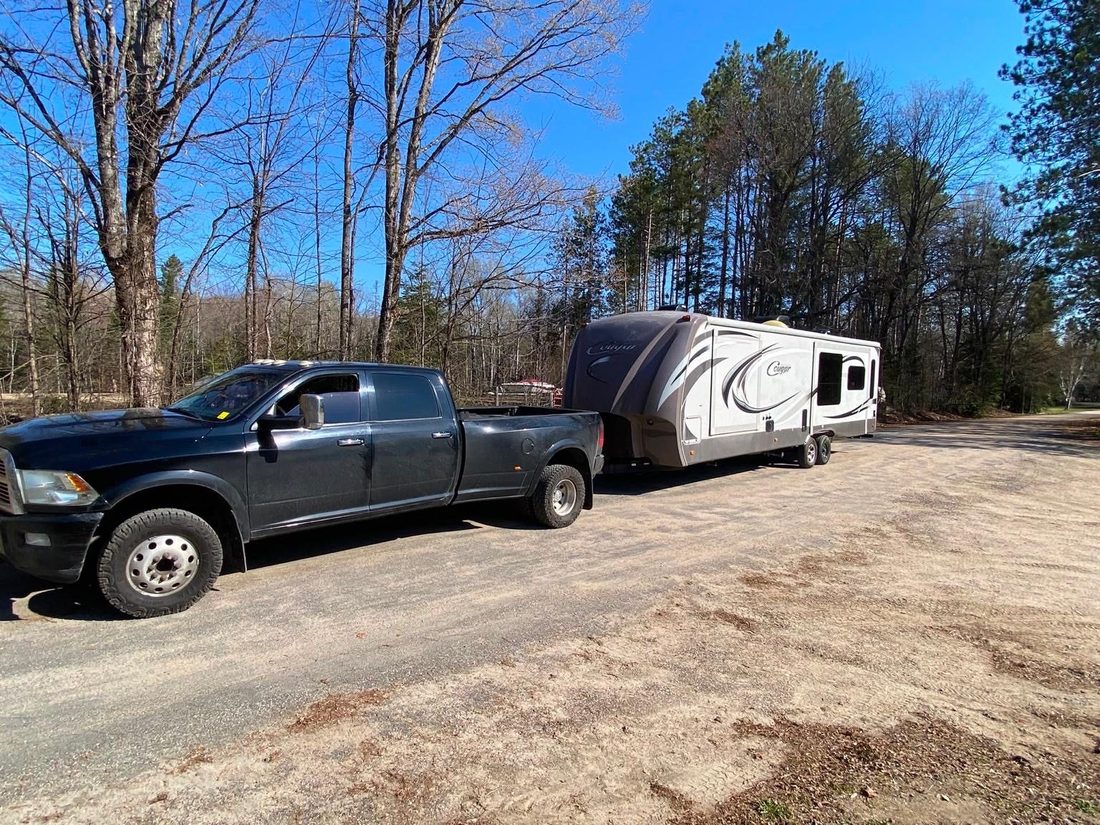
Fuel is the largest variable cost in any transport quote, and there is no current diesel price on this page, because we could not verify one. The Ontario government publishes weekly average fuel prices by region, but on 28 July 2026 the current week's figures would not load for us through any route we are permitted to use. Rather than print a number we had not actually read, we are telling you it is missing and pointing you at the live page.
Every other cost page you will find quotes a fuel price. We would rather explain the mechanism and leave the number to the source that updates it every Monday, because a diesel price hard coded into a web page in July is a lie by December.
Why fuel dominates a distance quote
A loaded transport rig does not get car fuel economy. Put ten thousand pounds of park model on a gooseneck deck, add the frontal area of a unit that is eleven or twelve feet tall, and fuel burn goes up in a way that has very little to do with the weight alone. Air is the expensive part. That is why a tall, light park model can cost as much to move over distance as a shorter, heavier trailer.
Then double it, more or less, for the return. As covered in the distance section, every one way move has an empty leg attached to it, and that leg burns fuel too. On a 300 kilometre delivery you are paying for something in the region of 600 kilometres of truck.
This is the single biggest reason quotes from different companies for the same move can be far apart. A carrier who prices from a fuel figure six months old, or who never adjusts, is either eating the difference or making it up somewhere you cannot see.
What the province publishes
The Ministry of Energy and Mines maintains an Ontario motor fuel prices page. Two sentences from it are worth having even without the numbers attached. The first: "The rates on this page (listed in Canadian cents per litre) are gathered weekly and published every Monday." The second: "Prices are collected by Kalibrate."
Those two sentences tell you three useful things with no figures at all. The data is weekly rather than daily, so a spike mid week will not show up until the following Monday. It is published on a predictable schedule, which means a carrier has no excuse for working from stale numbers. And it is collected by a third party rather than self reported by retailers, which is the difference between a survey and a press release.
The regional breakdown is the part that matters for our corridor. The survey reports separate columns for Toronto West and Toronto East, and a separate Peterborough column, alongside Ottawa, Windsor, London, St. Catharine's, Sudbury, Sault Saint Marie, Thunder Bay, North Bay, Timmins, Kenora and Parry Sound, plus a provincial average and separate southern and northern Ontario averages. A move from Beaverton east to Cobourg and a move north to Muskoka are not fuelling in the same market, and the survey is granular enough to show it.
The live page is here: Ontario motor fuel prices.
What we could not read, and why we are telling you
We tried three routes to the current week's Ontario average on 28 July 2026 and all three failed.
- The government page itself. Where the price table should render, the page returned "Unable to load data. This data is temporarily unavailable." The surrounding prose loaded normally, which is how we have the two sentences quoted above.
- The open data catalogue. The fuels price survey dataset on data.ontario.ca lists an update frequency of weekly and a date range beginning January 3, 1990 with no end date. Its published resources are a web link and two data dictionaries last updated October 5, 2016. There is no current spreadsheet attached to the catalogue entry.
- The underlying data file. We reached a file whose column headers list the regions above, but the response we received contained only records from 1996. Repeated attempts returned the same historical head rather than the current week.
So there is no fuel price on this page, and there is a line in the sources section saying exactly that with the date attached. We would rather have a visible hole in a page than a confident number in it that we did not actually read. If you need this week's figure, the Ministry page above is the source, and it updates on Mondays.
The federal fuel charge, which is now zero
There is one fuel related number that is settled and worth knowing, because it changed recently enough that older quotes were built on a different assumption. From the Canada Revenue Agency's fuel charge rates page: "On March 15, 2025, the Government of Canada made regulations that cease the application of the federal fuel charge, by setting all fuel charge rates to zero."
For several years before that, the federal fuel charge was a real and rising component of the pump price in Ontario. To give it a scale: in the CRA table covering Ontario together with Alberta, Manitoba, New Brunswick, Newfoundland and Labrador, Nova Scotia, Prince Edward Island and Saskatchewan, the published rate for light fuel oil in the period April 1, 2024 to March 31, 2025 was $0.2139 per litre. That is now zero.
If you are comparing a transport quote you were given in 2024 against one you are being given now, that is one of the things that moved underneath both of them. It is also a reason to be suspicious of any carrier still itemising a carbon charge as a separate line. The CRA fuel charge rates page is the source.
What this means for the number we give you
Fuel does not appear as its own line on a quote from us. It sits inside the price, the way a plumber's van sits inside a plumbing bill. The only thing we pass through separately is a government permit, billed at cost with no markup, and you can see that stated in our own price table near the top of this page.
If you are comparing quotes, ask each company one question: is fuel inside this number, or added later? It is a fair question, it takes ten seconds to answer, and the answer tells you a great deal about what the rest of the quote is worth. A number that can move after you have accepted it is not really a price.
Insurance, and what fully insured is supposed to mean
We carry $2,000,000 in liability, $150,000 in cargo coverage and $150,000 in non-owned trailer coverage, and we operate under Ontario CVOR 204-617-206. Fully insured is not a legal term and it costs nothing to say, so ask for the three numbers instead: the liability limit, the cargo limit, and whether non-owned trailer coverage exists at all. Any carrier moving your RV should be able to answer all three without going to look.
Insurance belongs on a pricing page because it is one of the biggest reasons two quotes for the same move can be hundreds of dollars apart. Coverage is a fixed cost that exists whether the truck moves or not, and a carrier who is not carrying it has a genuinely lower cost base. That is not a better deal. It is a different product.
Liability and cargo are not the same thing
This trips up almost everybody. Liability coverage responds when the operation damages somebody else: another vehicle, a guardrail, a gate post, a hydro pole, a neighbour's septic bed. Cargo coverage responds when the thing being carried is damaged. They are separate policies with separate limits, and a carrier can hold a large liability limit with no cargo coverage at all.
If your fifth wheel comes off a deck, liability coverage is not what pays for the fifth wheel. Cargo coverage is. So when a company tells you it is fully insured, the follow up question is not how much, it is for what.
Non-owned trailer coverage is the third piece, and it is specific to work like ours. In most of the jobs we do the trailer being towed is not ours, it is yours. Coverage that only extends to equipment the carrier owns leaves an obvious gap in exactly the scenario you care about.
The three questions to ask any carrier
- What is your cargo limit, and is my unit worth more than it? Ours is $150,000. That comfortably covers the great majority of travel trailers, fifth wheels and park models. If your unit is worth more than the limit, say so before the move rather than after it. That is a conversation about how to handle it, not a reason to walk away.
- Do you carry non-owned trailer coverage? If the answer is a pause, you have learned something. Ours is $150,000, and it exists precisely because the units we tow belong to customers.
- What is your CVOR number? A commercial carrier operating in Ontario has one and should hand it over without hesitation. Ours is 204-617-206. A number you can write down is worth more than an adjective.
You can ask us all three on the phone at (647) 961-9257, and you will get the numbers rather than a reassurance. More about how we work is on the about page.
What your own policy does, and what we will not pretend to know
We move RVs. We are not insurance brokers, and we are not going to interpret your policy for you on a web page. What we can tell you is which three questions are worth putting to your own broker before a move, because they have different answers on many policies.
Ask whether your unit is covered while it is in the care, custody and control of a third party carrier. Ask whether it is covered while stored away from your own property, which matters if it is going into outdoor storage for the winter. And ask whether it is covered while it is unoccupied and blocked on a seasonal site, which is a different situation again from either of the first two. Three questions, one phone call, and you will know where you actually stand.
Municipal insurance requirements, which behave like a price floor
Several municipalities in our service area will not issue an oversize permit unless the carrier holds specified limits and names the municipality as an additional insured. These are not fees. They behave like fees, though, because a carrier who cannot meet them cannot legally do the job in that municipality at all.
| Municipality | What the carrier has to carry | Area page |
|---|---|---|
| City of Oshawa | $5,000,000 automobile liability and $5,000,000 commercial general liability, City named as additional insured | Oshawa and Durham Region |
| City of Barrie | $2,000,000.00 motor vehicle plus $2,000,000.00 comprehensive general, $4,000,000.00 in total, City named as additional insured, plus a letter naming the designated signing officer | Barrie |
| Town of Midland | $2,000,000.00 general commercial and automobile liability, Town named as an additional named insured | Collingwood and Wasaga Beach |
| City of Quinte West | Public liability and property damage insurance not less than Two Million Dollars ($2,000,000.00), under By-law 00-143 | Belleville and Quinte West |
| Region of Durham | Some permits require a security deposit, minimum $1,000 | Oshawa and Durham Region |
Oshawa is the one worth noticing. Ten million dollars of combined coverage, with the City named, is a serious requirement, and it is not unusual for a small operator to be unable to meet it. So when a quote for a move into Oshawa comes in far below everybody else, one reasonable explanation is that the operator has no intention of pulling a municipal permit, because they could not get one if they tried.
What it costs to be a legal carrier in Ontario
An Ontario CVOR certificate costs $287.00 with HST included, made up of a $255 processing fee and a $32 learning and assessment fee, and it has to be renewed every year or every two years depending on the carrier's safety rating. That is the entry ticket, not the running cost. We operate under CVOR 204-617-206. If a company moving your RV commercially cannot give you a CVOR number, that is the end of the conversation.
None of this is a cost you pay directly. It is on this page because it is the honest answer to the question underneath every pricing question, which is why one quote is $400 and another one is $250.
The certificate itself
From the Ontario page on getting a CVOR certificate: "Commercial motor vehicles such as a buses [sic], trucks and tow trucks require a valid CVOR (Commercial Vehicle Operator's Registration) certificate before they can be operated in Ontario." The typographical slip is in the government's own text and we have left it as published rather than tidying a quotation.
On price, the same page states: "The fee for a CVOR (Commercial Vehicle Operator's Registration) certificate is $287.00 (HST (Harmonized sales tax) included)." It breaks that down as "a $255 processing fee and a $32 learning and assessment fee."
It is not a one time cost. The page is explicit: "You must renew your CVOR (Commercial Vehicle Operator's Registration) certificate every year or every two years depending on your carrier safety rating." That last clause carries more weight than it looks like it does. Renewal frequency is tied to safety rating, which means a carrier's record is not a private matter between the carrier and the Ministry. It changes the administrative burden of staying on the road.
Getting one involves more than paying. Ontario based applicants have to "complete a knowledge test (for Ontario-based applicants only)", with "6 months to pass" and, in the page's own words, "There is $5.00 fee" for it. That last sentence is quoted exactly as the government publishes it.
| Item | Published figure |
|---|---|
| CVOR certificate, total | $287.00, HST included |
| Processing portion | $255 |
| Learning and assessment portion | $32 |
| Knowledge test fee | $5.00 |
| Time allowed to pass the knowledge test | 6 months |
| Renewal cycle | Every year or every two years, depending on carrier safety rating |
The live page is here: get a Commercial Vehicle Operator's Registration certificate.
What that page does not say
Anybody trying to work out whether their own move is caught by the CVOR requirement will want a weight threshold. The page does not publish one. It describes the vehicle types that require a certificate rather than stating a kilogram line, and we are not going to supply a threshold it does not contain in order to round out a section.
If you are trying to decide whether a personal move with a personal truck falls inside the commercial regime, that is a question for the Ministry of Transportation rather than for us. What we can tell you plainly is the other direction: if somebody is charging you money to move your RV, they are operating commercially, and the certificate is not optional for them.
Trailer registration, which catches people out
If you have just bought a trailer privately and you intend to tow it yourself, there is a small cost that surprises a lot of first time owners. Ontario states it directly: "The cost to get a plate, permit and validation sticker is $72." And, usefully, "Remember you only have to register a trailer once."
Ontario trailer plates do not carry a validation sticker, and the registration is not renewed annually the way a passenger vehicle plate is. That is the source of a common misunderstanding in both directions: some people assume a trailer needs nothing at all, and others go looking for a renewal that does not exist. The Ontario trailer registration page is the reference.
This matters on a pricing page for one specific reason. If we are moving a unit for you on our own equipment, your trailer registration status is not our problem. If you are planning to tow it yourself and were pricing us as a comparison, it is one of the small costs that belongs in your own column. There is more of that arithmetic in the do it yourself section.
Why all of this sits on a cost page
Because the fixed costs are the answer. A registered carrier is carrying a CVOR certificate and its renewal cycle, commercial vehicle insurance at $2,000,000, cargo coverage at $150,000, non-owned trailer coverage at $150,000, a truck rated for the load, and a gooseneck rated to 30,000 lb. Every one of those exists before the truck moves a single metre, and every one of them is inside the price of the first job of the day.
A quote that undercuts every legitimate carrier in the region by half is usually not somebody who found an efficiency. It is somebody who has removed some of those line items. That may be fine for a short hop across a park with nothing on the line, and it is a serious problem the day something goes wrong on a public road with your unit on the back. We go through exactly how to read one of those quotes in how to read a cheap quote further down this page.
Access at both ends, the line people underestimate most
Access is the single most underestimated cost in RV transport, and it is the one you have the most control over. Soft ground, a tight turn, a gate that is narrower than the unit, low branches and overhead wires all turn a one hour job into a three hour job, and time is what you are actually buying. Nothing on this list is exotic. Every one of them can be checked from your own driveway in ten minutes, before anybody quotes you.
We can price distance from a map. We can price size from a tape measure. We cannot price access from a phone call unless somebody has looked, and that is why a company that never asks about your site is either going to be surprised on the day or has already padded the number to protect itself. Both of those end up costing you.
What a cheap site looks like
A site that costs nothing extra has four things going for it. There is a straight or gently curved approach with room to swing a truck and a long trailer. The ground is firm enough that a loaded rig will not sink, which in practice means gravel, compacted stone or dry established ground rather than fresh fill or lawn. There is nothing overhead within the height of the unit plus a margin. And the unit itself is where it is supposed to be, not tucked behind two other trailers and a boat.
If your site has all four, the move is the drive plus the hookup, and the price reflects that. Most sites have three of the four, and the fourth is the conversation.
What actually costs money
| Access problem | What it does to the job |
|---|---|
| Soft or freshly filled ground | The most expensive one. A truck that sinks stops being a truck. Mats, a longer pull, a second attempt on a drier day, or a refusal to try. |
| A tight turn at the road | Backing a long trailer around a corner with a hydro pole on one side is slow work. Slow work is billable work. |
| A gate or entrance narrower than the unit | Either it comes off, or the unit does not come out. This is the one that ends moves before they start. |
| Low branches | Cheap to fix in advance with a chainsaw, expensive to discover with a roof vent. |
| Overhead wires, especially service drops | Not a trimming job. A clearance question with a real answer that has to be sorted before the day. |
| Other units in the way | Every unit that has to be shuffled is a separate small move inside your move. |
| Blocking, skirting and decks still attached | All of it comes off before the unit lifts. If you have not done it, we do, and it is time on the invoice. |
| Slope | A steep approach limits what can be pulled up it and how the unit sits while it is being hooked. Sometimes it decides the direction of travel. |
Two of those show up on both ends of the job. It is common for the pickup to be easy and the delivery to be the problem, or the reverse, and a quote built on only one of them is only half a quote. When we ask about the destination as closely as the origin, that is why.
Overhead is the one nobody looks at
People measure width because width is the number they have heard about. Almost nobody looks up. A park model or a tall fifth wheel on a deck can sit high enough that a branch which has cleared every vehicle you have ever owned becomes the reason your roof needs repair.
Service drops, the wires running from the pole to a house or a park pedestal, are the serious version. Those are not something to duck under and hope. If a route out of a site passes under one, the answer is to establish clearance in advance, and where it cannot be established, to find another way out. That is a planning cost, not a surprise cost, provided somebody planned.
There is a full walk through of what to check before we arrive in our guide on how to prepare your RV for transport, and it is the single cheapest thing you can read on this site.
Parks and seasonal sites, where access is somebody else's decision
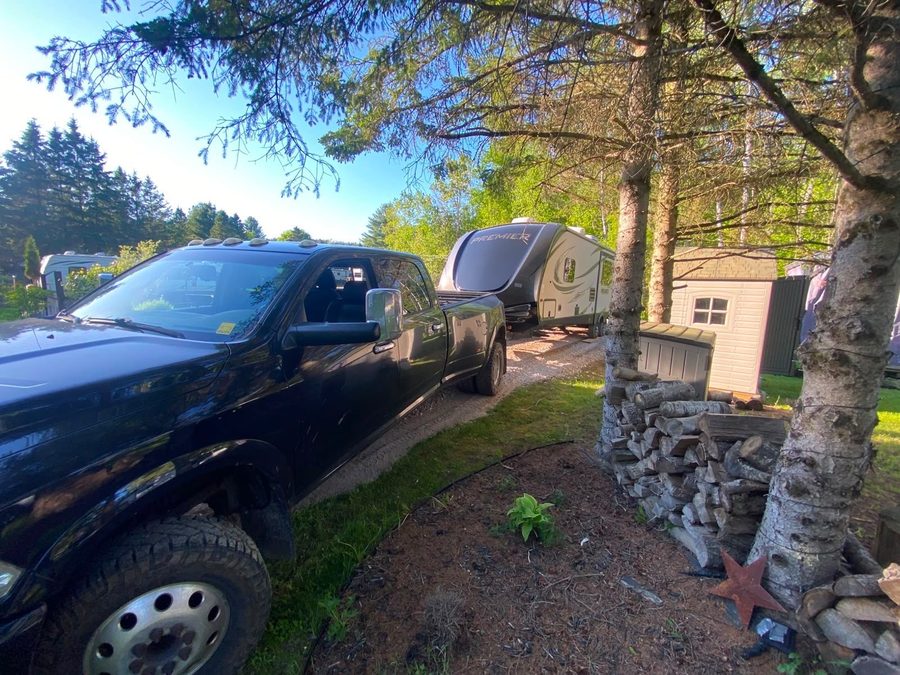
If your unit is on a seasonal site in a park, there is a third party in the conversation. Most parks have rules about who is allowed to work on site and when, and a good number want proof of insurance before a truck comes through the gate. We carry $2 million in liability, $150,000 in cargo coverage and $150,000 in non-owned trailer coverage under Ontario CVOR 204-617-206, and we send the certificate when a park asks. That is a normal request and it costs nothing.
What can cost something is the park's calendar. Some parks restrict movement during peak weekends, some require an office escort, and some have one gate that is genuinely the only way in. Ask your park office two questions before you book us: is there a restricted period, and is there a route in that takes a truck and a long trailer. If the answers are awkward, better to know in March than on the day.
How to describe your site so the quote is right the first time
- Surface. Gravel, asphalt, grass, or fill that went in this year. Say which. Fresh fill is the one that changes the answer.
- The entrance. The narrowest point between the road and the unit, measured, not estimated. Gate posts count.
- Overhead. Branches and any wire crossing the route out, including a service drop to the house.
- Turning room. What is on either side of the approach: ditch, hydro pole, septic bed, neighbour's fence.
- What is around the unit. Other trailers, boats, sheds, a deck, skirting, a fire pit ring set in concrete.
- Both ends. All of the above for the destination as well, even if you have never stood on it. A photograph from the park is enough.
Six answers, five minutes, and the number we give you on the phone is the number on the invoice. That is the whole point.
Levelling and blocking, and what the $799 flat rate covers
Levelling and blocking is $799 as a local flat rate, materials supplied, with the plumbing done at the same visit. Flat rate means a price rather than a meter running while somebody works. We re-level existing setups whether we moved them or not, and the work carries a 30 day workmanship guarantee. Full detail is on the levelling and blocking page.
This is quoted separately from a tow because it is a separate job with separate equipment and materials, and because plenty of people need one without the other. A unit that has been sitting on a seasonal site for four years and has started to bind at the door does not need to be moved anywhere. It needs to be set level again on support that carries the load into ground that will hold it.
What the flat rate actually includes
The $799 covers local work with the blocking materials supplied inside the price. It is not a deposit, not a call out fee and not a starting point that grows once somebody is on site. Where the job is bigger than a local flat rate job, we say so and quote it before we start, not after.
Levelling and plumbing get done at the same visit as a matter of course, because doing them on separate trips means paying for the same drive twice. That is a straightforward saving and it is the reason we bundle them by default rather than as an upsell.
The six things that move it off $799
| What changes the price | Why |
|---|---|
| Distance from our base | The $799 flat rate is for local work. Further out is quoted per kilometre or per job, whichever is fairer. |
| Size and weight of the unit | A 24 foot travel trailer and a 40 foot park model need different amounts of support. |
| Condition of the ground | A prepared gravel pad is one job. Soft, sloped or freshly filled ground needs work before anything sits on it. |
| Plumbing and skirting | Usually done at the same visit, quoted with the levelling. Cheaper together than as two trips. |
| Access | Room to work matters. A site we can get gear into is faster than one we cannot. |
| Whether we are already there | Adding levelling to a move we are already doing is the cheapest way to get it done. |
That last row is the one worth acting on. If a unit is being moved and it needs setting up at the far end anyway, having one crew do both is materially cheaper than booking a tow now and a levelling visit in three weeks. The drive is already paid for.
What out of level actually costs, which is why this is not optional
Almost nobody phones because they want their trailer levelled. They phone because a door will not latch, a slide has started to bind, a window is out of square or something in the plumbing has stopped draining the way it should. Those are all the same problem wearing different clothes. A unit that is out of level is a frame being asked to carry its load through the wrong points, and the fixtures bolted to that frame are the ones that complain first.
Priced against a door that has racked its frame, or a slide mechanism that has been fighting gravity for two seasons, $799 stops looking like a cost and starts looking like the cheap option. That is not a sales line. It is the reason spring is our busiest season for this work: people open the unit after five months and find that something moved.
The guarantee, and its edges
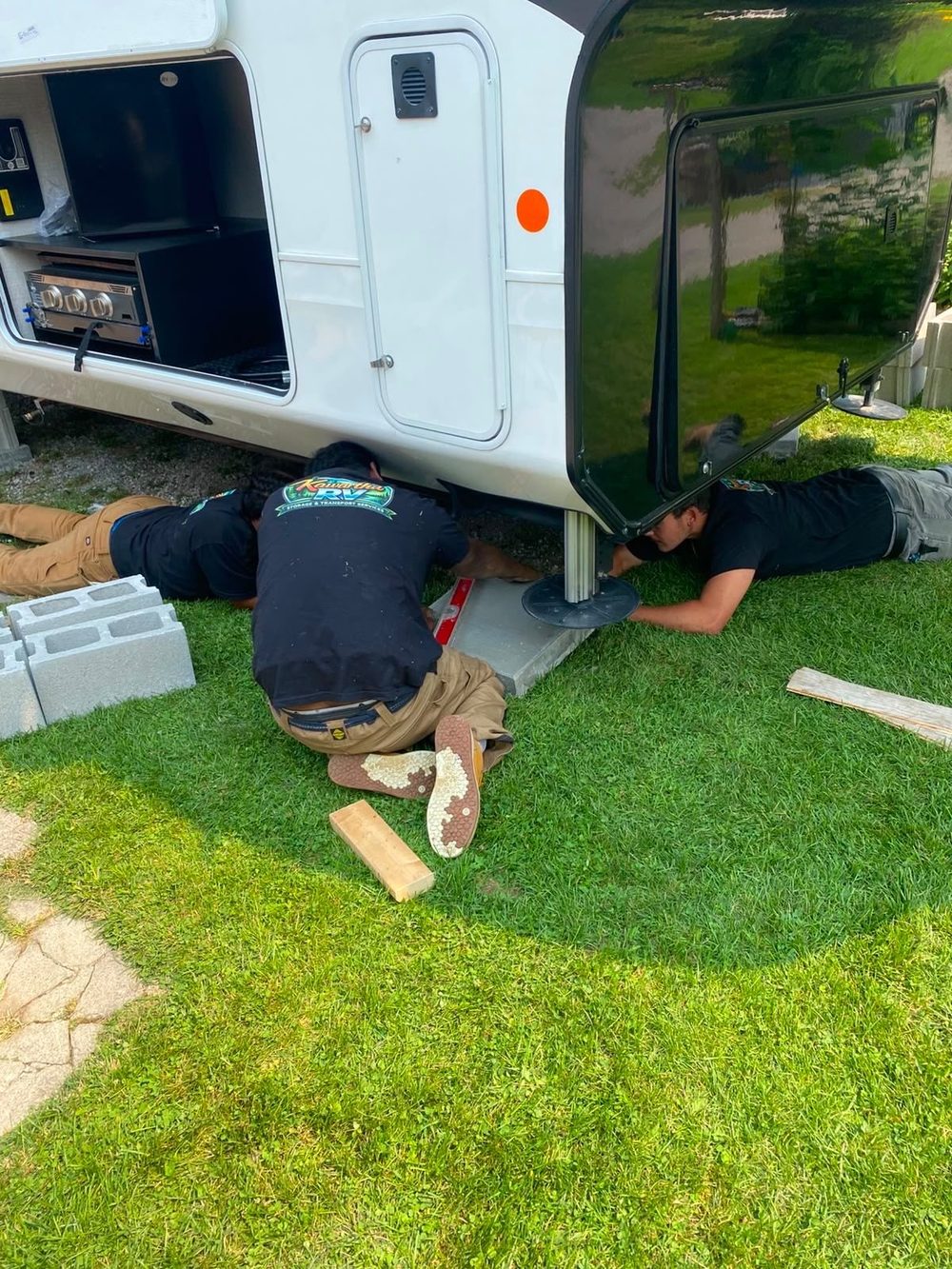
If a unit we set up shifts or moves because of our workmanship, we come back and redo the job at no charge. Weather and ground conditions are outside that, and we say so up front. We would rather print that boundary than write the word guaranteed and leave you to find the edge of it later. If a unit we set up shifts because of how we set it up, we come back. If the ground under it goes soft after a wet spring, that is ground, not workmanship, and we will tell you so honestly and quote the fix.
Storage pricing, and what $85 to $125 a month buys
Outdoor winter storage is $85 to $125 a month, set by the size of the unit, on a fenced property in Beaverton. The unit is blocked and levelled on arrival, which is included rather than extra. There is no deposit. Towing in and towing back out in spring are quoted separately, and a local tow starts around $400 within 45 km. Full detail is on the storage page.
That is the entire pricing structure. There is no administration fee, no seasonal minimum buried in a term sheet and no charge for setting the unit down properly instead of parking it. If you tell us the length and the type, we will tell you your number before you commit to anything.
What sets your rate inside the range
Size, and nothing else. A small travel trailer sits at the bottom of the range and a large fifth wheel or park model sits at the top, because a bigger unit occupies more of a finite property and takes more time to place. There is no premium for the make, the age or the condition of the unit.
| What you are paying for | What it means |
|---|---|
| Monthly rate | $85 to $125, set by the size of the unit, quoted before you book |
| The property | Fenced, outdoor, in Beaverton. Not indoor and not heated, and we say so plainly. |
| Setting the unit | Blocked and levelled on arrival. Included, not extra. |
| Tow in | Quoted separately. Local tows start around $400 within 45 km. |
| Tow out | A separate booking in spring. Tell us the date when you book the storage. |
| Deposit | None. Cash, credit card, debit or e-transfer. |
The five month arithmetic
Storage is the one number on this page that is easy to work out in advance, so work it out. A typical Ontario storage season runs roughly five months, from the end of the season in October to a spring collection. At the bottom of the range that is a little over $400 for the season. At the top it is a little over $600. Add a tow in and a tow out and you have the whole cost of the winter in front of you before you agree to any of it.
Compare that against what you are protecting. A unit that sits on a soft, unlevel spot through five months of Ontario freeze and thaw is a unit that will need something fixed in spring. The reason the setting is included in our rate rather than sold as an add on is that a stored unit which was set down properly is the one that does not generate a phone call in April.
What outdoor storage is, and what it is not
It is an outdoor, fenced, seasonal spot. It is not an indoor building, it is not heated, and it will not do the work that preparing the unit does. Nothing about parking a unit on a good lot substitutes for draining the water system, dealing with the batteries and sealing the places where water and animals get in. That is why the storage conversation and the winter storage checklist are two different things, and why we point people at the checklist whether they store with us or not.
On insurance: our coverage is our coverage. It protects the unit while it is in our care in the sense that a commercial carrier's coverage does, and that is a real thing rather than a slogan. It is not a substitute for your own policy, and the question of whether your policy covers a unit stored away from your own property is one for your broker, as covered in the insurance section above.
Season, and the weeks that cost the most
Spring and fall are the two peaks, and spring is the harder of the two, because the demand spike lands on top of reduced load restrictions that close roads to heavy vehicles across most of our service area from somewhere in February through to as late as mid May. The single cheapest thing you can do to a transport quote is book outside those windows. The second cheapest is to be flexible on the date inside them.
Season affects price in three separate ways and it helps to keep them apart. There is demand, which compresses the calendar. There is the road authority, which can make a route legally unavailable regardless of what anybody is willing to pay. And there is ground condition, which decides whether a site is workable at all. Only the first of those is really about money. The other two are about whether the job can happen.
The two peaks
Spring runs from the moment restrictions lift until roughly the end of June. Everybody with a seasonal site wants their unit delivered and set up for the same long weekend, and everybody who stored a unit wants it back at the same time. Fall runs from about Thanksgiving to freeze up, when the same units come off sites and go into storage. Between the two, July through September is quieter, and the middle of winter is quieter still.
What that means in practice is not a surcharge. It means the good dates go first, and the flexibility that lets us route two jobs efficiently disappears. A move we can slot into an existing run costs less than a move that requires a dedicated trip, and in peak weeks there are fewer existing runs to slot into. Book early and you are choosing from a full calendar. Book in the third week of May and you are taking what is left.
Reduced load season, which is not a price but a closed door
From late winter into spring, road authorities across Ontario restrict the weight that may be carried per axle on their roads while the frost comes out of the ground. It is a legal restriction, not a fee, and it cannot be paid around. The relevant point for a cost page is blunt: during those weeks some routes are simply not available to a loaded transport rig, which is why the calendar rather than the price list decides what is possible.
The dates are set municipality by municipality and they are not the same. Here is what the authorities across our service area published, each figure linked to the area page where we set it out in full with the by-law behind it.
| Authority | Published window | Axle limit | Area page |
|---|---|---|---|
| Township of Scugog | The first day of February to the 31st day of May inclusive, in each and every year, where authorized signs are displayed | See area page | Port Perry and Scugog |
| City of Belleville | Published policy window February 15 to April 30. The City's own news post of April 14, 2026 said trucks had been restricted since January and the by-law would lift Friday, April 17 | Not printed in the news post | Belleville and Quinte West |
| City of Quinte West | 2026: in effect February 17, 2026, lifted May 4, 2026 | 5,000 kg, 5 tonnes per axle | Belleville and Quinte West |
| Township of Stirling-Rawdon | 2026: in effect as of February 23, 2026 | 5,000 kg, 5 tonnes per axle | Belleville and Quinte West |
| Township of Hamilton | Approximately mid February, the earliest published start in Northumberland County | Half loads at 5 tonnes per axle | Cobourg and Port Hope |
| Municipality of Port Hope | March 1, 2026 until late April | 5 tonnes per axle on rural roads | Cobourg and Port Hope |
| City of Peterborough | March 1 to April 30 in 2026, on designated streets | The City does not publish a per axle figure | Peterborough |
| City of Barrie | March 1 to April 30, on a published list of ten named roads | 5,000 kg per axle | Barrie |
| County of Simcoe | March 1 to April 30, restriction system wide with a schedule of exempt segments | Where axle weight exceeds 5,000 kg | Barrie |
| Town of Collingwood | March 1st to April 30th unless otherwise advised through notification, By-law 2023-022 | 5,000 kg per axle | Collingwood and Wasaga Beach |
| Township of Tay | March 1 to April 30, extension into May possible at the Township's discretion, By-law 2014-27 | 5,000 kg per axle | Collingwood and Wasaga Beach |
| Town of Bracebridge | 2026: March 9 at 12:01 a.m. to May 31 at 11:59 p.m. as published, ended early at May 15 by an update dated May 6, 2026 | 5 tonnes per axle | Muskoka |
| Town of Gravenhurst | 2026: Monday, March 9, 2026 to Saturday, May 16, 2026 | 5 tonnes per axle | Muskoka |
| District Municipality of Muskoka | Not published in advance. Generally March to May, exact dates set annually on road conditions and temperatures | 5 tonnes per axle | Muskoka |
| Town of Georgina | March 1 to May 15 on Town owned roads | Five tonnes per axle | Georgina and Sutton |
| Township of Georgian Bay | End date published as May 15, 2026. No start date published | 5 tonnes per axle | Collingwood and Wasaga Beach |
| Region of Durham | On regional roads | 5,000 kilograms, or five tonnes, per axle | Oshawa and Durham Region |
| Town of Wasaga Beach | Publishes none | None published | Collingwood and Wasaga Beach |
| Municipality of Cramahe | No half load rule published | None published | Cobourg and Port Hope |
| Tweed and Madoc Township | No half load rule published on their roads pages | None published | Belleville and Quinte West |
What that table is actually telling you
Three things, and each one has a cost attached.
First, the weight is close to uniform and the calendar is not. Five tonnes per axle is the common standard almost everywhere. What varies, and varies enormously, is the window. Scugog publishes February 1 to May 31, four months. Peterborough and Barrie publish March 1 to April 30, two months. That is a difference of eight weeks between two municipalities under two hours apart, and a single move can cross both.
Second, the published date is not always the real date. Belleville's policy window says February 15 and its own news post says trucks had been restricted since January. Bracebridge published an end of May 31 and then moved it to May 15. Collingwood attaches the phrase about being otherwise advised through notification to its own dates. A load that is legal on May 1 in a normal year is not automatically legal on May 1 in a cold one. This is why we confirm the specific road with the specific authority before quoting a spring date, rather than reading a calendar.
Third, a silence is not permission. Wasaga Beach, Cramahe, Tweed and Madoc Township publish nothing. That means we could not find a rule, not that no rule exists, and we will not tell you a road is open on the strength of a page that does not mention it.
Winter moves, which are not the disaster people expect
Frozen ground carries load extremely well. In pure engineering terms, February is a better surface than April. The problems in winter are different ones: whether a lane has been plowed to a width that takes a truck and a long trailer, whether a site can be reached at all, and whether the unit has been sitting long enough that something has seized. Those are access questions, and they belong in the access section above.
What winter buys you is a quiet calendar. If your move is genuinely flexible and the access works, the middle of winter is the least contested time of year to book a truck. Full details for your own area are on the service areas page.
The other calendar: permit lead times
If your unit needs a permit, the season interacts with a second clock. A provincial single trip permit has a stated turnaround of 5 business days. An annual or project permit can take up to 15 business days. A superload can take at least 5 business days and up to 6 months. Municipal lead times run from 24 hours in Quinte West to 10 to 15 business days in Oshawa.
Stack that against a restriction window that ends in mid May and a delivery date somebody wants for the Victoria Day weekend, and the arithmetic does itself. If you are moving something oversize into a spring date, the phone call belongs in February, not in April. The detail on provincial fees and timing is in the provincial permit section, and the municipal side is in the municipal permit table.
What is included, what is not, and where the tax goes
Our quote includes the truck, the driver, the fuel, the insurance, the empty leg and placing the unit where you want it. It does not include permits, tire or bearing work, unblocking, levelling at the far end unless you ask for it, tolls we cannot route around, or HST. Every one of those is a question we ask on the phone, which is why the call takes five minutes instead of one. Nothing on this list is designed to be discovered on the invoice.
This is the section that decides whether comparing two quotes is even possible. Two companies can quote the same trailer, the same two addresses and the same date, and be describing different jobs. One is quoting a tow on your own axles with you doing the prep. The other is quoting a deck haul with unblocking at one end and levelling at the other. The second number is bigger and it is also correct. What follows is our line, drawn in public, so you can hold anybody else's quote up against it.
What is inside the number
| Included in our quote | What that means in practice |
|---|---|
| The truck and the driver | Rated equipment, a gooseneck deck rated to 30,000 lb, and somebody who has done this before. |
| Fuel, both directions | Inside the price rather than a separate line. See the fuel section for why we will not print a per litre figure. |
| The empty leg | Every move has a leg with nothing on the deck. It is priced in, which is why a 40 km move is not half the price of an 80 km move. |
| Commercial insurance | $2,000,000 liability, $150,000 cargo, $150,000 non-owned trailer, under Ontario CVOR 204-617-206. Detail in the insurance section. |
| The pre move walk around | We check the tires, lights and hitch before we hook up, and you hear about anything unsafe on the spot rather than afterwards. |
| Placing the unit | Put where you want it, not dropped at the end of the driveway. Positioning is part of the job, not an extra. |
| The quote itself | Free, and there is no deposit to hold the date. |
What is not inside it, and why each one is separate
Everything below is separated for the same reason: it is real work or a real fee that only some jobs need, and rolling it into a headline number would mean charging the people who do not need it.
- Permits. Billed at cost, with no markup, when a route needs them. Provincial fees are in the provincial permit section and municipal ones are in the town by town table. Most consumer RVs need none at all.
- Tire, bearing and axle work. A unit that does not roll can almost always still be moved, but it changes the method. Flat tires, seized bearings and a rotted axle are all normal for us and all cost more than a straight tow.
- Unblocking. If the unit is sitting on cribbing or blocks, getting it down safely is a job on its own. It is quick when the ground is firm and slow when it is not.
- A deck, shed or addition in the way. This is a real service with its own page, deck and shed moving, and it gets quoted as one rather than absorbed into a tow price.
- Levelling and blocking at the far end. Our local flat rate is $799 and it is deliberately separate, because plenty of deliveries need nothing beyond being parked. Full breakdown in the levelling section.
- Tolls we cannot route around. Passed through at cost, and we ask before we use the road. The charges and how they work are in the 407 section.
- Storage. Priced monthly at $85 to $125 by size. The tow in and the tow out are quoted separately from the storage itself, as set out in the storage pricing section.
- HST. Thirteen per cent, added to the invoice as its own line, and covered immediately below.
The oversize hand off, stated plainly
There is one thing we do not do in house, and it belongs in a section about what is included. We do not run oversize permits ourselves. When a job genuinely needs them, we bring in a contractor who specialises in that work and they handle the permits, the routing and the escorts. You still deal with us and we still stand behind the job. That arrangement is published on our own RV and trailer transport page as well, and we would rather you read it here than discover it halfway through a move.
What it means for your budget is straightforward. On an oversize move the government fee is passed through at cost, and the specialist work involved in getting a wide load legally down a specific route is part of what gets quoted for that job. Before you commit to anything, we tell you the likely permit total rather than the transport number alone, because the transport number on its own would be misleading.
HST, which is thirteen per cent and is not ours
Transport is a taxable service in Ontario and the tax goes to the government, not to us. The province states the rate directly: "Currently, the Harmonized Sales Tax is 13% in Ontario. However, Ontario provides a rebate on the 8% provincial portion of the HST (Harmonized Sales Tax) on specific items through a point-of-sale rebate." The same page records when the current system came in: "Effective July 1, 2010, the Harmonized Sales Tax (HST) replaced the 5% federal goods and services tax (GST) and the 8% retail sales tax (RST) on most goods and services in Ontario."
The point of sale rebate list exists, and it is worth knowing that it exists, but RV transport is not on it. Our quotes are before tax unless we say otherwise and the invoice shows the tax on its own line. The Ontario HST page is the reference if you want to read it yourself.
One question worth asking every carrier
Ask whether the number you have been given includes tax. Thirteen per cent is exactly the size of gap that makes one quote look meaningfully cheaper than another when the two are actually identical. It is the single most common reason two honest quotes look different on paper, and one sentence clears it up.
How you pay, and when
There is no deposit. You pay when the job is finished, by cash, credit card, debit or e-transfer. We normally need 24 to 48 hours of notice to book a date, and same day and emergency work is available when we can fit it in. We have never found a good reason to hold somebody's money for three weeks before we have done anything for them, and we are not going to start.
Government permit fees are the one exception to the pay on completion pattern in the sense that they are incurred before the truck moves. They still appear on your invoice at cost, and you still see the amount before we file anything.
How to get an accurate quote, in one phone call
An accurate RV transport quote needs eight things: the length, the width and the height of the unit, both addresses, the condition of the tires and axles, whether the unit is on blocks, what the ground is like at each end, and how flexible your date is. With those, most straightforward local tows can be quoted firmly on the phone. Photographs of the site make the difference between a firm price and an estimate on almost every job that is not a paved pad beside a wide gate.
We would rather spend five minutes on the phone and give you a number that holds than spend one minute and give you a number that moves. Everything below is what we are actually trying to establish while you talk. If you gather it before you call, the call gets shorter and the price gets better, because we no longer have to price the uncertainty.
The eight things to have in front of you
- Length, width and height. Actual measurements, not the model name. Width is the one that decides whether this is a tow or a permitted move, so it matters more than the other two combined.
- Both addresses. Not just the towns. The specific addresses, because the last two kilometres at each end are where the difficulty lives and a map does not show a soft shoulder or a low wire.
- Condition of the tires. Holding air, cracked, flat, or unknown because nobody has looked in four years. Unknown is a perfectly acceptable answer and it is much better than a guess.
- Condition of the axles and bearings. If the unit has sat for several seasons, say so. Seized bearings change the method, not just the price.
- Whether it is on blocks. On blocks, on cribbing, on its own jacks, or sitting on the ground. Each is a different amount of work before it can move.
- The ground at both ends. Gravel, asphalt, packed stone, grass, fresh fill, or something that turns to soup after rain. This is the answer that most often changes a number.
- Date flexibility. A fixed Saturday in the third week of May is a different job from any weekday in a two week window. Flexibility genuinely buys you a better price because it lets the move ride along with a run we are already making.
- What you want at the far end. Parked, or parked and levelled and blocked. Two different numbers, and it is easier to answer that question now than on the day.
How to measure the width, since it decides everything else
Measure the widest point of the body, not the roof overhang, and tell us the number. That is the sentence we repeat most often on the phone and it is the one most likely to save you money. Ontario's legal maximum for a vehicle including load is 2.6 metres, and almost every consumer travel trailer and fifth wheel is built to sit under it deliberately. Park models are the ones that go either way: plenty are built narrow enough to tow like a long trailer and plenty are not.
If your tape says something between 2.5 and 2.7 metres, measure again, at the widest point, with the tape square to the unit rather than at an angle. The difference between 2.59 and 2.61 is the difference between a normal tow and a permitted move with flags, signs and a filing lead time. The full explanation of that line is in the size section above, and the prep side of it is on the RV transport prep guide.
The photographs that actually help
Four photographs answer more questions than fifteen minutes of description. Stand at the road and shoot down the approach so we can see the entrance, the gate and anything overhead. Stand at the unit and shoot back toward the road so we can see the line it has to travel. Take one of the ground immediately around the unit, particularly if it has rained. And take one of the tires and the hitch or pin, close enough that the condition is visible.
Photographs are also the reason a quote can be firm rather than approximate. We can price what we can see. We cannot price what we are being told about over the phone by somebody who is not looking for the same things we would look for, which is no criticism of anybody, because it is not their job to know that a guy wire at trailer height is a problem.
What happens after you send it
We work through the seven factors in the section near the top of this page and give you a price, per kilometre or per job, whichever is fairer for that trip, with anything extra spelled out up front. If the job needs a permit we quote the transport firmly and the permit at cost, and we tell you the likely permit total before you commit. Then we book the date, with no deposit.
On the day, we walk the unit, check the tires, lights and hitch, hook up and go. At the other end the unit gets placed where you want it rather than left at the end of the driveway. If you have asked for levelling and blocking, that happens on the same visit, which is the whole reason it is a flat rate.
What to ask us, and what to ask anybody else
- Is fuel inside this number or added later? There is only one right answer and it should be given without hesitation.
- Does this include HST? Thirteen per cent is too big a gap to leave ambiguous.
- What is your insurance and can I see the certificate? Covered in full in the insurance section. A carrier who cannot produce one has answered the question.
- Is this a tow on its own axles or a deck haul? They are different jobs with different prices and different risks.
- What would make this number go up on the day? An honest carrier has a short, specific list. A carrier who says nothing could possibly change it has either not asked enough questions or is not planning to hold the number.
Call (647) 961-9257 or use the contact page, and send the photographs with it. We are on the road Monday to Saturday, 7:00am to 7:00pm. Sunday closed, by appointment only.
How to read a quote that looks too cheap
A quote that is half of everybody else's is almost never an efficiency. It is usually a different job, a missing fee, or a missing insurance policy. Five questions separate a genuinely competitive price from an incomplete one: is it a tow or a deck haul, does it include permits, does it include tax, what is the insurance, and what would change the number on the day. A carrier with real answers to all five is worth hiring even if they are not the cheapest.
We are not going to tell you that the cheapest quote is always wrong. Sometimes it is a company with a truck already going that way, and that is exactly the sort of efficiency we look for ourselves. What we can do is show you where the difference actually comes from, so you can tell the two apart in about ninety seconds.
The arithmetic that a very low number has to survive
Start from the fixed costs, because they are the same for everyone and they are all published earlier on this page. A legitimate Ontario carrier is carrying a CVOR certificate at $287.00 with its own renewal cycle, commercial liability insurance at $2,000,000, cargo coverage at $150,000, non-owned trailer coverage at $150,000, a truck rated for the load and a deck rated for the weight. Then add fuel, which nobody can avoid, and the empty leg, which is real distance on real diesel.
Those costs exist before the truck has moved a metre and they are inside the price of the first job of the day. A number that undercuts every other carrier in the region by half has to be explained by something, and the honest explanations are short: the truck was already going that way, or the job is smaller than you think it is. The less honest explanations are that a line item has been removed. The whole breakdown of what it costs to run legally is in the carrier cost section.
The five questions
- Is this a tow on the unit's own axles, or a haul on a deck? These are genuinely different jobs. A tow is cheaper and it requires that the tires, bearings and axles are in condition to travel at highway speed. If your unit has sat for four seasons and somebody has quoted a tow without asking about the tires, they have quoted the cheap version of a job you may not be able to buy.
- Does this include permits? If your unit is over 2.6 metres wide, the answer has to be yes or the number is incomplete. Provincial fees start at $66.25 for a single trip oversize permit and municipal fees stack on top, town by town. A carrier who has not asked your width cannot have accounted for either.
- Does this include HST? Thirteen per cent, and it is the most common reason two identical quotes look different.
- What insurance do you carry, and can I see the certificate? Ask for liability, cargo and non-owned trailer coverage as three separate numbers, because they cover three different things. A carrier who gives you one number, or who says fully insured and stops there, has not answered. The full explanation of the difference is in the insurance section.
- What would make this number go up on the day? The right answer is a short specific list: soft ground, a unit that will not roll, something in the way. An answer of nothing at all means either the questions were not asked or the number was never going to hold.
The three patterns we see most often
The first is the quote that becomes a different job on arrival. Somebody quotes a straight tow over the phone in four minutes, arrives, finds the unit on blocks with two flat tires, and the price changes on the driveway when you have no alternative. This is not always dishonest. Often nobody asked the right questions. The effect on your wallet is the same either way, and it is why we ask about tires and blocks before quoting.
The second is the number without permits. A park model that measures 3.2 metres wide is an oversize move whether or not the quote mentions it. The permit is not optional and neither are the flags and the oversize sign. A quote that does not include them is either going to grow or the move is going to happen without them, and the second option is worse for you than the first.
The third is the number without tax, compared against a number with tax. Nobody is doing anything wrong and the comparison is still meaningless. One question fixes it permanently.
When a cheap quote is genuinely a good deal
There are real ones. A carrier deadheading home from a delivery in your direction can price your move against fuel and time rather than against a full return trip, and that is a legitimately cheaper job for a legitimately good reason. Ask directly: are you already going this way. If the answer is yes, the low number makes sense, and you should take it.
The same applies to timing. A move booked into a quiet week in November is not competing with forty other people who all want the same Saturday in May. Flexibility is the cheapest thing you can bring to a transport quote and it costs you nothing but patience. That, and having the unit road ready before anybody arrives, are the two things that reliably lower a price without lowering the standard of the work. The prep side of that is set out step by step in the RV transport prep guide.
Doing it yourself: the arithmetic nobody does
Towing your own trailer is legal on a standard Ontario G licence up to a gross vehicle weight of 4,600 kilograms, and it is cheaper than hiring a carrier only if you already own the truck, the hitch and the brake controller. Once you add a trailer registration at $72, a brake controller for any trailer at 1,360 kilograms or more, fuel for both legs, tolls, and the value of a Saturday, the gap narrows fast. For a short local move with a road ready trailer and a tow vehicle you already own, doing it yourself usually wins. For anything else, it usually does not.
We would rather tell you this honestly than pretend every move needs a truck with our name on it. Plenty of our customers tow their own trailer most of the time and call us for the one move a year that will not fit behind their own pickup. What follows is the arithmetic, with the legal requirements attached, so you can work out which category your move is in.
What the law actually requires of you
Ontario's Official Driver's Handbook sets out the towing rules and four of them decide whether this is even an option. A standard Class G1, G2 or G licence covers towing a trailer with a gross vehicle weight up to 4,600 kilograms. A trailer at a gross trailer weight, vehicle and load of 1,360 kilograms or more must have brakes strong enough to stop and hold it, which is a lower threshold than most owners assume and which catches a great many mid size travel trailers. About five to 10 per cent of the trailer's total weight should sit on the hitch, within the weight limit marked on the hitch itself. And where safety chains are used, the handbook requires them crossed under the tongue, so that a hitch that lets go does not put the tongue into the pavement.
There is a fifth requirement that starts at a width of 2.05 metres, which is a clearance lighting threshold and not a legal width limit. Those two numbers get confused constantly and confusing them costs money in both directions. The exact wording of all of these, reproduced from the handbook, is in the plates and paperwork section of our prep guide, and the source itself is the towing chapter of the Official MTO Driver's Handbook.
One line from that chapter is worth repeating on a cost page because ignoring it is how people end up buying tires: "Check your tire pressure with the trailer loaded while the tires are still cold." A trailer tire that has been run underinflated at highway speed does not always announce itself before it fails.
The costs that belong in your own column
| Your cost | What we can tell you about it |
|---|---|
| Trailer registration | $72 for the plate, permit and validation sticker, and Ontario states you only have to register a trailer once. Detail in the carrier section. |
| A hitch rated for the load | Prices vary by type and by vehicle and we do not sell them, so we are not going to print a figure we cannot stand behind. |
| A brake controller | Required in practice for any trailer at or above the 1,360 kg brake threshold. Again, a parts and installation cost we are not in a position to quote. |
| Fuel, both legs | The dominant variable cost, and the reason we will not print a fuel figure that is stale in a week. Get today's number from the province. |
| Tolls | Real if your route crosses the 407, and the flat trip charge applies on top of the per kilometre rate. See the toll section. |
| Your own insurance position | Whether your policy covers towing somebody else's unit, or your own unit away from your property, is a question for your broker. Covered in the insurance section. |
| A day | The one people leave out. A 200 km move is most of a Saturday once you count loading, the drive both ways, and the setup at the other end. |
Where doing it yourself clearly wins
A road ready trailer, inside your tow rating, moving a short distance, with a truck and hitch you already own and a site at each end you can drive straight into. That is a job you should do yourself and we will tell you so on the phone. We are not short of work and we would rather be the people who told you the truth than the people who took $400 for something you could have done in an hour.
Where it clearly does not
A unit that does not roll, a unit that is over 2.6 metres wide, a unit on blocks or cribbing, a site with soft ground or a tight turn, or anything where the tow rating question has an uncomfortable answer. Those are the jobs where the do it yourself version quietly turns into a tow truck call, a set of new tires, a damaged frame or a conversation with an insurer. The difference between our price and the cost of one of those going wrong is not close.
There is also the middle category, which is more common than either extreme: the unit is fine and the route is fine, but the last hundred metres are not. That is exactly the work described on the RV and trailer transport page, and it is worth a phone call before it is worth a weekend.
Sources, and what we could not verify
Every government figure on this page was read directly from the issuing body's own web page on 28 July 2026, and every municipal figure was verified during the build of the area page it links to. Where a source would not load, or would not state a number, this page prints no number and says so instead. There are nine of those refusals and they are listed below by name.
Almost no RV transport pricing page tells you where its numbers came from. That is not an oversight. A page that names its sources can be checked, and a page that can be checked has to be right. We would rather be checkable, so this section lists every page this guide was built from, what each one was used for, and the specific things we went looking for and could not find.
One rule runs through the whole page and it is worth stating before the table. Where text appears between quotation marks, those are the source's exact words as published, including any typographical errors, which are marked. Where a rule is described without quotation marks, that is our summary of it, and if the detail matters to your move you should read the original. We have linked all of them.
The twelve pages this guide was built from
These are the sources behind the figures above, in the order the page uses them. Every one of them is a government page or the operator's own rate chart. None of the numbers on this page came from another transport company's website, from a directory, or from an aggregator.
| Source | What it was used for on this page |
|---|---|
| Ontario, Guide to Oversize/Overweight Vehicles and Loads | The legal maximum width, height and length without a permit, the warning flag and oversize sign requirements, and the escort thresholds by width, length and height. |
| Ontario, Get an oversize/overweight permit | Every provincial permit fee quoted on this page, the weight, width, length and height each permit type covers, the published processing times, and the application methods. |
| Ontario, Get a CVOR certificate | The $287.00 certificate fee and its $255 plus $32 breakdown, the renewal cycle, the knowledge test and its fee, and the absence of any stated weight threshold. |
| ServiceOntario, Register a trailer | The $72 cost of a trailer plate, permit and validation sticker, and the fact that a trailer is registered once rather than annually. |
| Ontario, Harmonized Sales Tax | The 13 per cent rate and the July 1, 2010 replacement of the federal GST and the provincial retail sales tax. |
| Official MTO Driver's Handbook, towing chapter | The licence class and trailer brake thresholds, the hitch weight percentage and the safety chain rule, all described in our own words here because they are quoted in full on our transport prep guide, plus the cold tire pressure instruction quoted in the do it yourself section. |
| Canada Revenue Agency, Fuel charge rates | The March 15, 2025 regulations that set all federal fuel charge rates to zero, and the previous published rate used to give that change a scale. |
| Ontario, Motor fuel prices | The weekly publication schedule, the third party collection, and the regional breakdown. No price. See below. |
| 407 ETR, heavy multiple unit rate chart | The flat charges for the class a truck towing a trailer generally falls into, and the westbound weekday per kilometre range. |
| 407 ETR, heavy single unit rate chart | The published definition of a heavy vehicle at over 5,000 kg, and that class's flat charges. |
| 407 ETR, light vehicle rate chart | The published light vehicle definition and its flat charges, for the comparison that shows what class actually costs you. |
| Ontario e-Laws, Highway Traffic Act | The section numbers cited on this page. Nothing is quoted from it. Read the next heading for why. |
Why no Ontario statute or regulation is quoted anywhere on this page
This is a real limitation and we would rather explain it than hide it. Ontario publishes its consolidated law on e-Laws. On 28 July 2026, every route we are permitted to use returned the same thing from that site: a page telling us that e-Laws needs JavaScript to function properly, with no statute text behind it. CanLII, which is the usual second route to Canadian legislation, disallows automated access in its robots file, and we do not go around that. Archives, caches and mirrors are off limits to us as well.
So we made a rule and we have held to it. No sentence of Ontario legislation appears on this page in quotation marks. Where the law is relevant we cite the section number, describe the effect in our own words, and link to e-Laws so you can open it in a browser, which works perfectly well, and read the actual text yourself. The Highway Traffic Act dimension table in the section on width and the permit provisions in the provincial permit section are both handled that way.
There is a second consequence worth naming. The province charges its oversize and overweight fees under a regulation, but the friendly labels everyone uses for those permits, annual, project, single trip, enhanced, are the labels on the Ministry's web page rather than headings in the regulation. Since we could read the web page and not the regulation, every provincial fee on this page is attributed to the web page it was read on. If the regulation and the web page ever disagree, the regulation wins, and we would not know. That is exactly the kind of thing a page like this should tell you.
Municipal fees were verified once, in context, on the page that carries them
The municipal permit table and the reduced load table on this page are not fresh research. Every figure in them was verified from the municipality's own by-law, fee schedule or permit page during the build of the area page it also appears on, with the caveats and the contact details attached there. That is why each row carries a link. It is not decoration and it is not internal linking for its own sake. It is the audit trail.
If a number matters to your move, follow its link. The Peterborough, Oshawa and Durham, Kawartha Lakes, Port Perry and Scugog, Barrie, Collingwood and Wasaga Beach, Muskoka, Cobourg and Port Hope, Georgina and Sutton and Belleville and Quinte West pages each set out the by-law number, the lead time, the insurance condition and the office to call. A fee stripped of those things is half a fact.
The fuel price, and the date we failed to get it
This is the line we promised in the fuel section, with the date attached. On 28 July 2026 we could not retrieve a current Ontario average fuel price through any route available to us. The Ministry's own page returned an error where its table should have rendered, the open data catalogue entry carried no current file, and the underlying data we did reach returned only records from 1996. This page therefore publishes no fuel price of any kind. It is the single largest variable cost in transport and we do not have a verified current number for it. If you need this week's figure it is published every Monday on the Ministry page linked above.
Nine things we could not verify, listed plainly
These are the gaps. Every one of them is somewhere another page would have quietly filled with an estimate.
- A current Ontario fuel price. Three routes tried on 28 July 2026, all three failed. No price published anywhere on this page.
- Any Ontario schedule of private escort rates. We found none and we are not aware of one existing. Escort cost is quoted by the escort operator for your route and your dates, and we will not print a rate we cannot source.
- A weight threshold for when a CVOR certificate is required. The Ministry page describes vehicle types, not kilograms. We do not supply a kilogram figure it does not contain.
- The Town of Gravenhurst oversize permit fee. No amount is published. Our Muskoka page gives the Public Works number so you can ask directly.
- The Region of Durham oversize permit fee. The Region's application page states the process, the ten business day lead time and a minimum deposit, but no fee amount.
- A Municipality of Port Hope oversize or overweight permit. None is published at all. What Port Hope does publish is a road occupancy permit at $206.00, which is a different thing and is listed as such on our Cobourg and Port Hope page.
- Any Town of Cobourg road permit fee. Nothing road related was published on the pages we could read.
- How HST is treated on Barrie's permit fees. The City's fee schedule states the amounts and does not say whether they include or exclude tax. We are not going to guess about somebody else's tax treatment, and our Barrie page says the same thing.
- County of Simcoe permit fees, dimension limits, insurance requirements and contact details. The County's permits and fees page would not load for us, in either the bare or the www form of its address, and returned a message stating that JavaScript is required. We publish no County of Simcoe permit figure anywhere on this site. The County reduced load restriction that does appear in the seasonal table came from a separate County document that did load, and is limited to what that document says.
Four typos we left alone, and one correction we made
When we quote a government page we quote it as published. That includes its mistakes, because a quotation that has been quietly tidied is no longer a quotation, and because if you go looking for the passage you will find it spelled the way the government spelled it, not the way we would have preferred.
Four of those appear on this page. The Ministry's oversize page prints a length as "45.75 meters" in one row and "metres" everywhere else. Its own Guide prints a heading as "Certifed Superload Escorts". The CVOR page describes "a buses" and states "There is $5.00 fee" for the knowledge test. Each is marked where it appears. None is corrected.
There is also one correction we have made in the other direction, on a different page, and it is worth repeating here because it is exactly the failure mode this whole section exists to prevent. While building our Collingwood and Wasaga Beach page we held a pair of figures, a minor rate and a major rate, filed under Collingwood. On checking the source they belonged to the County of Simcoe, not to the Town. They were never published under the wrong name, and the Town's actual road occupancy fee is the one that appears. Reading across neighbouring authorities is how wrong numbers get onto websites and then get copied, and the only defence is to check every figure against the body that issued it.
What would make us change this page
Prices move. Permit fees are set by by-law and revised on municipal schedules that do not line up with each other. Provincial fees change. The 407 publishes new rate charts every January. Our own prices are what they are today and we will say so plainly if they change rather than quietly editing a number and hoping nobody noticed.
If you find something on this page that is out of date, wrong, or contradicted by the source it cites, tell us and we will fix it. Call (647) 961-9257 or use the contact page. We would far rather be corrected by a customer than be confidently inaccurate in front of the next thousand of them.
Where we do this
We are based in Beaverton and we quote, load and move units right across central and eastern Ontario. Every town below links to the page for that area, and those pages are where the municipal permit fees quoted earlier on this page were verified one at a time, in context, against the by-law or fee schedule that sets them.
If your town is not on that list, ask anyway. The service areas page has the full picture and the answer is usually yes. Pricing does not change because of which page your town appears on. It changes because of distance, size, access and the seven factors near the top of this guide. We are on the road Monday to Saturday, 7:00am to 7:00pm. Sunday closed, by appointment only.