
Kawartha RV Transport & Services moves RVs, park models, mobile homes, decks and sheds throughout the Georgian Bay shore, including the Town of Collingwood, the Town of Wasaga Beach, the Town of Midland, the Township of Georgian Bay, Stayner, Creemore, Thornbury, Penetanguishene, Victoria Harbour, Port McNicoll, Honey Harbour, Port Severn and MacTier. We are a family run outfit based in Beaverton, Ontario, at the east end of Lake Simcoe, which puts Wasaga Beach and Midland a little over an hour west and Collingwood a little further along the bay. Local tows start at $400, we tow up to 30,000 lb on a 30 foot gooseneck, we carry Ontario CVOR 204-617-206, and there is no deposit to book a date.
The Georgian Bay area we cover
This page covers the southern and eastern shore of Georgian Bay, from the ski hills west of Collingwood around through Wasaga Beach and the Nottawasaga flats, up into Midland and Penetanguishene on Severn Sound, and out to the granite and water country of Georgian Bay Township at Honey Harbour, Port Severn, MacTier and Go Home Lake. It is one drive for us and one quote for you. Administratively it is nothing of the sort.
We work here regularly because the RV population is dense and seasonal. Wasaga Beach and the Nottawasaga shore hold a large concentration of seasonal sites and park models. Collingwood and the Blue Mountains hold a different kind of customer again, often a fifth wheel or a large travel trailer that lives at a resort site for the season and gets moved twice a year. Midland, Penetanguishene and the Severn Sound towns sit on the water and on working roads that carry commercial traffic year round. Georgian Bay Township is rock, water, and a road network that behaves like Muskoka because it partly is Muskoka.
The practical work is the same everywhere: get the unit onto the truck, get it there legally, and set it down level on ground that will hold it. The paperwork is where this area stops being simple, and the rest of this page is mostly about that, because it is the part that decides whether a spring move happens on the date you wanted.
Eight authorities, one trip
Muskoka has three road authorities and we thought that was the complicated end of our service area. This corner has eight bodies that can each have something to say about a single move: the Town of Collingwood, the Town of Wasaga Beach, the Town of Midland, the Town of Penetanguishene, the Township of Tay, the Township of Georgian Bay, the County of Simcoe, and the Ontario Ministry of Transportation.
They do not coordinate. They publish on different pages, in different formats, with different thresholds, on different schedules, and in at least one case two pages belonging to the same town disagree with each other. Some of them publish thoroughly and precisely. Some of them publish nothing at all on the subject. We have gone through what each one actually publishes, verified it against the source document rather than against a summary of it, and written it out below, including the places where the answer is that there is no published answer.
The single most useful thing on this page is probably the sentence Midland puts on its own permit form, which we come to further down. It is the only place in our service area where a municipality states in writing that you need another authority's permit number before it will accept your application. Once you have read that, the eight authority problem stops being an abstraction.
Collingwood runs its own reduced load period
The Town of Collingwood publishes its reduced load restriction on its roads and active transportation page. The period runs from March 1st to April 30th unless otherwise advised through notification, and during that period commercial vehicles are not to exceed a weight of 5,000 kilograms per axle. The authority is Town of Collingwood By-law 2023-022.
Five thousand kilograms per axle is the same figure the County of Simcoe uses, the same figure Georgian Bay Township uses, and the same figure Tay Township uses. That consistency is genuinely helpful, and it is the one thing about spring in this area that is simple. What is not consistent is when the number applies, which document says so, and what happens at the end of April.
Whether a specific load is affected is a question of axle weight, not total weight, and that distinction is what confuses people. A heavy load spread across enough axles can be compliant. A lighter load concentrated on two can be over. On a park model or mobile home move the axle configuration matters more in March and April than the total scale ticket does.
The Town of Collingwood roads and active transportation page carries the restriction, the tonnage and the by-law number together in one place, which is more than most of the municipalities on this page manage.
By-law 2023-022 and the five words that decide the end date
The clause worth reading twice is the tail of the date sentence: unless otherwise advised through notification. April 30 is the published end of the restriction. It is not a guarantee.
This is the same structure Bracebridge uses in Muskoka, where the road operations page says a limit is in effect until May 31st or a date determined by staff. Municipalities write it that way because frost does not read by-laws. In a cold spring the subgrade is still soft after the printed end date, and the town keeps the restriction on to protect the road. In a warm spring they can lift it early. Either way the calendar on the website is a plan, not a promise.
What that means for booking is straightforward. If your move needs to happen in the last week of April or the first week of May and the load is heavy on an axle, we treat the date as provisional until the Town confirms. We would rather tell you that in February than call you on the morning of the move. In practice most travel trailer and fifth wheel tows are not affected at all, because they do not put 5,000 kilograms on an axle. Park models, mobile homes and heavily loaded units are the ones where this clause changes plans.
The eighteen Collingwood roads that stay open
Collingwood publishes a Schedule A to By-law 2023-022 listing the roads that are not restricted during the reduced load period. The document is titled as a list of unrestricted roads during the reduced load restriction period. It contains exactly eighteen entries, and here they are as the Town prints them, with the extents that matter:
| # | Road | Extent as published |
|---|---|---|
| 1 | King's Highway No. 26 | All of it |
| 2 | Hurontario Street | First Street to Poplar Sideroad |
| 3 | High Street | First Street to Sixth Street |
| 4 | Stewart Road | All of it |
| 5 | Sixth Line | North cul-de-sac to 500 metres southerly |
| 6 | Sandford Fleming Drive | All of it |
| 7 | Raglan Street | Hume Street to Ron Emo Road |
| 8 | Hume Street | Highway No. 26 to Hurontario Street |
| 9 | Ste. Marie Street | Highway No. 26 at Huron Street to Simcoe Street |
| 10 | Mountain Road | Highway No. 26 at High Street to Tenth Line |
| 11 | Tenth Line | Mountain Road to 600 metres northerly |
| 12 | Tenth Line | Mountain Road to 170 metres southerly |
| 13 | MacDonald Road | All of it |
| 14 | Connell Street | All of it |
| 15 | Pretty River Parkway Extension | Hume Street to Connell Street |
| 16 | RoneII Crescent, as the Town spells it | All of it |
| 17 | South Service Road | Pretty River Parkway extension to MacDonald Road |
| 18 | Ron Emo Road | None printed |
You can read the schedule yourself at the Town of Collingwood's Schedule A document. We are linking it rather than asking you to take our word for the list, because the list is the kind of thing that gets updated and we would rather you check the live one before a move.
Being on the list is not a permit
Every road in that table is exempt from the reduced load restriction only. None of it exempts an oversize or overweight load from needing an oversize permit from the Town, and none of it says anything about what the County of Simcoe or the Ministry of Transportation require on their own roads. Those are separate questions with separate paperwork.
Why the number is eighteen and not nineteen
We are going to be unusually transparent about this one, because it is a good illustration of why we verify.
Our research notes for this page recorded nineteen unrestricted roads in Collingwood. When we went back to the source document to check the list before writing, we counted eighteen. So we fetched the document a second time and asked specifically for every row transcribed, with nothing renumbered, and for the exact number of rows stated. It came back eighteen again.
So the page says eighteen. It does not say approximately eighteen and it does not say nineteen. If the Town adds a road tomorrow the number changes and our page will be out of date until we catch it, which is exactly why the link above goes to the Town's own document rather than to a copy of it. Small numbers like this are where a website quietly goes wrong, and the only defence is checking the source rather than the summary.
Three traps in reading that list
Schedule A is short but it is not simple, and there are three things in it that will catch you out if you skim.
Tenth Line appears twice. Rows 11 and 12 are both Tenth Line, both measured from Mountain Road, one running 600 metres north and the other 170 metres south. That is not a duplicated entry and it is not a typo. It is two separate exempt stretches from the same intersection, and they are different lengths. If you are planning a route on Tenth Line you need to know which of the two you are on, because a few hundred metres past the end of either one you are back on a restricted road.
Row 16 is spelled RoneII Crescent on the schedule. Read closely and it appears to use two capital letter i characters where an l and an l belong, which is almost certainly a rendering artifact for Ronell. We have reproduced the Town's spelling rather than quietly correcting it, because if you go looking for the road on a map you will want to know why the schedule and the map do not match. We hit exactly the same thing in Bracebridge, where the exempt road list prints Tayor Court in one entry and Taylor Court in the entry directly above it. Municipal PDFs are converted documents and conversion introduces errors. When you see one, ask the town rather than assuming the map is wrong.
Ron Emo Road has no extent printed. Row 18 gives the road name with no from and to, while row 7 uses Ron Emo Road as the eastern boundary of the exempt stretch of Raglan Street. Both of those are on the same page of the same document. We are not going to guess whether row 18 means all of Ron Emo Road, so if your route depends on it, that is a question for the Town's public works department at 705-445-1030 or publicworks@collingwood.ca.
The County of Simcoe restriction underneath it
Collingwood's by-law covers Town roads. County roads through and around Collingwood are the County of Simcoe's, and the County sets its own reduced load restriction. The County's published restriction runs from March 1 to April 30 and applies where the weight upon an axle exceeds 5,000 kilograms. The authority is the Simcoe County Consolidated Traffic By-Law #6609, and the document we read is dated April 2023.
The dates and the tonnage happen to match Collingwood's, which makes this one of the easier overlaps in the area to plan around. Do not take that as a general rule. Georgian Bay Township's season ends at a different time entirely, and three of the municipalities on this page publish no restriction at all. The alignment between the Town of Collingwood and the County of Simcoe is a convenience, not a principle.
The County document is at the County of Simcoe reduced load restrictions PDF. We have paraphrased the date range rather than quoting it, because the source prints it with a dash character this site does not use anywhere.
The County page we could not open, and what that means
Here is a gap we are publishing rather than papering over.
The County of Simcoe's permits and fees page, which is where County oversize and overweight permit dimensions, fees, insurance requirements and contact details live, would not load for us. It returns a message stating that Javascript is required and must be enabled before the page can be seen. We tried both the bare and the www form of the address. Our environment does not permit fetching pages by any other method, so there was no second route to the content.
The consequence is specific and we want to state it plainly. This page does not print a single County of Simcoe permit fee, dimension limit, insurance amount or phone number, because we could not verify one. Our research notes contain figures attributed to the County. We are not publishing them, because we could not put eyes on the source. If your route uses County roads, and around Collingwood and Midland it very likely does, the County is a phone call you or we make directly, and we will make it as part of planning your job.
What did fetch cleanly was the County's reduced load PDF, quoted in the section above. That is a separate document on a separate part of the County's site, and everything we have attributed to the County on this page comes from it.
Georgian Bay Township ends its season in May
The Township of Georgian Bay, at the top of this service area around Honey Harbour, Port Severn, MacTier and Go Home Lake, runs a different calendar again. The Township published that its reduced load season, with a maximum of 5 tonnes per axle, ends on May 15, 2026, on all Township and District roads.
Note the wording carefully, because it is doing two jobs. It covers Township roads and District roads in the same sentence, which reflects the fact that Georgian Bay Township sits inside the District Municipality of Muskoka. The District roads named on the Township's page are District Road 5, which is Honey Harbour Road and Port Severn Road, District Road 11 High Street, District Road 12 Twelve Mile Bay Road, District Road 32 Go Home Lake Road, District Road 33 South Gibson Lake Road, District Road 34 White's Falls Road, and District Road 48 South Bay Road. If your move touches any of those, you are on District infrastructure, and our Muskoka RV transport page goes through the District's own rules in more detail than we can here.
The Township maintains approximately 190 kilometres of roads, and it notes that tar and chip paving is used on rural roads with low to medium volumes of traffic as a more cost effective and durable alternative to asphalt paving. Highway 400, which is how most loads reach this part of the world, is maintained by the Ministry of Transportation. The source is the Township of Georgian Bay roads page.
The Georgian Bay start date nobody publishes
The Township publishes an end date and a tonnage. It does not publish a start date, and it does not publish a by-law number. We looked for both.
That is unusual and it matters. Every other authority on this page that restricts loads gives you a start, an end and a by-law. Georgian Bay gives you one of the three. We are not going to fill in the other two by assuming the Township follows the common March 1 pattern, because we do not know that it does, and assuming would be exactly the kind of plausible invention this site is written to avoid.
There is a second thing worth flagging honestly. The date the Township published, May 15, 2026, is already behind us as this page goes up. We are reporting what the Township published, not forecasting a future season. Before a spring move in Georgian Bay Township, the Township office is a phone call, not a website lookup. We make that call as part of planning.
Tay Township attaches a permit fee to its restriction
Tay Township, between Midland and Port Severn, publishes a reduced load restriction with a detail none of its neighbours include. The Township's restriction runs from March 1 to April 30, with the possibility of extension into May at the Township's discretion, and states that no commercial motor vehicle or trailer shall be operated or drawn upon any designated highway where the weight upon an axle exceeds 5,000 kilograms. The authority is By-law 2014-27, made under Section 122 of the Highway Traffic Act.
The unusual part is that the same page publishes a yearly permit fee of $300 a year. Tay is the only municipality in this group that puts a reduced load period and an annual permit fee on the same page, which at least tells you the two things are connected in the Township's mind. Source: the Township of Tay reduced load restriction page.
Tay also states the extension possibility explicitly rather than burying it in a clause, which we appreciate. Collingwood says unless otherwise advised through notification. Tay says with the possibility of extension into May at the Township's discretion. Same idea, plainer language.
Three towns that publish nothing at all
Wasaga Beach, Midland and Penetanguishene publish no reduced load dates, no tonnage and no by-law number that we could find.
For Wasaga Beach we can be more precise than that, because we read the Town's roads page live specifically to check. It contains no statement about reduced load restrictions, half loads or road weight limits at all. That is a confirmed absence of a published rule on the page where such a rule would normally appear.
We want to be careful about what that means, because this is exactly the kind of gap where a website tells you what you want to hear. A rule we cannot find published is not the same as a rule that does not exist. There may be a traffic by-law that is not summarised on the roads page. There may be signage posted seasonally. There may be an internal practice. What we can tell you is that the Town does not publish one where you would expect to find it, and that before a heavy spring move in Wasaga Beach, Midland or Penetanguishene we phone the town rather than assume the road is open to any weight.
The reduced load calendars side by side
Everything above, in one table. This is the spring planning picture for the whole area.
| Authority | Published period | Limit | Authority cited |
|---|---|---|---|
| Town of Collingwood | March 1 to April 30, unless otherwise advised through notification | 5,000 kg per axle | By-law 2023-022 |
| County of Simcoe | March 1 to April 30 | Where axle weight exceeds 5,000 kg | Consolidated Traffic By-Law #6609 |
| Township of Tay | March 1 to April 30, extension into May possible at the Township's discretion | 5,000 kg per axle | By-law 2014-27 |
| Township of Georgian Bay | End date published as May 15, 2026. No start date published | 5 tonnes per axle | None published |
| Town of Wasaga Beach | None published | None published | None published |
| Town of Midland | None published | None published | None published |
| Town of Penetanguishene | None published | None published | None published |
Four of the seven publish a restriction. Three publish nothing. Of the four that do, three cite a by-law and one does not, and one publishes an end without a beginning. If you have ever wondered why a mover asks so many questions before quoting a spring job on this shore, that table is the reason.
What 5,000 kilograms per axle means for a fifth wheel
Five thousand kilograms is a little over 11,000 pounds. Per axle. That sounds generous until you look at how weight actually sits on a trailer.
A typical tandem axle travel trailer runs well under that on each axle even loaded, which is why most travel trailer tows are untroubled by reduced load season. A large fifth wheel on tandem axles can get closer, particularly if it is loaded and particularly if the weight distribution is nose heavy. Triple axle units spread it further and are usually fine. The units that genuinely need thought are park models and mobile homes, which are heavy, often sit on axles that were designed for a single delivery trip rather than repeated travel, and can concentrate a lot of mass over a short wheelbase.
The other half of the equation is the truck. Our tow vehicle has axle weights of its own, and on a restricted road the restriction applies to the commercial vehicle as well as to the trailer. That is why the answer to whether a spring move is affected is rarely just about the RV.
Our page on RV transport cost in Ontario goes through how weight, size and season change a quote, and how to prepare your RV for transport covers what you can do before we arrive. If you are not sure what your unit weighs on each axle, tell us the model and year and we will work from the manufacturer's figures rather than guessing.
The Collingwood oversize and overweight permit
Reduced load restrictions are a seasonal question. Permits are a size and weight question, and they apply all year.
Collingwood publishes a set of oversize and overweight load guidelines, footnoted as revised February 2023 per By-law BL2023-23, and it is the most detailed document of its kind anywhere in our service area. Most municipalities tell you to contact the engineering department. Collingwood tells you the numbers.
The Town's 2026 published permit fees are $175.00 for an annual permit, which the Town describes as running January 1 through December 31, and $100.00 for each single trip permit. Applications must be submitted 5 business days prior to commencement of work. The contact is publicworks@collingwood.ca or 705-445-1030, and the mailing address the Town publishes is 97 Hurontario Street, P.O. Box 157, Collingwood, ON L9Y 3Z5.
The guidelines document is at the Town of Collingwood oversize and overweight load guidelines. The spelling in that address is the Town's, not ours.
What counts as legal in Collingwood before a permit
You only need a permit if you are outside the legal limits, so the first useful thing is knowing where those sit. Collingwood publishes them.
| Dimension | Legal limit in Collingwood |
|---|---|
| Width | 2.60 m |
| Length, single vehicle | 12.50 m |
| Length, semi-trailer | 14.65 m |
| Length, combination | 23 m |
| Height | 4.15 m |
Run your own unit against that. A 30 foot travel trailer behind a pickup is comfortably inside all five. A 40 foot fifth wheel behind a dually is around 18 to 19 metres of combination, still inside the 23 metre limit, and typically 2.5 metres wide, just inside the width limit. Height is usually the one people forget: a tall fifth wheel on a lifted truck can approach 4 metres, and roof mounted air conditioning adds to that.
Park models are the clear break point. A park model is generally 12 feet wide or more, which is 3.66 metres, well outside the 2.60 metre legal width. That is why a park model move needs a permit essentially always, and a travel trailer move usually does not. Mobile homes are wider again.
What an annual permit buys you
Collingwood's annual permit covers widths from 2.60 metres up to 3.70 metres on all Town roads, heights to 4.26 metres, combinations to 25 metres, and a maximum rear overhang of 4.65 metres.
That envelope is worth understanding because of what it does and does not cover. A single wide park model at 12 feet, or 3.66 metres, sits just inside the 3.70 metre annual width. A 14 foot wide unit at 4.27 metres does not, and needs a single trip permit instead. The 25 metre combination length covers most fifth wheel and park model work behind our truck. The 4.65 metre rear overhang figure is the one that catches people moving decks and long structures, where the load extends well past the trailer deck.
For a company that moves in and out of Collingwood repeatedly through a season, an annual permit at $175.00 is the sensible instrument. For a homeowner moving one unit once, a single trip permit at $100.00 is the right tool. We hold what we need for the work we do, and the permit cost forms part of the quote rather than being a surprise at the end.
What a single trip permit buys you
The single trip permit is where the envelope opens up considerably. Collingwood publishes combination lengths from 23 metres up to 45.75 metres, widths from 2.61 metres up to 5.00 metres handled through customer service, and weights up to 120,000 kilograms.
Those are large numbers. A 45.75 metre combination is 150 feet. A 5 metre width is over 16 feet. A 120,000 kilogram load is 264,000 pounds. None of that describes RV work, and we want to be honest about that: we tow up to 30,000 lb on a 30 foot gooseneck, which is a fraction of the top of that envelope. Those figures exist for industrial and infrastructure moves.
What matters for our work is that the single trip permit comfortably covers the widest park model or mobile home section anyone is likely to move on this shore, and that the Town has a published process for it rather than a case by case negotiation.
The one permit number we will not print
There is a height figure associated with the single trip permit that we are not going to publish, and we would rather explain why than quietly omit it.
Our research notes recorded one number. The live document, read immediately before writing this page, gave a different one. The two are close enough that either looks plausible and far enough apart to matter if you are planning a load near the limit. We could not resolve which is correct from the source.
So the page prints neither. The annual permit height of 4.26 metres is separately verified and appears above. For a single trip height figure, ask the Town's public works department directly, and get it in writing on the permit. We are not going to hand you a number we are not sure of on a subject where being wrong means hitting something.
Escorts, and the only published thresholds in our service area
This is the section that makes Collingwood genuinely unusual, and it is worth the space.
Almost no municipality publishes the point at which an oversize load requires an escort vehicle. The usual answer is that the engineering department decides case by case, which is fine but means you cannot plan or budget until you apply. Collingwood publishes the thresholds in metres. As far as we can tell from working across our whole service area, it is the only one that does.
| Measurement | Escort required at | Police escort mandatory at |
|---|---|---|
| Width | 4 m and greater | 5 m and greater |
| Length | 36.76 m and greater | 45.75 m and greater |
| Height | 4.87 m and greater | Not published |
Read those against real units. A single wide park model at 3.66 metres is under the 4 metre escort width. A 14 foot wide section at 4.27 metres is over it and needs an escort. A mobile home at 16 feet, which is 4.88 metres, is approaching the 5 metre police escort threshold. The difference between a 12 foot and a 16 foot wide unit is, in Collingwood, the difference between no escort and a mandatory police escort. That is a real cost difference and it is knowable before you commit.
Length is less likely to bite in RV work. Our longest combinations are nowhere near 36.76 metres. Height at 4.87 metres is above any RV we handle but relevant if a unit is being moved on a lowbed that adds deck height.
When a police escort stops being optional
The word in the Town's document is mandatory, and it applies at widths of 5 metres and greater and lengths of 45.75 metres and greater. Mandatory means it is not a judgement call by the mover.
A police escort is not something a transport company can arrange casually. It involves the police service, it involves scheduling, and it costs money. If a load is over 5 metres wide, that requirement is part of the job from day one, not a detail discovered the week before.
Practically, most of what we move on this shore does not approach it. We are telling you where the line is so that if you are buying a wide unit and planning to move it, you know that the width you choose has a downstream consequence that shows up as a line on a quote. A 16 foot wide mobile home is not simply a bit more expensive to move than a 12 foot one. It can be in a different regulatory category.
Five business days, ten to fifteen, and forty five
Collingwood publishes three lead times, and the escalation between them tells you how the Town thinks about risk.
The baseline is that applications must be submitted 5 business days prior to commencement of work, and that normal processing timelines are 5 business days from the date that a complete application is submitted. The Town separately suggests allowing 10 to 15 business days. For exceptional loads it asks for applications at least 45 days prior to the proposed move date.
The phrase carrying all the weight there is complete application. The five day clock does not start when you email the Town. It starts when the Town has everything it asked for. If a document is missing, or an insurance certificate names the wrong party, or a route is unclear, the clock has not started and you may not find out for several days.
That is why we start paperwork early on permit jobs rather than efficiently. A park model move booked six weeks out with the application in during week one is a calm job. The same move booked with ten days notice is a job where everything has to go right the first time.
Weekend and holiday moves
Collingwood publishes a separate and tighter envelope for weekend movement, which is a detail most towns do not address at all.
For weekend moves the Town publishes a width of 3.70 metres on two lane roads and 3.85 metres on multi-lane roads, a combination length of 25 metres, a single vehicle length of 12.50 metres, and weight no greater than 63,500 kilograms.
Compare that to the single trip weekday envelope of up to 5 metres wide and 45.75 metres long and the logic is obvious: the Town will accommodate a genuinely large load on a weekday when it can be managed, and keeps weekends to loads that do not need managing. A 12 foot wide park model at 3.66 metres fits inside the weekend width on either road type. A 14 foot section at 4.27 metres does not.
We mention this because weekends are when a lot of people want their unit moved, particularly on and off seasonal sites. If your unit is wide, a Saturday may not be available to you in Collingwood regardless of whether our truck is free. Our hours are Monday to Saturday, 7:00am to 7:00pm. Sunday closed, by appointment only.
The road occupancy permit, and a fee that is not the County's
A road occupancy permit is a different instrument from an oversize permit. An oversize permit is about the load. A road occupancy permit is about using or obstructing the road itself, which is what happens when a large unit has to be manoeuvred into a site from a public street.
Collingwood's road occupancy permit fee is $244.50, payable online through Paymentus, or by cash, debit or cheque at Town Hall.
We want to flag something about that number. Our research notes carried a different pair of figures in the Collingwood context, a minor and a major rate. On checking, those turned out to belong to the County of Simcoe, not to the Town. It is an easy mistake to make when reading across authorities and it is precisely the kind of error that ends up on a website and gets repeated. The Town of Collingwood's published road occupancy fee is $244.50. We are attributing it to the Town because that is where it comes from.
When Collingwood asks for a bond
The Town publishes two triggers for requiring a bond on an oversize move: where tire loading exceeds 11 kilograms per millimetre of tire width, or where gross vehicle weight exceeds 120,000 kilograms.
Neither of those is anywhere near RV or park model work. A bond requirement at 120,000 kilograms is aimed at transformers, bridge beams and industrial plant. We include it because it completes the picture of what the Town's permit system is actually built for, and because it tells you something reassuring: the parts of the Collingwood permit process that sound alarming are mostly aimed at loads several times heavier than anything a family RV move involves.
Tire loading of 11 kilograms per millimetre of tire width is a specification worth understanding conceptually even if it does not apply to you. It is a measure of how concentrated the load is where rubber meets asphalt, which is what actually damages a road surface. Total weight matters less than how it is distributed, which is the same principle behind axle based reduced load restrictions.
Midland's oversize and overweight permit
Midland runs its own permit system, and its published form carries the single most useful sentence on this page.
The Town states that a vehicle, load, object or structure in excess of the dimensional limits set out in Section 109 of the Highway Traffic Act, or the weight limits set out in Part VII of the Highway Traffic Act, is permitted on a highway if a permit has been issued by the Town Engineer. That is a clean statement of the rule and it is refreshingly direct.
Midland's fees are $116 for a single trip permit and $232 for an annual permit. Both are higher than Collingwood's published equivalents of $100 for a single trip and $175 for an annual, which is a useful reminder that these numbers are set independently by each municipality and there is no regional rate. A permit that costs $100 on one side of a boundary costs $116 on the other, and a truck that crosses the boundary needs both.
The Town also requires that permits be produced on demand from a police officer or an officer appointed for carrying out the provisions of the Highway Traffic Act. That means the paperwork travels with the truck, which is how we run anyway. Source: the Town of Midland oversize and overweight permit page.
The permit numbers you need before you apply
This is the sentence we said was worth the whole page, and here it is.
Midland's permit page states that County Road 93 and Simcoe Road 25 require permits from the County of Simcoe, that Highway 12 requires a permit from the Ministry of Transportation, and that permit numbers are required at the time of applying for your application to the Town of Midland.
Read those three clauses in sequence and a scheduling problem appears that nothing else in our service area states out loud. You cannot complete the Town of Midland application until the County and the Ministry have already issued their permits, because the Town wants their numbers on your form. That is not three applications you can submit in parallel on the same afternoon. It is a chain, and the Town application is last.
Anyone who has moved a park model through Midland and been surprised by how long it took has probably met this without it being explained. Midland deserves credit for putting it in writing. Every other town in this area has the same underlying reality, since County roads and provincial highways run through all of them, and none of the others tell you about the sequencing.
What this means for your booking
If a Midland move touches County Road 93, Simcoe Road 25 or Highway 12, the realistic lead time is not the Town's processing time. It is the County's processing time, plus the Ministry's, plus the Town's, in that order. We build that into the schedule before we give you a date rather than discovering it afterwards.
Two Midland pages, two answers on Highway 12
While verifying the above we found a genuine conflict inside the Town of Midland's own published material, and we are reporting it rather than picking a side.
The permit page says Highway 12 requires a permit from the Ministry of Transportation. A separate Midland roads page states that County Road 93 and Highway 12 are maintained by the County of Simcoe. Those cannot both be the operative answer for permitting purposes.
We are not going to guess which is right. For a mover the safe reading is the conservative one: if your route uses Highway 12, ask both the County and the Ministry which of them issues the permit, and do it early, because the answer determines who is in the chain described above. This is a question the Town can settle in a phone call and we would rather make the call than publish a confident guess.
The insurance number Midland puts in writing
Midland publishes an insurance requirement that most municipalities leave to the application form: proof of general commercial and automobile liability insurance in the amount of $2,000,000.00, with the Town of Midland named on the insurance certificate as an additional named insured.
Two things about that. First, the amount. Two million dollars of general commercial and automobile liability is a normal figure for commercial road transport and is not an obstacle to a properly insured operator, but it does rule out anyone attempting a park model move with a personal policy and a borrowed truck. If someone quotes you a suspiciously cheap park model move in Midland, the insurance requirement is a good question to ask them.
Second, the additional named insured requirement. Naming the Town on the certificate is not automatic. It has to be requested from the insurer and the certificate reissued, which takes days rather than minutes. It is another reason permit jobs need lead time. We carry Ontario CVOR 204-617-206 and handle the certificate side as part of the job.
Section 109 and Part VII, and a page we could not open
Everything above sits on top of provincial law. The dimensional limits are in Section 109 of the Ontario Highway Traffic Act and the weight limits are in Part VII. Reduced load restrictions are made under Section 122, which is the section Tay Township cites for By-law 2014-27.
We tried to read those sections at source and could not. The Ontario e-Laws page for the Highway Traffic Act returns no retrievable text for us. We are linking it anyway, at the Highway Traffic Act on Ontario e-Laws, because it is the authoritative source and you may have better luck opening it than our tools did. What we are not doing is paraphrasing sections we could not read.
What we can attribute is what municipalities say about them. Midland's permit page cites Section 109 for dimensional limits and Part VII for weight limits. Tay's page cites Section 122 for reduced loads. Those are secondary attributions from primary municipal documents we did read, and we are labelling them as exactly that.
Permits side by side
| Authority | Single trip | Annual | Published lead time | Insurance stated |
|---|---|---|---|---|
| Town of Collingwood | $100.00 | $175.00, January 1 through December 31 | 5 business days minimum, 10 to 15 suggested, 45 days for exceptional loads | Not published on the guidelines document |
| Town of Midland | $116 | $232 | None published | $2,000,000, Town named as additional named insured |
| Township of Tay | Not published | $300 a year | None published | Not published |
| County of Simcoe | Page not retrievable. We publish no County figures. | |||
| Town of Collingwood road occupancy | $244.50, payable online through Paymentus or at Town Hall | |||
Three of the four bodies that publish a permit fee publish a different one, and only one of the four publishes a lead time. That is the practical case for letting a mover who works here regularly handle the paperwork.
Decks and sheds, four municipalities, four different tests
We move decks and sheds as often as we move trailers, and along this shore it is the single most confusing part of the job for the customer. Four of the municipalities we serve here publish building permit thresholds for decks and accessory structures. All four use numbers that look similar. None of the four use the same test.
The reason this matters to a transport company is simple. If you are having us lift a deck off a seasonal site and set it down somewhere else, or take a shed from one property to another, whether that structure needed a permit where it came from is one question and whether it needs one where it is going is a completely separate question. Cross a municipal boundary between the two and the answer can change even though the deck did not.
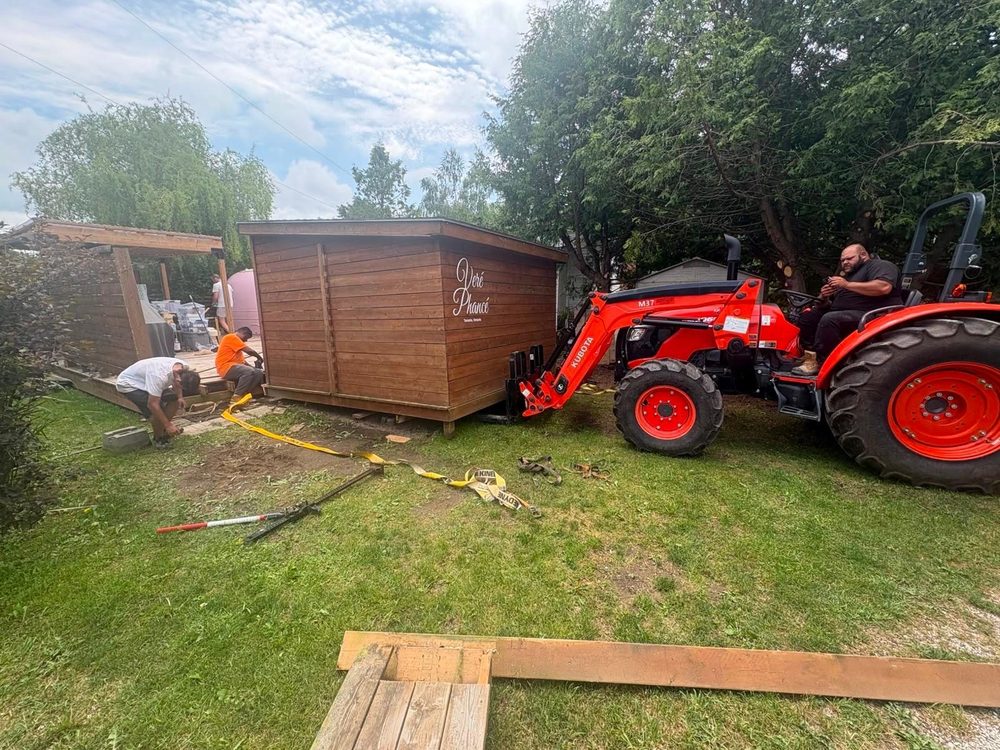
Below is what each of the four actually publishes, in their own terms, followed by a table and a worked example. We are not building inspectors and this is not advice about your specific structure. It is a plain reading of what four municipal websites say, gathered so you can see where they disagree. Confirm with the municipality before you build or move anything. Our part of the job is the lift and the haul, and we will tell you when we think a call to the building department is worth making first.
Collingwood tests height and area together
The Town of Collingwood publishes a residential deck bulletin, numbered BD.BB.19.12, issued January 30, 2019 and revised May 13, 2019. It is the clearest document of the four because it separates the two situations explicitly.
A building permit is required when the proposed deck is 24 inches or greater above finished grade and is 10 square metres, printed as 107 square feet, or greater in size. Both conditions have to be true. A deck can be enormous and sit two inches off the ground and stay outside that trigger. A deck can be four feet in the air and be tiny and also stay outside it.
The bulletin lists four more situations that require a permit. Replacement of existing guards on a deck that meets the height and area test. Replacement, extension or structural alteration of a deck that meets that test. Any deck that supports or will support roof loading, regardless of size, which is the exception that catches the small covered platform. And a change of use to something other than residential.
It also lists what does not require a permit. A deck less than 24 inches above finished ground level. Installing guards on a deck less than 24 inches above grade. Extension or alteration of a deck less than 24 inches above grade. And the replacement of only the deck boards on any deck structure, which is the line that saves a lot of people a lot of paperwork when they are simply re decking.
The thing Collingwood does not say
The Collingwood deck bulletin does not distinguish an attached deck from a detached one. Read it as written and a free standing platform and a deck bolted to the back of a house are tested identically, on height and area alone. Every other municipality on this list makes attachment part of the test. We are flagging that as a difference we can see in the published text, not as an interpretation of the Building Code. If your deck is attached and near the thresholds, that is a question for the Town.
Source: the Town of Collingwood residential decks building bulletin.
Collingwood sheds, and the zoning certificate that comes first
Collingwood publishes a separate page for garages and sheds. A shed is exempt from a building permit only if all of these are true at once. No more than 15 square metres in gross area. No more than one storey in building height. Not attached to a building or any other structure. Used solely for storage purposes ancillary to a principal building on the lot. And it does not have any plumbing.
That is a five part test and every part has to hold. Attach the shed to a garage and it is caught no matter how small it is. Run a hose bib inside it and it is caught. Use it as a workshop rather than storage and, on a plain reading, it is caught.
Two more details from the same page that people miss. First, effective January 1, 2022, a Zoning Certificate is required before you apply for a building permit in Collingwood. That is a step ahead of the permit, not part of it, and it adds time. Second, slab foundations exceeding 55 square metres, which the Town prints as 592 square feet, require professional design.
One gap worth naming. The Town does not publish a square foot equivalent for the 15 square metre shed threshold anywhere we could find, even though it prints equivalents for other numbers on the same site. We are not going to convert it for you and present the result as the Town's number. If you are close to the line, ask the building department for the figure in the units you are working in.
Source: the Town of Collingwood garages and sheds page.
Ten square metres or fifteen, on the same website
Here is a conflict we verified live rather than inferring. The Town of Collingwood building services frequently asked questions page states that a permit is required for the construction of any structure exceeding an area of 10 square metres, which it prints as 108 square feet. The garages and sheds page on the same website exempts a detached storage shed up to 15 square metres.
Those two statements cannot both be the operative rule for a 12 square metre detached shed. One page says it needs a permit, the other says it does not.
There is a second, smaller discrepancy sitting next to it. The FAQ page converts 10 square metres to 108 square feet. The decks bulletin converts the same 10 square metres to 107 square feet. Neither is wrong enough to matter in practice, but it tells you that these documents were written at different times by different hands and were not reconciled against each other.
We are not going to pick a winner. We are publishing the conflict because a reader who found only one of those two pages would walk away confident and possibly wrong. If your structure is between 10 and 15 square metres in Collingwood, that is the call to make before you order materials, not after. Source: the Town of Collingwood building services FAQ.
How long a Collingwood building permit takes
Collingwood is the only municipality in this group that publishes processing timelines, and it publishes them as a tiered list tied to building type rather than to the kind of work.
| Building type as published | Processing time |
|---|---|
| Single residential dwelling | 10 business days |
| Part 9 buildings, multi family residential, commercial and industrial less than 600 square metres and not over 3 storeys | 15 business days |
| Part 3 buildings, residential, commercial and industrial over 600 square metres and more than 3 storeys | 20 business days |
| Post disaster buildings | 30 business days |
Read that table carefully and you will notice what is not in it. Sheds are not mentioned. Decks are not mentioned. Mobile homes and trailers are not mentioned. The list is organised around buildings, and the small accessory structures that make up most of our deck and shed work do not appear in any tier.
We are not going to tell you a shed permit takes 10 business days because a single residential dwelling does. That would be us filling a gap with a guess. What we can tell you is that when a customer asks us to hold a date until a permit lands, we build in more time than the shortest published tier, because the published tiers do not cover the thing they are applying for. Add the Zoning Certificate step ahead of it and the honest answer is that you should start earlier than you think.
Wasaga Beach tests attachment and the exit door
The Town of Wasaga Beach uses a completely different test. Its building page says a permit is required to construct or demolish a deck regardless of size if it is attached to a building or adjacent to an egress door, which the Town helpfully glosses as an exit door. It also requires a permit to construct a porch or balcony regardless of size.
Note what has disappeared. There is no height number at all. A deck four inches off the ground that is attached to the trailer, or that sits in front of the door you would use to get out, is caught. In Collingwood that same deck would be outside the trigger because it fails the 24 inch test.
On the exemption side, Wasaga Beach says a permit is not required to construct or demolish a deck under 10 square metres in area that is not attached to a building and not adjacent to an egress door. Replacing non structural elements such as deck boards is exempt, which matches Collingwood. Pergolas not consisting of a floor, roof or a wall are exempt. And constructing or demolishing a standalone building under 10 square metres with no plumbing is exempt.
For sheds, Wasaga Beach requires a permit to construct or demolish a detached accessory shed not exceeding one storey in height, or greater than 15 square metres. It also requires a permit to construct or demolish a building, other than a shed, greater than 10 square metres. So the shed number is 15 and the general building number is 10, the same split Collingwood has, except here both numbers sit on one page rather than contradicting each other across two.
Source: the Town of Wasaga Beach building page.
The relocation line that matters most to us
Buried in the same Wasaga Beach list of work that requires a permit is a single line that is, as far as we can establish, the most directly relevant published sentence in this entire six municipality area to what we do for a living.
Relocation of a building greater than 10 square metres
Wasaga Beach lists the relocation of a building greater than 10 square metres as work requiring a building permit. It does not say park model. It does not say mobile home. It does not say trailer. But a park model is a structure well over 10 square metres, and relocating it is, on the face of that sentence, relocating a building. This is the only published trigger in the area we serve here that plausibly captures the act of moving a park model onto or off a property, and we are presenting it as exactly that: the nearest published sentence, not a confirmed rule about park models.
If you are having us bring a park model into Wasaga Beach, or take one out, this is the line we would point at when you call the Town to ask. It is a short call and it is worth making before the truck is booked, not after. Our park model and mobile home moving page explains what the move itself involves; what the Town wants on paper is theirs to define, and here they have at least written something down.
Midland tests attachment and the principal entrance
The Town of Midland publishes a third test again. A permit is required for decks over 10 square metres, or if they are attached to another building, or if they form part of the principal entrance. Enclosing an existing deck, porch or patio of any size requires a permit.
So Midland's version of the exit door test is the principal entrance test. Similar in spirit, different in wording, and the difference is real: an egress door in Wasaga Beach terms could be a back door, while a principal entrance in Midland terms reads as the front one.
Midland's exemptions mirror the triggers. An uncovered platform such as a deck is exempt provided it is under 10 square metres, printed as 107 square feet, and is not attached and does not form part of the principal entrance. A one storey shed used for storage under 15 square metres is exempt as long as it does not contain plumbing and is not attached to another building.
Midland also publishes several triggers the others do not. Constructing a new building over 10 square metres, printed as 107 square feet. Constructing a shed used for storage larger than 15 square metres, printed as 161 square feet, which is the one place in this whole survey where a municipality actually gives you the square foot equivalent of the 15 square metre shed number. Constructing a tent that covers more than 60 square metres, printed as 646 square feet, or is attached to a building, or is within 3 metres of another structure. Constructing a retaining wall more than one metre in height, provided that wall is on or adjacent to public property. And changing a building's use.
One sentence on the Midland page applies everywhere and is worth quoting in substance: even if a building permit is not required, compliance with the zoning by law is still required. That is the sentence that catches people who confirm they do not need a permit and assume that settles it. Source: the Town of Midland building permits page.
Georgian Bay Township tests attachment at any size
The Township of Georgian Bay publishes a permits pamphlet and a separate deck construction guide, and between them they give the strictest reading of the four.
The deck guide says decks of any size that are attached to another structure, and it gives a house as the example, require a building permit as per the Ontario Building Code. Any size. There is no area floor at all on the attached side. A free standing deck that is over 10 square metres, printed as 107 square feet, is considered a structure and requires a building permit.
The permits pamphlet, which carries no printed year on the document itself although its file name references 2026, lists work requiring a permit including the construction or installation of an accessory building such as a garage, tool shed, dock, boathouse or playhouse larger than 10 square metres, printed as 107 square feet. It also lists a storage shed over 15 square metres. And it lists a structure less than 10 square metres attached to another structure with a total greater than 10 square metres, which is the clause that catches the small addition to an existing small building.
So the 10 versus 15 conflict that Collingwood spreads across two web pages, Georgian Bay Township contains inside a single document. The pamphlet says accessory buildings larger than 10 square metres need a permit and, a few lines later, says a storage shed over 15 square metres needs one. A 12 square metre tool shed is caught by the first line and not the second. We verified this live and it is genuinely what the document says.
The pamphlet also lists several other triggers directly relevant to seasonal properties. Enclosing a porch or deck. Adding or replacing a deck to an existing home. Raising a building, which is worth noting for anyone thinking about levelling and blocking work that changes a structure's height meaningfully. Relocating structures. And installing any type of plumbing.
Sources: the Township of Georgian Bay building permits pamphlet and the Township of Georgian Bay deck construction guide.
The 600 millimetre number, and what it is really about
The Georgian Bay deck guide contains a 600 millimetre figure that is easy to mis file, and we mis filed it ourselves at the research stage before catching it on a second read. Here is what it actually says.
A guard is required at any point where the distance between the top of the decking and the grade is greater than 23 and a half inches, which the guide gives as 600 millimetres.
That is a guard requirement measured from the top of the deck surface down to the ground. It is not a permit trigger, and it is not measured from the underside of the frame. Our own research notes had it recorded as a permit threshold measured from underneath, which would have been wrong in two separate ways in the same sentence, and we are saying so here because it is exactly the sort of number that gets copied from site to site until nobody remembers what it originally measured.
Compare it to Collingwood's 24 inches and you will see they are very close in magnitude, 600 millimetres against roughly 610 millimetres, and completely different in function. Collingwood's 24 inches, combined with area, decides whether you need a permit. Georgian Bay's 600 millimetres decides whether you need a railing. A deck can be over one and under the other.
The deck guide carries no publication date we could find and its disclaimers reference the 2012 Building Code, so treat it as guidance the Township has published rather than as a current statement of code. Confirm with the Township.
Deck and shed thresholds side by side
Everything above, in one place. Every cell is what the municipality publishes, in its own terms. Blank means the municipality does not publish that test, not that the test does not apply.
| Municipality | Deck permit trigger as published | Detached shed exemption | Attachment part of the test |
|---|---|---|---|
| Collingwood | 24 inches or greater above grade AND 10 square metres or greater; any size if it supports roof loading | Up to 15 square metres, one storey, unattached, storage only, no plumbing | Not mentioned in the deck bulletin |
| Wasaga Beach | Any size if attached to a building or adjacent to an egress door; otherwise 10 square metres | Permit required over 15 square metres | Yes, plus the exit door test |
| Midland | Over 10 square metres, or attached, or forming part of the principal entrance | Under 15 square metres, one storey, no plumbing, unattached | Yes, plus the principal entrance test |
| Georgian Bay Township | Any size if attached to another structure; 10 square metres if free standing | Pamphlet gives both 10 square metres for accessory buildings and 15 square metres for storage sheds | Yes, at any size |
| Stayner, Creemore, Thornbury, Penetanguishene, Tay | Not published at a URL we could verify | Not published at a URL we could verify | Unknown |
That last row is not padding. We looked for Penetanguishene and Tay building thresholds and could not reach a page that published them. Rather than borrow a neighbouring municipality's numbers and present them as local, we are telling you the research came up empty. If you are building or moving in one of those places, call the municipality directly.
The same small deck, four different answers
Here is the example that makes the table concrete. Picture a deck that is 9 square metres, which is roughly 10 feet by 10 feet, sitting 12 inches off the ground, and bolted to the side of a park model. That is an extremely common structure on a seasonal site along this shore. Now put it in each of the four municipalities.
In Collingwood, it fails the height test. Twelve inches is less than 24 inches, so the permit trigger is not met, and the bulletin does not add an attachment test. On a plain reading of the published bulletin, no permit.
In Wasaga Beach, it is attached to a building. The Town's trigger for an attached deck is any size, with no height qualifier at all. Permit.
In Midland, it is attached to another building. Same result. Permit. And if it happens to be in front of the door you use as the principal entrance, it is caught twice over.
In Georgian Bay Township, decks of any size attached to another structure require a permit as per the Ontario Building Code. Permit.
One deck. Four municipalities inside an hour's drive of each other. Three permits and one exemption, and the exemption is the one place where the published document happens not to mention attachment. We are not telling you Collingwood does not care about attached decks. We are telling you that the document Collingwood publishes does not test for it, and that if your deck is attached you should ask rather than assume the silence is a permission.
This is also why we ask where a deck or shed move is going before we quote it, not just where it is coming from. The haul is the same. The paperwork on the far end is not.
Park models and mobile homes, and the rule nobody publishes
We move park models and mobile homes into and out of this area regularly, and this is the section where we have to be most careful about what we say, because the honest answer is that almost nothing is published.
Across all six municipalities in this service area, we could not find a single published statement that a permit is or is not required specifically to place or move a park model trailer or a mobile home. Not on the building pages, not in the permit pamphlets, not in the FAQs. The word does not appear where you would expect it to appear.
What exists is adjacent. Wasaga Beach's relocation of a building greater than 10 square metres, discussed above, is the closest thing to a directly applicable published trigger. Georgian Bay Township's pamphlet lists relocating structures as work requiring a permit, which is similar in effect though less specific about size. Midland's change a building's use trigger could matter depending on what the unit is being used for. Collingwood's building services FAQ does not mention mobile homes or trailers in its processing time list at all.
A rule we cannot find published is not the same as a rule that does not exist. Municipal building departments apply the Ontario Building Code and their own zoning by laws whether or not their website has a page about your exact situation. What we can tell you is what we do: we ask the customer to confirm with the municipality before the move date, we do not tell anyone a permit is unnecessary, and we do not price a job on the assumption that no paperwork will be needed.
If you want the transport side explained separately from the building side, that is what our park model and mobile home moving page is for. The permit questions on this page are about the structure. The permit questions on that page are about the road.
Collingwood section 4.38, and what we could not read
Collingwood's comprehensive zoning by law, number 2010 040, contains a section numbered 4.38 titled Storage of Recreational Vehicles. We know this because the section appears in the table of contents of the consolidated document, at page 4 to 13.
We could not read the section body. We tried the consolidated PDF three separate times, including two attempts with deliberately narrow prompts aimed at that one section, and on every attempt the only thing that rendered was the table of contents line. The body text of section 4.38 did not come through.
Why we are telling you this instead of just leaving it out
There are numbers circulating for Collingwood RV storage: maximum unit counts, height limits, length limits, which yards you may use, how many days a year an oversize unit may sit. Our own research notes contained one version of those numbers and a subsequent retrieval produced a different version, and we could not confirm either against the actual section text. So we are publishing neither. If we printed a length limit here and you built a pad to it, and the by law said something else, that is a real cost to you caused by us guessing. Call the Town at 705-445-1030 and ask them to read you section 4.38.
The one detail we can state with confidence is that the consolidated version of the by law we attempted to read carries a consolidation date of April 2, 2026, so it is current as of this year. The document is at the Town of Collingwood consolidated zoning by law if you want to try it yourself. You may have better luck than we did.
Storing an RV on your own property
Given the previous section, here is what we can and cannot say about keeping a trailer at home along this shore.
We cannot give you Collingwood's rules, for the reason just explained. We cannot give you Wasaga Beach's, Midland's, Georgian Bay Township's, Tay's or Penetanguishene's either, because we could not reach a page where any of them publish residential RV parking or storage provisions. That is six municipalities and zero verified rules, which is an unusual result and we are reporting it rather than smoothing over it.
What we will not do is turn that silence into a green light. Nearly every municipality in Ontario regulates this somewhere, usually in the zoning by law rather than on a friendly web page, and the fact that we could not find the page does not mean your neighbour's complaint will not find the by law officer. The rules that typically exist in Ontario zoning by laws cover how many recreational vehicles may be stored on a residential lot, which yard they may sit in, how close to the lot line, whether they may be occupied, and whether there are seasonal date windows. Assume something along those lines applies and confirm the specifics locally.
The practical version, from our side of it: if you are not certain the unit can legally sit at your house, that is a good reason to look at RV storage. Our yard in Beaverton runs $85 to $125 a month depending on size, and we can move the unit in and out for you. It is about an hour and a bit from Collingwood and Wasaga Beach, which is far enough that you would not do it weekly and close enough that a spring out and fall in arrangement is easy.
The Collingwood overnight winter parking ban
Collingwood publishes an overnight winter parking restriction that catches a lot of people who are storing a trailer, waiting for a gate to open, or staging a unit before a move.
The Town states that no vehicles are to be parked or left standing on any street, or in any area designated as a municipal parking area within the Town, between the hours of 1:00 a.m. and 7:00 a.m. from November 1 to March 31. It is enforced under Winter Parking By law 03-62.
Read that carefully. It is not a snow event restriction that switches on when it snows. It is a fixed five month calendar window, every night, whether there is snow on the ground or not. And it covers municipal parking areas as well as streets, so the municipal lot is not a workaround.
For us this is a scheduling fact rather than a legal problem. It means a unit cannot sit on a Collingwood street overnight between November and March waiting for us, and it means we do not plan an arrival that would leave a trailer parked on the road at one in the morning. If a driveway is not ready, the unit goes somewhere else, and that is usually our yard.
The same page lists the Town's winter maintenance structure: six roadway routes and four sidewalk routes. Source: the Town of Collingwood winter roads page.
What Wasaga Beach does publish about its roads
Wasaga Beach publishes no reduced load restriction, and we confirmed that as a live negative rather than assuming it from a failed search. What the Town does publish is its winter operation, in more detail than most municipalities bother with.
The town has designated 11 plowing routes and each route takes approximately six to eight hours to complete. The Town uses approximately 4,500 tonnes of Ministry of Transportation specified winter sand. The sand is mixed with roughly seven percent salt to maintain the workability of the winter sand mix. And the Town notes that normally salt should never be applied when the temperature is below minus 12 Celsius, however that in the presence of sun and heavy traffic volume, which creates a higher road surface temperature, salt can sometimes be effectively applied to a temperature of minus 18 Celsius.
That last detail is more useful to a transport operator than it looks. A six to eight hour route time means that after a meaningful snowfall, a road at the back of a route can be untouched most of a day. Sand with seven percent salt is a traction mix, not a melting mix, which is the right choice on a road base like Wasaga's and also means the surface stays firm rather than going to slush. When we are deciding whether a January move into Wasaga Beach happens on the scheduled morning or gets pushed by half a day, that is the arithmetic we are doing.
Source: the Town of Wasaga Beach roads page.
The Georgian Bay road network
The Township of Georgian Bay maintains approximately 190 kilometres of roads. That is a large network for a small permanent population, and it is spread across a geography of bays, inlets and lakes where a straight line on a map is often a twenty minute drive.
The District roads through the Township are the ones that carry most of our work: District Road 5, which is Honey Harbour Road and Port Severn Road, District Road 11 which is High Street, District Road 12 which is Twelve Mile Bay Road, District Road 32 which is Go Home Lake Road, District Road 33 which is South Gibson Lake Road, District Road 34 which is White's Falls Road, and District Road 48 which is South Bay Road.
The Township also explains its surfacing choice, which matters more to a heavy load than most people realise. Tar and chip paving is used on rural roads with low to medium volumes of traffic as a more cost effective and durable alternative to asphalt paving. Tar and chip behaves differently from asphalt under a concentrated load in hot weather, and it is one reason we are careful about scheduling a heavy park model move into the back roads on a thirty degree August afternoon rather than a cool morning.
Highway 400 through the Township is maintained by the Ministry of Transportation, not by the Township, which is the one road in the area where a Township restriction is not the governing rule.
Bridges, and the numbers we will not give you
Every so often somebody asks us for a list of posted bridges along a route. We would like to publish one. We cannot.
Municipal bridge inventories in Ontario live in asset management documents and biennial inspection reports under the Public Transportation and Highway Improvement Act. Those documents exist for the municipalities on this shore. We could not retrieve them at a live, citable URL for Collingwood, Wasaga Beach, Midland or the Township of Georgian Bay, and the County of Simcoe's own permits and structures pages are behind a script wall we discuss above.
What this means in practice
We are not going to state a bridge count for Collingwood, and we are not going to publish a posted load limit, width restriction or vertical clearance for any individual bridge in this service area. Our research turned up exactly one posted load figure anywhere in the wider County material, a five tonne posting on a structure the County describes as reachable only by snowmobile, which is useless to a truck and which we could not re verify at a live page. So it stays out too. If your route depends on a specific structure, the municipality or the County engineering department is the only reliable source, and they will tell you over the phone.
What we do instead is route planning by inspection. On an oversize or overweight move we drive the route first when there is any doubt, and the permit application itself forces the question, because a municipality issuing a permit is telling you it has looked at the route you described.
Clearance numbers that are not road clearances
This shore has a specific trap in it, and we have watched people fall into it more than once.
The Trent Severn Waterway runs through Port Severn and Big Chute at the north end of this service area, and Parks Canada publishes overhead clearance figures for the waterway. Those are marine clearances. They describe how much room a boat has passing underneath a bridge on the water. They have nothing whatever to do with how tall a load can be on the road crossing over the top of it.
If you search for clearance figures near Port Severn you will find waterway numbers long before you find road numbers, because the waterway publishes them and the roads mostly do not. Taking one of those figures and treating it as a road height limit is the kind of mistake that ends with a park model roof and a bridge girder occupying the same space.
The same trap exists in two other forms elsewhere in our service area, and we mention them so the pattern is visible. On the Kawartha Lakes side, the widely quoted clearance figure at Lock 33 in Lindsay is also marine. And in Northumberland County, the only clearance numbers published in the local zoning by laws are minimum ceiling heights for parking garages, which are a building standard and not a road limit at all.
The rule we work by: a clearance number is only a road clearance if the authority that maintains the road published it. If it came from a waterway, a marina, a zoning by law or a parking structure, it is answering a different question.
The one height number that does govern our work is the legal envelope, which Collingwood publishes as 4.15 metres, and the permit heights we discuss further up this page. Those are load heights, not structure clearances, and the difference is the whole point of this section.
Craigleith Provincial Park
Craigleith is 65.69 hectares, established in 1967, and sits on the southern shore of Georgian Bay at the base of Blue Mountain, on Highway 26 in The Blue Mountains. The park office number is 705-445-4467. It is the closest provincial park campground to Collingwood and it is a genuinely easy delivery for us, because Highway 26 is on Collingwood's list of roads that stay open through the reduced load season.
Ontario Parks states that all of Craigleith's campsites are accessible by car, and the park is laid out in four areas that suit very different equipment.
Area A is non electrical and ideal for tents, with a designated dog beach at the west end and a comfort station with flush toilets, showers, laundry facilities and a water tap. Area B contains both electrical and non electrical sites that are ideal for both tents and trailers, and has a mini comfort station. Area C is made up of both electrical and non electrical sites that are all radio free, with the non electrical sites suited to tents or small trailers and the electrical sites suited to trailers and RVs, plus a comfort station, a trailer filling and dumping station, a playground, a volleyball court, horseshoe pits and a playing field. Area D is primarily electrical with only two non electrical sites, most of the electrical sites have water hook up which makes the area ideal for trailers and RVs, and it is radio free with one comfort station and the day use area at the east end.
If you are having us deliver a larger unit to Craigleith, Area C and Area D are the parts of the park built for it, and Area C is where the trailer filling and dumping station is. Source: Ontario Parks, Craigleith camping.
McRae Point Provincial Park
McRae Point is 137.60 hectares, established in 1971, on the shores of Lake Simcoe near Orillia at 4366 McRae Park Road in Ramara Township. The park number is 705-325-7290. It is not on Georgian Bay, but it sits almost exactly on the line we drive between Beaverton and this shore, which makes it one of the easiest parks in the region for us to serve.
McRae Point offers car camping in the North and South Campgrounds. Ontario Parks describes the North Campground as fully serviced with electricity, with large pull through sites that accommodate extra large trailers and motorhomes. There are fully serviced washroom and shower buildings located in that campground, with smaller washrooms found throughout. The South Campground features both electrical and non electrical campsites.
Why the pull through detail matters
Very few parks in this part of Ontario advertise pull through sites that accommodate extra large trailers, and McRae Point is one that does in its own published words. If you are shopping for a park that will take a big fifth wheel without a difficult back in, that sentence is doing a lot of work. It also makes our job faster, which we would rather pass along than pad the invoice with.
Source: Ontario Parks, McRae Point camping.
Awenda Provincial Park
Awenda is 3,025 hectares, established in 1975, at 670 Awenda Park Road in Tiny Township on the tip of the peninsula north of Penetanguishene. The park number is 705-549-2231. It is by a wide margin the largest of the provincial parks in this service area, and one of the largest we serve anywhere.
Ontario Parks says Awenda offers camping in six campgrounds, that sites are shaded beneath Sugar Maples and Red Oaks, and that they are spaced further apart than many other provincial parks. That spacing is a real advantage when we are threading a long unit onto a site.
On services, all of the sites in Wolf and some sites in Hawk Campground offer electrical hook ups. Deer and Bear Campgrounds are designated radio free, while Snake Campground is radio free, pet free and generator free. All six campgrounds are serviced by drinking water taps, vault toilets and a central comfort station complete with flush toilets and showers. Laundry facilities are included at the comfort stations in Turtle, Hawk and Bear Campgrounds.
Two things Awenda does not publish on its camping page, and we are naming them rather than filling them in: there is no statement about pull through sites, and there is no site count or maximum trailer length by campground. If you are bringing something long, call the park before you book the site rather than after. Source: Ontario Parks, Awenda camping.
Wasaga Beach Provincial Park is day use only in 2026
This is the single most important park fact on this page, because it is the one people get wrong.
Wasaga Beach Provincial Park is 1,844.30 hectares, established in 1959, with a park number of 705-429-2516, and it offers seven kilometres of sandy shore accessible from four different beach areas. It is the largest freshwater beach in the world by the usual reckoning and it is the reason a great many people come to this shore at all.
There is no camping there
The 2026 operating dates published by Ontario Parks for Wasaga Beach Provincial Park show day use only. No camping season is listed. If somebody tells you they have booked a campsite at Wasaga Beach Provincial Park for this year, they have booked something else, most likely a private park in the town. We check this every season because it is the kind of thing that changes, but for 2026 it is day use.
What that means for a delivery is straightforward. If you want us to bring a unit to Wasaga Beach, the destination is a private campground, a seasonal park or a residential property, never the provincial park. Tell us which one at the quoting stage and we will look at the access before we commit to a date. Source: Ontario Parks, Wasaga Beach Provincial Park.
Devil's Glen, and the parks with no camping
Devil's Glen Provincial Park is 60.19 hectares, established in 1965, off Highway 24 south of Collingwood, and it shares the 705-429-2516 phone number with Wasaga Beach. Ontario Parks states that the park is gated and only accessible by foot, and that camping and fires are not allowed.
We include it because the name comes up when people search for parks near Collingwood and because it is worth knowing before you drive there with a trailer that there is nowhere to put one. Gated and accessible only by foot is about as clear as a park description gets.
Between Devil's Glen and Wasaga Beach Provincial Park, two of the five provincial parks closest to Collingwood have no camping at all. The camping in this region is concentrated at Craigleith, at Awenda up the peninsula, and at McRae Point on the Lake Simcoe side, with the private and seasonal parks carrying most of the rest of the load. That concentration is why site availability along this shore gets tight early and why our transport calendar for the area fills before the season does.
Six Mile Lake and Springwater
Two more provincial parks sit at the edges of this service area and we cover them in depth elsewhere on the site rather than repeating ourselves here.
Six Mile Lake Provincial Park is just north of Port Severn, technically in Georgian Bay Township, and its Pine and Birch campgrounds can accommodate large equipment and are equipped with hydro. We write it up in full on our Muskoka RV transport page, including which of its campgrounds suit a big unit and which are walk in only.
Springwater Provincial Park is south of this area near Midhurst, and we cover it on our Barrie RV transport page. If your trip touches either of those parks, those pages have the detail and it is current.
Trailer length, and how Ontario Parks sorts sites
One system wide fact answers more customer questions than any individual park page, so it is worth stating plainly.
Ontario Parks reserves camping sites by trailer size, in bands: up to 18 feet, up to 25 feet, up to 32 feet, and over 32 feet. The system holds over 19,000 car camping sites, and over 3,000 campsites offer electrical service at 15 and 30 amp. Trailer dumping and water filling stations are available in most camping parks. And critically, Ontario Parks notes that a few parks cannot accommodate trailers of more than 32 feet.
| Ontario Parks reservation band | What typically fits |
|---|---|
| Up to 18 feet | Tent trailers, small travel trailers, teardrops |
| Up to 25 feet | Most single axle and smaller tandem axle travel trailers |
| Up to 32 feet | Larger travel trailers and many fifth wheels |
| Over 32 feet | Large fifth wheels and Class A motorhomes, and not available at every park |
Measure your unit before you book, and measure it the way the reservation system means it, which is the trailer itself. If you are at 33 or 34 feet you are in the top band and your park choices narrow. We move units up to 30,000 lb on a 30 foot gooseneck, so length is rarely our limit, but it is regularly the park's. Source: Ontario Parks, RV and trailer camping.
Getting a load in and out along the bay
The paperwork on this page is unusual. The physical work, mostly, is not. What is different about the Georgian Bay shore is the ground and the layout, and both of those change how a day goes.
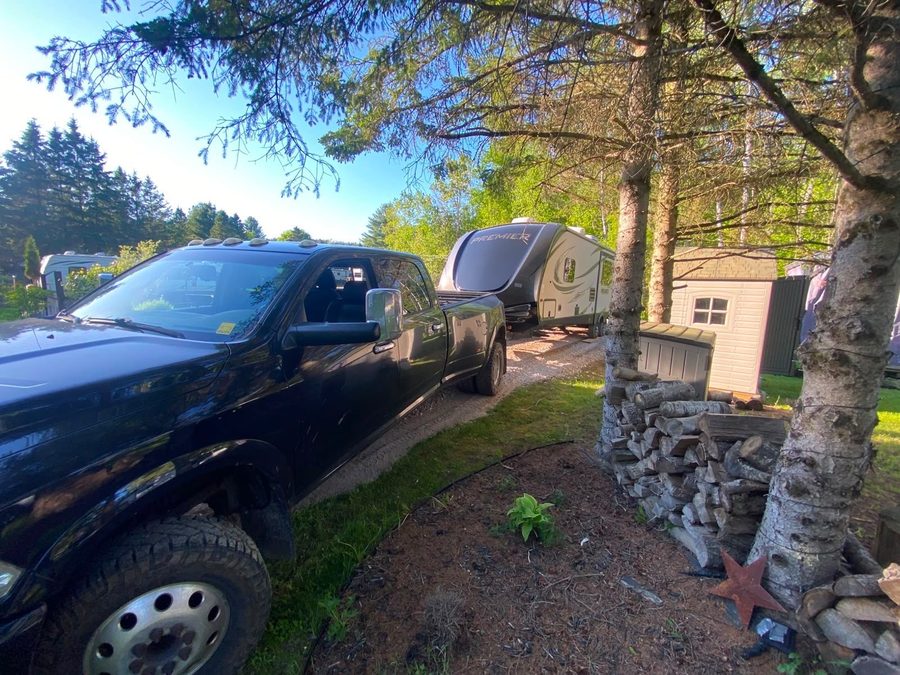
Four things come up over and over on this shore. Sand, first: Wasaga Beach and much of the Tiny and Tay shoreline sit on deep sand, and sand that looks firm in April is not the same surface in August. Second, the tar and chip rural roads through Georgian Bay Township, which are durable but behave differently from asphalt under a heavy concentrated load in heat. Third, the escarpment side around Collingwood and Blue Mountain, where the grade and the shale change what a truck can do on a wet morning. Fourth, and most commonly, seasonal sites laid out decades ago for units two thirds the size of what people buy now.
None of that is a reason to say no. It is a reason to ask questions before we quote. Width at the narrowest point, overhead clearance from branches and wires, whether the approach turns, what the surface is, and where the septic is. A five minute phone conversation about the last forty feet saves a wasted trip more often than anything else we do. Our how to prepare your RV for transport guide covers the customer side of that list.
When a Georgian Bay booking actually moves
Put the reduced load calendars from the top of this page together with the season, and the practical booking year on this shore looks like this.
| Window | What is realistic |
|---|---|
| January and February | Moves happen, weather permitting. Collingwood's overnight parking ban is in force. Frozen ground is often better to work on than spring mud. |
| March 1 to April 30 | Collingwood, the County of Simcoe and Tay are all in reduced load season. Georgian Bay Township is restricted with no published start date. Heavy moves need planning around road choice, and Highway 26 through Collingwood stays open. |
| May | Georgian Bay Township published a season end of May 15 for 2026. The busiest weeks of the year for seasonal site deliveries begin here. |
| June through August | Open season. Book early, because everyone wants the same three weekends. Heat and tar and chip surfaces move some jobs to early mornings. |
| September and October | The best moving weather of the year on this shore, and our quietest stretch. If your date is flexible, this is where to put it. |
| November and December | Pull outs, storage moves and winterisation runs. Collingwood's overnight parking ban resumes November 1. |
The single most useful thing you can do is decide early whether your move needs a permit. A Collingwood permit wants five business days minimum, the Town suggests ten to fifteen, and an exceptional load wants at least forty five days. A move into Midland may need permit numbers from the County of Simcoe and from the Ministry of Transportation before Midland will even take the application. None of that is difficult. All of it takes calendar time you cannot compress on the day.
Levelling and blocking on sand and shale
Setting a unit level is a different job on this shore than it is on clay.
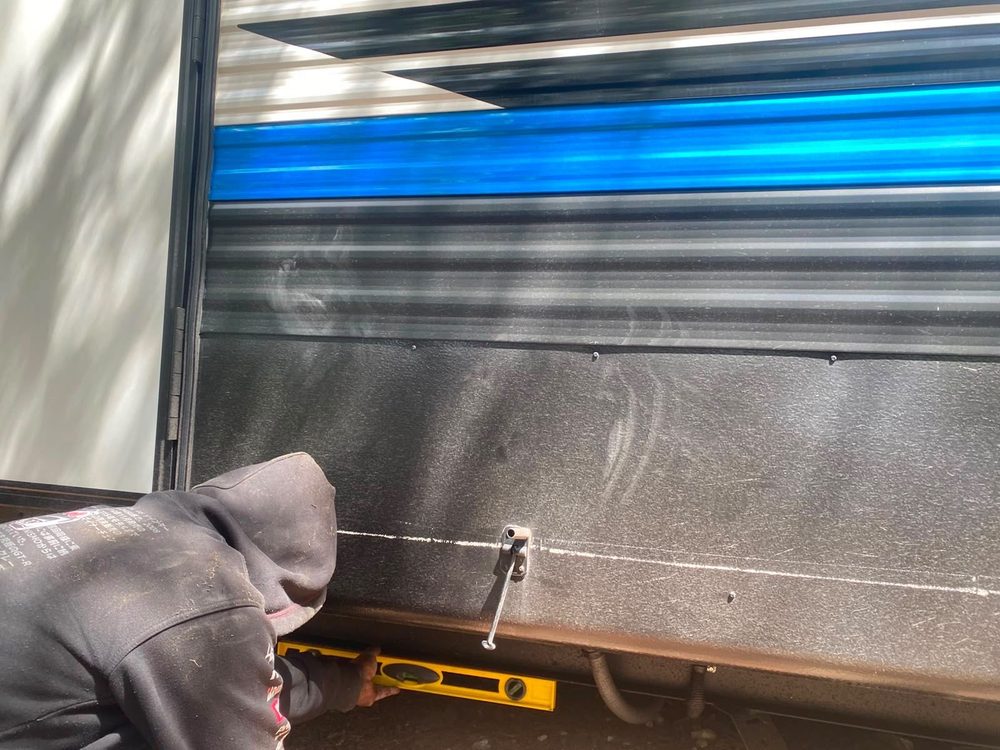
Sand drains beautifully and compacts badly. A pad that was set on bare sand in spring can settle unevenly by midsummer, particularly under the heavy end of a park model. On the escarpment side the problem reverses: shale and thin soil over rock give you a hard bearing surface with very little forgiveness, so the blocking has to be shimmed properly rather than muscled into place.
Our full set up is $799. That covers levelling and blocking the unit properly, checking it at the frame rather than at the floor, and setting it so the doors close and the slides run true. We would rather do it once and correctly than come back, which is also the point of the guarantee at the bottom of this page. There is more detail on our RV levelling and blocking page, including what we use and why we do not shortcut the blocking under the tongue.
What we do around Collingwood and Wasaga Beach
Everything below is available anywhere on this shore, from Stayner and Creemore across to Honey Harbour and MacTier.
- RV transport. Travel trailers, fifth wheels, toy haulers, tent trailers and motorhomes that cannot drive themselves. Driveway to driveway, dealer to site, site to storage, storage to site. Up to 30,000 lb on a 30 foot gooseneck, local tows from $400.
- Park model and mobile home moving. The permit heavy end of the work, which on this shore means Collingwood's oversize permit, Midland's three authority chain, or both. We handle the move; the building side stays with the municipality and the owner.
- Levelling and blocking. $799 for a full set up, done at the frame, on sand, shale or gravel.
- Deck and shed moving. Lifting and relocating decks, sheds and small structures, with the four municipality threshold problem set out in full above so you know what to ask before we lift.
- RV storage. $85 to $125 a month depending on size, at our yard in Beaverton, with moves in and out arranged around your season.
- RV rentals. Delivered and set up on a site of your choosing, which along this shore usually means a seasonal park or a family property rather than a provincial park campground.
Three guides on this site cover the questions that come up before and after a job: how to prepare your RV for transport, which is worth reading the week before we arrive, RV transport cost in Ontario, which explains what actually drives a quote, and the Ontario RV winter storage checklist, which matters more here than most places because of how early the wind comes off the bay.
Storage when the property will not take it
Two things push Georgian Bay customers toward storage rather than keeping a unit at home. The first is the zoning question we could not resolve for Collingwood and could not find published anywhere else on this shore. The second is simply space, because a lot of the housing stock along the beach was not built with a forty foot fifth wheel in mind.
Our yard is in Beaverton, at the east end of Lake Simcoe, and storage runs $85 to $125 a month depending on the size of the unit. From Collingwood or Wasaga Beach that is a little over an hour, which is the right distance for a seasonal arrangement: we take the unit out in the spring, bring it back in the fall, and you never tow it yourself. The RV storage page has the details, and the winter storage checklist covers what should be done to the unit before it sits.
What a move to this area costs
Local tows start at $400. Beyond that, the honest answer is that a quote for this shore depends on the same four things everywhere: distance, size and weight, access at both ends, and whether a permit is involved. The permit question carries more weight here than it does in most of our service area, for every reason set out on this page.
| Service | Price |
|---|---|
| Local tow | From $400 |
| Levelling and blocking, full set up | $799 |
| Storage | $85 to $125 a month depending on size |
| Deposit to book a date | None |
| Maximum tow weight | 30,000 lb on a 30 foot gooseneck |
Municipal permit fees are separate and they are set by the municipality, not by us. On this shore that is $175 for a Collingwood annual permit or $100 for a single trip, $232 for a Midland annual or $116 for a single trip, $244.50 for a Collingwood road occupancy permit, and $300 a year for the Tay permit attached to its reduced load by law. County of Simcoe fees we could not verify and will not quote. We tell you which of those apply to your job before you commit to anything, and we do not mark them up. Our RV transport cost in Ontario guide explains the rest of the arithmetic.
When to book
There is no deposit to hold a date with us. That is deliberate, and it means the only thing standing between you and a confirmed date is whether the date is still there.
For a straightforward tow with no permit, a week or two of notice is usually plenty outside the summer peak. For anything needing a Collingwood permit, work backwards from five business days minimum and preferably ten to fifteen, and from forty five days if the load is exceptional. For a Midland move that needs County and Ministry permit numbers first, add the time those take on top. For the late June through August weekends, book in the spring, because those dates go early and no amount of planning creates a truck that is already committed.
How to get the quote right the first time
Tell us six things and we can usually quote without a site visit.
- What the unit is. Make, model year and length if you have it, or the plate and the tag if you do not.
- Where it is now and where it is going. Addresses, or at minimum the municipality at both ends, because on this shore the municipality determines the permit question.
- Whether it is a park model or a mobile home. This changes the answer completely, because width above the legal envelope means a permit before anything else is discussed.
- What the access looks like at both ends. Narrowest point, overhead branches and wires, surface, and whether the approach turns.
- Whether anything needs to move first. A deck, a shed, a fence panel, a picnic table set in place fifteen years ago.
- Your date, and how firm it is. Flexible dates are cheaper and easier, especially in September and October.
Photographs help more than descriptions. One picture of the unit, one of the driveway from the road, and one of the site from the approach will answer most of what we would otherwise phone you about. Call (647) 961-9257 or email transport@kawartharvrentals.ca. We are open Monday to Saturday, 7:00am to 7:00pm. Sunday closed, by appointment only.
Our 30 day guarantee
If a unit we set up shifts or moves because of our workmanship, we come back and redo the job at no charge. Weather and ground conditions are outside that, and we say so up front.
We put it in writing because the ground on this shore is the part nobody controls. Sand settles, shale does not forgive, and a hard frost will move things we set perfectly in October. If a unit shifts because of how we did the work, that is ours and we come back. If it shifts because of weather or the ground itself, that is outside the guarantee and we say so before we start rather than after you call. We carry Ontario CVOR 204-617-206.