
The short version
To prepare an RV for transport, do three things: get the unit down off its blocks and sitting on its own wheels with the jacks and stabilisers up, clear everything standing between the unit and the road, and make sure the tires hold air and are not cracked. Those three are the difference between a driver hooking up and leaving, and a driver standing in your yard making phone calls. Everything else on this page is worth doing and will make the day go better, but only those three will stop a job dead.
We run RV and trailer transport out of Beaverton, and we have this same conversation on the phone several times a week. Most people booking a move have never had one done before. They are not sure whether the tanks matter, whether the propane has to come off, whether we bring the blocks or they do. So rather than repeat it, we wrote it down. This is the checklist we would give you ourselves, in the order it actually matters, with the Ontario rules that genuinely apply and an honest note wherever we could not find a rule that people assume exists.
| What we require | Why it matters |
|---|---|
| Unit down on its wheels | A unit sitting on blocks with the jacks extended cannot be hitched or winched. Lowering it is the single most common reason a job runs late. |
| A clear path to the road | We need room to back in, swing and pull out. Decks, sheds, skirting, fire pits, parked cars and low branches all count. |
| Tires that hold air | If it is being towed on its own axles, the tires are load-bearing at highway speed. Flat or crazed tires change the job and the price. |
Everything below that line is optional in the sense that we can work around it. It is not optional in the sense that skipping it can cost you money. A slide-out that creeps open, an awning that unrolls, a fridge door that swings, a full fresh tank sitting three metres behind the axles: none of those stop us loading, and all of them can turn a routine tow into a repair bill.
- Slides in, awning rolled and latched. Travel locks on if the unit has them.
- Grey and black tanks emptied. Fresh tank drained for anything longer than a local hop.
- Propane valves closed, tanks strapped in their brackets. Tell us what you have when you book.
- Everything inside secured. Cupboards latched, loose items on the floor, nothing on a countertop.
- Roof cleared. No branches, no stored items, no tarp that can catch wind.
- Steps and antenna retracted, vents closed, windows shut and locked.
- Photos taken. Four sides, the roof if you can do it safely, and any existing damage.
- Keys, plate and paperwork in one place. Ownership sorted before the day, not after.
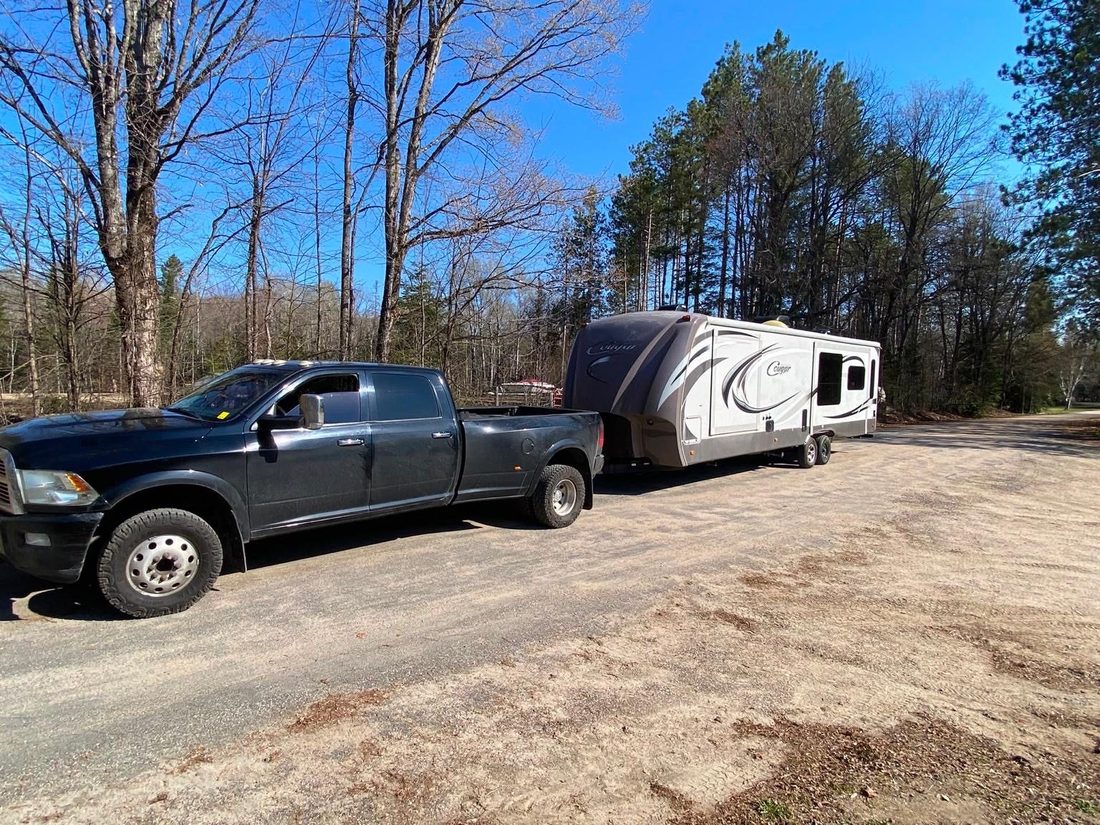
If you cannot do any of it yourself, say so when you book and we will price the prep into the job. That is normal work for us. Unblocking, moving a deck or shed out of the way, pulling skirting, dealing with tires: none of it is unusual and all of it is cheaper as part of a planned day than as a surprise on the morning. What costs real money is a driver and a truck sitting idle while somebody hunts for a jack.
Why prep matters more than people expect
An RV parked in a yard is a building. An RV on the highway is a structure being shaken at 100 km/h by a road surface that was not designed with it in mind. Those are different jobs, and the transition between them is where damage happens.
The thing most owners underestimate is how much of the load in transit is not vertical. A trailer sitting still carries its weight straight down through the tires and the frame. A trailer being towed carries that same weight while also being twisted along its length every time one wheel crosses a frost heave the other does not. Cabinetry, plumbing joints, slide-out seals and roof membranes are all attached to a frame that is flexing. Anything loose inside becomes a hammer. Anything unlatched outside becomes a sail.
The second thing people underestimate is time. A move that should take an hour on site turns into three because the unit has been sitting on cribbing for six years and nobody has looked underneath it. We arrive, and the jacks are seized, or the blocks have sunk unevenly into soft ground on one side, or a deck was built up against the door two summers ago and the only way out is through it. None of that is a disaster. All of it is a phone call you would rather have had a week earlier.
The honest version
Nothing on this page is written to make our life easier at your expense. Every item here exists because we have watched it go wrong at least once. The propane section is the one people argue with most and the tire section is the one that actually costs the most money.
There is also a straightforward safety argument. We tow with a 30 foot gooseneck deck and heavy-duty trucks, and we carry commercial credentials including Ontario CVOR 204-617-206, but no amount of equipment compensates for a unit that comes apart in the wind. Ontario has real limits on what can go down a road without a permit, and a unit that is over them is a different job with different paperwork. We cover that below under when a unit is oversize.
Tires: the part that costs people the most
RV tires almost always age out before they wear out, because a trailer spends most of its life parked. Sidewall cracking, not tread depth, is the failure mode that matters on a unit that has been sitting. Check pressure cold, check both sidewalls for crazing, and check the spare.
If we had to pick one thing on this page that turns a routine tow into an expensive afternoon, it is tires. Not because they are complicated, but because a trailer that has sat behind a garage for four seasons looks fine from ten feet away and is finished up close.
Pressure, and why yours will read low
Set pressure to the number on the tire placard or the sidewall, and measure it cold. Transport Canada is specific about what cold means: "Measure the pressure when your tires are cold, and don't forget the spare. Tires will be cold if the vehicle has been stationary for at least three hours or has not been driven more than 2 km." A trailer that has been parked all winter comfortably qualifies.
Two facts from the same Transport Canada guidance explain nearly every low reading we see. Tires "lose pressure when the air temperature gets colder (about 7 kPa or 1 psi for every 5°C drop in temperature)", and they "may also lose a certain amount of pressure due to their permeability (about 14 kPa or 2 psi per month)". Put those together for a unit that went into storage warm in October and is being moved in March, and a tire that is 15 psi down is not leaking. It is doing exactly what tires do. Top it up and watch it for a day. If it goes down again, then you have a leak.
| What you notice | What it usually means |
|---|---|
| All four tires down a similar amount after winter | Temperature and permeability. Normal. Inflate and recheck the next day. |
| One tire down and the rest fine | A leak, a valve stem or a bead seal. Worth finding before the unit moves. |
| Tire holds air but the sidewall is crazed | Age. Tread depth is irrelevant at this point. |
| Flat spot that does not round out after a slow roll | The tire has taken a set from sitting. Treat it as suspect. |
How old is too old
We looked for a Canadian federal or Ontario government source that sets a maximum age for a tire and we could not find one, so we are not going to tell you there is a legal number. There is not one that we could verify, and we would rather say that plainly than repeat a figure we have seen quoted on forums.
What we can give you is what Transport Canada does publish and what we see in the yard. Transport Canada's wear rule is unambiguous: "A tire must be replaced when the tread has worn even with the tread wear indicator", and it identifies that indicator as "1.5 mm or 2/32 of an inch in depth". That is the wear test. It is not the age test, and on RV tires the age test is the one that fails first. A trailer tire that has done four thousand kilometres in nine years can be legally fine on tread and completely unsafe on rubber.
The practical check takes two minutes. Crouch at each wheel and look at the sidewall where it flexes, both inside and outside faces. Fine cracking that runs in a ring around the tire, sometimes called crazing or weather checking, means the rubber has hardened and lost its ability to flex. If you can see it, the tire is done. We will tell you the same thing when we arrive, and if the sidewalls are crazed we are not towing on them at highway speed.
What we could not confirm
We found no Canadian federal or Ontario government source that sets a maximum permitted age for a tire in service. We are recording that as a gap in what we could verify, not as permission to run old tires. If a manufacturer publishes a service life for your specific tire, that number is better than any general rule and better than ours.
The spare, and tires that are being stored
Check the spare. It is the single most skipped item on this page and it is the one that matters at the worst possible moment. It is also usually the oldest tire on the unit.
If your tires are coming off for the winter rather than travelling, Transport Canada's storage guidance is worth following: "If tires are stored on their rims, the tire pressure should be reduced to approximately 103 kPa (15 psi) to avoid possible cracking and deformation", and tires "should be stored upright in a clean indoor location, free from exposure to sunlight or strong artificial light, heat, ozone (electrical motors) and hydrocarbons". Ozone from an electric motor is the one nobody expects. A tire stacked next to a running freezer or a furnace blower ages faster than one that is not.
Most of our customers are not storing tires separately, though, because the unit is going to sit outside on them. That is a different problem and we deal with it properly on the winter storage checklist, along with what to do about the batteries, the plumbing and the roof before a unit sits through an Ontario winter. If the unit is coming to us instead, our RV storage page covers what we do and do not take.
Source for everything in this section: Transport Canada, Riding On Air.
Getting it off the blocks
The unit needs to be sitting on its own wheels with the stabilisers and levelling jacks fully retracted before we arrive. That is the one prep item most likely to be missed and the one most likely to add hours to the day.
Almost every seasonal unit in Ontario spends its life on something. Blocks, cribbing, a stack of patio stones, purpose-made pads, sometimes just a couple of pressure-treated offcuts under each stabiliser. All of that has to come out, and the unit has to come down, before anything can be hitched or winched.
The order that works is boring and reliable. Retract the powered levelling jacks first if the unit has them and they still run. Then wind the manual stabilisers up, corner by corner, taking a turn or two at each rather than dropping one corner all at once. Then pull the blocking out from under the frame. Then, and only then, look at whether the tires are actually carrying the unit or whether one corner is still resting on something.
When the jacks will not move
Seized stabilisers are common on anything that has been outside for more than two winters, and there are really only three causes. The scissor mechanism has rusted at the pivot, the electric motor has failed or the battery is flat, or the jack foot has sunk far enough into soft ground that the weight has locked it. Penetrating oil and patience fix the first. A jumper pack or a hand crank fixes the second on most units. The third needs the unit taken off the jack before the jack will move, which is genuinely awkward and is the point at which most people call us.
If you get to that point, stop and call rather than improvising. A trailer coming off cribbing sideways is dangerous in a way that is not obvious until it happens. We do this with proper equipment and we would rather do it as part of the booked job than clean up after.
Do not put it back on blocks at the other end
People often assume the unit needs to be re-blocked immediately on arrival. It does not need to happen in the same hour, but it should not be left indefinitely either. A unit sitting on its tires alone for a season flat-spots the tires and puts all the frame load through four contact patches. We do levelling and blocking as a service and most customers have us do it while we are already on site, which is cheaper than a second trip.
What we bring and what you need
| Item | Who provides it |
|---|---|
| Truck, 30 foot gooseneck deck, straps, chains and binders | Us. Always. |
| Hitch, ball, pintle or gooseneck coupling for the tow | Us. |
| Removing your existing blocks and cribbing | You, ideally. Us if you cannot, at an added charge agreed beforehand. |
| New blocking material at the destination | Us, if you have booked levelling and blocking. Otherwise you. |
| Skirting removal and reinstallation | Discuss when booking. Removal is straightforward, reinstallation is a separate job. |
One more thing about blocking that nobody mentions until it bites them. If the unit has been sitting on the same blocks for years, the ground under those blocks has consolidated and the ground beside them has not. When the unit comes down onto its wheels, it can settle unevenly and pinch a door frame or bind a slide. That is not a reason to avoid lowering it. It is a reason to lower it in stages and look at the door before you take the last of the blocking out.
Clearing the way out
We need a path wide enough and firm enough to back a truck and deck in, swing, and pull out with the unit behind us. The obstacles that catch people are decks, sheds, skirting, low branches, soft ground and parked vehicles, in roughly that order.
The unit itself is rarely the problem. Getting to it usually is. Send photos when you book and we will tell you honestly whether the approach works. We would far rather have that conversation on the phone than in your driveway.
The obstacle list
- Decks and porches. Anything built up against the door or along the awning side has to move. This is common enough that deck and shed moving is a service we offer in its own right, and on a lot of jobs we move the deck, pull the unit and set the deck back down.
- Sheds and storage boxes. Same problem, usually easier. A shed on skids can often be dragged clear in ten minutes.
- Skirting. Vinyl, foam board and plywood skirting all have to come off before the unit moves. It is quick. It is also easy to damage if it is brittle from cold, so do it on a mild day if you have the choice.
- Trees and branches. Look up. A unit is normally between 3.4 and 4 metres tall on the road and the branches that have been growing over the site for six seasons are now in the way. Trim before the day.
- Ground conditions. A loaded truck and deck is heavy. Soft ground after spring melt or a week of rain is the single most common reason we move a date. Firm frozen ground is often better than soft summer ground.
- Gates, posts and hydro pedestals. Measure the narrowest pinch point. A seasonal site entrance that a car passes easily can be tight for a truck with a trailer swinging behind it.
- Cars, boats and the neighbours. On a seasonal park site the neighbour's vehicle is not yours to move. Give them notice.
Seasonal parks have their own rules
If the unit is on a seasonal site, the park is a third party in this job whether anybody says so or not. Most parks want notice before a transport truck comes in, some have restricted hours, some want the site fees settled before a unit leaves, and a few have a specific route they want trucks to use. None of that is unreasonable and all of it is easier to sort out a week ahead. Call the office, tell them the date, and ask if there is anything they need from you.
We work in parks across the region constantly, from Kawartha Lakes and Peterborough County through Northumberland and the Quinte area, up into Muskoka and across to Collingwood and Wasaga Beach. If you tell us which park, there is a fair chance we already know the entrance.
The outside walk-around
This is the ten-minute lap that catches most of what is left. Start at the hitch and work around the unit in one direction so you do not skip a side.
| Where | What to do |
|---|---|
| Hitch and coupler | Clear the jack area, remove any lock, make sure the coupler is free and not seized with rust. Leave the safety chains where we can reach them. |
| Front wall and propane bay | Valves off, tanks strapped in, bay door latched. Nothing loose stored in the bay. |
| Awning | Rolled fully, arms latched, travel locks engaged if fitted. An awning that unrolls at speed usually takes the sidewall with it. |
| Slide-outs | Fully in and latched. Check from outside that the seal is seated all the way round. |
| Steps | Retracted and locked. Powered steps that have lost their battery feed sometimes stay out. |
| Doors and hatches | Every exterior compartment latched, including the ones you never open. Water heater and fridge access panels included. |
| Windows and vents | Closed and latched. Roof vents down. Vent covers that are cracked will not survive the drive. |
| Antenna and satellite | Down. Crank-up antennas are the classic one that gets left up. |
| Roof | Nothing stored on it, no branches resting on it, no tarp that can catch air. If a tarp has to stay, it needs to be tight enough that it cannot flap. |
| Underside | Look for anything hanging: insulation, a loose sewer hose, a sagging underbelly panel, corrugated drain pipe. |
| Lights and wiring | Leave the seven-pin plug accessible and dry. We will test the lights before we pull out. |
Two things on that list deserve extra attention because they cause disproportionate damage. The first is the awning. The second is anything on the roof. Both fail the same way: they catch air at speed, they lever against their mounting, and they take a section of wall or roof membrane with them when they go. Neither failure is subtle and neither is cheap.
Inside the unit
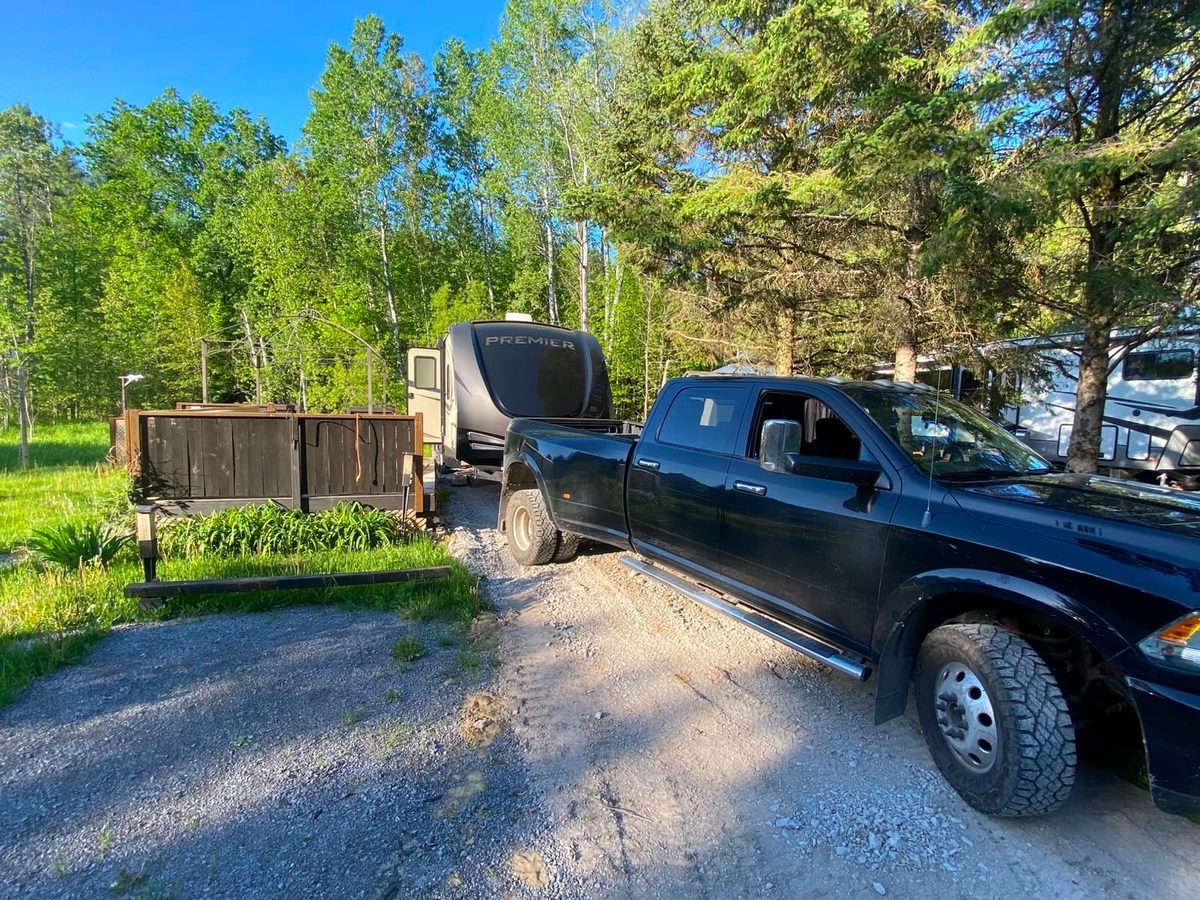
Treat the interior the way you would pack a room that is about to be shaken for two hours. Anything on a horizontal surface will move, anything in an unlatched cupboard will come out, and anything heavy that is not on the floor will find a way down to it.
The interior is the part people rush, because a trailer that is parked and tidy looks ready. It is not the tidiness that matters, it is whether things can move. A single cast iron pan left in an overhead cupboard with a magnetic catch will open that cupboard on the first real bump and then spend the rest of the trip finding out what else it can break.
| Area | What to do |
|---|---|
| Overhead cupboards | Empty the heavy items out entirely. Latch everything. Magnetic catches are not travel catches. |
| Fridge and freezer | Empty, wiped down, and propped slightly open if the unit is being stored afterwards. Latch the door for the drive itself. |
| Countertops and tables | Bare. Everything goes into a cupboard or onto the floor. |
| Bathroom | Shower door latched or wedged, mirror cabinet closed, toilet lid down and secured. |
| TV and electronics | Off the wall mount if it is a bracket-hung set on a long arm. Padded and on the floor is safer than swinging. |
| Loose furniture | Recliners, ottomans and free-standing chairs need to be strapped, wedged or removed. |
| Interior doors | Latched open or latched shut, not free to swing. A bedroom door swinging for an hour will destroy its own hinges. |
| Valuables and documents | Take them with you. Not because we will not look after the unit, but because they should not be in a building that is being towed. |
If the unit is going into storage rather than straight to a new site, this is the moment to deal with food, soft goods and anything that attracts mice. It is far easier to strip a unit while it is standing where you can park beside it than after it has been moved somewhere less convenient.
Propane and the rules that actually apply
Close the valves and make sure the cylinders are secured in their brackets. Whether the cylinders come off entirely depends on the job, so tell us what you have when you book. We do not rely on the small-quantity exemption in the federal dangerous goods rules, because that exemption is written for users, purchasers and retailers, not for a carrier hired to haul your unit.
This is the section people push back on, so we want to lay out exactly what we know and exactly where the limits of our knowledge are.
What the federal regulation says
Propane is a dangerous good. The federal rules are the Transportation of Dangerous Goods Regulations, SOR/2001-286. Section 1.15 of those regulations is titled the 150 kg Gross Mass Exemption, and it is the provision that gets quoted at us most often.
What it actually does is switch off five parts of the regulations in defined circumstances. In the words of the regulation, "Part 3 (Documentation), Part 4 (Dangerous Goods Safety Marks), Part 5 (Means of Containment), Part 6 (Training) and Part 8 (Reporting Requirements) do not apply to the handling, offering for transport or transporting of dangerous goods on a road vehicle, a railway vehicle or a vessel on a domestic voyage if" a list of conditions is met. Those conditions include limits on the amount in any one container and on the total being carried, and then there is a fourth condition that decides the question for us.
That fourth condition requires that "the dangerous goods are in a quantity or concentration available to the general public and are transported (i) by a user or purchaser of the dangerous goods, or (ii) by a retailer to or from a user or purchaser of the dangerous goods."
Read that carefully. It covers you driving your own cylinder home. It covers a retailer delivering to you. It does not describe a transport company that has been hired to haul a unit that happens to have cylinders mounted on the A-frame. We are not the user, we are not the purchaser, and we are not a retailer moving goods to or from either of them. So we do not treat that exemption as our authority to carry propane, and we would rather tell you that than pretend the rule is simpler than it is.
There is a second limit in the same section worth knowing about even if the first one did not apply. Subsection (2) lists goods the exemption does not reach at all, and paragraph (d) of that list captures dangerous goods that "are included in Class 2.1, Flammable Gases, and are in a cylinder with a capacity greater than 46 L". Propane is Class 2.1. The capacity of your cylinder is stamped on the collar. If you are working out where you stand, that stamp is the number to look at.
What this means in practice
It means: tell us what cylinders are on the unit when you book, and let us make the call for that particular job rather than assuming. Sometimes the answer is that the cylinders travel with the unit, valves closed and strapped. Sometimes the answer is that they come off and you move them yourself in the back of the truck, which is a trip you are entitled to make and we are not. It costs nothing to ask and it avoids a conversation on the morning.
The part that is not about regulations
Independently of any of the above, do these things because they are sensible.
- Close every valve, including the one on a cylinder you think is empty. An empty cylinder is not an empty cylinder, it is a cylinder with vapour in it.
- Check the brackets and straps. The plastic covers and clamp bolts on A-frame mounts corrode. A cylinder that has been sitting in the same bracket for eight years may not be as held as it looks.
- Look at the regulator and hoses. Cracked pigtail hoses are common on older units and are worth replacing regardless of the move.
- Turn appliances off at the appliance, not just at the tank. Fridge, furnace and water heater all have their own switch.
- Never move a unit with an appliance running. Absorption fridges in particular do not belong on a highway with a flame lit.
If the unit is going to sit for the season afterwards, the propane routine is different again and we go through it properly on the winter storage checklist.
Water, waste and plumbing
Drain the grey and black tanks every time. Drain the fresh tank for anything except a short local move. Water is heavy, it moves, and in freezing weather it is the most expensive thing you can leave in a unit.
The grey and black tanks are simple: empty them, and empty them properly at a dump station rather than into a field, because there is nothing pleasant about a partially full black tank being agitated for two hours and there is nothing legal about the alternative. Rinse if the unit has a flush system. Leave the valves closed for the drive.
The fresh tank is a judgment call and it comes down to weight and where the weight is. Water is about one kilogram per litre, so a moderate fresh tank is a few hundred kilograms of load that slides around while you corner. If the tank sits over or near the axles, that is manageable. If it sits at the back, behind the axles, it works as a lever on the hitch and changes how the unit tows. For a fifteen-minute move across a park, we do not fuss about it. For anything on a highway, drain it.
Freezing weather changes the answer completely
If the move is happening in freezing conditions and the unit has not been winterised, drain everything and tell us. Lines, traps, water heater, pump, filter housings, the outside shower, the low point drains. Water expanding in a fitting is the classic cracked-in-October-discovered-in-May problem, and it is worse after a move because the vibration finds every joint that was already marginal.
Ontario winters mean this applies over a longer stretch of the year than people expect. We have drained units in early October and in late April. If you are moving a unit that has been sitting, assume there is water somewhere in it until you have proved otherwise.
| System | Before a normal move | Before a freezing-weather move |
|---|---|---|
| Black tank | Empty and rinse | Empty, rinse, add antifreeze to the bowl and tank |
| Grey tank | Empty | Empty, antifreeze down each drain |
| Fresh tank | Empty for anything beyond a local move | Empty, always |
| Water heater | Leave as is | Drain, remove the plug or anode |
| Lines and pump | Leave as is | Blow out or pump antifreeze through, then open the low point drains |
| Traps and toilet | Leave as is | Antifreeze in every trap |
Batteries and power
Two questions matter here: is the battery going to move, and is anything going to drain it while the unit sits.
On the movement side, check that the battery is properly clamped in its tray and that the tray itself is still solid. Battery boxes on A-frames take weather, and a hold-down that has rusted through will let a heavy battery walk around inside its box, which is bad for the terminals and worse for anything the terminals touch. Make sure the terminals are clean and, if the unit is being stored afterwards, disconnect the negative so parasitic loads do not flatten it.
On the drain side, turn off the main disconnect if the unit has one. Propane and carbon monoxide detectors, radio memory, the antenna booster and stereo standby all draw current continuously. A battery that is flat when we arrive is not a problem for the tow, but it does mean powered steps, powered jacks and powered slides all become manual jobs, which is worth knowing in advance rather than discovering at eight in the morning.
If the unit is going into long-term storage, battery treatment is worth doing properly rather than quickly, and we cover the cold-weather side of it in detail on the winter storage checklist. Lithium and lead acid want different things from you, and the difference matters most at the temperatures Ontario actually reaches.
Plates, paperwork and the rules people get wrong
The owner is responsible for the trailer having a valid plate and permit. We are responsible for our own commercial credentials, including Ontario CVOR 204-617-206 and our insurance. If the unit has just been bought privately, sort the ownership transfer before the move rather than after.
Most of the legal questions we get asked are really about who is responsible for what. The short answer is that the unit is yours and the truck is ours, and each side looks after its own paperwork. Beyond that, there are a handful of Ontario rules that come up often enough to be worth setting out accurately, along with one that we could not verify and are therefore not going to repeat.
What the MTO driver handbook actually says about towing
The towing chapter of the Official MTO Driver's Handbook is written for people towing their own trailer, which is what most of our customers do between our visits. Four things in it are worth knowing.
| Rule | What the handbook says |
|---|---|
| Licence | "You must have a valid driver's licence (Class G1, G2 or G) or higher class of licence to tow a trailer with a gross vehicle weight of up to 4,600 kilograms." |
| Trailer brakes | "If your trailer has a gross trailer weight, vehicle and load of 1,360 kilograms or more, it must have brakes strong enough to stop and hold the trailer." |
| Hitch weight | "About five to 10 per cent of the trailer's total weight should be supported on the hitch, within the weight limit marked on the hitch." |
| Safety chains | "If safety chains are used, they must be crossed under the tongue to prevent the tongue from dropping to the road if the primary hitch accidentally disconnects." |
The 1,360 kilogram brake threshold is the one that surprises owners, because it is a lower number than people assume and it catches a lot of mid-size travel trailers. The hitch weight figure is the one that explains why a badly loaded trailer sways: too little weight on the ball and the trailer starts steering the truck.
The clearance light rule, stated correctly
The same handbook chapter says that "If your trailer is wider than 2.05 metres, it must also have:" two yellow clearance lights at the front, one on each side and as far apart as possible, and two red clearance lights or reflectors at the rear, again one on each side and as far apart as possible. The handbook explains the purpose plainly: the front lights let drivers coming toward you know the width of your trailer, and the rear ones do the same for drivers behind you.
2.05 metres is not a width limit
This one gets misquoted constantly. The 2.05 metre figure is the point at which clearance lights become required. It is not a maximum legal width and it has nothing to do with permits. Ontario's maximum width without a permit is a different number entirely, set out in the next section. A trailer that is 2.4 metres wide is legal, needs clearance lights, and does not need a permit.
What we could not verify
People often tell us that Ontario requires a breakaway brake system on trailers over a certain weight. We went looking for that requirement in the Highway Traffic Act and we could not establish it as a general rule that applies to a trailer of the kind our customers own. Rather than cite a section that does not say what it is claimed to say, we are recording this as unverified. If breakaway braking matters for your specific unit, and on heavier trailers it certainly can, the right people to ask are the Ministry of Transportation directly or a licensed trailer shop who can look at your actual coupler and axles.
We would rather leave a gap on this page than fill it with something we cannot stand behind. That principle applies to everything here.
Plates, ownership and private sales
For a trailer travelling on Ontario roads there needs to be a valid trailer plate and permit, and keeping that current is the owner's job. Where this trips people up is a private purchase. You buy a trailer, you arrange transport for the following week, and the ownership has not been transferred yet. That is fixable but it is much easier fixed before the truck arrives than while it is idling in a driveway.
- Buying privately. Get the ownership signed over and the plate sorted before the move date.
- Buying from a dealer. Ask the dealer who is arranging plating. Sometimes it is them, sometimes it is you, and the assumption goes wrong in both directions.
- Moving a unit you already own. Check the plate is current. A seasonal unit that has not left its site in four years often is not.
- Park models and units that never travel. These are their own category. See the park model and mobile home moving page, because the paperwork and the rig are both different.
On our side, we carry Ontario CVOR 204-617-206, $2 million in liability, $150,000 in cargo coverage and $150,000 in non-owned trailer coverage. Ask and we will send the certificate before you book. We think you should ask that of any transport company you are considering, including us.
When a unit is oversize
Ontario's published maximum width for a vehicle including its load is 2.6 metres, and the maximum height is 4.15 metres. Over those numbers the move needs a permit, warning flags, an oversize sign and, once you get wide enough, escort vehicles.
Most travel trailers and fifth wheels are inside the legal envelope. Park models and older mobile homes routinely are not. The difference between the two situations is large enough that they are effectively different services, which is why park model and mobile home moving has its own page.
The numbers
Ontario's Guide to Oversize/Overweight Vehicles and Loads sets out the dimensions that can move without a permit.
| Dimension | Limit as published |
|---|---|
| Width | "Vehicle including load - 2.6 m (metres)" |
| Height | "Vehicle and load - 4.15 m (metres)" |
| Length, single vehicle | "Single vehicle including load - 12.5 m (metres)" |
| Length, combination | "Combination of vehicles and load - 23 m (metres)" |
| Weight | Determined by axle configuration rather than a single figure. The guide refers to the Highway Traffic Act regulation on vehicle weights and dimensions. |
Measure the widest point of the body. Not the roof overhang, not the awning rail, not the mirrors on a motorhome. If you are close to 2.6 metres, measure twice, because being wrong in the wrong direction turns a straightforward tow into a permitted move on the morning of the job.
What an oversize move actually involves
Once a load is over the legal dimensions, the marking requirements start. The provincial guide states that "Vehicles and/or loads in excess of dimensions prescribed under Section 109 of the Highway Traffic Act shall be marked with bright red or orange warning flags of not less than 40 cm square and shall be mounted to the extremities of the vehicle or load." An oversize load sign is also required, with the words OVERSIZE LOAD "in black letters at least 200 mm high" on a yellow background, visible from 150 metres, and the guide is specific that "The signs must be removed or covered when not required."
Escorts come in above certain thresholds. Reading the provincial guide, widths from 2.61 to 3.99 metres do not require an escort. Private escort vehicles come in for widths of 4 metres and greater, with the exact requirement varying by highway type, and for lengths of 36.76 metres and greater and heights of 4.87 metres and greater. Certified superload escorts are required for the largest loads, including widths of 5 metres and greater and lengths of 45.75 metres and greater, or upon request from the ministry's weight and load engineer.
How we handle oversize work
We are honest about the boundary of what we do. Standard RV and trailer transport is our own work with our own equipment. Genuinely oversize moves, the ones that need permits and escorts, we arrange through a contractor who specialises in exactly that. You get one point of contact and a job done by people who do it every week. What you will not get from us is somebody pretending an oversize move is routine.
If you want to know what any of this costs before you commit, the RV transport cost guide goes through pricing in detail, including what changes the number and where the permit and escort costs land.
Photos and condition, before anything moves
Take photos. It takes five minutes, it costs nothing, and it removes every argument that could ever happen afterwards. We say this to every customer and we would say it about any valuable thing being moved by anybody, including us.
The set that is actually useful is not a general snapshot of the trailer looking nice. It is a methodical record of condition.
- All four sides, square on, from far enough back to get the whole wall in frame.
- The roof, if and only if you can get up there safely. A ladder photo from the edge is better than nothing and much better than a fall.
- Every existing area of damage, close up. Delamination, soft spots, previous repairs, cracked skirting on the fibreglass front cap.
- The tires, including the sidewalls and the date codes if they are legible.
- The hitch, coupler and A-frame, including the propane bay.
- The interior, one photo per room, plus the ceiling in each.
- The odometer or hour meter on a motorhome.
Make sure the timestamps are on. Most phones do this automatically and store the date in the file. Do not edit or crop them, because an unedited original is worth more than a tidy one. Send us a copy of anything that shows access to the site, because that genuinely helps us plan the day.
What we need to know from you
Tell us the unit, the two addresses, the date window, and anything unusual about either site. The unusual part is where the value is. Nobody has ever caused a problem by giving us too much information.
Here is the information that lets us quote accurately and turn up with the right equipment.
| What we ask | Why |
|---|---|
| Type of unit | Travel trailer, fifth wheel, park model, motorhome, toy hauler. Determines the rig and the hitch. |
| Length and width | Width decides whether the move is legal-dimension or oversize. Length affects routing. |
| Approximate weight if you know it | Usually on a sticker inside a cupboard or on the A-frame. |
| Where it is now, and where it is going | Town and site, plus a pin if it is a rural property or a large park. |
| Condition of the tires and axles | The single biggest determinant of whether this is a tow or a deck load. |
| Whether it is on blocks and whether the jacks work | Decides how much time we allow on site. |
| Ground conditions and approach | Gravel, grass, soft, sloped, tight entrance. Photos beat descriptions. |
| Anything in the way | Deck, shed, skirting, trees, fence, neighbour's vehicle. |
| Access restrictions | Park hours, gate codes, seasonal road limits, whether anybody will be on site. |
| Whether you want it levelled and blocked on arrival | Almost always cheaper on the same visit than as a second trip. |
Photos of the site approach, the unit and the tires answer most of the above without you having to type anything. Send them with the enquiry and we can usually give you a firm number the same day. We work throughout the region, and the service areas page lists every town we cover along with the closest local page for each.
Season by season in Ontario
The same unit needs different preparation in April than it does in August. Not dramatically different, but different in ways that matter, and the differences are all driven by ground, water and wind.
Spring
Spring is our busiest stretch alongside fall, and it is the season with the most ways to lose a day. The ground is the main one. Frost coming out of the ground turns a driveway that carried a truck all winter into something that will not, and a site that looks firm at eight in the morning can be soft by noon. If your site is on grass or unimproved gravel, an early start is genuinely better.
Reduced load periods are the other spring factor. Individual road authorities post seasonal load restrictions on the roads they are responsible for, and the dates are not uniform across the province. We looked for a single provincial regulation that fixes those dates and could not find one, which matches how it works in practice: the restriction belongs to whoever owns the road. For most RV moves this is not a limiting factor, but on a heavy park model it can change the route.
Spring is also when winterising comes back to bite people. If the unit was winterised in October it needs to be de-winterised before anybody uses it, and if it was not winterised, spring is when you find out. Move first, then commission the plumbing at the new site, not the other way round.
Summer
Summer is the easiest season for the move itself and the hardest for scheduling, because everybody wants their unit on site and the seasonal parks are full. Book earlier than you think you need to. The prep list barely changes: tires get hot, so check pressure cold in the morning rather than after the unit has been baking, and pay a bit more attention to the roof because summer is when things get stored up there and forgotten.
Fall
Fall is the mirror of spring and it is the busiest end of our year. Everything is coming off sites at once, and the units are typically going either to a home property or into storage. Two things change. First, this is the move where winterising is not optional, because the unit is going to sit. Second, ground conditions are unpredictable: a dry October is the best towing of the year and a wet one is the worst.
If the unit is being stored for the winter after the move, do the full winter storage preparation before we arrive rather than after we leave. It is far easier to work on a unit standing where you can park beside it with a hose and a power outlet than one that has just been placed in a storage row.
Winter
We move units in winter and it is often better than people expect. Frozen ground carries weight beautifully, and a cold dry day is more predictable than a mild wet one. The things that change are wind, daylight and water.
- Wind is the deciding factor. A tall trailer is a sail. If the forecast has a strong crosswind, we will move the date, and we will tell you why rather than just not turning up.
- Daylight is short. A job that needs four hours needs to start early in January.
- Everything with water in it must be drained or protected. No exceptions in freezing weather.
- Snow and ice on the roof adds weight and comes off at speed. Clear what you safely can.
- Frozen-in blocking. Jack pads that have iced into the ground need thawing or digging, not force.
- Batteries are weaker cold. Powered jacks and slides may not have the current they need. Have a hand crank ready.
If you cannot do the prep yourself
We do it, and we tell you the price before we start. Prep work is normal work for us. What is not normal, and what costs everybody money, is discovering the prep was not done after the truck has already arrived.
Plenty of our customers are not physically able to crawl under a trailer, or live three hours away from the unit, or bought it sight unseen from an estate sale. None of that is a problem. It is only a problem when we find out on the morning.
| Situation | How we handle it |
|---|---|
| You are not local to the unit | Send photos, give us a contact for site access, and we will handle the rest. This is routine for dealer and private-sale pickups. |
| You cannot physically do the work | We quote the prep as part of the job. Say so at booking. |
| Nobody knows the unit's history | Estate sales and repossessions. We expect to find surprises and we price for a look-first approach. |
| A deck or shed is in the way | Deck and shed moving is a service in its own right. Often we move it, pull the unit, and set it back. |
| The tires are gone | We deck it instead of towing it, or sort tires on site. Either way it is a decision made in advance, not on the day. |
| It has not moved in a decade | Genuinely normal. Tell us the history and we will bring what we need. |
The only thing we ask is honesty about the condition. A unit that has sat behind a barn since 2014 is a job we know how to do. A unit described as road ready that turns out to have a seized axle is a job that costs you a day and costs us one too.
The mistakes that actually cost money
In rough order of how often we see them and how much they cost when they happen.
- Leaving the unit on blocks. The most common single delay. Costs time, and time is the main thing you are paying for.
- Assuming the tires are fine because they hold air. Sidewall cracking is the failure mode, and it is invisible from a distance.
- Forgetting the awning travel locks. An awning that deploys at speed usually damages the sidewall it is attached to.
- Leaving the antenna up. Cheap to fix, embarrassing to explain, and it takes the roof seal with it if it catches something.
- Not draining tanks before a freeze. The damage shows up months later and is expensive every time.
- Loose heavy items in overhead cupboards. Cast iron and canned goods do real structural damage to cabinetry.
- Not clearing the route. Discovering the deck is in the way is a wasted trip if it cannot be moved that morning.
- Ignoring low branches. A roof-height scrape along the top edge is one of the more expensive things to repair properly.
- Skipping the ownership transfer on a private sale. Turns a booked move into a rescheduled one.
- Not telling us the unit is wider than standard. A park model that arrives as a surprise cannot legally be moved that day.
- Leaving the fresh tank full for a long haul. Adds weight in the wrong place and makes the unit tow badly.
- Not taking photos. Costs nothing until the day it matters, and then it costs everything.
Our guarantee, stated plainly
If a unit we set up shifts or moves because of our workmanship, we come back and redo the job at no charge. Weather and ground conditions are outside that, and we say so up front.
Where these facts come from
We think a page like this should tell you where its claims come from, and should be equally clear about where it stops. Everything quoted below was read directly from the source while this page was being written. Where a quotation appears in quotation marks, those are the source's words. Where we describe a rule without quotation marks, that is our summary of it and you should read the original if the detail matters to you.
| Source | Used for |
|---|---|
| Official MTO Driver's Handbook, towing chapter | Licence class, the 1,360 kg trailer brake threshold, hitch weight of five to 10 per cent, crossed safety chains, and the 2.05 metre clearance light requirement. |
| Ontario Guide to Oversize/Overweight Vehicles and Loads | Legal maximum width, height and length without a permit, warning flag and oversize sign requirements, and escort thresholds. |
| Transportation of Dangerous Goods Regulations, SOR/2001-286, s.1.15 | The 150 kg gross mass exemption, the parts of the regulations it switches off, the user, purchaser and retailer limitation, and the 46 L flammable gas cylinder exclusion. |
| Transport Canada, Riding On Air | Cold pressure measurement, pressure loss with temperature and permeability, the tread wear indicator depth, and tire storage guidance. |
What we could not verify, stated openly
- A general Ontario breakaway brake requirement for trailers. We could not establish one that applies to a typical consumer trailer, so we do not assert it. Ask the Ministry of Transportation or a licensed trailer shop about your specific unit.
- A maximum permitted age for a tire. No Canadian federal or Ontario government source we could find sets one. The wear rule is published. The age rule, as far as we could verify, is not.
- Exact Ontario statutory wording. The provincial e-Laws site would not return readable statute text to us while this page was being written. Rather than reconstruct legislation from memory, we cite provincial law by section number, describe it in our own words, and link to the official source so you can read it yourself.
If you find something on this page that is out of date or wrong, tell us and we will fix it. We would rather be corrected than be confidently inaccurate.
Where we do this
We are based in Beaverton and we prep, load and move units right across central and eastern Ontario. Each of these towns links to the page for that area, with the parks, the roads and the local detail that matters there.
If your town is not on that list, ask anyway. The service areas page has the full picture and the answer is usually yes. We are on the road Monday to Saturday, 7:00am to 7:00pm. Sunday closed, by appointment only.