
The Muskoka area we cover
Kawartha RV Transport & Services moves RVs, park models, mobile homes, decks and sheds throughout Muskoka, including the Town of Bracebridge, the Town of Gravenhurst, Huntsville, Port Carling, Baysville, MacTier and the lake country in between. We are a family run outfit based in Beaverton, Ontario, at the east end of Lake Simcoe, which puts the south end of Muskoka a little over an hour up Highway 11. Local tows start at $400, we tow up to 30,000 lb on a 30 foot gooseneck, we carry Ontario CVOR 204-617-206, and there is no deposit to book a date.
Muskoka is the hardest district we work in, and it is not the distance that makes it hard. It is that a single move can cross three separate road authorities, each of which sets its own seasonal weight restrictions on its own roads, on its own calendar, under its own by-law. The District Municipality of Muskoka owns the numbered roads that connect the towns. The Town of Bracebridge owns the streets inside Bracebridge. The Town of Gravenhurst owns the streets inside Gravenhurst. In 2026 those three authorities did not all start on the same day and they did not all finish on the same day, and one of them changed its own end date partway through the season.
Then there is the ground itself. The District describes its own subgrade as granite rock and swamp. That is not us being colourful, it is the District's published words on its road maintenance page, and it is the single best explanation of why levelling and blocking a unit in Muskoka is a different job from levelling one in Durham Region. Rock will not take a footing. Saturated ground will take one and then keep taking it.
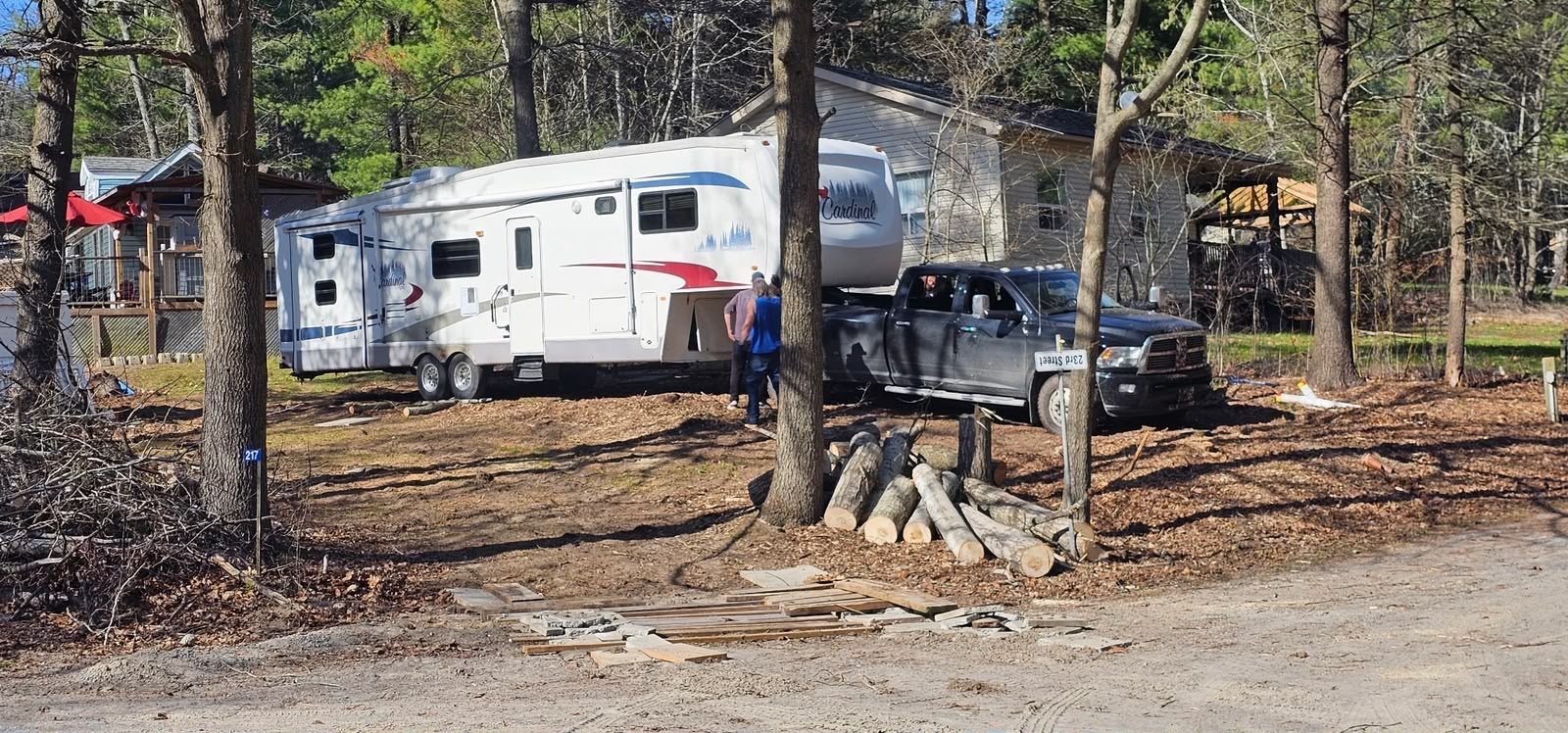
So this page is written the way a Muskoka move actually has to be planned. Not "we serve Muskoka and area" with a phone number, but which body owns the last stretch of road in front of your lot, what that body allows on it in the month you picked, whether your unit is wide enough to need a permit, how many authorities have to sign off on the route, and what the ground at the far end is going to do to your blocking over the next twelve months. We have read the District's load restriction and road maintenance pages, both Towns' reduced load pages, both Towns' building permit pages, Bracebridge's online permits page, the province's seasonal load listings and both Ontario Parks camping pages, and written down what they actually say. That includes where they disagree with each other and where they say nothing at all.
The communities we run into regularly: Bracebridge, Gravenhurst, Huntsville, Port Carling, Bala, Torrance, MacTier, Baysville, Dorset, Milford Bay, Utterson, Rosseau, Windermere, Severn Bridge and the properties strung along Lake Muskoka, Lake Rosseau, Lake Joseph, Skeleton Lake and the Muskoka River. If a truck with a loaded gooseneck behind it can reach the address, we work there.
Three road authorities, one trip
Start here, because almost everything else on this page depends on it.
Muskoka is a two tier system. The District Municipality of Muskoka is the upper tier, and it owns and maintains the District Transportation Network, which is the set of numbered Muskoka Roads that stitch the district together. Underneath it sit the area municipalities, including the Town of Bracebridge and the Town of Gravenhurst, each of which owns and maintains its own local streets. Layered across the top are the provincial highways, principally Highway 11, which belongs to the Ministry of Transportation and to nobody local at all.
That structure is ordinary. What is not ordinary is how visible it becomes in the spring. Each of those authorities has the power to restrict loads on its own roads during the thaw, and each of them exercises it independently. The result is that a move from a Gravenhurst driveway to a Bracebridge seasonal site in April is one trip in your head and three regulatory regimes in ours, potentially four once the route touches Highway 11.
Why a mover cares
Because the paperwork and the weight limit follow the road authority, not the destination. We ask for the exact civic address at both ends rather than the town, because the town does not tell us which roads the load has to travel on and the address does.
The District of Muskoka half load rule
The District Municipality of Muskoka publishes its position on its load restrictions page. The restriction applies to vehicles exceeding five tonnes per axle, and the District says that temporary signs will indicate when a road is restricted to vehicles exceeding five tonnes per axle.
Two things are worth pulling out of that. The first is that it is a per axle rule, not a gross weight rule. Five tonnes is 5,000 kilograms, and it is measured on each axle rather than on the whole combination. A truck and trailer that would be nowhere near an overall limit can still be over the limit on one axle, and that is the number the rule reaches. The second is that the restriction is announced by signage on the specific roads affected rather than as a blanket district wide prohibition you could look up once and be done with.
The District cites By-Law 2016-4 and By-Law 2018-12 as the authority for the restriction. Those are District by-laws governing District roads, and they do not reach the streets inside Bracebridge or Gravenhurst, which have their own.
Dates set annually, and what that does to a booking
Here is the sentence that changes how you plan a spring move in Muskoka. The District states that half load restrictions are generally from March to May, and that exact dates are set annually, dependent on road conditions and temperatures.
Read that carefully, because it is a genuinely different kind of statement from what most Ontario municipalities publish. Barrie publishes March 1 to April 30 and you can put it in a calendar in December. The County of Simcoe does the same. The District of Muskoka does not commit to dates in advance at all. It gives you a three month window and tells you the real answer depends on the weather, which means the honest planning answer for a District road is that any move between the beginning of March and the end of May might be caught.
That is not the District being unhelpful. It is the District being accurate about a district where the frost genuinely does come out of the ground at different times in different years. But it does mean that if you are moving on a District road in that window, the only reliable way to know is to check at the time, and the practical consequence is that we build more slack into spring Muskoka bookings than we do anywhere else we work.
Exemptions are not typically granted
The same District page carries a sentence we quote to customers regularly, because it saves a lot of wasted effort: exemptions are not typically granted during the half load restriction period.
We take that at face value. We do not tell customers we can get them an exemption, we do not imply that a phone call from a carrier carries weight it does not carry, and we do not book a spring move on the assumption that one will come through. What we do instead is plan around the restriction, which in practice means one of four things.
- Move outside the window. Where the date is genuinely flexible, this is almost always the cheapest and simplest answer. Late June through September is the easy season up here.
- Use the exempt roads where the route allows it. Both Towns publish lists of roads that stay open, and they are set out in full further down this page. Whether they help you depends entirely on where your address sits.
- Split the job. Sometimes the right answer is to move the unit into storage before the window opens and deliver it to the site after the window closes, which is two short moves instead of one caught one.
- Talk to the road authority. If the move truly cannot wait, that conversation belongs with the body that owns the road, not with us. We will tell you which body that is.
The District permit sentence people miss
The District's load restrictions page carries a second statement that has nothing to do with the spring thaw and applies all year: an oversize and overweight permit is required for anyone wanting to move loads exceeding Ontario Ministry of Transportation legislated limits.
That matters because it is easy to read a page headed load restrictions, note that it is May, decide the seasonal restriction is over and stop reading. The permit requirement is not seasonal. If your unit is over the province's legislated dimensions, and most park models and every mobile home are, you are in the permit system in July exactly as much as in March. The seasonal restriction and the oversize permit are two separate systems that happen to be described on the same page.
Bracebridge runs its own calendar
The Town of Bracebridge does not follow the District's approach. It publishes dates, in advance, by by-law.
Its reduced load limit notice for 2026 states that effective Monday, March 9 at 12:01 a.m., the annual reduced load limit will be in place, and that the load limit will remain in effect until 11:59 p.m. on Sunday, May 31. The authority cited is By-Law 2022-045, made under section 122(7) of the Highway Traffic Act, R.S.O. 1990, c.H.8 as amended.
So on the face of it, Bracebridge gives you what the District does not: a start date, a start time, an end date and an end time, all published before the season begins. That is genuinely more useful for planning. It is also, as it turns out, not the whole story.
The four words that decide when it ends
The Town's road operations page states the restriction slightly differently. It says a limit of 5 tonnes per axle is in effect until May 31st or a date determined by staff.
Those last six words are the important part, and they are the reason the published end date on the notice is a ceiling rather than a commitment. Staff can end the restriction earlier. The by-law date is the outside edge of the period, not a fixed duration, and in a year where the frost comes out early there is no reason for the Town to keep a restriction running on roads that no longer need it.
What this means when you book
If you are hoping the restriction lifts early, you cannot plan on it, but you can ask. If you are planning around the restriction being in place, plan to the published date and treat an early end as a bonus. We do the checking either way as part of quoting a spring job.
The year Bracebridge moved the end date up
This is not hypothetical. It happened in 2026, and both versions are still on the same page.
The original notice says the load limit will remain in effect until 11:59 p.m. on Sunday, May 31. Above it sits an update dated May 6, 2026, stating that the annual reduced load limit will end effective 11:59 p.m. on Friday, May 15.
That is sixteen days earlier than the published date, announced nine days before it took effect. For a carrier that is a useful thing to know about. For a homeowner who booked a move for the last week of May on the basis of the original notice, it is the difference between a restricted route and an unrestricted one, and nobody would find out unless they went back and reread a page they had already read.
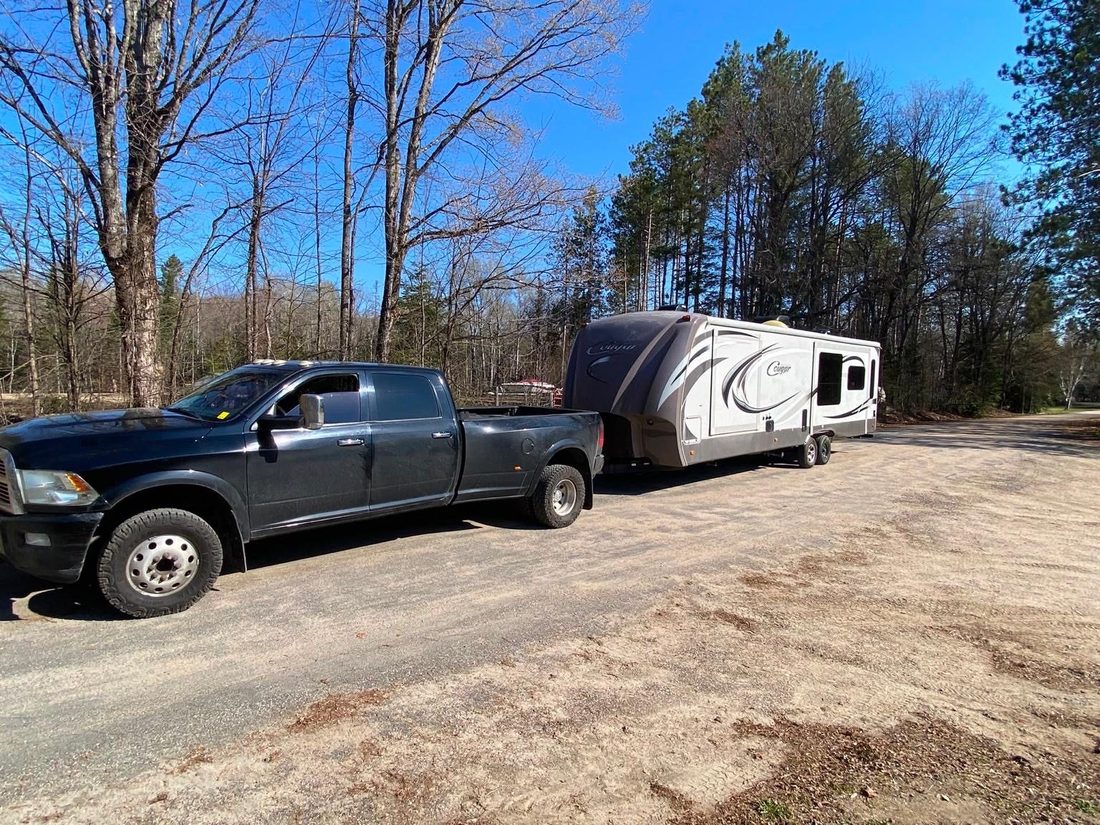
We mention it because it is the clearest single illustration of why we re check dates rather than quoting them from memory, and why this page tells you where the dates live rather than just telling you what they are. A published municipal date in Muskoka is accurate on the day it is published. It is not a promise about May.
Signs are a reminder, not the rule
Both the District and the Town of Bracebridge address signage, and Bracebridge puts it in the clearest terms we have seen anywhere in Ontario. Its notice states that temporary signage will be installed to remind drivers of the restrictions, however the absence of signage does not waive the restriction.
That sentence is doing a lot of work. The reasonable assumption, if you drive onto a road in April and there is no reduced load sign at the entrance, is that the road is not restricted. Bracebridge is telling you that assumption is wrong. The sign is a courtesy. The by-law is the rule, and the by-law applies whether or not anyone got to that particular road with a sign.
The District words it more softly, saying temporary signs will indicate when a road is restricted, but the underlying legal position is the same: the restriction comes from the by-law, not from the sign. If you are moving a heavy unit in the spring, the question to ask is not whether you saw a sign. It is which authority owns that road and what its by-law says this year.
Where the Bracebridge tonnage figure actually lives
A small point of sourcing that matters if you go looking for this yourself. The Bracebridge reduced load notice, the page that gives you the dates, the by-law number and the Highway Traffic Act citation, does not state a tonnage figure anywhere. It tells you when the restriction runs without telling you what the restriction is.
The tonnage is on the road operations page instead, in the sentence quoted above: a limit of 5 tonnes per axle. So the two halves of the Bracebridge rule sit on two different pages of the same Town website, and reading either one on its own leaves you with half the answer. That is worth knowing before you conclude a page is incomplete or a figure is missing.
The nineteen Bracebridge roads that stay open
Bracebridge publishes a list of roads exempt from the reduced load restriction, with the exact extent of each one. There are nineteen entries. Here they are as the Town sets them out:
| Road | Extent |
|---|---|
| Armstrong Street | Wellington Street (MR 118 West) to Wellington Street (MR 118 West) |
| Ball's Drive | Muskoka Road 118 West to West Mall Road |
| Barron Drive | Taylor Court to the end of the road |
| Cedar Lane | Taylor Road roundabout (MR 42) to Fraserburg Road (MR 14) |
| E.P. Lee Drive | Lagoon Lane to Robert Dollar Drive |
| Gray Road | Monica Lane to the end of the road |
| Keith Road | Ecclestone Drive (MR 118 West) to its southerly end |
| Kirk Line | Rosewarne Drive to Highway 11 |
| Kirk Line West | Highway 11 to 100 metres westerly |
| Kirkhill Drive | Ecclestone Drive (MR 118 West) to the end of the road |
| Lagoon Lane | Ecclestone Drive (MR 118 West) to its westerly end |
| Monica Lane | Cedar Lane to Gray Road |
| Robert Dollar Drive | Ecclestone Drive (MR 118 West) to E.P. Lee Drive |
| Rosewarne Drive | Taylor Road to Kirk Line |
| Salmon Avenue | Wellington Street (MR 118 West) until the end of the road |
| Taylor Court | Taylor Road until the end of the road |
| Taylor Road | Highway 11 to Rosewarne Drive |
| West Mall Road | Muskoka Road 118 West to Ball's Drive |
| Winhara Road | Ecclestone Drive (MR 118 West) to Town of Gravenhurst boundary |
One note on that list, offered because we would rather you know than think we made a transcription error. The Town's own page spells the road two different ways within three lines of each other: the Barron Drive entry runs to Taylor Court, and the entry for the road itself is printed as Tayor Court. We have written it correctly above. If you are searching the Town's page for it, try both.
How to read that list before you book
Look at where those roads are and a pattern appears immediately. Ecclestone Drive, Muskoka Road 118 West, Taylor Road, the industrial roads off them, and the connections to Highway 11. This is not a list of residential streets. It is the commercial and industrial spine of Bracebridge plus the roads that get you onto the provincial highway.
That tells you what the exemption is for. It exists so that businesses on those roads can keep operating and so that heavy traffic can reach the highway without being routed through the town, not so that a homeowner on a side street can move a park model in April. An exempt road helps you if your route can actually use it end to end. If your address is on a restricted residential street, an exempt road two kilometres away does not solve your problem, because you still have to get from one to the other.
That is precisely why we ask for the civic address rather than the town. Two Bracebridge properties can have completely different answers in April depending on which street they sit on, and the only way to know is to look at the actual route.
Gravenhurst publishes fixed dates instead
The Town of Gravenhurst takes a third approach, different again from both the District and Bracebridge. It publishes the season's dates on its reduced load period and permits page, plainly and in advance, with no discretionary clause attached.
For 2026 the Town states that the reduced load period begins Monday, March 9, 2026 and ends Saturday, May 16, 2026. The restriction is 5 tonnes per axle. The exemption list is published as Schedule A to By-law 2009-019.
A small note on the source, in the interest of not quietly correcting a municipality without saying so: the Town's page prints the word axle as axel. It is a typo on their page and nothing turns on it. The figure is five tonnes per axle, the same figure the District and Bracebridge use.
What is genuinely different is the shape of the commitment. Gravenhurst gives a start date and an end date with no "or a date determined by staff" attached. That is the most plannable of the three positions, and if your whole move sits inside Gravenhurst you can work to those dates with more confidence than you can anywhere else in the district.
The eight Gravenhurst roads that stay open
Gravenhurst's exempt list is much shorter than Bracebridge's. Eight roads, published as Schedule A to By-law 2009-019:
| Road | Extent |
|---|---|
| Clarence Street | From Gillan Drive South to Edward Street |
| Edward Street | Entire length |
| George Beard Lane | Entire length |
| Gillan Drive | Entire length |
| Industrial Drive | Entire length |
| Progress Road | Entire length |
| Talisman Drive | Entire length |
| Winhara Road | From Langford Drive, north to town limits |
The same pattern as Bracebridge, only more concentrated. Industrial Drive, Progress Road, Talisman Drive, Gillan Drive. This is the industrial end of Gravenhurst, exempted so that the businesses on it can keep receiving and shipping through the thaw. Six of the eight are exempt for their entire length, which is administratively simpler than Bracebridge's approach of naming precise extents, and it reflects the fact that these are short purpose built roads rather than long routes.
The one road on both lists
Put the two lists side by side and one name appears on both. Winhara Road.
Bracebridge exempts it from Ecclestone Drive, which is Muskoka Road 118 West, to the Town of Gravenhurst boundary. Gravenhurst exempts it from Langford Drive north to the town limits. Those two extents meet at the municipal boundary between the two towns.
That is the two Towns quietly coordinating, and it is the only place in either list where you can see it happening. Winhara Road crosses the boundary, and rather than each Town exempting only its own convenient stretch and leaving a restricted gap in the middle, both have exempted their side right up to the line. The practical result is a continuous exempt route across the boundary during reduced load season.
Do not over read this
One coordinated road is not a coordinated system. The dates still differ, the by-laws still differ, and the District's roads between the two towns are on a third calendar again. Winhara Road is a useful piece of route knowledge, not evidence that the three authorities are working from one plan.
The three calendars side by side
This is the table we wish existed on one municipal website, and does not. Everything in it is drawn from the three official pages linked above, for the 2026 season.
| Authority | Roads it covers | 2026 dates | Weight | Authority cited |
|---|---|---|---|---|
| District Municipality of Muskoka | Numbered Muskoka Roads between the towns | Not published in advance. Generally March to May, exact dates set annually on road conditions and temperatures | Five tonnes per axle | By-Law 2016-4 and By-Law 2018-12 |
| Town of Bracebridge | Streets inside Bracebridge | March 9 at 12:01 a.m. to May 31 at 11:59 p.m. as published, ended early at May 15 at 11:59 p.m. by an update dated May 6, 2026 | 5 tonnes per axle | By-Law 2022-045, under section 122(7) of the Highway Traffic Act |
| Town of Gravenhurst | Streets inside Gravenhurst | Monday, March 9, 2026 to Saturday, May 16, 2026 | 5 tonnes per axle | Schedule A to By-law 2009-019 |
Three observations worth drawing out of it.
First, the weight is the same everywhere. Five tonnes per axle is the common standard across all three, and it is the standard across most of the province. Nobody in Muskoka is running an unusual weight limit. The variation is entirely in the calendar.
Second, both Towns started on the same day. Monday, March 9, 2026 is the start date in Bracebridge and in Gravenhurst. If you were only ever going to look at one thing, the start of the season is the least confusing part of it.
Third, the ends are where it falls apart. Gravenhurst ended May 16. Bracebridge ended May 15, a day earlier, but only because of an update published ten days before, against a by-law date of May 31 which is fifteen days later than Gravenhurst. And the District never published an end date at all. Anyone planning a mid May move on the basis of one authority's published date is working from incomplete information about the other two.
Section 122 of the Highway Traffic Act
The Bracebridge notice cites its legal source explicitly, which not every municipality does: By-Law 2022-045 is made under section 122(7) of the Highway Traffic Act, R.S.O. 1990, c.H.8 as amended.
We are going to be careful here, because this is the kind of place where a transport company page usually starts paraphrasing a statute it has not read. Section 122 is the part of the Highway Traffic Act that deals with weight restrictions on highways, and subsection (7) is the provision Bracebridge relies on for its municipal reduced load by-law. That is what the Town says, and we are reporting the Town's own citation of its own authority.
What we are not going to do is quote the section text or characterise exactly what it permits, because Ontario's e-Laws site did not return readable text to us when we went to check it. The link above goes to the statute so you can read it yourself. If the precise scope of the provision matters to your situation, that is a question for a lawyer or for the Town, not for a mover who has told you honestly that he could not open the page.
The Bracebridge oversize load permit
Separate system, separate page, separate set of rules, and it runs all year rather than seasonally.
The Town of Bracebridge issues oversize and overweight load permits through its online permits page. If a load exceeds the province's legislated dimensions, it needs one. In practice that means most park models and every mobile home, because these units are usually over 2.6 metres wide, which is the width that triggers an oversize permit almost everywhere in Ontario.
A standard travel trailer or fifth wheel is generally within legal width and does not need a permit at all. This is the single biggest fork in a Muskoka quote: whether the unit is a legal load or a permit load. If you tell us the make, model and width, we can tell you which side of that line you are on before we quote.
The permit sentence that catches people out
The Bracebridge online permits page carries one sentence that is more important than the fees, and it is the sentence we get to explain most often. In the Town's own words: approval is only given for roads under the jurisdiction of the Town of Bracebridge. Depending on the route, approval may also be required from the Ministry of Transportation, the District Municipality of Muskoka and other local municipalities.
That is one permit and up to four authorities. Read it slowly, because the natural assumption is exactly wrong. A Town permit feels like permission to make the move. It is not. It is permission to be on Town roads. The moment the route touches Highway 11 you are on Ministry of Transportation ground. The moment it touches a numbered Muskoka Road you are on District ground. The moment it crosses into Gravenhurst or Huntsville or Muskoka Lakes you are on another municipality's ground.
What this means for a real move
A park model coming off a lot on Muskoka Road 118 West, through Bracebridge, up Highway 11 and onto a seasonal site in another township can touch all four in twenty five minutes of driving. Establishing which authorities a specific route requires, and getting each of them squared away, is part of what we do rather than something we hand back to the customer.
What the Bracebridge permit costs and how long it takes
The Town publishes three permit categories with figures, on the same online permits page:
| Permit type | Fee |
|---|---|
| Annual | $200 |
| Project | $150 |
| Single trip | $60 |
For a homeowner moving one unit once, single trip is the relevant category. Annual and project permits are aimed at carriers and contractors running repeated movements, either continuously through a year or across the life of one job.
The Town also states that permits take 5 days to process. That number is the reason more Muskoka moves get pushed back a week than any other single factor, and it is entirely avoidable if you know about it. The clock does not start when you decide to move. It starts when a complete application is in front of the Town.
If you are working to a fixed date, a closing, a park season opening, a site handover, tell us the date at the first conversation rather than the last. We work backwards from it, and five business days is comfortable lead time right up until the moment it is not.
Gravenhurst permits, and the number we will not print
Gravenhurst's reduced load page refers to permits and points at the Town's 2026 Fees and Charges Bylaw for the amounts. It does not print the amounts on the page itself.
So we are not going to give you a figure. We are not going to assume Bracebridge's $60, $150 and $200 carry across the town line, because there is no reason at all to think two independent municipalities set identical fees, and we are not going to estimate. What we can tell you is where to get it: the Town's Public Works and Operations department, at 705-687-3412.
If you are booking a Gravenhurst move with us, we make that call as part of the job and the actual figure appears in your quote rather than a guess. This is the same standard we apply everywhere on this site. A number we cannot source does not get printed, and the gap gets named as a gap.
Ontario 511, and the line at the Severn River
The province runs Ontario 511, which publishes seasonal load restrictions on provincial highways. It is the right place to check Highway 11, and it is worth understanding what it does and does not cover.
The page divides the province in two. Southern Ontario restrictions run in March and April. Northern Ontario restrictions run in March, April and May, a month longer, for the obvious reason. The dividing line is described as a line formed by the Severn River to Regional Road 169, continuing east through a series of highways and regional roads.
The Severn River is the southern boundary of Muskoka. So the line the province draws between its southern and northern seasonal load regimes runs along the bottom edge of the district you are moving into. Muskoka sits on the northern side of it, which is the province's own acknowledgement that the frost here behaves differently from the frost an hour south, and it lines up with what the three local authorities do independently: a season that runs into May rather than ending in April.
What Ontario 511 will not tell you is anything about municipal roads. Its schedules cover provincial highways. When we checked it, Schedule 1, Schedule 2 and Schedule 3 each read none at this time, with the page last updated June 15th, 2026. A clear Ontario 511 means the provincial highways are clear. It says nothing whatsoever about whether Bracebridge, Gravenhurst or the District have restrictions running on the roads at either end of your trip.
Load posted bridges, and the page we could not read
We would like to give you a list of weight restricted bridges in Muskoka. We cannot, and we are going to tell you why rather than leave a conspicuous silence.
The District's own load restrictions page, which is the page that would most naturally carry them, lists no bridges at all. The District does publish a roads and bridges page, and we tried to read it four separate times. Every attempt was refused by the site's robots file, one of them failing on a certificate error before it got that far. The same happened with the District's access policy document, its road closures and restrictions page, and its roads and transportation directory.
So the honest position is this: we do not know whether Muskoka has posted bridges, where they are, or what they are posted at. We are not going to say there are none, because a page we could not open is not evidence of absence. We are not going to speculate about likely candidates. If your route crosses a bridge and your unit is heavy, that is a question for the District at 705-645-2100, and it is one we ask on your behalf when we are routing a heavy move.
Muskoka Road, not Highway
A small piece of local vocabulary that saves confusion on the phone, and that we get wrong on this site nowhere else because nowhere else has the issue.
The numbered roads that connect the Muskoka towns are District roads and they are properly called Muskoka Roads. Muskoka Road 118 West is the one that runs through Bracebridge, and it appears in the Town's own exempt road list under that name, sometimes abbreviated to MR 118 West. Muskoka Road 169 runs down toward Gravenhurst and the Severn. Muskoka Road 42 and Muskoka Road 14 appear in the Bracebridge exempt list as the roads that Cedar Lane runs between.
Highway 11, by contrast, genuinely is a highway. It is a provincial highway under the Ministry of Transportation, and it is the spine that everything else hangs off. Kirk Line, Kirk Line West and Taylor Road all appear on the Bracebridge exempt list specifically defined by their relationship to it.
Calling a District road a highway is harmless in conversation and actively misleading when you are working out who has to approve a permit, because the answer for a Muskoka Road is the District and the answer for Highway 11 is the province. We use the correct names on this page for that reason.
Granite rock and swamp
Everything above this point is about calendars and paperwork. This section is about the thing underneath the trailer, which is the part of a Muskoka job that decides whether the unit stays level after we leave.
The District does not leave this to interpretation. Its road maintenance page states plainly that generally, in Muskoka, the subgrade consists of granite rock, which is costly to build on, and swamp, which is challenging to build on because of drainage and frost heave. That is the District describing its own road network, in its own words, on its own website. It is not a marketing line and it is not our opinion.
We quote it here because it is the single most useful sentence a Muskoka property owner can read before booking a levelling and blocking job. The two ground types it names are opposite problems with opposite solutions, and a property can easily have both within fifty metres.
Granite is unforgiving in one direction. It does not settle, it does not compress, and it does not care how heavy the unit is. What it does instead is refuse to be flat. Shield rock comes up at whatever angle it feels like, and where it surfaces under a site you cannot dig it out with anything we own. You build up from it, which means more blocking, more shimming and more material, and it means the level you set is the level it stays, because nothing under you is going to move.
Swamp is the opposite in every respect. It is level and it is soft, so the first hour looks easy and the next spring does not. Organic ground holds water, water freezes, freezing ground lifts, and a unit that was dead level in September is out by an inch in April with no one having touched it. The District names frost heave specifically as the reason swamp is difficult to build on, and what is true of a road bed is true of a trailer pad sitting on the same material.
Most Muskoka properties are somewhere on the spectrum between those two, and the honest answer is that we do not know which one you have until we look. That is why we do not quote a Muskoka levelling job blind off a phone description of a flat site. Flat tells us nothing about what is under the flat.
Low volume roads, and what a PCI of 55 means
The same District page introduces a category that matters enormously for a heavy trailer and that almost nobody outside road maintenance has heard of. The District defines low volume roads, abbreviated LVRs, as roads carrying fewer than 500 vehicles per day. It reports that LVRs make up 19 per cent of the District Transportation Network, which it puts at 135 kilometres.
Then it publishes the number that matters. The District reports an average Pavement Condition Index of 55 out of 100 on its low volume roads, against an average of 59 out of 100 across Muskoka overall. Both figures are the District's own.
| District of Muskoka pavement figures | Published value |
|---|---|
| Low volume road definition | Fewer than 500 vehicles per day |
| Low volume roads as a share of the network | 19 per cent |
| Low volume road length | 135 km |
| Average PCI, low volume roads | 55 out of 100 |
| Average PCI, Muskoka overall | 59 out of 100 |
| Transportation network replacement cost | $1.95 billion as of 2024 |
A four point gap sounds small written down. In practice it is the difference between a road surface that behaves predictably under a loaded gooseneck and one that does not. PCI is a condition score, and the roads scoring lowest are by the District's own definition the quietest ones, which in Muskoka means the ones running out toward the lakes. Those are exactly the roads a seasonal site sits on.
We are not publishing this to criticise anybody's road maintenance. A district with a granite and swamp subgrade and a $1.95 billion transportation network to keep up is dealing with a genuinely hard problem. We publish it because it is the strongest available evidence for something we say on the phone constantly: the last five kilometres of a Muskoka delivery is usually harder than the ninety before it, and the quote has to reflect that.
The size of the network you are moving on
The District also publishes a network size figure, and it is worth being precise about what it actually says, because it is easy to quote wrongly. The figure of more than 700 kilometres of District owned roads appears on the road maintenance page in the context of winter operations. It is a winter operations figure, not a bare network total, and we attribute it that way rather than rounding it into a general statistic.
Set against that, the low volume road figure of 135 kilometres at 19 per cent of the District Transportation Network describes a differently defined network. Two numbers, two definitions, one authority. We are not going to reconcile them for you and we are not going to pretend they are the same measurement, because the District does not present them as the same measurement.
What both figures establish is scale. Muskoka is not a town with a few roads. It is a district with hundreds of kilometres of its own asphalt on top of whatever the towns maintain, plus Highway 11 running through the middle of it under provincial jurisdiction. When we tell you that a Muskoka route needs to be worked out rather than assumed, that is why.
Gravenhurst counts its own roads differently
The Town of Gravenhurst publishes its own network figures on its roads and sidewalks page, and they are worth reading beside the District numbers because they are broken out by surface type, which the District figures are not.
Gravenhurst states that its staff maintains over 69 kilometres of asphalt roads, 63 kilometres of gravel roads, 132 kilometres of surface treated roads and approximately 24 kilometres of sidewalks.
| Gravenhurst road surface | Published length |
|---|---|
| Asphalt | Over 69 km |
| Gravel | 63 km |
| Surface treated | 132 km |
| Sidewalks | Approximately 24 km |
Read the first three rows again. Asphalt is the smallest of the three road categories. Gravel and surface treated roads together come to 195 kilometres against 69 kilometres of asphalt, which means that on the Town's own numbers, roughly three quarters of the Gravenhurst road network is not conventional asphalt.
That is not a complaint either. Surface treatment is a completely sensible way to maintain a rural road network at a sustainable cost. But it changes what a spring delivery looks like. Gravel and surface treated roads soften under thaw in a way asphalt does not, which is precisely why reduced load seasons exist, and it is the practical reason a Gravenhurst booking in March is a different conversation from the same booking in July.
Why we put the road surface numbers on a transport page
Because they answer the question people actually ask, which is why we will not commit to a spring date on a lake road. The answer is not that we are being difficult. It is that on the Town's own published figures most of the network is gravel or surface treated, and those surfaces are the reason the reduced load period exists in the first place.
Levelling and blocking on Muskoka ground
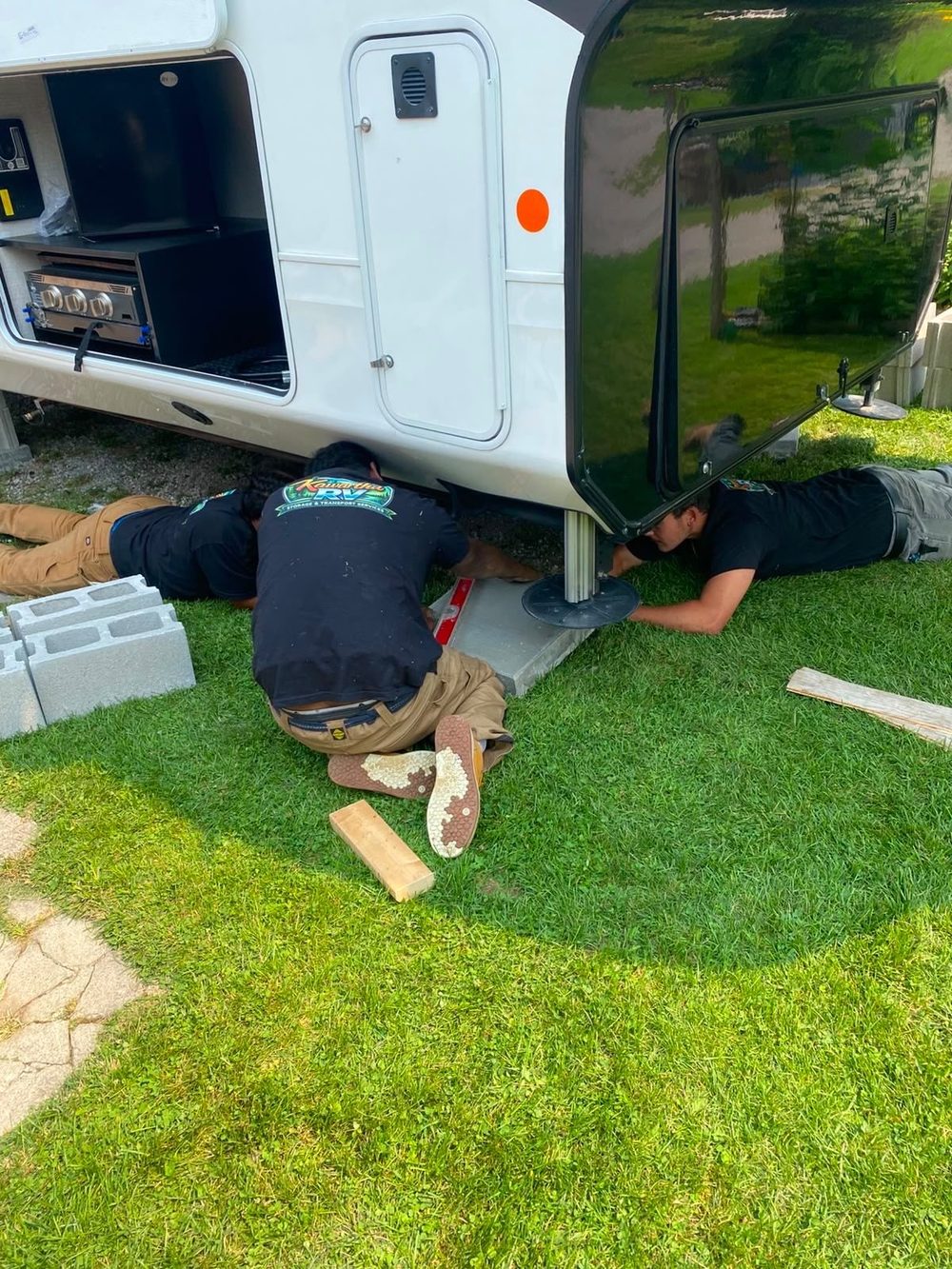
Levelling and blocking is $799 for a full set up, and that price is the same in Muskoka as it is in Beaverton. What changes in Muskoka is how long it takes and how much material goes under the unit, and the reason is everything described above: granite that will not let you dig down, and organic ground that will not let you trust what you built on.
The order of work does not change. We get the unit onto its final position first, because there is no point levelling something you are still going to move. Then the unit comes up on jacks, corner by corner, and blocking goes in underneath as it rises rather than being slid in afterward. Then it comes back down onto the blocking, and only then do we check level in both directions and start shimming.
What we are actually chasing is not a pretty bubble on a spirit level. It is the frame. A park model or a travel trailer carries its load through the frame rails, and if the frame is twisted then the doors bind, the windows go out of square, the slide will not seat and the roof seams work themselves loose over a season. Getting the frame flat is the job. The level is how we measure it, not what we are doing.
On granite the constraint is that you cannot go down, so you go up, and every extra course of blocking is another joint that has to be right. On soft or organic ground the constraint is that whatever you put down has to spread the load over enough area that it does not sink, which usually means a bigger footprint than the customer expected. Both of those cost time. Neither of them costs more than $799 for a standard full set up, and we would rather tell you that up front than surprise you with it.
What actually goes under a unit
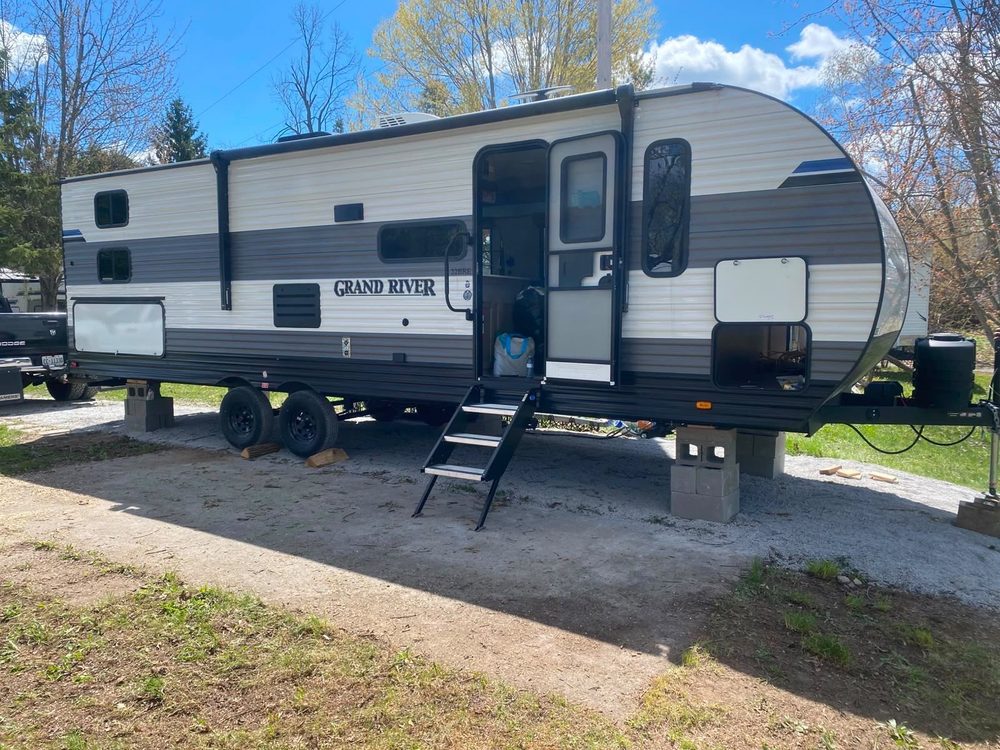
The single most common thing we are called out to fix is not a badly levelled unit. It is a correctly levelled unit sitting on blocking that was never going to hold, which then moved.
Blocking has to do three things. It has to carry the load without crushing, it has to spread that load over enough ground area that the ground does not give way under it, and it has to stay put horizontally when the unit is worked on, walked on, and pushed by wind on a long flat side. Solid concrete block does the first. A proper pad or footing under the block does the second. Keeping the stack low and wide, and cross stacking rather than tower stacking, does the third.
Things that do not work, all of which we have found under units in this region: wood scraps and offcuts stacked to height, which compress unevenly and rot from the bottom in wet ground. Hollow core block laid on its side, which is not rated to carry load in that orientation. Patio slabs used as the sole footing on soft ground, which crack. Single tall stacks under one point of a long frame, which is the arrangement most likely to walk sideways over a winter.
None of that is exotic knowledge. It is just the kind of thing that gets skipped when a unit is dropped somewhere in a hurry in July and nobody comes back to it. If your unit was set up by whoever delivered it and never checked since, it is worth a look before you spend money on anything else.
Freeze and thaw, and why a level unit stops being level
This is the section that explains our guarantee, so it is worth reading carefully.
The District names frost heave as one of the two reasons its swamp subgrade is difficult to build on. Frost heave is not a Muskoka speciality, but Muskoka gets a harder version of it than the shoreline communities further south, because the same organic and poorly drained ground that makes it worse is exactly the ground a lot of seasonal sites sit on.
The mechanism is simple. Water in the ground freezes, ice takes up more room than water, and the ground lifts. It does not lift evenly, because the water is not distributed evenly, so one corner of a pad can rise while the corner four metres away does not move at all. Then it thaws, and the ground comes back down, and it does not always come back to exactly where it started, particularly if the load pushed the softened ground sideways on the way down.
A unit that goes into winter dead level can therefore come out of winter out of level with nothing wrong with the set up at all. That is not a workmanship failure. It is the ground doing what the District says the ground here does.
Which is why our 30 day guarantee is written the way it is. If a unit we set up shifts because of how we did the job, we come back and redo it at no charge. Weather and ground conditions sit outside that, and we say so before you book rather than after you call. We would rather be clear and keep the customer than be vague and lose them in April.
The practical advice, which costs you nothing, is to check level every spring on any unit that stays out over winter in this region. Ten minutes with a level on the frame rails in April tells you whether anything moved, and a small adjustment caught in April is a far cheaper problem than a season of doors that will not close.
Deck and shed permits in Bracebridge
Almost every seasonal unit in Muskoka eventually grows a deck, and the deck is where the building department enters the story. This matters to us because we also do deck and shed moving, and because a deck attached to a unit we are about to move has to come off first, which is a job people routinely forget to budget for.
The Town of Bracebridge publishes its thresholds on its building permits page. On decks it is short and clear: a permit is required for building a porch or deck greater than 24 inches above grade, and a permit is not required for decks less than 24 inches from grade without a roof.
Read the exemption again, because it has two conditions and people only remember one. Under 24 inches is the first. Without a roof is the second. Put any kind of roof over a low deck and the exemption stops applying regardless of height.
On sheds and accessory structures the Town publishes both a list of triggers and a list of exemptions. A permit is required if a shed is more than 161 square feet, more than one storey, attached to another structure, used for any purpose other than storage, contains plumbing, or reaches 23 or more feet to the peak. Separately, a permit is required for a detached garage or accessory structure other than a shed at 160 square feet, which the Town also expresses as 15 square metres, or greater.
The exemption runs the other way and it is cumulative. A shed is exempt only if all of the following are true: smaller than 161 square feet, which the Town gives as 15 square metres, one storey in building height, not attached to or supporting any building or structure, used only for storage ancillary to a principal building on the lot, no plumbing, and 22 feet to the peak height.
| Bracebridge threshold | What the Town publishes |
|---|---|
| Deck or porch, permit required | Greater than 24 inches above grade |
| Deck, permit not required | Less than 24 inches from grade, without a roof |
| Shed, permit required | More than 161 sq ft, or more than one storey, or attached, or used for anything other than storage, or contains plumbing, or 23 or more feet to the peak |
| Shed, exempt | All of: under 161 sq ft (15 m2), one storey, not attached, storage only, no plumbing, 22 feet to the peak |
| Detached garage or accessory structure other than a shed | Permit required at 160 sq ft (15 m2) or greater |
Two numbers for the same threshold
Read the Bracebridge lists side by side and two things do not line up. We are pointing them out rather than smoothing them over, because if you are trying to work out whether you need a permit, you deserve to know that the published page can be read two ways.
The first is peak height. The trigger list says a permit is required at 23 or more feet to the peak height of the shed. The exemption list says a shed is exempt at 22 feet to the peak height. Those two statements leave the space between them undefined on the page as published.
The second is area. The shed threshold is given as 161 square feet, and the detached garage or accessory structure threshold is given as 160 square feet, with both tied to 15 square metres. Fifteen square metres converts to roughly 161.5 square feet, so the two figures are two different roundings of the same metric number applied to two different structure types.
What to do about it
Phone the Town. We are a transport company, not a building department, and the only correct answer to a threshold question that the published page answers two ways is the one you get from the people who issue the permit. Bracebridge Public Works can be reached at 705-645-5264, extension 3650, and the building permits page is the right starting point for anything to do with decks, sheds and accessory structures. We will happily move the deck once you know where you stand. We are not going to tell you what the by-law means.
Gravenhurst is the one town that publishes park model guidance
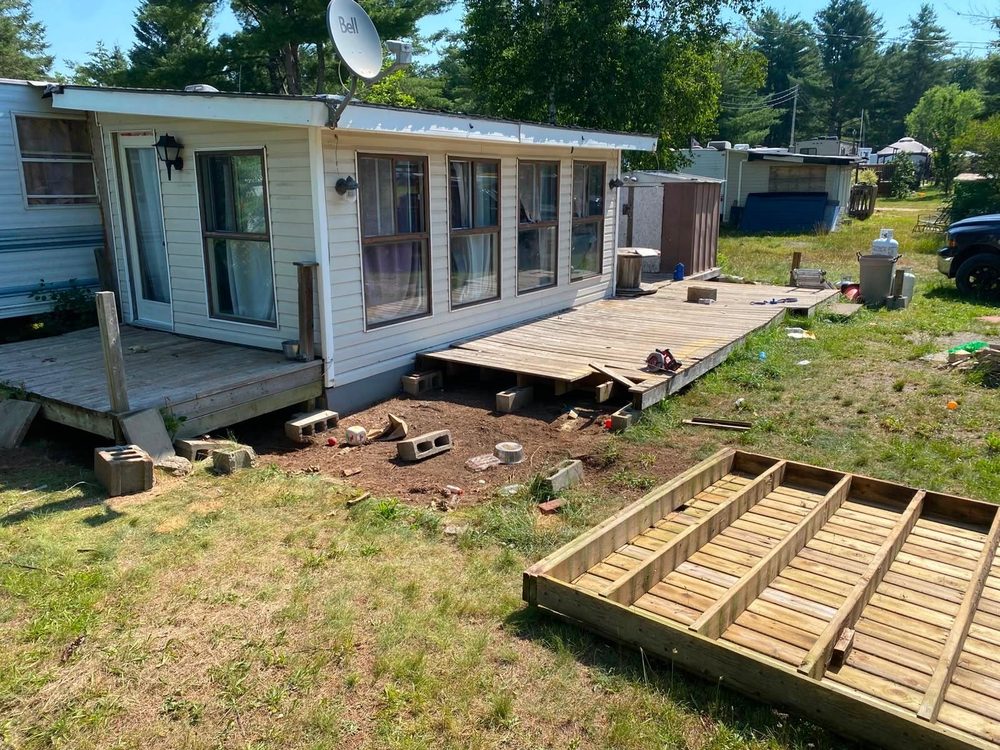
Here is the finding that surprised us most while researching this page, and it is the reason this section exists at all.
We looked for the words park model, mobile home and trailer on the building permit pages of every municipality we serve. On the Bracebridge building permits page, none of those three terms appears anywhere. That is not a criticism of Bracebridge; most municipalities we checked are the same, and the City of Barrie is no different.
The Town of Gravenhurst is the exception. On its building permits page, park models and mobile homes appear by name, more than once, in the resource material. The Town publishes a Park Model or Mobile Home Deck Drawing Guide, and it groups material under the heading Park Models and Mobile Homes.
That is genuinely unusual and it is genuinely useful. A deck drawing guide written specifically for a park model is exactly the document a seasonal owner needs and almost never finds, because a deck attached to a park model is not the same problem as a deck attached to a house. The unit can be moved. The deck usually cannot. What connects them, and how, is the whole question, and Gravenhurst is the only municipality in our service area that we found publishing guidance aimed squarely at it.
If you own a park model in Gravenhurst and you are planning a deck, start there before you start anywhere else. If you own one in Bracebridge, the honest position is that the published material is written for houses and sheds, and the sensible move is to phone the building department and describe what you actually have.
The Gravenhurst permit thresholds
Gravenhurst publishes its thresholds in metric first with imperial in brackets, and the numbers are different from Bracebridge, which is the whole point of putting both towns on one page.
A permit is required to construct or demolish a detached accessory structure, other than a shed, greater than 10 square metres, which the Town gives as 108 square feet. A permit is required to construct or demolish a detached accessory shed exceeding one storey in height or greater than 15 square metres, given as 161 square feet. And a permit is required to construct or demolish a deck greater than 10 square metres, given as 108 square feet, or attached to a building regardless of size.
A permit is not required to construct or demolish a standalone building under 10 square metres with no plumbing, or a detached accessory shed not exceeding one storey in height and not greater than 15 square metres. The Town also lists erecting fences and installing a pool as not requiring a permit.
| Gravenhurst threshold | What the Town publishes |
|---|---|
| Detached accessory structure, other than a shed | Permit required above 10 m2 (108 sq ft) |
| Detached accessory shed | Permit required if exceeding one storey or greater than 15 m2 (161 sq ft) |
| Deck | Permit required above 10 m2 (108 sq ft), or attached to a building regardless of size |
| Standalone building, exempt | Under 10 m2 (108 sq ft) with no plumbing |
| Detached accessory shed, exempt | Not exceeding one storey and not greater than 15 m2 (161 sq ft) |
| Fences and pools | Listed as not requiring a permit |
Now compare the deck rules across the two towns, because this is where a seasonal owner with property in both places gets caught out. Bracebridge draws the line on height: over 24 inches above grade and you need a permit. Gravenhurst draws it on area and attachment: over 10 square metres, or attached to a building at any size at all.
A small deck 12 inches off the ground and bolted to a park model is exempt on the Bracebridge height test and caught by the Gravenhurst attachment test. Same deck, same unit, twenty minutes apart on Highway 11, two different answers. That is not an error by either town. It is two municipalities regulating the same thing on different criteria, and it is exactly the kind of detail that makes a confident assumption expensive.
What none of them publish
We would rather show you the edge of what we could verify than pretend the edge is not there, so here is what we looked for and did not find.
- No load posted bridge list we could read. The District's roads and bridges page blocked automated access on every attempt we made, so we have no bridge weight, no bridge location and no bridge count to give you. We say more about that in the bridges section above. If your route crosses a structure you are unsure about, the District can be reached at 705-645-2100.
- No published Gravenhurst oversize permit fee. The Town's reduced load page points to its Fees and Charges by-law but does not state an amount, so we will not print one.
- No Bracebridge residential RV storage rule we could verify. The Town's zoning by-law is hosted on a document portal that blocked automated access, so we cannot tell you what Bracebridge permits by way of parking or storing a recreational vehicle on a residential lot. If that matters to your plan, ask the Town directly. It is a zoning question, not a transport question, and it is one we are not qualified to answer for you.
- No park model or mobile home wording in the Bracebridge building material. Confirmed by looking, not assumed. The words are simply not on the page.
- No maximum trailer length at either provincial park. Covered in the park sections below.
Five gaps on one page is more than we would like, and it is also the honest count. Everything else on this page came off a municipal, District or provincial source that we opened and read ourselves. Where we could not open it, we have said so and given you the phone number for the people who can.
Arrowhead Provincial Park
Arrowhead sits just north of Huntsville and it is the busiest provincial park delivery destination in Muskoka. Ontario Parks publishes its campground detail on the park's camping page, and the figures below come from there.
Arrowhead has 382 campsites spread across three campgrounds. Lumby is divided into North and South sections and has both electric and non electric sites. East River is described as offering private electric campsites. Roe is described as offering large, private, electric and well drained sites. Ontario Parks also lists seven pull through campsites with electrical service, located between East River and Roe, available year round.
| Arrowhead Provincial Park | What Ontario Parks publishes |
|---|---|
| Total campsites | 382 |
| Campgrounds | Three: Lumby (North and South sections), East River, Roe |
| Lumby | Both electric and non electric sites |
| East River | Private electric campsites |
| Roe | Large, private, electric and well drained sites |
| Pull through sites | Seven, with electrical, between East River and Roe, available year round |
| Total electrical site count | Not published |
| Maximum trailer or RV length | Not published |
The two campgrounds described as offering large or private electric sites are the ones we would look at first for anything substantial, and Roe in particular, because large and private are the two words that matter when you are backing a fifth wheel into a site with trees on both sides. But we would not book a specific site on that description alone, and neither should you. Call the park first. The site that reads well on a map can be the one with a hydro pedestal exactly where the tow vehicle needs to swing.
The seven pull through sites are worth knowing about for a different reason. A pull through means the unit does not have to be reversed into position, and reversing is where a delivery into a treed park site either goes smoothly or takes an hour. Seven is not many out of 382, so they go early, but if you are bringing something long they are the first thing to ask about.
Six Mile Lake Provincial Park
Six Mile Lake sits at the southwest edge of the district, down toward Georgian Bay, and its camping page publishes something Arrowhead's does not, which turns out to be the single most useful sentence in this whole section.
The park has seven campgrounds: Pine, Birch, Maple, Oak, Poplar, Lakeview Heights and Cedar. And Ontario Parks states directly that Pine and Birch campgrounds can accommodate large equipment and are equipped with hydro.
That is as close as we have found any Ontario Parks page in our service area to a straight answer on where to put a big unit. It is not a length limit and we are not going to convert it into one, but if you are bringing something substantial to Six Mile Lake, Pine and Birch are the two names to start the conversation with.
The page also notes that Cedar campsites are walk in sites only and have motorboat restrictions along their stretch of shore. Walk in means what it says. There is no delivering a trailer to a walk in site, and if a booking comes through for one we will tell you before we load rather than after we arrive.
| Six Mile Lake Provincial Park | What Ontario Parks publishes |
|---|---|
| Campgrounds | Seven: Pine, Birch, Maple, Oak, Poplar, Lakeview Heights, Cedar |
| Large equipment and hydro | Pine and Birch |
| Cedar | Walk in sites only, motorboat restrictions along that shore |
| Total campsite count | Not published |
| Total electrical site count | Not published |
| Maximum trailer or RV length | Not published |
Maximum trailer length, and the number nobody publishes
This is the question we are asked more than any other about provincial park delivery, and the answer is unsatisfying, so we are going to give it to you straight rather than dress it up.
Ontario Parks does not publish a park specific maximum trailer length for Arrowhead and does not publish one for Six Mile Lake. We looked at both camping pages and it is not there. We are not going to invent a figure, and you should be sceptical of anybody who quotes you one for a specific park without saying where it came from.
What does exist is a system wide booking convention. Camping sites across Ontario Parks can be reserved by trailer size, in categories up to 18 feet, up to 25 feet, up to 32 feet, and over 32 feet. That is a reservation category, not a park rule, and it tells you how the booking system sorts sites rather than what any individual site will physically take.
Ontario Parks also notes system wide that park roads can be narrow and winding. That is the constraint we actually plan around. A site rated for over 32 feet is of no use if the loop road to reach it will not take the turn, and the turn is not something either of us can assess off a website.
So the real answer is: book the size category you need through the reservation system, then phone the park and describe the actual unit and the actual tow vehicle before you commit. Two minutes on the phone with a park that knows its own loop roads is worth more than any number we could put on this page, and it is free.
Getting a load into and out of Muskoka
Muskoka has one obvious way in and several less obvious ones, and which one we use changes the job.
Highway 11 is the spine. It is a provincial highway, it runs north from the Severn through Gravenhurst and Bracebridge and on toward Huntsville, and for a unit coming up from the Kawarthas, Durham or the GTA it is the route for all but the last stretch. Everything about a Muskoka move is easier while you are still on it.
The complication is that almost nothing is actually on Highway 11. The destination is on a District road, then a town road, then usually a private lane, and each of those transitions is a change of authority and a change of surface. The Bracebridge exempt road list reads the way it does for exactly this reason: the roads that stay open are the ones connecting the highway to the industrial and commercial areas, which tells you where the Town expects heavy traffic to need to go, and it is not out to the lakes.
Coming across rather than up is a different problem. From Barrie the natural line is Highway 11 north, which is straightforward. From Collingwood, Wasaga Beach and Midland the route comes across the top of Simcoe County and into the southwest corner of the district, which is the Six Mile Lake side. From Kawartha Lakes and from our own base in Beaverton the practical line is west and then north, and that crossing of the Severn River is the same line Ontario 511 uses to divide its northern and southern half load seasons, which is discussed in the Ontario 511 section above.
The last part is always the same wherever you came from. The lane, the trees, the grade down to the water, and the turn at the bottom that was laid out for a car. We would rather see a photo of that before quoting than guess at it, which is what the quote section below is about.
When a Muskoka booking actually moves
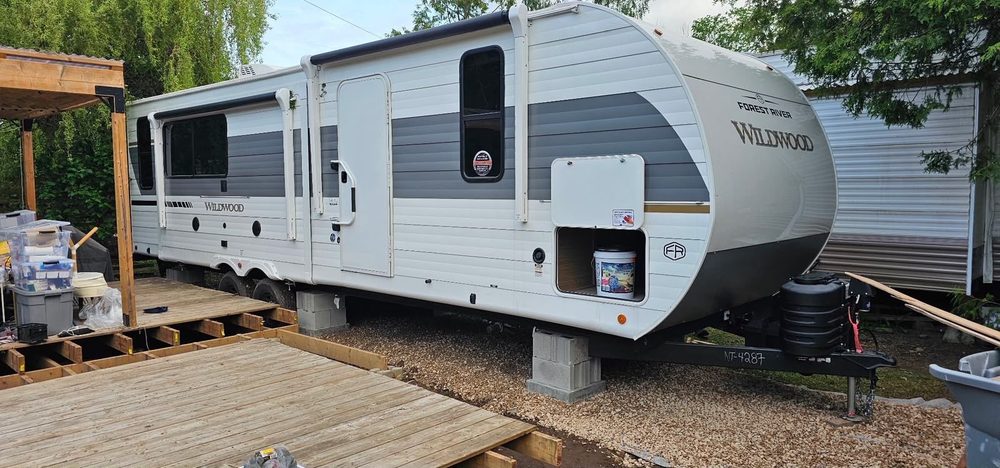
Put the three calendars together with the ground conditions and a Muskoka year has a shape that is different from anywhere else we work.
January and February are quiet for moves and busy for questions. Frozen ground actually carries load well, but access is the problem, and a lane that has not been plowed to a width that takes a truck and a trailer is not a lane we can use.
March to mid May is the restricted window. The District generally runs March to May with dates set annually. Bracebridge began March 9 and published an end of May 31 that it then moved to May 15 by its May 6, 2026 update. Gravenhurst published March 9 to May 16, 2026. In practice this is the period where the road authority, not the truck, decides what is possible, and where the nineteen exempt Bracebridge roads and the eight exempt Gravenhurst roads are the only certainties.
Mid May through June is when the season actually starts, and it is when everybody wants the same three weekends. If you want a unit in place for the May long weekend, that booking wants to exist in February, not in May.
July and August are steady. Ground is dry, roads are open, and the work is mostly repositioning, deliveries and levelling touch ups.
September and October are the second peak, and the busier of the two in our experience, because everything that went out in May comes back. Seasonal sites close, units go to storage, and the phone does not stop. Book the fall move at the same time you book the spring one if you can.
November and December are the last window before frost closes the soft ground, and they are a good time to get anything done that has been put off, because we are quieter and the ground has usually firmed up without the snow arriving yet.
What we do around Muskoka
One family, one truck, one CVOR. Everything below is done by the same people, which is the reason we can tell you honestly whether a job is worth doing rather than selling you the version that pays best.
- RV transport. Travel trailers, fifth wheels, toy haulers, tent trailers and motorhomes that cannot drive themselves. Driveway to driveway, dealer to site, site to storage, storage to site. Up to 30,000 lb on a 30 foot gooseneck, local tows from $400. This is the bulk of what comes into and out of Muskoka.
- Park model and mobile home moving. The permit heavy end of the work, and the end where the three Muskoka authorities matter most. These units are usually over 2.6 metres wide, which is the width that triggers an oversize permit almost everywhere, and in Bracebridge that means a Town permit plus, depending on the route, approval from the Ministry of Transportation, the District and other local municipalities.
- Levelling and blocking. $799 for a full set up. The service this region needs most, for the granite and swamp reasons set out above. We level to the frame, not to the floor, and we block wide and low rather than tall and narrow.
- Deck and shed moving. Decks come off before a unit moves and go back on after, and sheds get relocated across a site more often than people expect. Check the Bracebridge and Gravenhurst permit thresholds above before you rebuild rather than after.
- RV storage. $85 to $125 a month depending on size, at our yard in Beaverton. Useful for Muskoka owners whose property will not take the unit over winter, and useful during the restricted period when a unit needs somewhere to sit until the roads reopen.
- RV rentals. Delivered and set up on a site of your choosing, which for Muskoka usually means a seasonal site or a provincial park booking you have already made. You do not tow anything and you do not level anything.
Three guides on this site cover the questions that come up before and after a Muskoka job: how to prepare your RV for transport, which is worth reading the week before we arrive, RV transport cost in Ontario, which explains what actually drives a quote, and the Ontario RV winter storage checklist, which matters more here than it does further south.
Storage when the property will not take it
A specific Muskoka situation comes up often enough to deserve its own section. The seasonal site closes for the winter, the park or the landowner will not let the unit stay, and the owner lives somewhere the unit cannot go either.
Our yard is in Beaverton, which is roughly an hour and a half south of Bracebridge on the practical route. Storage runs $85 to $125 a month depending on size, and the units that come to us from Muskoka are usually park models and larger fifth wheels that have nowhere else to be.
The other version of this is the restricted period. If a unit needs to come off a site in March and the roads it would have to travel are load restricted, the choice is to wait or to move it to a yard while access still exists and bring it back when the restriction lifts. That second option is a two move job rather than one, and it costs accordingly, but it is sometimes the only way to hit a hard date.
We will tell you which of those makes sense for your situation, including when the answer is that neither does and the unit should just stay where it is until May.
What a Muskoka move costs
Our published prices are the same everywhere we work. What changes in Muskoka is distance and access, and we would rather set that out than pretend the number on the page covers every case.
| Service | Price |
|---|---|
| Local tow | From $400 |
| Levelling and blocking, full set up | $799 |
| Storage | $85 to $125 a month depending on size |
| Deposit to book a date | None |
| Maximum tow weight | 30,000 lb on a 30 foot gooseneck |
From $400 is a local tow. Muskoka is not local to Beaverton, so a Muskoka job is priced on the actual run, and the honest version of that is that most Muskoka transport work sits above the starting figure rather than at it. Distance is the first reason. The second is that the last part of a Muskoka job takes longer than the last part of a job in a subdivision, for every reason set out on this page.
Levelling at $799 is a flat price for a full set up and it does not change because the ground is granite. Access that requires a second pair of hands or an unusual amount of material is the exception, and we will say so when we look rather than adding it to an invoice afterward.
Permit costs are separate and they are not ours. The Bracebridge fees are published as $60 single trip, $150 project and $200 annual. Gravenhurst does not publish a fee amount for its permit. Those are Town charges, they get passed through at cost, and we do not mark them up.
There is no deposit to hold a date. We have never taken one and we are not going to start.
When to book
The short version: earlier than you think, and earlier again if your date falls in May or September.
For a May long weekend placement, February is not too early. For a fall removal, book it in July at the same time you are thinking about the summer. For anything in the March to May window, the booking is really a conversation about which roads are open rather than a date, and it wants to happen well before March so there is time to work out whether the job is even possible.
Because there is no deposit, booking early costs you nothing and changing a date costs you nothing. The only thing you lose by waiting is the date itself, and in this region the dates that go first are exactly the ones everybody wants.
Hours are Monday to Saturday, 7:00am to 7:00pm. Sunday closed, by appointment only. Call (647) 961-9257 or email transport@kawartharvrentals.ca. CVOR 204-617-206.
How to get the quote right the first time
A Muskoka quote goes wrong in one of two ways. Either we underquote because we did not know about the lane, or we overquote to cover ourselves because we did not know about the lane. Both are fixed by the same five pieces of information.
- What the unit is. Make, model and year if you have them, or the length and rough weight if you do not. A park model and a 24 foot travel trailer are different jobs even when they look similar on a driveway.
- Where it is now and where it is going. Addresses, not town names. The route matters here more than almost anywhere else we work, because it decides which of the three road authorities are involved and whether a permit is needed.
- When. Specifically whether the date falls inside a reduced load period, because if it does, the answer may be that the road decides, not us.
- Photos of the access. The lane, the turn off the road, the gate if there is one, and anything overhead. This is the single most useful thing you can send and almost nobody sends it unprompted.
- What happens at the other end. Whether the unit is being set up and levelled, whether a deck has to come off or go back on, and whether anything is already sitting where the unit needs to go.
Send those five and you will get a real number rather than a range. Send the first two and you will get a range, because that is all the information supports.
Our 30 day guarantee
If a unit we set up shifts or moves because of our workmanship, we come back and redo the job at no charge. Weather and ground conditions are outside that, and we say so up front.
Plainly: if a unit we levelled and blocked shifts within 30 days because of how we did the job, we come back and redo it at no charge. Weather and ground conditions sit outside it, and in Muskoka that distinction carries more weight than it does anywhere else on this site, for the frost heave reasons the District itself publishes and which we set out in the freeze and thaw section above.
We would rather draw that line clearly before you book than argue about it in April. It is the same guarantee we give in Beaverton, in Barrie and everywhere else we work, and it is the reason we spend as long as we do on the blocking rather than the level.