
Where we are based, and how far out we go
Kawartha RV Transport & Services is a family run RV and trailer transport company based in Beaverton, Ontario. Beaverton sits on the east shore of Lake Simcoe at the north end of Durham Region, which puts a lot of Ontario within a short run. The Kawarthas are east of us, Durham Region is south, Simcoe County and Muskoka are west and north, and Northumberland and Quinte are down the 401. Most of the work we do sits inside those areas. We also take long distance jobs right across Ontario and into the rest of Canada, and we tow units up to 30,000 lb with our own trucks and a 30 foot gooseneck.
This page is the map of where we work. Each of the ten areas below has its own page with the local road rules, the half load dates, the permit offices and the access conditions written out properly, because those things genuinely differ between municipalities that are twenty minutes apart. If you already know your area, go straight to it. If you want to understand why a move that is legal in one township needs a permit in the next one, read on.
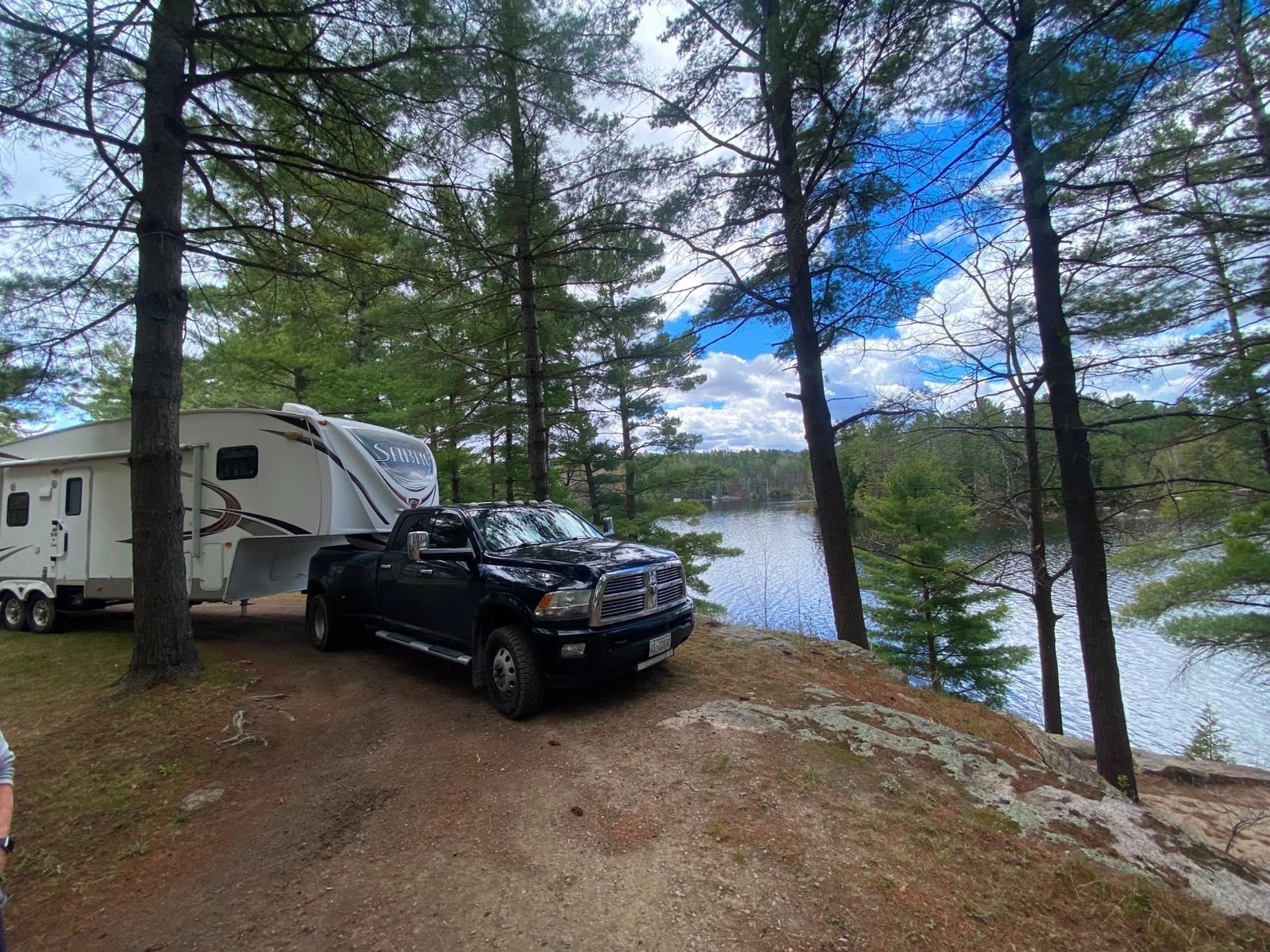
The ten areas we cover, and what is different about each
These are not ten copies of the same page with the town name swapped. Each one was written from that area's own published material: the municipality's road department pages, its building department thresholds, its zoning by-law and its road permit forms. Where a fact was not published, we say it was not published rather than filling the gap.
Peterborough, Keene, Buckhorn and Apsley
The county with the most cottage traffic we deal with, and the one with the clearest published rules. The City of Peterborough and Peterborough County run separate half load seasons and separate oversize permit systems with different fees and different notice periods, so a single trip into a lake road north of the city can touch both. Several townships in the county require a building permit for a park model trailer. Read the Peterborough transport page.
Kawartha Lakes, Lindsay, Bobcaygeon and Fenelon Falls
One single tier municipality covering an enormous area, which simplifies the permit question and complicates the road question. Kawartha Lakes sets its reduced load season by by-law and lifts it when conditions allow rather than on a fixed date, and it keeps a small number of streets restricted year round, two of them in Bobcaygeon. Read the Kawartha Lakes transport page.
Oshawa, Whitby, Ajax, Pickering and Bowmanville
The most jurisdictionally crowded area we serve. Durham Region controls the regional roads and five local municipalities control their own streets, each with its own dates, its own axle limit and in some cases its own permit fee. Oshawa and Durham Region both run oversize permit systems, with different thresholds, different lead times and different fees. Read the Oshawa and Durham Region transport page.
Port Perry and Scugog
Rural Durham, and the place where the gap between the by-law and the practice is widest. Scugog's traffic by-law defines a reduced load window running from the first of February to the end of May, while the season the township actually posts and lifts each year is much shorter. Knowing which one applies to your date is the difference between a move that happens and one that does not. Read the Port Perry and Scugog transport page.
Georgina and Sutton
Our own back yard, and the one with the most year round restrictions. Georgina keeps a list of town roads under a five tonne per axle limit twelve months a year, and several of them are exactly the lakeshore roads a trailer needs. York Region adds its own schedule on top, including segments restricted year round. Read the Georgina and Sutton transport page.
Barrie
A city that publishes its load restricted roads as a named list rather than a blanket rule, which is useful, and a zoning by-law that draws a hard line on living in a trailer outside a licensed trailer camp. Barrie's oversize permit process is run by the city itself. Read the Barrie transport page.
Muskoka, Bracebridge and Gravenhurst
Three layers of road authority in one district, and the longest reduced load seasons we deal with. The District of Muskoka sets its dates annually rather than publishing them in advance, Bracebridge and Gravenhurst each publish their own, and Muskoka states plainly that exemptions from the half load period are not normally granted. Read the Muskoka transport page.
Collingwood, Wasaga Beach, Midland and Georgian Bay
Simcoe County's consolidated traffic by-law is the most detailed reduced load document in our whole service area, right down to a schedule of road segments that are exempt from restrictions every day of the year. Wasaga Beach governs RV storage through a specific section of its zoning by-law. Read the Collingwood and Wasaga Beach transport page.
Cobourg, Port Hope and Brighton
Three neighbouring municipalities with three different answers on nearly every question. Cobourg's zoning by-law permits two stored recreational trailers on a lot, Port Hope's permits one, and Brighton's prohibits mobile homes in all zones. Their half load start dates differ too. Read the Cobourg and Port Hope transport page.
Belleville, Quinte West, Trenton and Madoc
The area with the strictest published limits on storing a large unit at home. Quinte West's zoning by-law caps a stored recreational vehicle at six metres long and 3.2 metres high, which rules out most fifth wheels, and its parking by-law keeps oversized vehicles off residential streets at any time of year. Belleville's actual 2026 half load season ran considerably longer than the dates on its standing web page. Read the Belleville and Quinte West transport page.
Why we wrote ten pages instead of one
Because the answer to "do I need a permit" changes at a municipal boundary and nowhere else. A park model that can be placed without a building permit in one township needs one in the next. A trailer you can legally store in your Cobourg driveway alongside a second one may not fit the size limit in Quinte West at all. Generic advice is worse than no advice here, so we did the reading for each area separately.
Long hauls past the region
The ten areas above are where most of our weeks are spent. They are not a fence. We regularly run north to Minden, south into Toronto, and as far as Sudbury, and we take long distance work across Ontario and into the rest of Canada. Dealer deliveries, private sales, seasonal relocations and one way moves out of province are all normal jobs for us.
What changes on a long haul is planning rather than capability. A move that crosses several counties crosses several sets of road rules, and if it happens in spring it may cross several half load seasons with different start dates. Long distance work also tends to be scheduled around return loads where possible, which is how the price stays reasonable. Give us as much notice as you can on anything over a few hours of driving and we will usually find a better window than a rushed booking allows.
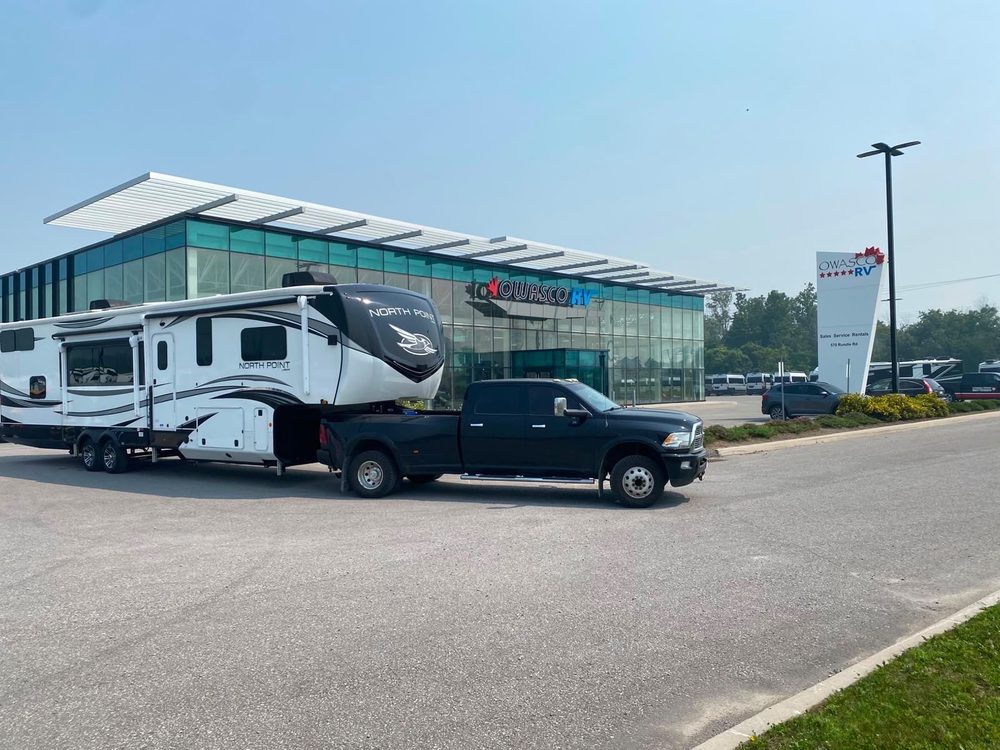
Half load season, and why it moves more bookings than weather does
If you take one thing from this page, take this one. Every spring, municipalities across Ontario put temporary weight limits on their roads while frost comes out of the ground and the road base is at its weakest. They are called reduced load restrictions, spring weight restrictions or, most commonly, half loads. Peterborough County explains the reason directly: vehicles over the limit must take an alternate route or face the penalties in the Highway Traffic Act. The City of Peterborough puts the rationale as protecting roadways during the spring thaw, when pavement structures have reduced load bearing capacity.
For an RV owner this matters because a loaded transport rig is exactly the kind of vehicle these rules are aimed at. During a half load period, a route that is fine in July can be closed to us in March. Sometimes there is a legal alternate route and the job goes ahead with a longer drive. Sometimes there is not, and the honest answer is that the move waits.
- The dates are local, not provincial. Section 122 of the Highway Traffic Act lets the municipality or other authority with jurisdiction over a road designate by by-law when its reduced load period starts and ends. Neighbouring municipalities routinely pick different dates.
- The signs are the trigger. Northumberland County states that restrictions apply when the signs are displayed. Bracebridge states the opposite side of the same coin: the absence of signage does not waive the restriction.
- Published dates are estimates, not promises. Almost every municipality reserves the right to start earlier or finish later based on conditions. In 2026 Bracebridge ended its period two weeks early by posted update, and Belleville lifted its restrictions on April 17 rather than the April 30 on its standing page.
- Some roads are restricted year round. Georgina lists eleven town roads under a permanent five tonne per axle limit, several of them lakeshore roads. Kawartha Lakes keeps two Bobcaygeon streets restricted permanently. Those do not lift in May.
- Exemptions are not casual. The District of Muskoka states that exemptions are not typically granted during the half load restriction period.
Half load dates and limits by municipality
This is the comparison we wish somebody had published before we had to build it ourselves. Everything below comes from the municipality's own published pages and by-laws, checked in July 2026. Where a municipality does not publish a per axle figure, we say so rather than importing a neighbour's number. Treat this as a planning aid and confirm the current year with the road authority before you rely on it, because these dates move every year.
| Road authority | Published window | Per axle limit as published | Stated authority |
|---|---|---|---|
| City of Peterborough | March 1 to April 30, 2026. Lifted May 1, 2026 | Not published as a weight | By-law No. 12-044 |
| Peterborough County | Typically March 1 to April 30, weather dependent | 5 tonnes | Highway Traffic Act s.122 |
| City of Kawartha Lakes | 2026 started 12:00am March 5, lifted 12am May 2 | Not published as a weight | By-Law 2022-190 |
| Region of Durham | 2026 ended 12:01am May 1 | 5,000 kg, five tonnes | Highway Traffic Act and Regional By-law 26-2018 |
| City of Oshawa | March 9 to April 30, 2026, end date may change | 5 tonnes | Highway Traffic Act ss.110 and 122 |
| Town of Whitby | March 1 to approximately April 30 | Five tonnes | Town of Whitby by-law 1718-84 |
| City of Pickering | March 9 to April 30, 2026, end date subject to review | Not published on the notice | Refers to Schedule 12 and Highway Traffic Act s.122 |
| Municipality of Clarington | Implemented March 9, 2026, tentatively to April 30 | Five tonnes | Highway Traffic Act s.122 |
| Town of Ajax | Page not updated past 2018 dates. Weather governs | Five tonnes | Town of Ajax Traffic By-law, number not published |
| Township of Scugog | Started March 9, 2026, lifted May 1, 2026 | Five tonnes | Township of Scugog Traffic By-law 23-22 |
| Town of Georgina, town roads | March 1 to May 15, plus eleven roads restricted year round | 5 tonnes | Town of Georgina roads page |
| York Region roads in Georgina | March 1 to April 30, plus two segments year round | Over five tonnes needs a Load Exemption Permit | York Region |
| City of Barrie | March 1 to April 30 | Five tonnes, 5,000 kg | Traffic By-law 2020-107 s.6.10, adopting Highway Traffic Act s.122 |
| County of Simcoe | March 1 to April 30 | 5 tonnes | Consolidated Traffic By-law No. 7098-24 |
| District of Muskoka | Generally March to May, exact dates set annually | Five tonnes | By-Law 2016-4 and By-Law 2018-12 |
| Town of Bracebridge | Began 12:01am March 9, 2026. Ended 11:59pm May 15 by posted update | 5 tonnes | Reduced Load Period By-Law 2022-045 under Highway Traffic Act s.122(7) |
| Town of Gravenhurst | March 9, 2026 to May 16, 2026 | 5 tonnes | Schedule A, By-law 2009-019 |
| Northumberland County | Signs usually posted March 1 to April 30, may run earlier or later | 5 tonnes | Highway Traffic Act s.122 |
| Town of Cobourg | Started Monday March 2, 2026, signs removed mid to late April | Not published as a weight | Town of Cobourg notice |
| Municipality of Port Hope | March 1 to April 30 each year, all rural roads | Five tonnes | Municipality of Port Hope |
| Municipality of Brighton | Started March 1, 2026. Lifted Friday May 1 | Not published as a weight | Municipality of Brighton notices |
| Hamilton Township | Approximately mid February to mid April | 5 tonnes | Hamilton Township |
| City of Belleville | Standing page says February 15 to April 30. In 2026 restrictions ran from January and lifted April 17 | Not published as a weight | By-law 2021-49 |
Read across that table and the point makes itself. In a single week in early March 2026, Cobourg was restricted, Kawartha Lakes was restricted three days later, and Oshawa, Pickering, Clarington, Scugog, Bracebridge and Gravenhurst all came into effect on March 9. Brighton and Port Hope had already started on March 1. At the other end, Gravenhurst was still restricted on May 16 while Belleville had been clear since April 17. There is no single Ontario half load season. There are dozens.
What we do about it
We check the road authorities on your route before we quote a spring date, not after. If the route is restricted, we tell you what the realistic options are: a legal alternate route, a date either side of the season, or storage until it lifts. What we will not do is take a booking we know we cannot legally run and sort it out on the day.
What the Highway Traffic Act actually says about reduced loads
The provincial framework sits in the Highway Traffic Act, and it is worth understanding because it explains why the municipal picture looks so scattered.
Section 122(1) sets the default. During a reduced load period, no commercial motor vehicle or trailer, with limited exceptions, may be operated or drawn on a designated highway where the weight on an axle exceeds 5,000 kilograms. That is where the five tonne figure that appears on municipal page after municipal page comes from.
Section 122(2) raises that ceiling to 7,500 kilograms for a narrow set of two axle vehicles, including heating fuel tankers, livestock feed trucks and live poultry transport. Section 122(4) exempts certain vehicles entirely, including those used in municipal highway maintenance, milk transport, fire apparatus, municipal waste collection and public utility emergency vehicles. An RV transport rig is not on either list.
Section 122(7) is the one that produces the table above. It gives the municipality or other authority with jurisdiction over a highway the power to designate by by-law the date on which a reduced load period starts or ends. The province sets the weight. The local road authority sets the calendar. That single division of responsibility is why the season starts on March 1 in Port Hope, March 2 in Cobourg, March 5 in Kawartha Lakes and March 9 in half of Durham.
There is a related power worth knowing about if your route crosses a small bridge in cottage country. The municipality or other authority with jurisdiction over a bridge may by by-law limit the gross vehicle weight of any vehicle or class of vehicle passing over it. Those limits are posted at the structure and they apply year round, not just in spring. In our service area the most consolidated published list of posted bridge limits belongs to the Municipality of Tweed, and Hamilton Township posts a limit at its Sackville Bridge.
Size and weight limits that apply everywhere in Ontario
Separate from the seasonal rules, the Highway Traffic Act sets standing dimensional limits that apply on any highway in the province. These are the numbers that decide whether your unit is a normal load or a permit job, and they are worth knowing before you buy a trailer rather than after.
| Dimension | Limit | Where it comes from |
|---|---|---|
| Width | 2.6 metres | Highway Traffic Act s.109(1) |
| Length, single vehicle | 12.5 metres | s.109(6) |
| Length, recreational vehicle | 12.5 metres, extendable to 14 metres where prescribed requirements are met | s.109(11) and s.109(11.1) |
| Length, combination of vehicles | 23 metres | s.109(7) |
| Length, semi-trailer | 14.65 metres | s.109(10) |
| Height | 4.15 metres, 4.3 metres for prescribed configurations | s.109(14) and s.109(14.1) |
| Penalty for exceeding | Not less than $200 and not more than $20,000 | s.109(15.1) |
Two details in that table are easy to misread. First, s.109(6.1) specifically carves trailers, buses, recreational vehicles, fire apparatus and road service vehicles out of the 12.5 metre single vehicle rule, and then s.109(11) puts recreational vehicles back under a 12.5 metre limit of their own. Second, a city that was a city on December 31, 2002 may pass a by-law prohibiting combinations over 15.25 metres on its streets, under s.109(12). If you are moving into an older urban core, that one can bite.
The practical translation for most customers is simple. A standard travel trailer or fifth wheel is within these limits and needs no permit. A park model is very often over the 2.6 metre width limit, and a mobile home section almost always is. That is the line where the job changes character. Our park model and mobile home moving page goes through what happens on that side of the line.
Oversize permits, and who actually issues them
When a load goes past the standing limits, section 110 of the Highway Traffic Act is the mechanism that lets it move anyway. It allows a permit to be issued for a vehicle or load of excessive dimension or weight. Several features of that section matter to anyone planning a move.
- Permits are route and time limited. A permit is not a general licence. It covers specified routes and periods, and security may be required.
- The original has to be in the truck. Section 110(6) requires the original of the permit to be carried in the vehicle. A photo on a phone is not what the section says.
- The mover stays liable for damage. Section 110(5) is explicit that holding a permit does not transfer responsibility for damage to the highway away from the person moving the load.
- One permit can cover several municipalities. Section 110(4) allows the Ministry to issue a single permit covering more than one municipality, which is the mechanism that makes a long oversize move administratively possible.
- The penalty range is wide. Section 110(7) sets a fine of not less than $200 and not more than $20,000.
On top of the provincial layer, most of the road authorities we deal with run their own permit system for their own roads. The thresholds and the fees are not the same from one to the next.
Permit costs, lead times and thresholds where they are published
Not every municipality publishes this. Where they do, here is what they say, checked in July 2026. Fees change, so confirm before you budget.
| Road authority | Published fee | Notice required | Notes as published |
|---|---|---|---|
| City of Peterborough | $172.00 | At least 5 business days | Under Highway Traffic Act s.110 and City By-Law No. 93-25. Escorts required over 4 m wide, 36.76 m long or 4.87 m high |
| Peterborough County | $50.00 single move, $85.00 if less than 5 days notice, $75.00 over 63,500 kg, $100.00 expedited, $250.00 annual first vehicle | 5 business days, 10 for over 63,500 kg | Permit must be carried in the vehicle |
| Region of Durham | Not published on the application page | Ten business days | Oversize above 2.6 m wide, 4.15 m high or 23 m long. Police escort over 5.00 m wide or 45.75 m long. Some permits require a security deposit, minimum $1,000 |
| City of Oshawa | $154.50 plus tax | 10 to 15 business days | Annual permit valid 12 months. Requires $5,000,000 automobile and $5,000,000 commercial general liability with the City as additional insured |
| City of Belleville | Annual $300.00, seasonal $200.00, single trip $75.00, plus a $10 administrative fee | Not published | Contact Transportation and Operations, 613-967-3275 |
| Hamilton Township | Annual $150.00, single trip $50.00 | Not published | The only published oversize fees found in Northumberland |
Say it plainly
We do not run oversize permits ourselves and we are not a permit service. When a job needs them, we bring in a contractor who specialises in that work, and they handle the permits, the routing and the escorts. You still deal with us and we still stand behind the job. We would rather tell you that than pretend it is all in house.
Why a municipal boundary matters more than the distance
People assume the hard part of a move is the kilometres. In this province it is more often the boundary. Building permits in Ontario are issued and enforced by the local municipality, not by the province, so the rule that applies to your unit is set by whichever municipality the pad is in. Three examples from our own service area make the point.
Storing a trailer at home. Cobourg's zoning by-law allows a maximum of two recreational trailers, vehicles or boats to be stored on a lot, with setbacks, no habitation and a main building required. Port Hope's zoning by-law permits one. Quinte West caps a stored recreational vehicle at six metres long and 3.2 metres high, which excludes most fifth wheels outright, and its parking by-law keeps oversized vehicles, defined as over 3,400 kilograms and expressly including RVs and recreational trailers, off residential streets at any time. Barrie's zoning by-law prohibits living in a trailer anywhere in the city except a licensed trailer camp. Four municipalities, four different answers.
Placing a park model. Otonabee-South Monaghan and Trent Lakes both require a building permit for a park model trailer. The Municipality of Brighton's zoning by-law prohibits mobile homes in all zones. The City of Kawartha Lakes publishes no park model guide at all and directs unlisted project types to its building department. If you are buying a unit for a specific lot, the municipality is the first phone call, not the last.
Sheds and accessory buildings. Kawartha Lakes exempts a qualifying shed up to 15 square metres, subject to four conditions, while requiring a permit for any accessory building over 10 square metres that does not meet its shed definition. Collingwood's exemption is also framed around 15 square metres, one storey and not attached to anything. Peterborough publishes its own threshold. The numbers rhyme but they are not identical, and the conditions attached to them differ. Our deck and shed moving page goes through this in detail.
None of this is us giving you legal advice. It is us telling you which office to phone, and telling you that the answer your neighbour got in the next township is not your answer.
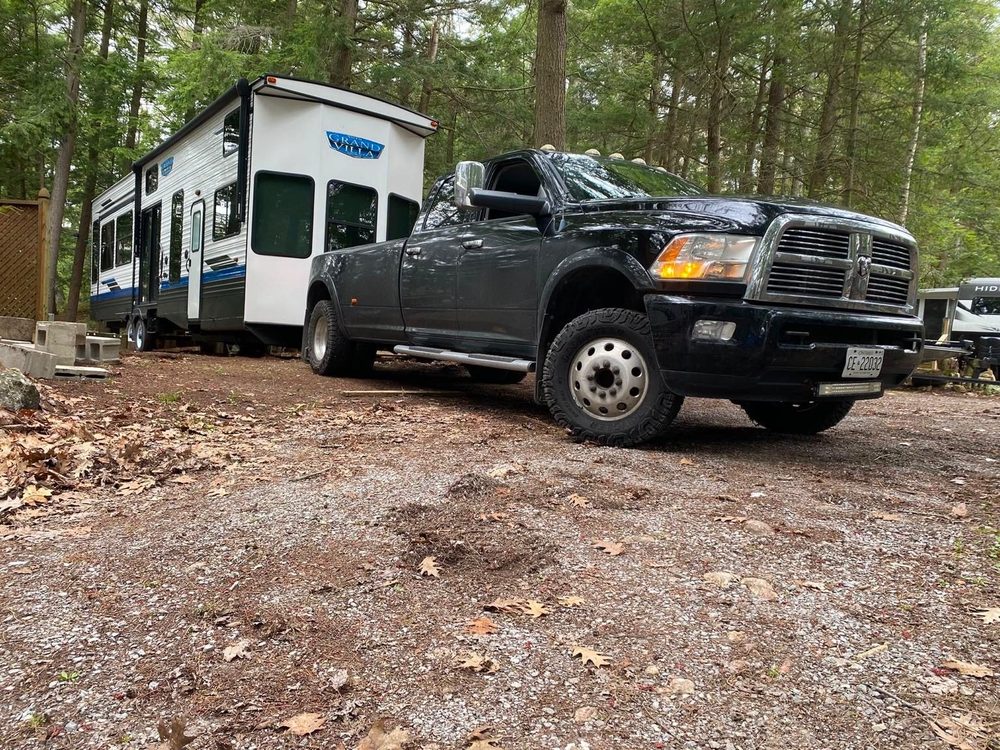
What actually changes the price from one area to another
Local tows start at $400. Beyond that, the honest answer is that the address matters less than what is at the address. These are the things that move a quote, in roughly the order they matter.
- Access at both ends. The single biggest factor. A pull through gravel pad and a straight run to the road is the cheap version. A tight seasonal park lane with a ninety degree corner, a hydro guy wire and a neighbour's awning in the way is the expensive version, and it can be the expensive version over a distance of forty feet.
- What the unit is. Length, weight and how it hitches. A park model is a different job from a travel trailer even over the same route.
- Ground condition. Soft ground turns a one hour job into a half day job and occasionally into a no. Spring and late fall are when this shows up most.
- Distance and route. It counts, but usually less than people expect, and a legal detour around a half load route counts more than the raw kilometres.
- What else has to happen. Levelling and blocking at the far end, a deck moved out of the way first, skirting, or storage in between. Those are separate services and we price them plainly.
Our guide to what RV transport costs in Ontario breaks the numbers down further. Levelling and blocking starts at $799 as a local flat rate and is covered on the levelling and blocking page. Outdoor winter storage runs $85 to $125 a month by size on the storage page. Quotes are free and there is no deposit to book, in any area we serve.
Access and ground, by the kind of place you are in
Our service area contains four fairly distinct kinds of site, and each has its own failure mode.
Lakeshore and cottage lots. Narrow lot frontages, mature trees close to the driveway, steep approaches down to the water and often a septic bed somewhere you cannot drive over. The constraint is nearly always overhead or underfoot rather than width. This is where photographs of the way in earn their keep.
Seasonal parks and campgrounds. Tight internal lanes, fixed hydro pedestals, decks built right to the lot line and neighbours whose awnings are out. Many parks also have their own rules about when units can be moved, whether a park model can have a deck attached, and who is allowed on site. Check with the park office before you book a date with us, because their calendar governs.
Rural residential and farm properties. Usually the easiest access and the softest ground. A long gravel lane that carries a pickup fine all summer can rut badly in April, and once it does, it stays rutted. If your lane is soft, tell us and we will plan around it rather than discover it.
Urban and suburban driveways. The narrowest working space and the most parked cars. In older urban cores there may also be a municipal by-law limiting combination length on city streets. If you are in a subdivision, the practical problem is almost always the turn out of the driveway and the cars on the street, and both can be solved with a bit of notice to neighbours.
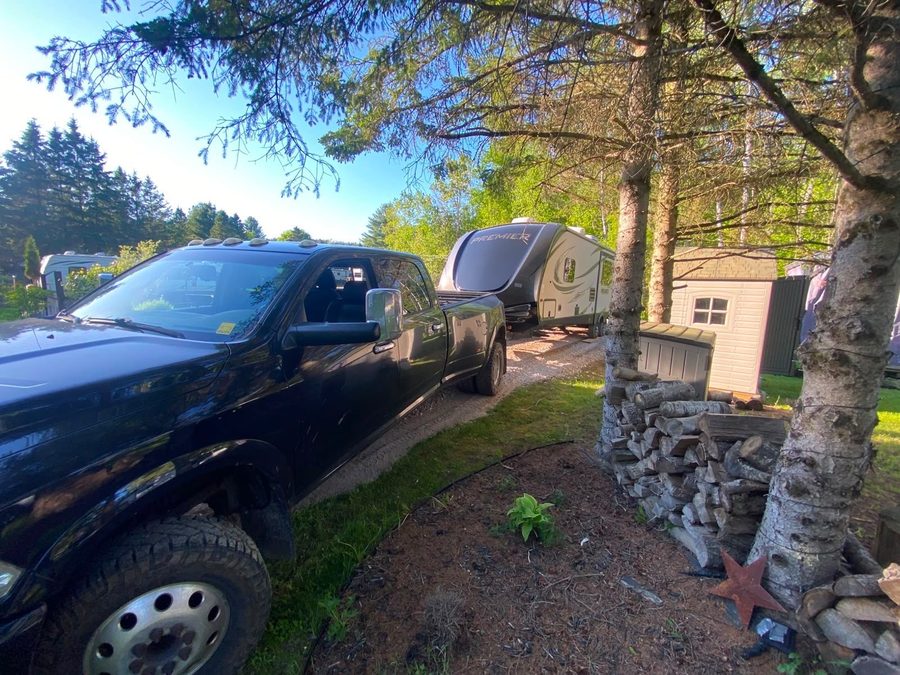
Private roads, unassumed roads and road associations
A large share of cottage country in our service area is served by roads the municipality does not own or maintain. Otonabee-South Monaghan and North Kawartha both publish the fact that private roads exist in their townships and are not municipal responsibility. This changes three things for you.
First, the municipality's half load dates may not be what governs your lane. The road association's own rules might, and some of them are stricter and longer than the municipal season, precisely because the road is thinner and there is no public works budget behind it. Ask your association before you book a spring date.
Second, if the road gets damaged, the cost of fixing it lands on the association, which means the association takes it seriously. We would rather be told about a weight restriction in advance than argue about a rut afterwards.
Third, private roads are often the ones with the tightest geometry, the lowest branches and the least maintained shoulders. None of that stops us. It just needs to be known in advance, and the way to know it in advance is photographs.
Provincial parks and public campgrounds in our service area
A fair amount of our seasonal work is into and out of parks and campgrounds, so it is worth naming the public ones we deal with most and what they publish about sites. Private seasonal parks are a separate world with their own rules, and their office is the authority on their site.
| Park | Area | What it publishes |
|---|---|---|
| Emily Provincial Park | Omemee, nearest car camping park to Peterborough | Car camping park serving the Peterborough and Kawartha Lakes area |
| Darlington Provincial Park | Clarington, inside Durham Region | The car camping provincial park inside Durham Region |
| Sibbald Point Provincial Park | Sutton West, Georgina | The provincial park serving Georgina and the south Lake Simcoe shore |
| Presqu'ile Provincial Park | 328 Presqu'ile Parkway, Brighton | 982 hectares, established 1922, over 300 car camping sites across eight loops, barrier free sites 81 and 83 in High Bluff. 613-475-4324 |
| Ferris Provincial Park | 474 County Road 8, Campbellford | Over 150 sites in two campground loops, Valleyview and Bedrock. 705-772-9561 |
| Victoria Park Campground | 138 Division Street, Cobourg, municipal | 70 trailer sites near the lake, 30 amp service, all camping units must be backed in, one camping unit per site, boats and boat trailers may not be stored in the campground. 905-373-7321 |
| Silent Lake Provincial Park | North of Apsley on Highway 28 | Car camping park north of the Peterborough County line |
| Kawartha Highlands Provincial Park | Apsley and Buckhorn area | Backcountry only. No car camping and no RV access |
| Petroglyphs Provincial Park | Woodview, North Kawartha | Day use. No camping |
| North Beach Provincial Park | Prince Edward County, near Quinte | Day use only. No camping |
Two of those rows exist specifically to save you a trip. Kawartha Highlands and Petroglyphs both appear on maps as provincial parks in prime cottage country, and neither takes an RV. North Beach is the same story on the Quinte side. If somebody has told you to book a trailer site at one of them, they are mistaken.
When to book, by season
March and April. Half load season across nearly every municipality we serve. This is the hardest window to move a big unit and the easiest window to be disappointed in. If your move has to happen in these weeks, get in touch early so we can work out whether there is a legal route.
May and June. The busiest weeks of our year. Everything comes out of storage at once and seasonal sites open. Book as far ahead as you can. Restrictions have usually lifted by mid May across most of the region, though Georgina, Gravenhurst and Bracebridge can run later.
July and August. The easiest time to get a date and the best ground conditions. If your move is flexible, this is when to do it. It is also the right time for the jobs that need dry ground, like moving a deck or re-levelling a unit that has settled.
September and October. The second rush, going the other way. Seasonal sites close, units go into storage, and the calendar tightens again. Ground is usually still good through September.
November through February. Quieter, and more possible than people assume. Frozen ground carries weight well, which is the opposite of the spring problem. The limits are daylight, snow and whether the site can be reached at all. Winter moves get booked around the weather rather than the calendar.
If your unit is going to sit anyway, our winter storage checklist covers what to do to it before it sits outside through an Ontario winter, and the preparation guide covers what we need you to do before we arrive on any job.
How to tell us where you are, so the quote is right the first time
The fastest quotes we give are the ones where the customer sent everything at once. Four things do it.
- The unit. Type and length. Travel trailer, fifth wheel, park model, toy hauler, boat trailer, gooseneck. If you know the weight, send that too.
- Both addresses. Pickup and drop. If one of them is a seasonal park, the park name and site number is more useful than a civic address.
- Two or three photos. One of the unit, one of the way in, and one of where it has to end up. This is the part people skip and it is the part that decides the price.
- Your date, and how firm it is. A flexible week is worth real money in spring and fall. A fixed day in May needs early notice.
Send that to transport@kawartharvrentals.ca or call (647) 961-9257. We are open monday to saturday, 7:00am to 7:00pm. sunday closed, by appointment only. Quotes are free and there is no deposit to book.
What we do not do
Worth being direct about, because it saves everyone time.
- We do not pull building permits for you. Those are issued by your municipality and the application is yours to make. We will tell you which department to phone.
- We do not run oversize permits in house. When a load needs them we bring in a contractor who specialises in that work.
- We do not give legal or zoning advice. Everything on this page is published municipal material, paraphrased and pointed at. Your municipality is the authority on your property.
- We do not guarantee weather or ground. Our guarantee covers our workmanship, and we would rather tell you where the line is before the job than after it.
Our 30 day guarantee
If a unit we set up shifts or moves because of our workmanship, we come back and redo the job at no charge. Weather and ground conditions are outside that, and we say so up front. It applies the same way in every area we serve. If something we set up shifts because of how we set it up, we come back. That is the whole of it, and it is deliberately worded so that nobody is surprised later.
We are fully insured and we carry Ontario CVOR 204-617-206. If a park, a dealership, a campground or a municipality wants proof of insurance before we come on site, ask and we will send it ahead.
Every town we serve
Grouped by the area page that covers each one. If your town is not on the list, ask anyway. The list is where we go most, not where we stop.
Peterborough
Kawartha Lakes
Oshawa and Durham Region
Port Perry and Scugog
Georgina and Sutton
Barrie
Muskoka
Collingwood and Wasaga Beach
Cobourg and Port Hope
Belleville and Quinte West
Beyond those ten areas we regularly work in Minden, in Toronto, and as far north as Sudbury, and we take long distance work across Ontario and into the rest of Canada. Distance on its own has never been the reason we said no to a job.