What we rent, and how it works
Kawartha RV Transport & Services rents clean, well kept travel trailers and RVs out of Beaverton, Ontario, and will deliver, level and set one up on your site if you would rather not tow. Tell us your dates and how many people are coming and we will help you pick a unit that actually fits the trip, then either hand it over on the hitch or bring it to you ready to use.
Quotes are free. Rates depend on the unit and the season, so we give you the number on the phone instead of publishing one price that would be wrong for most bookings. We run under Ontario CVOR 204-617-206 and carry $2 million in liability with $150,000 in cargo coverage, which is the same coverage behind the roughly 1,800 trailers we have moved over the last five years.
Most people who call about a rental are in one of three situations. They are curious about RVing and not ready to spend forty thousand dollars finding out whether they like it. They own a unit that is in the shop, or sold, or not big enough for the people coming this year. Or they have a seasonal site and want something sitting on it without buying the something. All three are fine reasons, and all three end up wanting slightly different things from us.
What follows is the whole picture: what we rent, what it costs, what the Ontario rules actually say about towing one of these, and what people get wrong on their first trip. It is longer than a rental page needs to be. That is deliberate. Half the calls we get are really questions about licences, brakes and campsite sizes, and it is easier to put the answers somewhere you can read them at eleven at night than to repeat them one at a time.
Two ways to rent
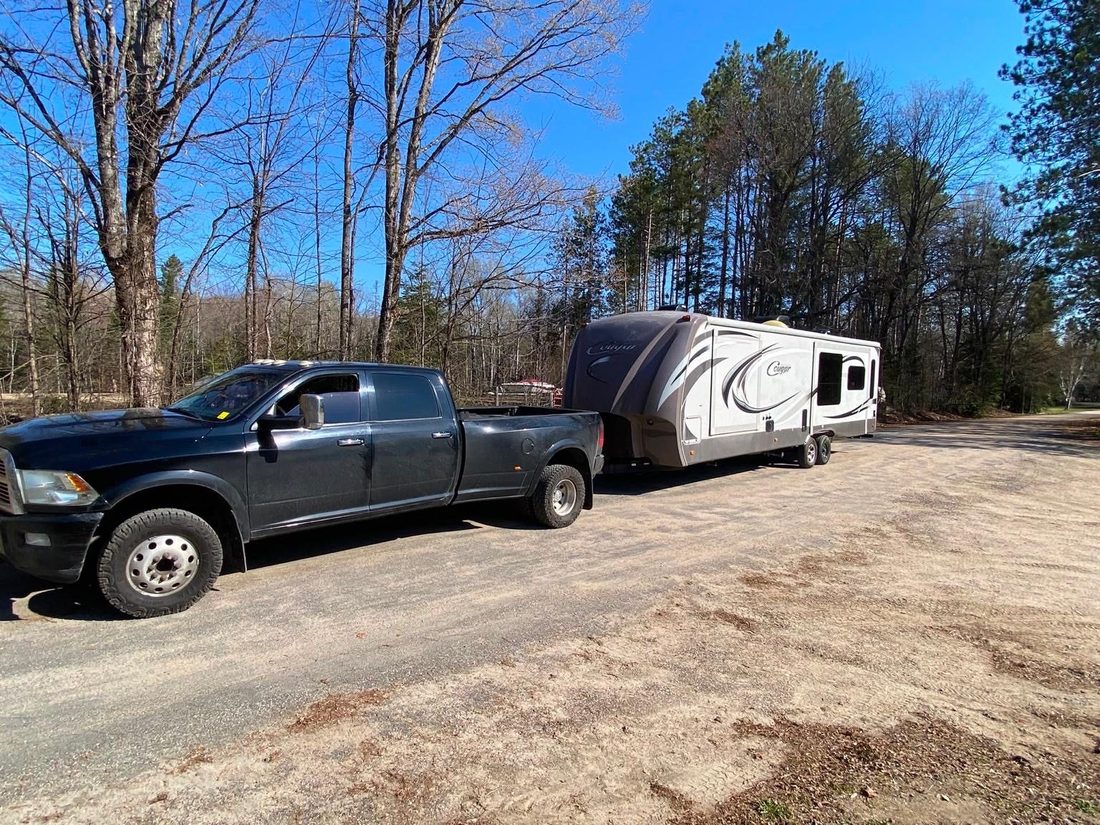
There is a fork at the start of every rental booking, and it decides most of what comes after it. Either you tow the unit yourself, or we deliver it. Neither is the right answer for everybody, and we are not going to push you toward the more expensive one.
| Question | Tow it yourself | We deliver and set it up |
|---|---|---|
| What you need | A tow vehicle rated for the unit, a working brake controller, a licence that covers the weight | An address and a spot for it to go |
| Who levels it | You do, on arrival | We do, before we leave |
| Best for | Moving around, park hopping, people who already tow | Seasonal sites, one location trips, first timers, anyone without a truck |
| Cost | Rental only | Rental plus the delivery, quoted together |
| Guarantee | Our workmanship guarantee does not apply, because we did not set it up | 30 day workmanship guarantee on the setup |
If you are on the fence, ask yourself one question: are you going to move it more than once? If the answer is no, delivery usually wins on both cost and stress, because you are paying for one trip in and one trip out instead of buying or borrowing a truck for the week. If the answer is yes, and you plan to hop between parks, towing it yourself is the only sensible option.
Delivered, set up and left ready
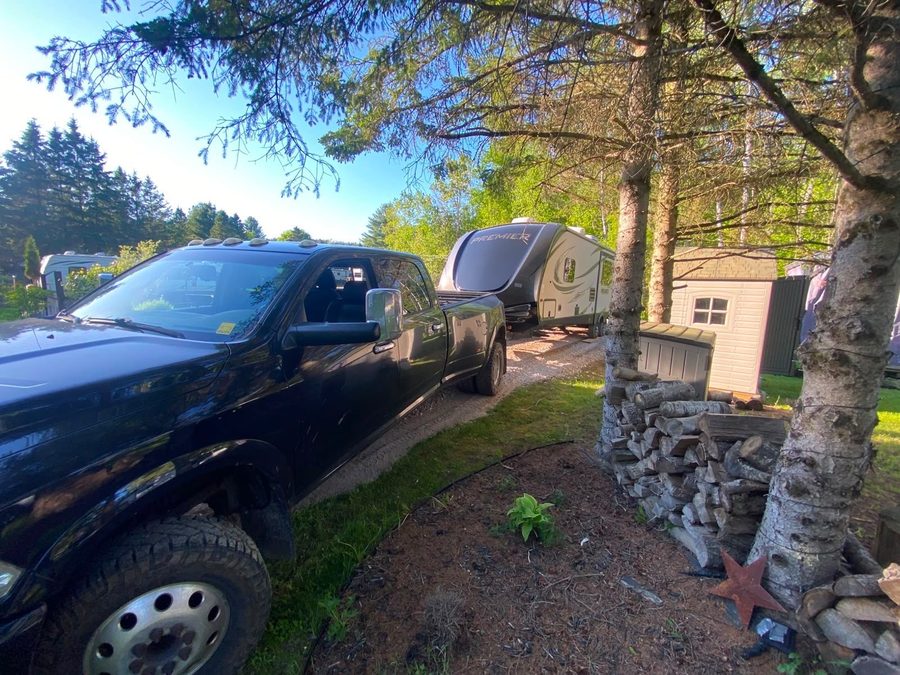
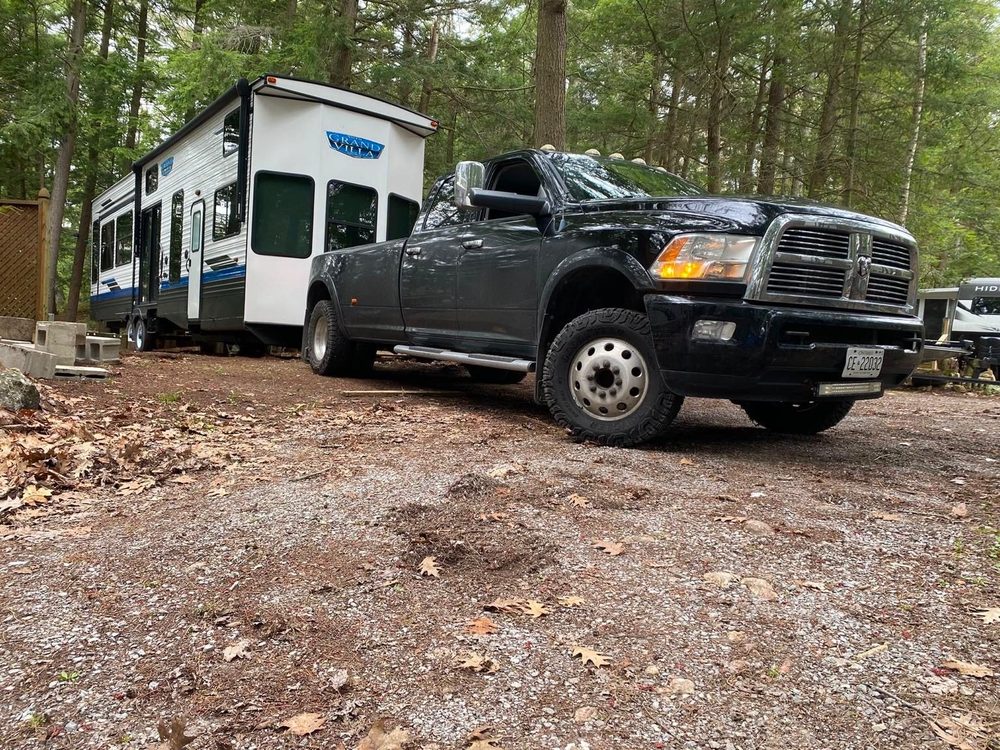
This is the version of a rental that suits us, because it is the work we do every day anyway. We hook the unit to one of our three one ton duallys, bring it to the address you give us, put it exactly where you want it, and then do the part most people underestimate, which is setting it down properly.
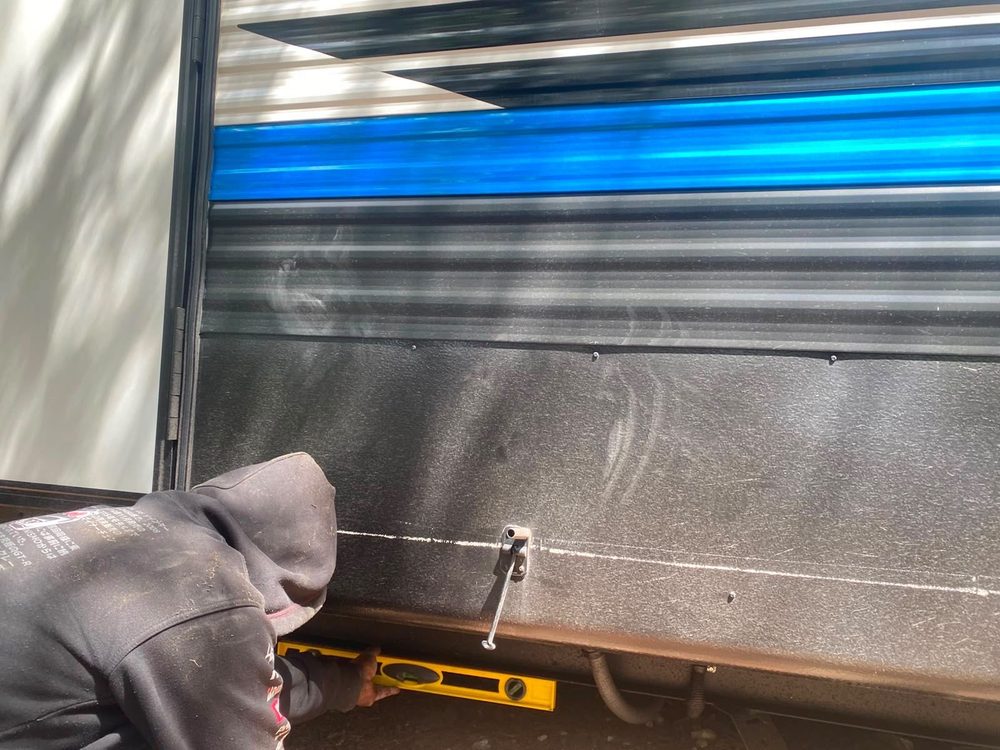
Setting down properly means blocking under the frame at the right points, taking the weight off the suspension where that is appropriate, and bringing the unit level side to side and front to back. It is not a case of dropping the jacks and calling it done. A trailer that is out of level pulls on the frame, fights the slide out seals, and stops the fridge working the way it was designed to. Our levelling and blocking page goes through the whole method if you want the detail.
Site access is the usual limiting factor, not the trailer. Wooded lanes, soft spring ground, tight cottage lots and seasonal sites laid out before anybody imagined a one ton dually turning around in them are all normal for us, and we bring machinery when a site needs it. What we will not do is force a unit into a spot that will not take it safely. If that is where you are, we will say so on the phone or on the first look, before you have paid for anything.
The honest summary
A delivered rental is a transport job with a trailer attached. That is a good thing for you, because transport is the thing we have done roughly 1,800 times. Nobody at this company is learning how to tow on your booking.
Towing it yourself
If you are taking the unit away on your own hitch, there is a short checklist we go through with you in the yard before you leave, and none of it is theatre.
- Your tow vehicle's ratings, against the loaded weight of the unit. Not the brochure weight, the loaded weight.
- The hitch itself, the coupler, and the second attachment that the law requires.
- Safety chains, crossed under the tongue.
- The brake controller in your vehicle, and that the trailer brakes actually respond to it.
- Lights: running, brake, signals, and the plate light.
- Tire pressures, cold, on both the trailer and the tow vehicle.
- Mirrors, and whether you can see far enough back with the unit attached.
If something on that list is not right, we would rather find it in our yard than have you find it on Highway 12. It takes about ten minutes and it is the cheapest ten minutes of the whole rental.
What it costs and how booking works
Rental rates move with the unit and the season, so the honest answer is that we quote on the call. What we can tell you is how the process runs, because that does not change.
Quotes are free and cost you nothing to get. Call (647) 961-9257 or email transport@kawartharvrentals.ca with your dates, the number of people, and whether you want it delivered or you are towing. We tell you what is available for those dates and what it comes to, including delivery if you want it. Payment is cash, credit, debit or e transfer.
On notice: 24 to 48 hours is the usual ask and it works for most bookings. Same day happens and we will always try. But July and August weekends in the Kawarthas go early, and the units people want most are the ones that go first, so the further ahead you call the more say you have in what you get. Our hours are Monday to Saturday, 7:00am to 7:00pm. Sunday closed, by appointment only.
If your booking also involves moving something you already own, say so at the quote stage. It is almost always cheaper to have us do two jobs in one trip than two jobs on two days. Our RV transport page covers that side of it, and the cost guide explains how transport is priced.
What your Ontario licence lets you tow
This is the single most common question we get from first time renters, and the answer is more reassuring than people expect.
The Official MTO Driver's Handbook states that you must have a valid driver's licence, Class G1, G2 or G, or a higher class, to tow a trailer with a gross vehicle weight of up to 4,600 kilograms. That is roughly 10,100 pounds, and it covers the large majority of travel trailers on Ontario roads. If you drive a car on a full G licence, you are already licensed for most of what gets rented.
Two things worth saying plainly. First, G1 and G2 licences carry their own separate conditions on where and when you can drive, and those conditions do not disappear because there is a trailer behind you. Read the towing chapter of the handbook before you book. Second, being licensed to tow it is not the same as your vehicle being rated to tow it. The licence is the law's question. The rating is the manufacturer's, and it is the one that decides whether the trip is a pleasure or a white knuckle experience.
Over 4,600 kg, and the fifth wheel exception
Above 4,600 kilograms the rules get more specific, and this is where people get caught out with the bigger fifth wheels.
Ontario's guidance on driving a recreational vehicle says that if the trailer weighs more than 4,600 kilograms you need a Class A or Class A Restricted driver's licence, unless every one of a list of conditions is met. All of them, not most of them. The list includes:
- The total weight of the combination of truck and trailer is 11,000 kilograms or less.
- The tow vehicle is a pickup truck with a manufacturer's gross vehicle weight rating of 6,500 kilograms or less, with its original manufacturer's box.
- The trailer is a house trailer, meaning a cabin, tent, camping or collapsible trailer.
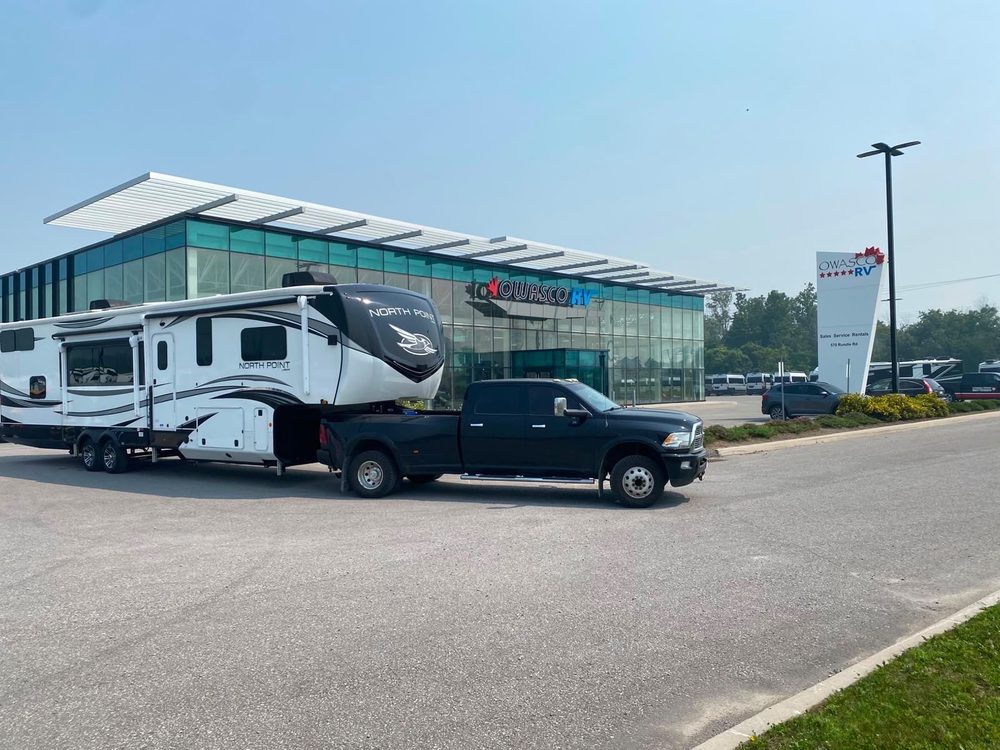
- The connection is a fifth wheel assembly.
- The truck has no more than two axles.
- Neither the truck nor the trailer has air brakes.
- Both comply with Canadian or United States safety standards and carry the proper certification labels.
- The use is personal, not business related.
- The trailer is not owned by an employer for employee housing.
- It is not carrying commercial tools, equipment or cargo.
- Less than half the trailer floor space is used for animals, equipment or vehicles.
Read that list once and the shape of it is obvious. It exists to let ordinary families tow a large fifth wheel behind a pickup for holidays, and to stop that same allowance being used to run a business. If your trip is a family holiday behind a one ton pickup, you are almost certainly inside it. If any part of the trip is commercial, you are not, and you need the A or A Restricted.
Where we sit on this
We check the weight of the unit against what you tell us about your licence and your truck before you take it. If the combination does not work we will tell you, and we will usually be able to offer either a smaller unit or delivery instead. What we will not do is hand you keys to something you are not licensed to tow and let you find out at a scale.
Trailer brakes and the 1,360 kg line
The handbook's rule is specific: if your trailer has a gross trailer weight, vehicle and load, of 1,360 kilograms or more, it must have brakes strong enough to stop and hold the trailer. That is about 3,000 pounds, and it is a low bar. A small single axle travel trailer clears it once it has a family's gear in it. Anything with two axles is well past it.
So in practice, every unit we rent that is worth renting has brakes. The part that trips people is the other half of the system. Most trailer brakes in this category are electric, and electric brakes do nothing at all unless the tow vehicle has a brake controller wired in and set up. A truck with a factory tow package usually has one. A crossover with a hitch installed at a muffler shop often does not.
We check that the controller is present, wired and actually operating the trailer brakes before anyone leaves with a unit. It is a thirty second test in the yard and it is the difference between stopping and hoping.
Hitch, chains and the two attachment rule
Ontario requires that your trailer have two separate ways of attaching to your vehicle, so that if one fails or comes loose the trailer stays attached. That is the coupler, plus something else, and for most travel trailers the something else is safety chains.
The handbook is also specific about how chains are run: if safety chains are used, they must be crossed under the tongue, so that if the primary hitch disconnects the tongue drops into the chains rather than onto the road. Crossed, not parallel. It takes no longer to do it right and it is the single detail we see done wrong most often on customer trucks.
Two more rules from the same chapter that surprise people:
- You may not carry any person in any trailer, including a house or boat trailer, while it is being towed. Everyone rides in the tow vehicle.
- It is against the law to tow more than one trailer behind a non commercial vehicle. No trailer behind the trailer, no boat behind the camper.
- If the load in your trailer blocks your view to the rear, you must have additional mirrors that give a clear view of the road behind you.
Loading, tongue weight and sway
How you pack a trailer decides how it behaves at 90 kilometres an hour, and most first timers pack it like a car boot. The handbook gives a number worth memorising: about five to 10 per cent of the trailer's total weight should be supported on the hitch, within the weight limit marked on the hitch itself.
Too little weight on the tongue and the trailer starts to sway. The handbook says it directly, that poor load balance can cause your trailer to sway or fishtail, and sway is the failure mode that puts trailers in the ditch. Too much weight on the tongue and you unload the front wheels of the tow vehicle, which takes away steering and braking exactly when you need them.
Practical version: heavy things go low and roughly over the axles, slightly forward of centre rather than behind it. Nothing heavy at the back. And strap it down. The handbook's wording is that when loading your trailer you should strap everything down inside as well as outside, because a sudden stop can cause the load to shift, and a shifted load turns a controlled stop into a jackknife.
Driving with it behind you
Towing a travel trailer is not difficult. It is just different, and the differences all point the same way: everything takes longer.
Stopping takes longer, so increase your following distance. The handbook's advice is to increase the following distance between you and the vehicle ahead specifically to avoid sudden stops, because a sudden stop is what causes a trailer to jackknife or slide sideways. Overtaking takes longer, so leave more room than feels necessary before pulling back in. Corners need more room, because the trailer cuts inside your line and will find a kerb, a post or a gate pillar if you let it.
Reversing is the part everybody dreads and it is genuinely a learned skill. The handbook covers the technique, and the short version is that your steering inputs are reversed and small. Find an empty lot before the trip rather than an occupied campsite on a Friday evening with an audience. It is twenty minutes well spent.
One thing we will not tell you is a magic towing speed, because the towing chapter of the handbook does not set a separate speed limit for towing and we are not going to invent one. Drive to the conditions, the load and the road. On a windy day on an open highway with a tall trailer, the conditions are telling you something.
Plates, permits and paperwork
For a rental, this section is short: our units are registered and plated, and the registration is the owner's responsibility, which means ours. You do not register anything to rent from us.
It matters if the rental turns into a purchase, which happens more than you would think. Ontario requires you to register a trailer before you take it out on the road, in person at a ServiceOntario centre. ontario.ca lists the cost at $72 for a plate and permit, and you only have to do it once, because a trailer registration does not expire. If you build your own trailer and it weighs more than 900 kilograms empty, you need a weight slip proving the empty weight before you can register it.
The handbook says the same thing from the driver's side: before you can tow a trailer on any public road you must register it and pay a one time registration fee at a ServiceOntario centre. Two sources, one rule, no ambiguity.
Insurance, said plainly
This is the section where most rental websites go vague, so here is the direct version.
Our insurance is $2 million in liability, $150,000 in cargo coverage and $150,000 in non owned trailer coverage, and we operate under Ontario CVOR 204-617-206. That coverage exists because we haul other people's units for a living. It is coverage for our hauling. It is not a travel policy, it is not your personal liability while you are camping, and it is not a substitute for your own insurance.
What we will do is tell you exactly what our rental agreement covers for the specific unit you are looking at, in writing, before you commit to anything. What we will not do is tell you that you are covered under your own policy, because we cannot see your policy and guessing about somebody else's insurance is how people end up with a very bad month.
Call your own insurer and ask the specific question, which is whether you are covered while towing and using a rented recreational trailer. Ontario's own guidance on driving a recreational vehicle notes that RV owners should carry specialised RV insurance covering liability, collision and comprehensive, which tells you the province does not assume a standard auto policy stretches to cover everything an RV does.
The one call to make
Before you book, phone your insurance broker and ask: am I covered towing a rented travel trailer, and am I covered for damage to it? Write down the answer. It takes five minutes and it is the only part of a rental that can genuinely cost you more than the rental.
Ontario Parks, and the site that fits
A large share of our rentals end up at a provincial park, and the mistake that ruins those trips is booking a site before knowing the length of the unit.
Ontario Parks lets you reserve campsites by trailer size in bands: up to 18 feet, up to 25 feet, up to 32 feet, and over 32 feet. They also note that a few parks cannot accommodate trailers longer than 32 feet at all. So the sequence is: pick the unit, get the length from us, then book the site. Not the other way round.
| What Ontario Parks publishes | What it means for a rental |
|---|---|
| Sites reservable by trailer size: 18, 25, 32 and over 32 feet | Know your unit's length before you reserve. Ask us and we will tell you. |
| Over 3,000 campsites offer electrical service at 15 and 30 amp | Not every site is serviced. Filter for electrical when you book, and know which plug your unit uses. |
| Waste and grey water dumping stations and water filling stations are in most parks | You can usually empty and refill without leaving the park, but confirm for the specific park. |
| Bring at least 100 feet of extension cord | Power posts can be a long way from where the unit sits. Bring more cord than you think. |
| Park roads can be narrow and winding, so check access for larger RVs | Call the park itself if you are near the top of a size band. |
Ontario Parks takes reservations online and by phone on 1 888 668 7275, open daily 7am to 9pm Eastern. Campground maps and campsite photos are available through the reservation service, and it is worth looking at the photo of the actual site before you commit, because the photo shows you the rocks, the fire pit and the trees that the map does not.
Park rules that catch first timers
The Ontario Parks rules and regulations are short and worth reading once. These are the ones that catch people out with a rented trailer:
- No more than six people can occupy a campsite, unless those people are a single family of parents and their children.
- Only one piece of shelter equipment can be a tent trailer, house trailer, motor home or self propelled camping unit. You cannot park two units on one site.
- Where space allows, up to three pieces of shelter equipment plus one dining shelter and a tarp are permitted.
- Parking for one vehicle is included with the campsite permit. Every additional vehicle needs its own permit.
- Check in is after 2:00pm and check out is before 2:00pm.
- The campsite permit holder must be sixteen years of age or older.
The one that costs people money is the extra vehicle permit, because a family arriving in two cars with a trailer is a completely normal situation and the second car is not covered. The one that costs people a holiday is the six person limit, which is worth checking before you invite another couple.
Private parks and seasonal sites
Provincial parks are only part of the picture. Plenty of our rentals go to private campgrounds and seasonal sites across the Kawarthas, Durham and Northumberland, and private parks set their own rules. Sizes, ages, pets, generators, quiet hours, guest fees and whether you may leave a unit on the site are all park by park decisions, so ask the park directly rather than assuming provincial rules carry over.
Seasonal sites are where a rental most often turns into something longer. The pattern is familiar: somebody rents for a season to find out whether they like the site and the park, discovers they do, and buys a unit the following spring. When that happens the work becomes transport, levelling and storage rather than rental, and we do all three. Our park model and mobile home moving page covers the larger units, and outdoor winter storage covers what happens when the season ends.
Propane, and how to be sensible about it
Every trailer we rent runs propane for at least the fridge, the water heater and the furnace, and propane is the one system where casual handling actually matters. The Technical Standards and Safety Authority publishes the rules for transporting and storing cylinders, and they are worth knowing.
- Never store propane cylinders indoors or in a garage. Not in the car, not in the shed, not in the basement.
- Store them upright, and protect them against tampering, unauthorised movement, dropping or impact that could cause a leak or a fire.
- Keep them at least one metre, which is three feet, from any building opening, sidewalk or air intake.
- Keep them away from operational heaters and smoking areas.
- If you are moving loose cylinders in a vehicle, TSSA permits up to five, upright, in a passenger compartment with the windows open, a trunk with the lid propped open, or a ventilated box.
On a rental the practical rules are simpler. The cylinders stay upright and secured on the A frame where they belong, they get turned off before you drive, and if you swap or refill one on the trip you put it back the way you found it. If you smell propane at any point, you shut the cylinder valve, open the windows and get everyone out before you start diagnosing anything.
The fridge, and why level matters
An absorption fridge does not have a compressor. It moves refrigerant around by heat and gravity through a network of tubing, which means the tubing has to be roughly where the designer expected it to be. A trailer parked significantly off level does not circulate properly, and a fridge that does not circulate properly does not cool, and can be damaged by running that way.
Dometic's own operating manual for the RMD 8500 series says to park the vehicle level, particularly when starting up the refrigerator and filling it with food before a journey. It also says that when the layer of frost reaches about 3 mm the fridge should be defrosted, that you should clean the inside before starting it up and repeat that at intervals, and that if the fridge is being taken out of service for an extended period you should close both the onboard shut off valve and the cylinder valve.
Nobody publishes a maximum number of degrees off level. We have looked, repeatedly, and manufacturers state the requirement qualitatively rather than numerically. So we are not going to quote a tolerance we cannot source. Level the unit properly and the question never comes up, which is exactly why levelling is a service we sell rather than an afterthought.
Water, tanks and dumping
A travel trailer has three water systems and confusing them is the classic first trip mistake. Fresh water goes in, grey water is what leaves the sinks and shower, and black water is the toilet. They are separate tanks with separate valves and they get emptied in a specific order, black first and grey second, so that the grey water rinses the hose.
Where you empty them is not optional. Ontario Parks says waste and grey water dumping stations and water filling stations are located in most parks, and that is where it goes. Not on the ground, not into a storm drain, not behind a tree. Private parks either have a station or will tell you where the nearest one is.
Two habits worth adopting. Do not leave the black valve open on a serviced site, because the liquid drains away and the solids stay, and that becomes a problem you can smell. And keep an eye on the grey tank in a unit with a shower, because it fills faster than people expect and there is nowhere for it to go once it is full.
If your trip is in the shoulder season, tell us when you book. Cold nights and water lines do not mix, and the answer is either to run the unit dry or to have the plumbing protected properly. Our winter storage checklist goes through what protecting the plumbing actually involves, including what RV antifreeze does and does not do.
Tires before you leave the yard
Trailer tires do not get the attention car tires get, partly because nobody sits on them. They matter more, not less, because a trailer tire failure at speed is how a good trip ends badly.
Two things to know. First, pressure. Michelin's guidance on flat spotting is to keep tires inflated to placard pressure, away from heat and away from chemical exposure, and notes that an underinflated tire is more susceptible to developing a flat spot during storage. Check pressures cold, before you drive, not after an hour on the highway.
Second, if a unit has been sitting, the first few kilometres can feel lumpy. Michelin describes temporary flat spotting, where a tire takes a set to the flat shape it was sitting on, and says that reaching normal highway speeds for over twenty minutes will relax most flat spotting. They also say plainly that they have no data verifying that tire cradles help. If a vibration is still there after twenty minutes at speed, that is not a flat spot and you should stop and look.
Continental's advice on storing tires is aimed at loose tires, and it says to keep them cool, dry, moderately ventilated and out of direct sunlight, because UV rays and the sun's heat wreak havoc on rubber. An RV parked at a campsite obviously cannot meet that standard, which is exactly why tire covers exist and why a unit that lives outdoors year round ages its tires faster than one that does not.
First trip, honest advice
If this is your first time in a trailer, here is what we would tell a friend.
Go somewhere close the first time. An hour away, not five. The first trip is where you discover what you forgot, and being an hour from home turns a disaster into an anecdote. Arrive in daylight. Setting up a unit you have never used before, in the dark, in the rain, with tired children, is the worst introduction to RVing available and people do it every single weekend.
Walk the site before you back in. Ontario Parks says it themselves, that you should be aware of all rocks, campfire pits and trees on your site before parking. Two minutes on foot saves an hour of manoeuvring and the cost of a scraped corner.
Level it before you do anything else, and level it properly, front to back and side to side. The fridge needs it, the doors need it, the shower drain needs it, and you need it if you want to sleep without rolling into a wall.
And write down what you wish you had brought. Everybody's list is different, and the second trip is always better than the first for exactly that reason.
What goes wrong on a rental
Five years and roughly 1,800 trailers gives you a fairly clear view of how these go wrong. These are the ones we see, in order of how often.
- Not levelling it properly. This is the big one. A unit sitting badly out of level puts stress on the frame, fights the slide out mechanisms and seals, and stops the fridge and the drains working the way they were designed to. It is also completely avoidable.
- An underrated tow vehicle. A vehicle that can technically move a trailer is not the same as a vehicle that can control it. The trip where you find out the difference is usually downhill, in wind, with a truck beside you.
- Skipping the safety checks. Chains not crossed, brake controller not connected, lights not tested, pressures not checked. Every one of those takes under a minute and every one of them has caused somebody a very bad day.
- Booking a campsite that does not fit. Turning up at a 25 foot site with a 30 foot trailer is a problem with no good solution at 6pm on a Friday.
- Packing heavy things at the back. Weight behind the axles is what starts sway, and sway at highway speed does not resolve itself politely.
- Assuming somebody else's insurance covers it. Five minutes on the phone with your broker beforehand, versus an argument afterwards.
Bringing it back
Returning a unit is straightforward and we try to keep it that way. Tanks emptied at a proper dump station, propane turned off, fridge emptied and the door left ajar so it does not go mouldy, and the unit reasonably clean inside.
If something broke, tell us. Things break on trips. Steps get bent on rough sites, a screen gets a hole, a latch gives up. What we care about is being told, because the next family gets the same unit and we would rather fix it in the yard than discover it at their site. Nobody has ever been in trouble here for saying what happened.
If we delivered the unit, the return trip is our job too, and it usually gets booked at the same time as the delivery so the dates are locked in. If you are on a seasonal site and the unit is staying until the end of the season, we will schedule the pull out closer to the time, and if it is going into storage rather than back to you, our outdoor winter storage page explains how that works.
Our 30 day guarantee
Our workmanship guarantee applies to the setup work we do, which on a rental means the delivery, blocking and levelling. If a unit we set up shifts or moves because of our workmanship, we come back and redo the job at no charge, within 30 days.
The guarantee, in plain words
If a unit we set up shifts or moves because of our workmanship, we come back and redo the job at no charge. Weather and ground conditions are outside that, and we say so up front. If the ground heaves, washes out, freezes and thaws, or the weather moves something, that is not workmanship and the guarantee does not cover it. We would rather tell you that before you book than argue about it after. If you tow the unit away yourself and set it up at the other end, the guarantee does not apply, because we did not do the setup.
Where we deliver
We are based in Beaverton, Ontario, and we deliver rentals and run transport across a wide area of central and eastern Ontario. If your site is on this list, or near something on it, we can almost certainly get to you.
Not sure whether you are inside the range? The service areas page has the detail, or call and ask. If a site is genuinely too far or too tight to be worth it, we will say so rather than string it out.