
Kawartha RV Transport & Services tows RVs, park models and mobile homes throughout Belleville, Quinte West, Trenton, Frankford, Madoc, Tweed, Stirling-Rawdon and Centre Hastings. Local tows start at $400, levelling starts at $799, we haul up to 30,000 lb on a 30 foot gooseneck, and we carry Ontario CVOR 204-617-206. What follows is the actual regulatory picture for this corner of Hastings County, checked against each municipality's own published pages rather than repeated from memory, including the places where two official documents disagree with each other and the places where nothing is published at all.
The Quinte area we cover
Quinte is not one municipality and that is the whole problem. A trailer sitting on a seasonal site north of Stirling and heading for a lot in Trenton can cross four separate road authorities in under an hour, and every one of them writes its own rules about when heavy vehicles can use its roads, what an oversize load has to do before it moves, and what has to be parked where overnight. Three of those four publish something useful. One publishes nothing at all. Knowing which is which before the truck rolls is most of the job.
We work the whole of the lower Trent and Bay of Quinte area from our base in Beaverton. That means the City of Belleville and the City of Quinte West, which includes Trenton and Frankford, and it means the smaller municipalities north of the 401 corridor: Madoc and Madoc Township, the Municipality of Tweed, the Township of Stirling-Rawdon, and the Municipality of Centre Hastings. It also means the lake and river sites in between, the seasonal parks along the Trent, and the private lots and farm properties where a lot of park models actually live.
If your unit is west of here, our Cobourg and Port Hope page covers Northumberland County, and our Peterborough page covers the Kawarthas proper. Between the three pages, the whole eastern side of our service area is documented municipality by municipality. The full list is on the service areas page.
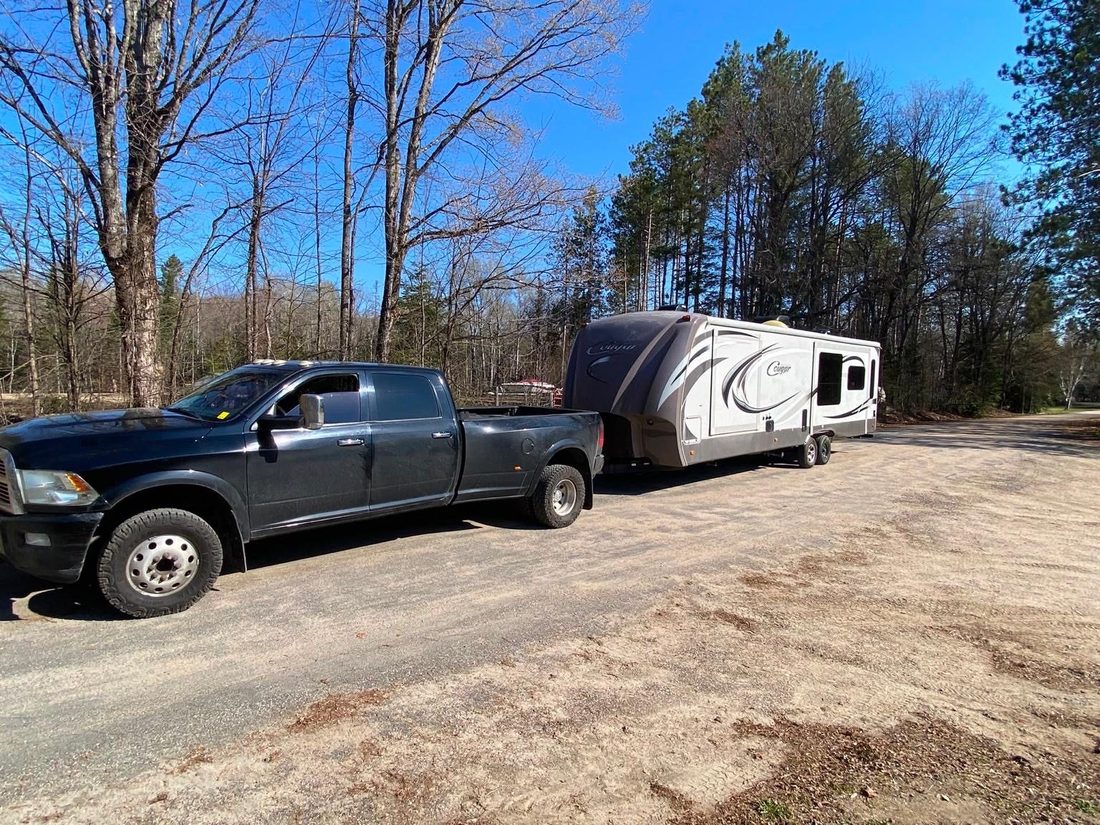
Quick answers before you read on
If you only want the numbers, here they are in one place. Everything below is sourced further down the page, and every figure names the document it came from.
| Local tow, starting | $400 |
| Levelling and blocking, local flat rate from | $799 |
| Outdoor winter storage | $85 to $125 a month by size |
| Maximum tow weight | 30,000 lb on a 30 foot gooseneck |
| Ontario CVOR | 204-617-206 |
| Deposit to book | None |
| Quinte West oversize permit, one month | $50.00 |
| Quinte West oversize permit, six months | $100.00 |
| Quinte West oversize permit, one year | $200.00 |
| Half load axle limit, Quinte West and Stirling-Rawdon | 5,000 kg, 5 tonnes per axle |
| Ontario legal width without a permit | 2.6 m |
| Ontario legal height without a permit | 4.15 m |
One thing worth reading twice
Quinte West By-law 00-143 prohibits moving an oversized load on any City highway on any Saturday, Sunday or statutory holiday unless you have prior written permission from the Director of Public Works. If your only free day is a Saturday, that has to be arranged in advance, not discovered on the morning of the move.
What we tow into and out of Quinte
The short version is anything on wheels that is meant to be lived in, plus the structures people build around it once it stops moving. Travel trailers, fifth wheels, toy haulers, hybrid and pop up trailers, park models, single wide mobile homes, boats on trailers, and gooseneck and equipment trailers up to 30,000 lb. See the RV and trailer transport page for what is involved in a standard tow, and the park model and mobile home moving page for the wide loads.
The split that actually matters in this area is not brand or age, it is width. A travel trailer or fifth wheel is almost always built to fit inside the 2.6 m legal width, which means it moves on ordinary rules and ordinary paperwork. A park model or a single wide is usually built wider than that on purpose, because it is designed to be placed once and left. The moment you cross 2.6 m you are into a permit system, and in Quinte West you are into a second, municipal permit system on top of the provincial one. That is not a reason to panic. It is a reason to call before you commit to a date.
We also do the work that makes the tow possible in the first place. If a deck, a shed or a set of stairs is between the trailer and the road, we move it, which is covered on the deck and shed moving page. If the unit has to sit level and solid at the other end, that is levelling and blocking. If it needs somewhere to sit between seasons, that is outdoor winter storage.
- Travel trailers, fifth wheels and toy haulers, any length we can legally pull
- Park models, including CSA Z241 units that are over legal width
- Single wide mobile homes
- Boats on trailers, and bare gooseneck or equipment trailers
- Non running and project units, which we still tow, though they need to be told about up front
- Decks up to 30 feet and sheds, moved out of the way or moved to a new spot
What a tow into Quinte actually costs
Local tows start at $400. That is a genuine starting point rather than a teaser, but it is a starting point for a short local move, and Beaverton to the Bay of Quinte is not a short local move. A Belleville or Trenton job is a highway run down the 401 corridor or across county roads, so most Quinte quotes land above the starting figure.
What moves the number: total distance and whether it is one way or a round trip; the size and weight of the unit; whether the tires, bearings and lights are roadworthy or need attention before we leave; whether the far end needs levelling, blocking or skirting work; whether the unit is over legal width and therefore needs permits and possibly escorts; and whether the date falls inside half load season, which can force a longer route or a different week entirely. Our RV transport cost guide walks through each of those in detail.
What does not move the number: a deposit, because we do not take one. You book a date, we show up on it, and you pay when the work is done.
Half load season, the date that decides everything
Every spring, Ontario municipalities reduce the weight allowed on their roads while the frost comes out of the ground. The technical name is a reduced load period. Everyone calls it half loads. For a few weeks the road surface sits on saturated, thawing subgrade, and a heavy axle that the road carries comfortably in August will pump water through the base and tear it apart in April. So the weight comes off, and it comes off municipality by municipality, on dates each council sets for itself.
This is the single most important thing to understand about moving an RV or a park model in this area, because Quinte is stitched together from municipalities that do not use the same dates. In 2026, Quinte West started on a Tuesday in mid February and finished on a Monday in early May. Stirling-Rawdon started six days after Quinte West did. Centre Hastings uses whole calendar months. Belleville publishes one window and then, in its own news release, described a different one. Tweed and Madoc Township publish nothing at all on the subject.
Why we ask for your address before we quote a date
Not to be difficult. The half load calendar in this area can differ by more than two months from one side of a boundary to the other, and a route that is legal on a Wednesday in one municipality may be restricted on the same Wednesday two concessions over. We check the authority that owns each road on the actual route, not a general rule of thumb.
Belleville half loads, and the City's own numbers
The City of Belleville's published half load policy runs from February 15 to April 30. That is the window a customer planning a spring move would find and plan around, and for most purposes it is the right answer to work from.
What complicates it is the City's own news release. On April 14, 2026, Belleville published a post titled to advise that half load restrictions would be lifted on April 17. Three sentences from that post are worth having in front of you. The City wrote that it wished to advise residents and motorists that the Half-Load By-law would be lifted "this Friday, April 17". It wrote that heavy trucks had been "restricted in weight since January to preserve and protect municipal roads/assets from damage during the freeze thaw or spring thaw cycle". And it wrote that "The frost is now out of the ground and road damage that is associated with frost conditions is no longer a risk."
We checked the date arithmetic by hand: April 17, 2026 is indeed a Friday, so the notice is internally consistent. What it is not consistent with is the published policy window.
The Belleville policy versus practice gap
Put the two City of Belleville sources side by side and the difference is not small. The policy says February 15 to April 30. The news post says restrictions were in place since January and came off on April 17. That is roughly six weeks earlier at the start and two weeks earlier at the finish.
| Belleville published policy window | Feb 15 to April 30 |
| Belleville news post, Apr 14, 2026 | Restricted since January, lifted Friday April 17 |
| Difference at the start | Roughly six weeks earlier than published |
| Difference at the finish | Two weeks earlier than published |
| Tonnage stated in the news post | Not printed |
| Effective time of day in the news post | Not printed |
We are not going to adjudicate that for you, because both documents are the City's. What we do with it operationally is simple and conservative. We treat the wider window as the planning assumption, because being ready early costs nothing and being caught late costs a rescheduled truck. And when a customer's date falls anywhere near either edge, we call the City rather than reading a web page. Transportation and Operations is 613-967-3275 and the general email for the department is opgeneral@belleville.ca.
Belleville also publishes a short numbered list of roads exempt from the restriction. We counted it carefully, twice, because our own research notes disagreed with themselves about how many entries were on it, and the count is eleven. We are deliberately not reprinting that list here. Exempt road lists get revised between seasons, and a stale list on a transport company's website is worse than no list, because it reads with authority it has not earned. We check the current list against your route at quote time.
Quinte West half loads, Feb 17 to May 4, 2026
Quinte West publishes the cleanest half load statement in the area. For 2026 the City published that half load restrictions came into effect on Feb. 17, 2026 and would be lifted as of May 4, 2026. Both of those check out as real calendar dates: February 17, 2026 is a Tuesday, and May 4, 2026 is a Monday.
The restriction applies to vehicles exceeding 5,000 kg, which the City expresses as 5 tonnes per axle. That per axle framing is the part people get wrong. It is not a gross vehicle limit. A tandem axle trailer that seems modest on paper can still exceed 5 tonnes on a single axle once it is loaded and once the tow vehicle's weight transfer is accounted for.
That is also the longest window of any municipality in the area at eleven weeks, running from the back half of February straight through to the first week of May. If your seasonal site is in Quinte West and you want the trailer in place for the May long weekend, the arithmetic is tight. We would rather have that conversation in January than in April.
Quinte West Public Works can be reached at 613-392-2841, toll free at 1-866-485-2841.
The road list labelled unrestricted in a file named restricted
Here is a small thing that would be easy to get badly wrong. Quinte West's half load page carries a
link to a road list. The visible link text reads "View the list of unrestricted roads (PDF)". The file
that link points at is named qw_restricted_roads_2026.pdf.
Unrestricted in the label. Restricted in the filename. Those are opposite meanings, and a list read backwards would put a heavy trailer on exactly the roads it should be avoiding.
We are publishing the ambiguity and not the list. We did not read the document, so we have no business summarising its contents, and we are not going to resolve the naming conflict by guessing which of the two is the typo. If your route touches a Quinte West road during the restricted window, we call Public Works and confirm that specific road with a person. That is a five minute phone call that removes the entire problem.
Stirling-Rawdon, and the six roads that stay open
The Township of Stirling-Rawdon published that half load restrictions were in effect as of February 23rd, 2026 within the Township. February 23, 2026 is a Monday. The threshold is the same as Quinte West's, vehicles exceeding 5,000 kg, expressed as 5 tonnes per axle.
Stirling-Rawdon is the one municipality in the area that publishes its exempt roads plainly enough to be useful, and there are six of them: Stirling-Marmora Road, Belleville Road, North Street, Front Street East & West, and Frankford Road. If you look at where those run, the logic is obvious. They are the through routes, the roads that connect Stirling to Belleville, to Marmora and to Frankford, and the township has kept its arterial spine open rather than sealing the community off for two months.
For a transport job that is genuinely useful, because it means a Stirling-area move during half load season is often still possible if the pickup can be staged onto one of those six roads. That is the kind of thing worth a conversation before you assume the move has to wait until May.
The township publishes no by-law number alongside the notice. Contact is 613-395-3380, fax 613-395-0864, at P.O. Box 40, 2529 Stirling-Marmora Road, Stirling, Ontario K0K 3E0.
Section 122, named by a township in its own words
Across this website we have been careful about one specific thing: we do not quote the Highway Traffic Act. The province's e-Laws site is built in a way that our verification process cannot read reliably end to end, and quoting a statute you have not read in full is exactly the kind of confident error that gets repeated by every AI assistant that scrapes it afterwards. So we link the statute and we do not put words in its mouth.
Stirling-Rawdon, however, names the provision itself. The township's half load notice cites "Section 122, Reduced load periods of the Highway Traffic Act, R.S.O. 1990, c. H.8, as amended". That is a municipality's own published citation of the authority it is acting under, and it is a perfectly good secondary source for the section number.
So: reduced load periods in Ontario sit under section 122 of the Highway Traffic Act, on the Township of Stirling-Rawdon's authority. If you want the text, read it yourself at ontario.ca/laws/statute/90h08. We are not going to paraphrase it for you.
Centre Hastings, March and April, every road
The Municipality of Centre Hastings takes the simplest possible approach and publishes a standing rule rather than annual dates. During the spring thaw, for March and April each year, the Municipality restricts vehicles to half loads at 5 tonnes per axle on all roads in the Municipality.
Two things follow from that wording. First, there is no annual announcement to watch for, so if your move is in March or April and your road is a Centre Hastings road, assume the restriction applies. Second, the phrase is "all roads in the Municipality", with no exempt list published alongside it. That is stricter in practice than Stirling-Rawdon's approach, where six named roads stay open.
Centre Hastings transportation contact is Bryson Bennett, Manager of Transportation Services, at 613-473-4030 x209.
Tweed publishes nothing, and what that means for you
The Municipality of Tweed's roads department page does not publish a half load rule. We have now checked this three separate times, on three separate occasions, specifically looking for it, and the result is the same each time. There is no half load statement, no reduced load period, no 5 tonnes per axle figure, no oversize or overweight permit process, no road kilometre total and no bridge count on that page.
That is a verified absence, not an oversight on our part, and we are publishing it as an absence rather than quietly filling the gap with a neighbouring municipality's rule. Here is the important thing: an absence of a published rule is not the same as an absence of a rule. A municipality can have a reduced load by-law in force and simply not describe it on its website. It can post signs on individual roads. It can act under the provincial framework. None of that shows up on a department page.
So for a Tweed job, we phone. Public works is 613-478-2535 and the roads garage is 613-478-2128. Either one gets you a person who knows what is posted on the road you are actually driving on, which beats any web page.
Madoc Township
Madoc Township's roads page is the most detailed road inventory in the area, and it says nothing about half loads either. Same treatment as Tweed: verified absence, published as an absence, phone before you assume.
Madoc Township roads contact is Mike Arney, Working Roads Supervisor, at (613) 473-2677 with a cell number of (343) 645-5516, email roads@madoc.ca, fax (613) 473-5580. The road inventory itself is worth a section of its own further down, because it is the only one in this entire study area whose numbers add up.
Hastings County has no roads department page
This one surprises people, and it costs callers time, so it is worth stating clearly. Hastings County does not publish a roads, public works or transportation department page. We checked, and checked again. There is no county roads page to look up your restriction on, because for these purposes the County is not the authority you want.
Your road in this area is almost certainly one of three things: a municipal road belonging to Belleville, Quinte West, Tweed, Madoc Township, Stirling-Rawdon or Centre Hastings; a provincial highway belonging to the Ministry of Transportation; or a private lane or park road belonging to whoever owns the property. Each has a different authority and a different phone number. None of them is a county roads department, because there is not one to call.
How we plan a Quinte job around half load season
In practice the process is boring, which is the point.
- We ask for both addresses first. Not the town, the actual address, because the municipal boundary matters more than the postal town name.
- We identify every road authority on the route. A Stirling to Trenton run can cross Stirling-Rawdon, Quinte West and provincial highway in twenty minutes.
- We check the current published window for each one, rather than working from last year's dates, because they move.
- Where a municipality publishes nothing, we phone it. Tweed and Madoc Township both fall in this category.
- Where two of a municipality's own documents disagree, we phone as well. Belleville falls in this category.
- We plan the date around the widest window, not the narrowest, so a surprise early start does not strand the job.
- If the date cannot move, we look at exempt roads. Stirling-Rawdon's six named through routes have saved more than one spring move.
The customers who get burned are almost always the ones who booked a site opening for May 1 and a tow for the last week of April in a municipality whose window runs to May 4. That is a solvable problem in February and an expensive problem in April.
Oversize and overweight permits, municipal layer
There are two permit systems stacked on top of each other in Ontario, and confusing them is the most common mistake we see. The province regulates oversize and overweight loads on provincial highways through the Ministry of Transportation. Municipalities regulate them on municipal roads through their own by-laws. A park model move that starts on a township road, runs down a King's highway and finishes on a city street can touch all three, and satisfying one does not satisfy the others.
Across the six municipalities in this area, exactly two publish a permit process a member of the public can read. Quinte West publishes a complete by-law with fees. Stirling-Rawdon publishes an application with conditions but no fees. The other four publish nothing on the subject at all.
Quinte West By-law 00-143, the Oversized Loads Permit By-law
This is the most useful municipal document in the whole area, and it is worth going through properly. By-law 00-143, titled the Oversized Loads Permit By-law, was passed the 18th day of December, 2000. Its structure is straightforward.
Section 4(a) is the operative prohibition: no person shall move or transport any Oversized Load on any highway within the City of Quinte West without a Permit first being issued. Section 8 puts the issuing authority with the Director of Public Works. Section 9 requires that the movement cause the least interference with traffic. Section 11 makes a permit valid only for the specific date, time and route specified on it, which means a permit is not a season pass for a route, it is authorisation for one movement. Insurance must be public liability and property damage coverage of not less than Two Million Dollars ($2,000,000.00). Twenty four hours of notice is required. Penalties run under the Provincial Offences Act.
The by-law does not define its own key term
By-law 00-143 does not contain a definition of Oversized Load. That is not us failing to find one, that is the document. In practice this means the working test is the provincial one: if you are over 2.6 m wide, over 4.15 m high, over 12.5 m as a single vehicle or over 23 m as a combination, treat yourself as oversized and apply. If you are close to a line, apply anyway. A $50 permit is cheaper than a conversation on the shoulder of Old Highway 2.
The three Quinte West permit fees
These are the only municipal oversize permit fees anywhere in this study area that we could read from a primary source, and we confirmed them on two separate readings of the by-law because a fee figure is exactly the kind of number that is worth being sure about.
| Permit valid for one month | $50.00 |
| Permit valid for six months | $100.00 |
| Permit valid for one year | $200.00 |
| Insurance required | Not less than $2,000,000.00 public liability and property damage |
| Notice required | 24 hours |
| Issuing authority | Director of Public Works |
Note the interaction between the fee tiers and section 11. The tiers describe how long the permit document remains valid, while section 11 ties any given movement to a specific date, time and route. For a single park model delivery, the one month permit is the relevant tier. The six month and annual tiers exist for operators moving repeatedly. We handle the application either way, and the fee is passed through at cost rather than marked up.
No Saturday, Sunday or holiday moves without written permission
Section 10 of By-law 00-143 is the single most practically important sentence in this entire page for anyone booking a move around a work schedule. It states that no person shall be permitted to move or transport any Oversized Load on any highway within the City of Quinte West on any Saturday, Sunday or statutory holiday unless the prior written permission of the Director of Public Works is obtained.
Read that carefully. It is not a discouragement, it is a prohibition with an exception, and the exception requires prior written permission. Not a phone call on Friday afternoon. Not an understanding. Written permission, in advance, from a named official.
Most people who move a park model do it on a weekend, because that is when they are off work. In Quinte West that instinct is exactly backwards for an oversize load, and it is the reason we push for weekday dates on wide units and start the paperwork early when a weekend date genuinely cannot move. This affects park models and single wides. A standard travel trailer inside legal width is not an oversized load and is not caught by this at all.
Stirling-Rawdon By-law 1457-21
Stirling-Rawdon publishes a Permit Application for Excess Weight and Size, made under By-law 1457-21. It is an application form rather than a full by-law text, so what we can tell you is what the form itself requires.
- Property damage and public liability insurance in an amount not less than Two Million Dollars.
- The applicant must notify the Township of the time of the move.
- The applicant must adhere to the approved route. Not a route, the approved route.
- The Township reserves the right to change the permitted hours, with a minimum of 24 hours notice.
- The contact is the Manager of Public Works.
What the form does not publish is a fee and, more significantly, any dimension or weight threshold that triggers the requirement. So unlike Quinte West, where the provincial maxima are a sensible working test, in Stirling-Rawdon there is no published trigger at all. We treat that the same way we treat every other gap on this page: we call the Manager of Public Works and ask, rather than assuming a threshold that the Township has not published.
Two unrelated by-laws, the same two numbers
Something worth noticing, because it tells you what to expect elsewhere. Quinte West's By-law 00-143 was passed in December 2000. Stirling-Rawdon's By-law 1457-21 is from a different municipality two decades later. Neither cites the other. And both require public liability and property damage insurance of not less than Two Million Dollars, and both require 24 hours of notice.
That is convergence rather than a shared source, and it is the kind of pattern that tells you what a municipal oversize permit in eastern Ontario generally looks like even where nothing is published. If you are dealing with a municipality that has no public process, two million in coverage and a day's notice is a reasonable thing to have ready before you make the call. We carry the insurance, so on a job we are hauling this is our paperwork rather than yours. It matters if you are moving something yourself.
The four municipalities that publish no permit process
Belleville, Tweed, Madoc Township and Centre Hastings publish no oversize or overweight permit process that we could find, and in Tweed's case we specifically looked for one three times.
We are stating that as a fact about what is published, not as a claim that no requirement exists. Those are very different statements and the difference could cost you. A municipality can have a permit by-law in force, administer it entirely by phone, and never put a page about it on its website. That is common in smaller townships, where the process is a conversation with the roads superintendent rather than an online form.
So the honest instruction for those four is: if your load is over the provincial legal maxima and any part of the route is on their roads, phone them. The numbers are collected in the sources section at the bottom of this page, and on any job we are handling, that call is ours to make and not yours.
The provincial layer, and where it takes over
The moment your route touches a King's highway, the Ministry of Transportation's rules apply on top of everything above. In this area that means Highway 401 through Belleville and Quinte West, Highway 62 north out of Belleville toward Madoc, Highway 37 north toward Tweed, and Highway 7 across the top of the area through Madoc and Marmora. Those are provincial roads, and no municipal permit authorises anything on them.
These are the same provincial rules we set out on our RV transport page and on the Northumberland page. They do not change from county to county, which is exactly why they are worth learning once.
The legal maxima you are measured against
Without a permit, Ontario's limits are:
| Maximum width | 2.6 m |
| Maximum height | 4.15 m |
| Maximum length, single vehicle | 12.5 m |
| Maximum length, combination | 23 m |
Almost every travel trailer and fifth wheel built for the Canadian market fits inside all four, because the manufacturers build to those numbers deliberately. Park models and single wide mobile homes generally do not, because they are designed to be delivered once and then stay put, and the extra width buys real living space. That single difference is what separates a straightforward tow from a permitted move, and it is the first thing we ask about.
Escorts, flags and signs
Once you are over, the marking and escort requirements scale with how far over you are. A load between 4 m and 4.99 m wide requires one escort vehicle on a multi-lane highway. A load 4.87 m or greater in height requires one pole car, which is a vehicle carrying a height pole ahead of the load to find low wires and structures before the load does.
Marking requirements are specific. Flags must be not less than 40 cm square. The oversize sign must be visible for a distance of at least 150 m and must bear the words OVERSIZE LOAD.
Escorts add cost and they add scheduling complexity, because an escort operator has to be available on the same day as the truck and the crane, if a crane is involved. This is another reason wide load dates get booked further out than standard tows.
March, April, and summer Sundays
The province also blacks out certain periods entirely on King's highways, and the two that catch people in this area are these. There is a seasonal restriction on King's highways during March and April in Southern Ontario, which overlaps almost exactly with municipal half load season. And there is no Sunday travel from noon to midnight during June, July and August.
Stack those against the municipal calendar and a picture emerges. In March and April you are fighting both the province and the municipality at once. In June, July and August, Sunday afternoons are out on provincial highways and Saturdays and Sundays are out in Quinte West without written permission. For a wide load, the practical booking window in summer is a weekday, and everyone wants the same weekdays.
What a provincial permit costs
| Annual oversize permit | $448.75 |
| Enhanced annual permit | $744.50 |
| Project permit | $291.75 |
| Single trip, oversize only | $66.25 |
| Single trip, overweight, first tier | $127.50 |
| Single trip, overweight, second tier | $204.00 |
| Single trip, overweight, third tier | $265.25 |
| Superload | $714.00 |
Put the Quinte West figures beside these and you can see the shape of a park model move's paperwork cost: a $66.25 single trip provincial permit if the run touches a highway, plus $50.00 for a one month Quinte West permit if it touches a Quinte West road. That is a bit over a hundred dollars in permits. The permits are rarely the expensive part of a wide load move. The escorts and the scheduling are.
What an annual permit does not cover
An annual oversize permit is not unlimited, and the ceilings are worth knowing because a park model can exceed them. The annual permit caps at 63,500 kg, 3.85 m width on a multi-lane highway, 25 m in length and 4.26 m in height. Above any of those you are into single trip or project permits with their own conditions and routing review.
The provincial permits office is at 301 St Paul Street, 2nd Floor, St Catharines, Ontario L2R 7R4. On a job we are hauling, this is our administrative work and it is built into the quote. We are setting it out here because customers ask what they are paying for, and because a customer moving something themselves deserves to know what the actual requirements are before they get pulled over.
The road network under the trailer
Road inventories sound like trivia until you are trying to work out who to call about a soft shoulder or a posted bridge. In this area the published figures are also a case study in why you cannot compare municipalities to each other casually, because they are not all measuring the same thing.
We have gone through what each municipality actually publishes below. Where a figure is in an unusual unit, we say so, and we do not convert it, because converting someone else's number and then presenting the result as theirs is how errors get laundered into facts.
Belleville, 900 lane kilometres and 70 signals
The City of Belleville publishes that it maintains over 900 lane kilometres of roads and over 225 kilometres of sidewalks.
Lane kilometres, not centreline kilometres. A two lane road one kilometre long is two lane kilometres. A four lane arterial one kilometre long is four. That means Belleville's 900 is not remotely comparable to a township figure quoted in ordinary kilometres, and we are never going to put it in a table beside one. It is a measure of pavement to maintain, not of distance across the city.
On the traffic side, Belleville publishes that it operates and maintains more than 70 signalized intersections, along with all traffic signs and other traffic control devices on public roads across the city. For a wide load that number is more meaningful than it looks, because signal masts, overhead signal arms and sign gantries are the things a 4 m wide load has to be routed around at intersections.
Belleville Transportation and Operations is 613-967-3275, and the department email is opgeneral@belleville.ca. The City's traffic control page does not cite a traffic by-law number, and neither its road maintenance page nor its traffic page publishes a winter road classification system or plowing timelines, so we do not quote either.
The roads through Belleville that are not the City's
Belleville states this plainly and it is worth repeating, because it saves a wasted phone call. All signalized intersections and intersections along the provincial highways through the city, including Highway 401, Highway 62 and Highway 37, are owned and maintained by the Ministry of Transportation.
So if your route problem is on the 401, on Highway 62 heading north toward Madoc, or on Highway 37 heading north toward Tweed, the City of Belleville is not the authority. That is a provincial matter and it goes through the MTO permits process rather than a municipal one. It is also why a park model heading from Belleville up to a lot near Tweed usually needs both a provincial permit for the highway portion and a conversation with whichever township owns the last few kilometres.
Quinte West roads and the winter parking ban
Quinte West's operational material is organised around winter rather than around inventory. The City does not publish a winter road kilometre total, and its priority plowing timings are referenced as a heading without the detail behind them, so there is no figure for us to quote.
What it does publish, and what matters to anyone leaving a trailer anywhere in the city between December and March, is this: from Dec. 1 through March 31, parking is prohibited on all city streets, roads and municipal lots between 11 p.m. and 6 a.m. That is covered properly in the parking section below.
The City also sets out the windrow rule plainly. Snow plowed onto your driveway from the road is called a windrow, and it is the property owner's responsibility to clear the snow the plows leave at the end of the driveway. That is standard across Ontario but it catches seasonal residents who are not there in January. If you have a trailer stored on a residential property over the winter and the driveway is never cleared, getting a truck in there in March to pull it out is a genuine problem. Quinte West's relevant extension is 613-392-2841 ext. 4912.
Centre Hastings, 550 km and 222 square kilometres
Centre Hastings publishes two road figures on the same department page, in two different units, and they cannot be compared to each other.
The first: the Public Works Department is responsible for winter maintenance of nearly 550km of roadway. That is a linear measure, a distance of road plowed.
The second: the municipality maintains 222 square kilometers of roads in Centre Hastings year round, with the exception of seasonal roads, private lanes, and provincially owned highways such as Hwy 7. That is an areal measure, or at least it is written as one.
We are not going to reconcile those, and neither should anyone else without asking the municipality what each figure counts. Kilometres and square kilometres are different dimensions. A page that prints both is telling you two separate things, and the honest response is to report both with their units attached and leave the interpretation alone. The one useful piece embedded in the second statement is the exclusion list, which confirms that seasonal roads, private lanes and Highway 7 are outside the municipality's year round maintenance. If your site is on a seasonal road, that is your first question.
Madoc Township, the one inventory that adds up
Madoc Township publishes approximately 182 kilometers of roads, including 35km of tar and chip roads, 31km of hard top and 116km of gravel roads. The Township is also responsible for 6 bridges and 10 culverts.
We added the components by hand. 35 plus 31 plus 116 is 182, which is exactly the stated total. That makes Madoc Township the only road inventory in this entire study area whose published components reconcile with its published total, and we mention it not to be pedantic but because it is a signal. A department that publishes numbers that add up is a department whose other numbers are worth trusting.
| Tar and chip | 35 km |
| Hard top | 31 km |
| Gravel | 116 km |
| Stated total | Approximately 182 km |
| Components as added | 182 km, exact |
| Bridges | 6 |
| Culverts | 10 |
There is a practical point buried in that table too. 116 of 182 kilometres is gravel, which is close to two thirds of the township's road network. Gravel behaves very differently under a loaded trailer in a wet April than pavement does, and a gravel road that is perfectly passable in a pickup can be a problem for a tandem axle load. When we quote a Madoc Township job we ask about the last kilometre specifically.
Tweed, and who to call there
Tweed's roads department page publishes contacts and not much else. No road kilometre total, no bridge count, no half load rule, no permit process. We checked, and that is genuinely all that is there.
The numbers are worth having: public works at 613-478-2535 and the roads garage at 613-478-2128.
In a township that publishes little, the phone number is the document. We would rather give you two working numbers than a page of inferred rules.
Bridges, and the numbers that are not road numbers
Posted bridges are the quiet killer on a rural transport job, because a bridge with a reduced load posting can turn a fifteen minute detour into an hour and a half one, and you find out about it when you are already committed to the road.
Here is what we can and cannot tell you. Ontario Regulation 598 schedules bridges with reduced load limits, and no bridge in the Hastings area appears on that schedule. That is not proof that local bridges are unposted. Municipal bridges are posted by municipal by-law and do not necessarily appear in a provincial regulation. Reading the absence from Reg. 598 as an all clear would be a serious mistake, and we are flagging it precisely because it looks like reassurance and is not.
We are also not publishing bridge counts or tonnages for Tweed, despite having seen figures for them in secondary material, because we could not verify them against Tweed's own publications and Tweed's roads page carries no bridge information at all. Madoc Township's 6 bridges and 10 culverts is published by the township and is in the table above. That is the only local bridge inventory on this page, because it is the only one we could source.
On a job, we route to known clearances and we phone the road authority when a posting is possible. That is slower than guessing and it is the reason we have never left a customer's unit sitting at a bridge approach.
Trent-Severn clearances are vessel headroom
This one deserves its own heading because it is the single easiest number in this region to misread, and misreading it would be expensive.
The Trent-Severn Waterway publishes bridge clearance heights along its length. Around this area, the Veterans Skyway is listed at 8.5, the J.D. MacDonald at 7.8, the C.P.R. bridge at 13.2, the Highway 401 bridge at 7.5, and Frankford and Campbellford at 6.7 each, with a system minimum of 6.1 m. Parks Canada notes that bridge clearance heights are based on normal navigation season water levels.
Those are marine clearances
Every one of those figures is the headroom under the bridge for a boat on the water. None of them is a road height limit for a vehicle driving over the bridge. A driver who reads 6.7 m at Frankford and concludes a 4.3 m load will clear is reading the right number off the wrong document, and the number that actually governs is the posted clearance of whatever structure the road passes under, not the water clearance of the bridge itself.
We include them because customers in this area find them and ask, and the useful answer is not to ignore the figures but to understand what they measure. If you are moving a boat through the waterway, they are exactly what you want. If you are moving a park model down Highway 33, they are irrelevant.
Lock 1 at Trenton, and why the size matters
Lock 1 at Trenton is the entrance to the whole Trent-Severn system from the Bay of Quinte. Its chamber is 49.9 m by 9.7 m with an average lift of 5.4 m.
That is here for the boat owners, who make up a real share of what we tow in this area. A boat that fits a trailer does not necessarily fit a lock, and a boat bought on the Bay of Quinte with the intention of running it up to the Kawarthas has a hard limit at the narrowest chamber on the route. We tow boats on trailers, so if the water route does not work, the road one does.
Where you can and cannot leave a trailer overnight
This is the question we get asked most often after price, and it is the one where a wrong answer costs you a ticket rather than a phone call. Two of the six municipalities on this page publish a clear overnight parking rule. The others do not publish one we could read. Here is what each of them actually says, and, just as importantly, what none of them says.
Belleville overnight parking, all year on curbed streets
In Belleville, overnight parking is prohibited on all curbed streets for the entire year, between 1 a.m. and 6 a.m. On streets without curbs the restriction runs from November 1 to April 15, in the same 1 a.m. to 6 a.m. window. Parking on the driveway apron, the part of your driveway that crosses the City boulevard, is prohibited from November 1 to April 15.
The all year part is what catches people. Most Ontario cities run a winter overnight ban and leave the summer alone. Belleville does not. If the street in front of your house has a curb, the 1 a.m. to 6 a.m. restriction applies in July exactly as it applies in January. A fifth wheel left at the curb after a Friday delivery is exposed on the first night, not on the first night after a snowfall.
The rules sit in the City's Traffic By-law 12967, and a 2022 change to the overnight provisions is recorded as Council Resolution 336-2022. We are naming the by-law and the resolution as the source of the rules, and we are deliberately not reproducing any clause from them. The reason is the same reason this whole page is written the way it is: we could confirm the rules as the City states them on its own parking page, and we could not retrieve and verify the operative clause text of the by-law itself. Naming an unread clause number beside a quotation is how bad citations get manufactured, so we name the by-law and stop there.
For a question about a specific street, the City takes parking inquiries at 613-967-3200 ext. 2919.
Quinte West, Dec 1 to March 31, 11 p.m. to 6 a.m.
Quinte West prohibits overnight parking from December 1 through March 31, between 11 p.m. and 6 a.m., on all city streets, roads and municipal parking lots. It is a winter ban rather than a year round one, but it is broader in one respect than Belleville's: it explicitly covers municipal lots, not just the roadway.
Two differences from Belleville matter in practice. The window opens at 11 p.m. rather than 1 a.m., so there are two extra hours of exposure each night. And the municipal lot inclusion removes the obvious workaround. A driver who reads the Belleville rule, assumes Quinte West works the same way, and leaves a trailer in a City lot in Trenton on December 2 is wrong on both the start time and the location.
We have set this out in the roads section above as well, because it is a winter maintenance rule as much as a parking rule. Municipalities write these bans so plows can clear a full road width. That is also why we schedule Quinte West winter work to unload and clear rather than unload and leave.
What none of those rules actually say about RVs
Here is the part most pages in this niche get wrong, and it is worth being precise about.
Neither municipality's overnight parking material names recreational vehicles, trailers, boats or campers as a separate category. We checked specifically for those terms. They are not present. The overnight rules are general vehicle rules, and an RV is caught by them because it is a vehicle parked on the street during the restricted hours, not because there is a special RV clause somewhere.
Why we are telling you what is not there
A page that says "Belleville restricts overnight RV parking" is technically true and quietly misleading, because it implies a dedicated RV rule you could go and read. There is not one. What there is, is a general overnight restriction that an RV falls under. The practical consequence is that the exemption process, the enforcement pattern and the appeal route are the general ones, and a phone call about "the RV by-law" will be met with a pause on the other end. Ask about overnight parking on your street and you will get an answer.
The separate question, whether you can store an RV on your own property and under what conditions, is a zoning question, not a parking one, and it is dealt with in the next section. The two get conflated constantly. Street and municipal lot equals traffic by-law. Your own driveway or side yard equals zoning by-law, plus, in Belleville, a property standards by-law. Different documents, different departments, different answers.
If the honest answer is that you have nowhere legal to leave it for the winter, that is what our storage page exists for, and it is usually cheaper than the second ticket.
Zoning, and the honest limits of what we could read
What follows is the least satisfying section on this page, and we are going to explain why rather than paper over it.
Every municipality here publishes a zoning by-law as a single large consolidated PDF. Those documents run to hundreds of pages. The provisions that govern parking and storing a recreational vehicle on private property live deep in the general provisions, typically in a section five or a section fifteen. When we fetched those documents, the extraction stopped roughly a tenth of the way through in every single case. Cover page, table of contents and the opening sections came through cleanly. The body text of the sections we actually needed did not.
That is a retrieval limit, not a claim that the rules do not exist. The rules exist. They are printed in those PDFs. We could read the headings from the tables of contents and we could not read the clauses underneath them, and the difference between those two things is the difference between a citation and a guess. So below, we tell you exactly which sections govern, exactly where they are, and exactly which ones we could and could not read.
One thing this section did catch
During verification, a fetch of one of these by-laws came back with a fully formed section, complete with lettered clauses, that a targeted re-fetch of the same document showed was not in the document at all. It had been invented in the summarising step. That is precisely the failure this page is built to avoid, and it is why nothing below is quoted unless it survived being asked for twice.
Belleville Zoning By-law 2024-100
Belleville's zoning by-law is By-law 2024-100, consolidated March 11, 2024. Two things about it are worth knowing before you go looking.
First, you currently cannot download it from the City's own website. The City's zoning consolidation page no longer carries a PDF link. It carries the by-law number, the March 11, 2024 date, and a direction to contact the planning department for a copy. The former direct link to the master PDF returns a 404. A working third party copy of the consolidation is hosted at opencouncil.ca, and that is what we read.
Second, and this is the correction that matters most on this page:
There is no section 16.22 in Belleville's zoning by-law. Section 16 is Specific Uses and it runs from 16.1 Public Uses and Utilities to 16.12 Boat Houses in the consolidation, and to 16.13 in the January 2024 draft. Nothing exists above 16.13 in either version. The section that governs vehicles kept in yards is 15.22, Motor Vehicles in Yards, inside Section 15, General Provisions.
We are being emphatic about this because our own research pack carried "s.16.22" attached to a directly quoted phrase, and a section number that does not exist attached to a quotation is the signature of a fabricated citation. We checked it against two independent documents, the March 2024 consolidation and the January 2024 draft, and both agree. Belleville's own visual guides cite 15.17(3) for decks and porches and 17.3 for supplementary off street parking. Everything points at Section 15. Nothing points at 16.22.
We could not retrieve the body text of 15.22. So we can tell you which section governs and we cannot tell you what it says. We are publishing no vehicle counts, no setback distances and no storage caps for Belleville, because we did not read them. We also dropped a quoted phrase our pack carried, because we could not attach it to any section number in either document, and two adjacent sections exist, 15.24 Landscaping and 15.25 Outdoor Storage, that could just as plausibly be its real home.
If your question is whether you can keep a trailer beside your Belleville house, the correct move is to ask the City's planning department about 15.22 specifically. Naming the section will get you a faster answer than describing the trailer.
Belleville Property Standards By-law 2025-157
This one we could read, in full, with clause numbers intact, confirmed identically across two separate PDF files. It is a different by-law from zoning and it does something zoning does not.
By-law 2025-157 is titled "A By-law to Prescribe Standards for the Maintenance and Occupancy of Property within the City of Belleville". Section 3.3 reads:
"No yard shall be used for the parking, storing, or placing of any recreation Vehicle, boat, machinery, mechanical equipment, appliance, similar item, or part thereof, which is in an inoperable, discarded, dismantled, or disused condition."
Read the qualifier at the end, because it does most of the work. The clause bites on an RV that is inoperable, discarded, dismantled or disused. A functioning recreational vehicle parked in a yard is not what 3.3 is aimed at. This is a derelict vehicle provision, not a general RV storage ban, and the difference is the whole clause.
Two neighbouring clauses are worth knowing in the same breath. Section 3.1 requires every yard to be kept clean and free from hazardous objects, materials or conditions, from holes, ruts, depressions and excavations that are potential health or safety hazards, and from rodent and insect infestations. Section 3.2 requires domestic storage, which it lists as actively used firewood, building materials, garden equipment, landscape equipment, pool equipment, lawn furniture, barbeques and similar objects, to be stored in a rear or side yard, stored neatly and not against a fence or property line, and maintained to prevent accumulation, infestation and hazards.
Note what 3.2 does not list: a recreational vehicle. RVs are handled in 3.3, and only in the disused condition. Note also 3.1's mention of holes, ruts and depressions, which is a property standards issue that becomes our problem the moment a loaded trailer has to cross the yard. It is one of the reasons we walk a site before we commit to a route across it, which is covered on the levelling and blocking page.
One sourcing note, because it matters if you go looking. The City of Belleville publishes no PDF of this by-law on its own site. Its property standards page links a request form and reproduces no by-law text. The numbered PDF we read is hosted at opencouncil.ca. That is a real, citable document with clause numbers printed, and it is not the City's own server, so we are saying so plainly.
Quinte West Zoning By-law 14-86
Quinte West's zoning by-law is 14-86, and the current consolidation carries "Consolidated to By-law #26-009" on its cover. The linked copy is the May 2026 upload on the City's own site, which is the one the zoning page actually points at. A February 2026 path also resolves but is not the linked asset, so if you find two files and they differ, the linked one governs.
The section you want is:
| 5.8 | Access to Parking Areas and Parking Spaces |
| 5.9 | Unlicensed Motor Vehicles |
| 5.10 | Parking of Recreational Trailers, Vehicles or Boats |
| 5.11 | Parking Garages |
| 5.12 | Parking Exempt Areas |
The heading of 5.10 is confirmed from the table of contents. The clauses underneath it are not. We tried four separate consolidations, 2021, 2022, 2024 and 2026, and every one of them truncated before Section 5. The City's amending by-laws are hosted on a civicweb portal that is disallowed to automated readers, which closed the last route in. So we publish no length limit, no height limit, no side or rear setback and no unit count for Quinte West, because we did not read a single clause of the section that contains them.
If a page tells you the Quinte West cap is a specific number of metres, ask them which clause of 5.10 it comes from and whether they read it. We could not, and we are not going to pretend otherwise.
Buildings or structures to be moved
This one we did read, twice, and it is the most directly relevant zoning provision to what we do for a living anywhere on this page. Quinte West Zoning By-law 14-86, section 1.15, headed "Buildings or Structures to be Moved", states:
"In all Zones, no buildings, or structures, residential or otherwise, normally requiring a building permit for construction shall be moved within the area affected by this By-law without a Building Permit."
If you are moving a structure within Quinte West that would have needed a building permit to build, you need a building permit to move it. The clause does not name park models or mobile homes. It does not have to. It is written by reference to whether the thing would need a permit to construct, which is a wider net than any list of named structures would be.
This is why the honest answer to "does Quinte West require a permit to move a park model" is not a simple yes or no. Quinte West's building permit pages do not name park models or mobile homes anywhere. But 1.15 exists, it is in force in all zones, and it is phrased to catch structures generally. Whether a specific park model falls inside it depends on whether that unit would have required a permit to construct, which is a question for Building Services at 613-392-2841 ext. 4904, not for us and not for a website.
We raise it before a job rather than after. It is the same reason our park model and mobile home moving page starts with the permit conversation instead of the equipment list.
What a park model is, in the by-laws themselves
Definitions decide arguments. When a municipality tells you a rule applies to a park model but not to a travel trailer, the definition section is where that line is drawn, and around Quinte the definitions are readable even where the operative provisions are not.
Quinte West puts its definitions in Section 3, not Section 2, and defines both terms:
Mobile Home. "any dwelling that is designed to be mobile, and constructed or manufactured to provide a permanent residence in accordance with the applicable Canadian Standards Association (CSA) but does not include a park model home, travel trailer or tent trailer or trailer otherwise designed."
Park Model Home. "a trailer designed for temporary human habitation having permanent running gear and meeting CSA Standard Z241."
Two details in there are worth pulling out. The mobile home definition expressly excludes park models, so in Quinte West the two are legally distinct categories and a rule written for one does not reach the other. And the defined term is "Park Model Home", not "park model trailer", which is the phrasing Centre Hastings uses. If you are searching a document, search both.
The term in the heading is not a defined term
Section 5.10 is headed "Parking of Recreational Trailers, Vehicles or Boats". "Recreational vehicle" is not defined anywhere in the Quinte West by-law. We checked on two independent fetches and they agree. So the section that most people would go looking for uses a term the by-law never defines, while the terms it does define, mobile home and park model home, appear in a different section. That is not a criticism of the drafting. It is a warning that a keyword search will mislead you here.
Centre Hastings Zoning By-law 2002-10
Centre Hastings publishes Zoning By-law No. 2002-10 as a readable PDF, and its definitions came through clean and whole on two independent fetches, with no page break gap. It gives the most precise park model definition of any municipality on this page:
3.141 Park Model Trailer. "Shall mean a recreational unit mounted on a single chassis mounted on wheels designed to facilitate relocation from time to time, and designed as living quarters for seasonal camping and may be connected to those utilities necessary to supply those installed facilities, with a gross floor area including lofts not exceeding 50 m² (538 sq. ft.) in set up mode, and having a width greater than 2.6 m (8.5 ft.) in the transit mode. Further all Park Model Trailers shall comply with Canadian Standards Association Standard No. Z241."
That definition contains two numbers that decide whether a unit is a park model at all: a gross floor area, lofts included, of no more than 50 m² or 538 sq. ft. in set up mode, and a transit width greater than 2.6 m or 8.5 ft. The width is the one that decides whether we can move it inside the legal envelope or whether it needs an oversize permit, because 2.6 m is also the provincial legal width limit. A park model, by definition, is wider than legal width.
Read that last sentence again, because it is the single most useful thing on this page for a park model owner. Centre Hastings defines a park model trailer as having a transit width greater than 2.6 m. The provincial legal width limit for a vehicle or load is 2.6 m. The definition and the limit meet exactly at the same number, from opposite sides. That is why essentially every park model move needs a permit, and why a quote that does not mention permits should worry you.
The same by-law defines the two categories a park model is not:
3.160 Recreational Travel Trailer. "Shall mean any vehicle so constructed that it is suitable for being attached to a motor vehicle for the purpose of being drawn or propelled by the motor vehicle, and is capable of being used for the temporary living, sleeping or eating accommodation of persons for recreational purposes, notwithstanding that such vehicle is jacked-up or that its running gear is removed and for the purposes of this By-law does not include a mobile home, park model trailer or trailer as otherwise defined in this By-law."
3.119 Mobile Home. "Shall mean a transportable, factory-built dwelling designed to be used as a year-round residential dwelling, built in compliance with the Canadian Standards Association (CSA) Standard No. Z240M.H., as amended or replaced from time to time"
The mobile home definition continues past the point where we have closed the quotation, so treat it as the opening of the definition rather than the whole of it. The part that matters is already there: a mobile home is built to CSA Z240 M.H. and is designed for year round residential use, where a park model is built to CSA Z241 and is designed for seasonal camping. Different standard, different purpose, different rules, and in practice a different move. We tow both, and we quote them differently, which is set out on the park model and mobile home page.
Section 4.35 of the Centre Hastings by-law could not be retrieved. The extraction stopped at 4.5.4. We reached the definitions and the opening of Section 4 and no further. We located no retrievable RV or trailer storage provision for Centre Hastings, and we are not substituting a general Ontario rule in its place.
The sections we could not retrieve, named
Rather than leave the gaps scattered through the text above, here they are in one place. Each of these is a real section of a real by-law that governs something you may care about, and each is one we could not read the text of. If a competitor quotes any of them at you, this is the list to check the quote against.
| Belleville 15.22 | Motor Vehicles in Yards. Section confirmed, body text not retrieved. |
| Quinte West 5.10 | Parking of Recreational Trailers, Vehicles or Boats. Heading confirmed from the table of contents, clauses not retrieved. |
| Tweed 5.43 | Travel Trailers, Motor Homes, Camper Trailers, Truck Campers. Heading readable only from a file whose name says Final Draft. The enacted 2012-30 is a scanned image with no text layer. |
| Tweed By-law 2022-12 | Referenced by the Municipality as trailer regulation. The only PDF we located has no machine readable text. Not one character was read. |
| Stirling-Rawdon 5.45 and 5.46 | Zoning By-law 320-03. Clean text layer, but the fetch truncates at 5.3.1. Never reached. |
| Centre Hastings 4.35 | Truncation stops at 4.5.4. Never reached. |
The one negative we will stand behind
Across Belleville, Quinte West, Tweed, Stirling-Rawdon and Centre Hastings, none of the five publishes an express statement, on its building permit pages, that a building permit is or is not required to place a park model trailer or a mobile home. That is a carefully scoped negative and we mean it exactly as written. It does not mean no rule applies. Quinte West's zoning section 1.15 catches moved structures generally, and both Quinte West and Centre Hastings publish CSA linked definitions of these units. What it means is that if you go to those permit pages looking for a park model answer, you will not find one, and you will need to phone.
That is the honest state of the zoning layer around the Bay of Quinte. It is more gap than answer, and we would rather hand you an accurate map of the gaps than a confident page of numbers we did not read. The same approach runs through our Northumberland page and our Peterborough page, where the documents happened to be more cooperative and the sections are quoted in full.
Building permits across six municipalities
Where the zoning by-laws defeated us, the building permit pages did not. Every municipality on this page publishes a plain list of what needs a permit and what does not, in HTML, on its own website, and those lists we could read in full. So this section is the opposite of the last one: specific, quotable and mostly complete.
It matters to an RV owner more than it sounds like it should. A deck at the door of a park model, a shed beside a seasonal trailer, a set of stairs off a fifth wheel: each of those is a structure, and each of them has a threshold above which the municipality wants to see a drawing. We move decks and sheds as a service, so we deal with these lists constantly, and the thresholds differ enough between neighbouring municipalities that assuming is expensive.
Belleville building permits
Belleville publishes an eighteen item list of work requiring a permit. The items that touch what we do read as follows.
A permit is required to build a deck that is:
- Attached to a building, or
- Supporting a roof structure, or
- Larger than 55 m² (592 sq. ft.), or
- More than 600 mm (23 5/8 in.) above grade at any point
Those are separated by "or", not "and", and that single word is the whole rule. A deck that meets any one of the four needs a permit. A small ground level deck that touches the trailer is attached, so it needs one. A deck of any size at all that is more than 600 mm off the ground at any point needs one. Reading that list as a set of conditions that must all be met is the most common mistake made with it, and it is the one that produces an unpermitted deck.
Belleville also requires a permit to construct a structure larger than 10 m² (108 sq. ft.), except as noted for storage sheds, and separately to construct a storage shed larger than 15 m² (161 sq. ft.). So a shed gets fifteen square metres of room and everything else gets ten. Also on the list, and worth knowing if you are developing a property rather than just parking on it: constructing or registering an accessory dwelling unit, erecting a swimming pool or hot tub, and erecting a permanent sign. A tent needs a permit once the tent area is greater than 60 m² (645 sq. ft.). Farm buildings of low human occupancy are defined as no more than one person per 40 m² or 430 sq. ft. of floor area.
What is not on the list matters as much. We checked Belleville's permit material term by term, twice, across the body, sidebar, footer and accordions, for "mobile home", "mobile", "park model", "trailer" and "manufactured home". None of them is present. Belleville's permit pages simply do not address placing a park model or a mobile home, in either direction. That is not a loophole and we would not treat it as one. It is a gap you resolve with a phone call before the truck is booked, not after.
Belleville Building Services: 613-967-3200 ext. 3230, and building@belleville.ca.
Quinte West decks
Quinte West states its deck rule in a single sentence, and we are quoting it exactly as printed, including the non superscript "10m2" and the missing period after "ft":
"A permit is required for a deck that is attached to another structure, has a roof or is over 10m2 (108 sq. ft) and more than 600mm (2 feet) above grade."
Compare it to Belleville's for a second and the difference jumps out. Belleville sets its area trigger at 55 m². Quinte West sets it at 10m2. That is a five and a half times difference in the area threshold between two municipalities that share a border. A 20 m² deck beside a park model is well under Belleville's area trigger and well over Quinte West's, and if it is also more than 600 mm above grade it needs a permit in Trenton and might not in Belleville. Same deck, same builder, different side of the line.
Quinte West Building Services is at 7 Creswell Dr., PO Box 490, Trenton, ON K8V 5R6, on 613-392-2841 ext. 4904. The same page also lists Ontario One Call at 1-800-400-2255, Lower Trent Conservation at 613-394-4829 and Quinte Conservation at 613-968-3434.
We are not publishing an email for Quinte West Building Services
There is one on the page, and it cannot be read by anyone, including you. It is served through Cloudflare email protection, so the page renders a placeholder and an "email protected" notice instead of an address. A cache busted retry was blocked outright. The same is true of Centre Hastings' Chief Building Official. We mention it because a page that quietly omits a contact looks careless, and a page that invents one is worse. Phone them.
Quinte West sheds and detached garages
Quinte West's shed and detached garage page lists several conditions that trigger a permit. One of them we confirmed on two separate fetches and it is the one that catches people who already have a shed:
"Enlarge the current structure to greater than 15m² (161sq ft.)"
So the exemption is not a permanent property of the shed. It is a property of the shed's current size. Add to a compliant shed until it passes fifteen square metres and the addition needs a permit, which is a different question from whether the original shed needed one.
The setback rule on that page includes one sentence that decides a surprising number of arguments:
"The roof overhang can encroach a maximum of 0.6m (2'-0") into the setback."
Read that as an allowance rather than a restriction. The wall has to respect the setback, and the eave is allowed 600 mm of it. If you are siting a shed to the minimum distance from a lot line, the overhang is the part that is measured differently, and it is why a shed that looks compliant on a sketch of the walls can fail on the roof. The page carries further permit triggering conditions for sheds and both conditions for detached garages. We are pointing you at the page rather than reproducing a list we did not capture in full, because a partial list presented as a complete one is worse than no list.
Centre Hastings, and a live contradiction
Centre Hastings publishes a required list and a not required list side by side on the same page. Two items, one from each list, do not agree, and we verified this specifically because it looked like a transcription error on our end. It is not. Both numbers are printed, on the same page, in directly adjacent lists, confirmed on two independent fetches, the second a dedicated pass asking about nothing else.
| Permit required, item 11 | "To construct any addition to an existing storage shed so that the total area exceeds 100 square feet." |
| Permit not required, item 5 | "To construct any storage building less than 160 sq. ft. (Note: must meet set back requirements of Zoning Bylaw)." |
A 130 square foot shed in Centre Hastings is simultaneously exempt and permit triggering, depending on which of the two adjacent lists you read. Under 160, so the not required list says no permit. Over 100, so if it is built as an addition to an existing shed the required list says permit. The gap between 100 and 160 square feet is live, and the deciding factor appears to be whether the structure is new or an addition, which is a distinction the two lists do not spell out.
We are not resolving it for you, because resolving it is the Chief Building Official's job and not ours. We are flagging it so that if you are told two different things by two different people in Centre Hastings, you know why, and you know to ask specifically whether your project is being treated as a new structure or as an addition. That one question saves the argument.
Centre Hastings also publishes its processing times, which is unusually helpful and worth planning around:
| Decks and garages | Minimum of 5 days |
| House permits | Minimum of 10 days |
| Commercial and septic permits | Minimum of 30 days |
Note the word minimum in all three. Those are floors, not estimates. A thirty day floor on a septic permit is the kind of thing that decides whether a park model placement happens this season or next, and it is one of the first things we ask about when a Centre Hastings job involves anything more than setting a unit down.
The Chief Building Official is Matt deJong, at 613-473-4030 x211. His email is Cloudflare obfuscated, same as Quinte West's, so we are not publishing one. No permit fees are published on that page. We confirmed that on both passes. Centre Hastings' required list also includes an item its neighbours' lists do not: constructing any secondary residence.
Tweed, the $200 admin fee and the $700 deposit
Tweed's permit lists parallel Centre Hastings' closely, with one systematic difference: Tweed phrases its thresholds in metric, as square metres, where Centre Hastings uses square feet. If you are comparing the two lists side by side, that is the first thing to correct for, because 10 square metres and 100 square feet are not the same number and the lists look more similar than they are.
Two Tweed figures matter more than the thresholds, and both are penalties rather than requirements.
"Construction started prior to the issuance of a Building Permit is in violation of the Municipality's Building By-law and the property owner will be subject to an administration fee of $200, double permit fees and possible fines and penalties as set out in the Set Fines By-law."
Starting before the permit issues in Tweed costs a $200 administration fee plus double the permit fee, before any fine. That is not a discretionary penalty described in general terms. It is a published, specific consequence, and doubling the fee means the cost of starting early scales with the size of the project.
The second, confirmed on two fetches:
"The building permit by-law for the joint building services requires that a refundable deposit in the amount of $700.00 be paid at the time a permit is obtained, where the value of construction is more than $50,000.00."
Refundable, so it comes back, but it is $700 of cash flow at permit time on anything over fifty thousand dollars of construction value. A mobile home placement with services can clear that threshold without feeling like a big project. Tweed's required list also includes an item absent from Centre Hastings': constructing any boat port, boat house or dock. On the Bay of Quinte that is not a marginal item.
The Building Inspection Services Board
Six municipalities in this area do not each run their own inspection service. They share one, and knowing that changes who you call.
"The Building Inspection Services Board (BISB) looks after building inspections for Stirling-Rawdon, Deseronto, Madoc Township, Marmora and Lake, Tweed, and Tyendinaga."
That sentence is published on Stirling-Rawdon's building and renovating permits page, and it is corroborated word for word on Tyendinaga's site. To book an inspection or ask about plans, the number published on the same page is 1-866-414-0088.
A citation we had to repoint
Our research pack attributed that membership sentence and the inspection phone line to the BISB deck guide PDF. They are not in the PDF. They are on the parent HTML page. The PDF contains one sentence relevant to us: "Deck: A raised uncovered platform. All decks require permits in the 6 BISB municipalities." We are recording the correction here rather than silently fixing it, because a right fact with a wrong source is still a broken citation, and it is exactly the kind of error that propagates when nobody checks.
All decks require permits in the six BISB municipalities. No area threshold, no height threshold, no attached or detached distinction. That is a materially stricter rule than either Belleville's four part test or Quinte West's single sentence, and it applies across Tweed, Stirling-Rawdon, Madoc Township, Marmora and Lake, Deseronto and Tyendinaga. If you are moving a deck into or within any of those six, assume a permit.
Stirling-Rawdon publishes the annual BISB flyer, currently the 2025 edition. There is no 2026 version: the township's permits page still links the 2025 file, and a 2024 edition exists in the archive, which confirms the annual reissue pattern rather than contradicting it. The flyer carries the tagline "Joining Townships by Growing Communities - Since 2005" and one instruction worth repeating exactly: "Inspections can be obtained by calling 395-5166 or 1-866-414-0088. Do NOT call before ready." The capitals are theirs.
The fee figures nobody can read
Three gaps in this section are real and we are naming them rather than filling them.
Stirling-Rawdon's building fee by-law cannot be read. The township links it as Building By-law 38-2026 and the file is live, but three attempts, including a download variant, returned no extractable text at all. It is almost certainly a scanned image with no text layer. We could not confirm the by-law's date or a single fee amount from the document itself. The only things we can confirm are the filename and the township's own link label, both of which say 38-2026. A civicweb document centre route was blocked to automated readers. So we publish no Stirling-Rawdon deck, shed or mobile home fee figures. There are none available to us.
Guard heights and footing depths could not be retrieved. Four attempts across two different hosts, including cache busted and full document requests, and the extractor never got past the opening paragraph of the BISB deck guide. Every attempt returned the title and the deck definition and nothing else. We have no metric guard or footing figures for these municipalities and we are publishing none. We are specifically not supplying them from general knowledge of the Ontario Building Code, because a code figure recited from memory and printed beside a municipal source reads as though the municipality published it, and it did not.
Centre Hastings publishes no permit fees. Confirmed on both passes. Not a retrieval failure, simply not published on that page.
A neighbouring municipality's parallel by-law does render and does carry fee figures. We are not reproducing them here, because they belong to a different municipality and the surrounding table structure did not survive extraction cleanly enough for us to be certain which figures are permit fees and which are construction value rates. Attributing another township's numbers to Stirling-Rawdon would be the single worst error available on this page, and it is available precisely because the correct document will not open.
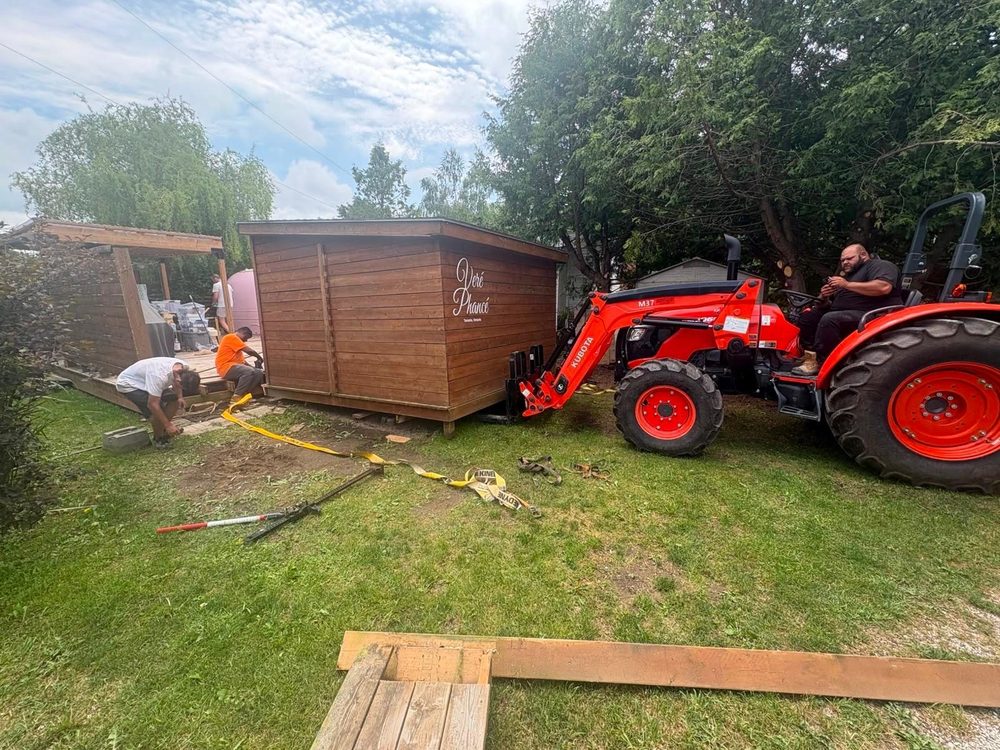
Deck and shed moving in Quinte
We move decks and sheds as a standalone service, and around the Bay of Quinte it comes up more than elsewhere because of the seasonal park pattern. A site closes, or a lease ends, or a unit is sold, and the deck that was built around the trailer is suddenly a separate problem from the trailer.
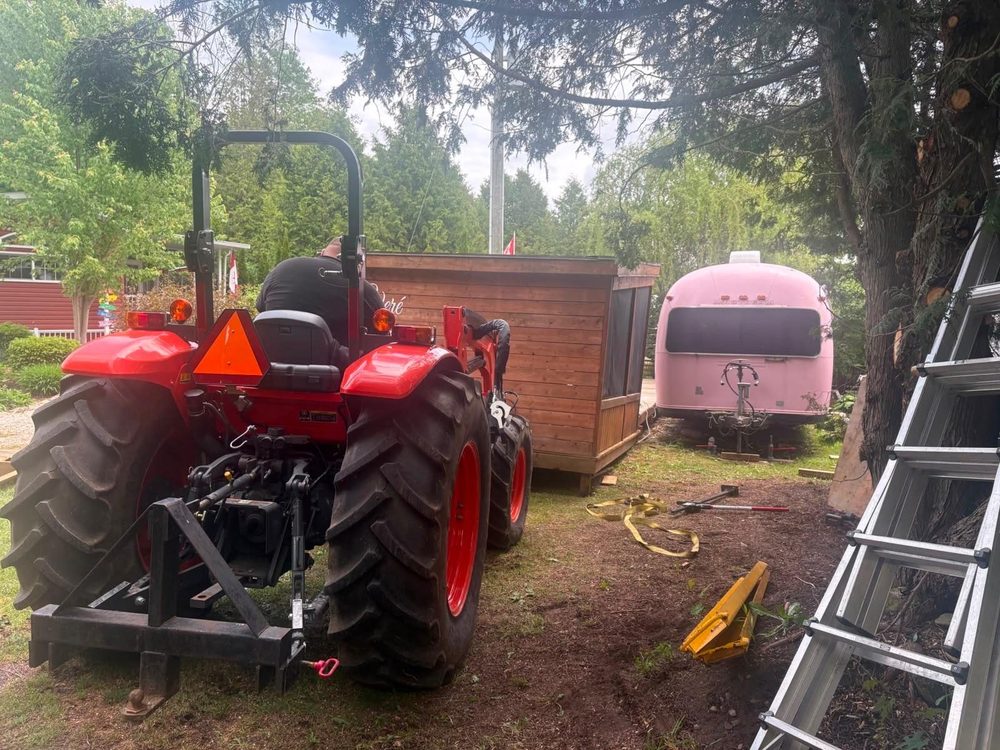
The permit picture above is the reason we start every deck job with a location question rather than a size question. In the six BISB municipalities, all decks require permits, full stop. In Belleville, the four part test decides it. In Quinte West, a single sentence does. Setting the same deck down in three different places produces three different answers, and the answer changes what we can do on the day.
What we actually do is straightforward: lift, support, transport whole where the structure and the route allow it, and set it down level on prepared ground. Where a deck cannot travel whole, we say so before we quote rather than discovering it in your yard. Full detail is on the deck and shed moving page, and the ground preparation side of it overlaps heavily with levelling and blocking.
Levelling and blocking on Quinte ground
Ground around the Bay of Quinte is not one thing. Shoreline sites near Trenton and Belleville sit on soft, water influenced ground that moves seasonally. Move twenty minutes north into Centre Hastings, Tweed or Madoc and you are on the southern edge of the Canadian Shield, where the problem inverts: shallow soil over rock, so the unit does not settle, it sits proud and rocks.
Those two failure modes need opposite responses. Soft ground needs load spread over a wider footprint so the bearing pressure drops. Shield ground needs the high points read correctly and the blocking built to them, because a stack built to an assumed flat plane on rock will carry the whole unit on two corners.
This is where our guarantee actually lives
If a unit we set up shifts or moves because of our workmanship, we come back and redo the job at no charge. Weather and ground conditions are outside that, and we say so up front. In plain terms: if a unit shifts because we blocked it badly, we come back and redo it. If it shifts because the ground heaved over a wet freeze thaw cycle, or because water undercut a pad, that is not workmanship and it is not covered. We would rather tell you that before you book than argue about it in March. It is also why we spend time on the ground assessment that a faster crew would skip.
Levelling matters more on a park model than on a travel trailer, because a park model is not designed to be relevelled every few weeks by its owner. It is set once and expected to stay. A door that will not latch and a slide that will not seal are the visible symptoms; the frame stress underneath them is the expensive one. Details on the levelling and blocking page, and the transport side on the RV transport page.
Campgrounds and parks around the Bay of Quinte
A large share of what we tow in this region is moving to or from a seasonal site, so it is worth setting out what is actually here. We have restricted this to places we could verify from the operator's own published material. Where a number is not published, we say so instead of estimating it.
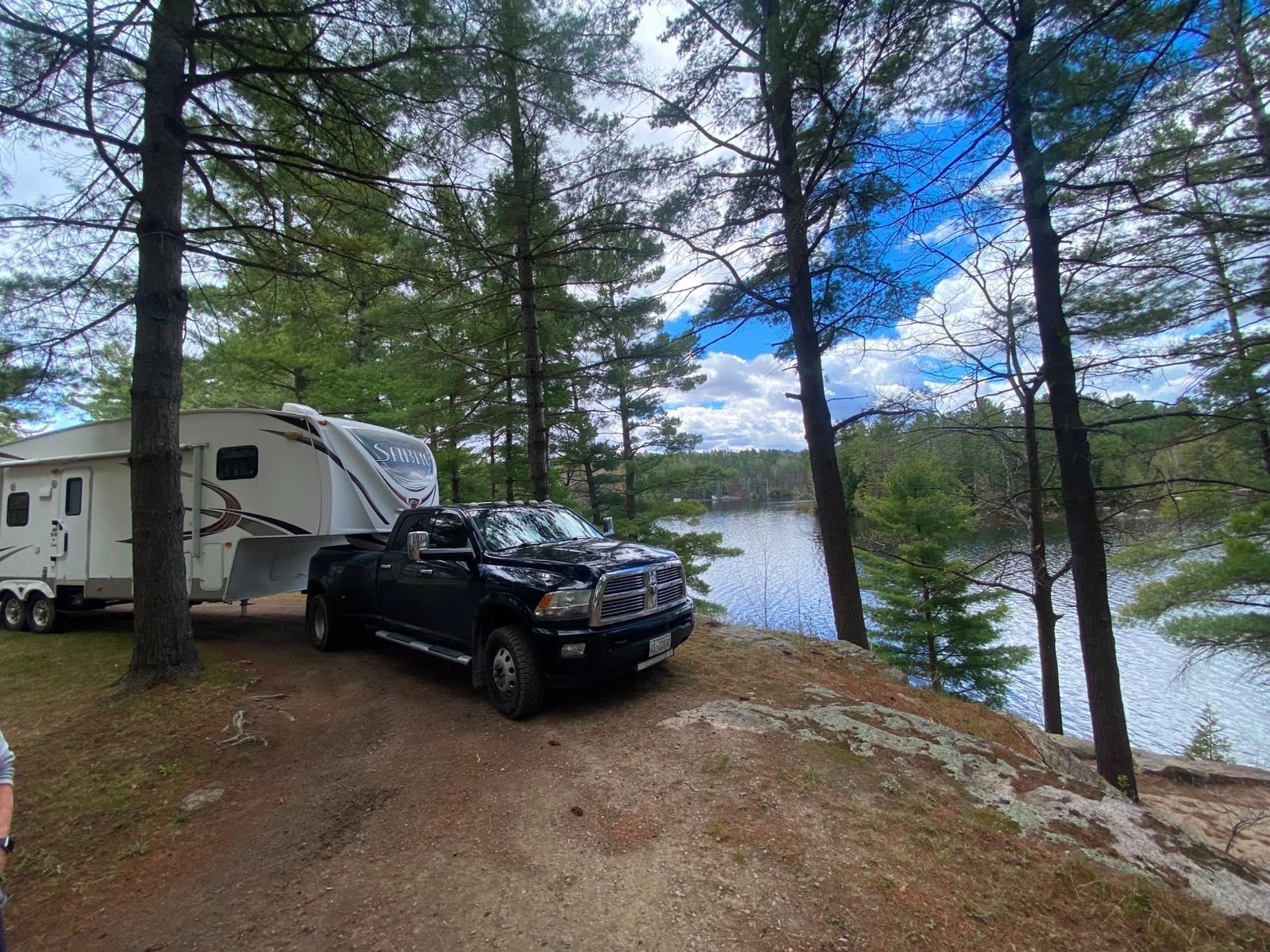
Frankford Tourist Park
Frankford Tourist Park sits at 2839 Frankford Rd. in Frankford, on the Trent, and it is run by the City of Quinte West rather than a private operator. That matters, because a municipal campground publishes its rules in by-laws and council documents rather than in a rental agreement, which means you can read them before you book.
| Address | 2839 Frankford Rd., Frankford |
| Phone | 613-392-2841 ext. 4910 |
| Park hours | Open daily from 6 a.m. to 11 p.m. |
| Washrooms | Open daily from May 1 to Thanksgiving |
| Seasonal removal | By the first Sunday after Thanksgiving |
The seasonal removal deadline is the first Sunday after Thanksgiving, and the City states that if the unit is not gone by then, the City of Quinte West will remove it at the owner's expense. That is a published consequence with a name on it, not a general warning. It is also the single most useful date on this page for a Frankford seasonal, because it sets a hard outside limit on when you need a truck booked.
Thanksgiving in Canada falls on the second Monday of October, so the first Sunday after it lands in the middle of the month. Every seasonal on that park has the same deadline, which means every one of them is looking for a tow in the same fortnight. We book Frankford removals from late August, and the people who call us in the second week of October are the ones we most often cannot help. That is not a sales line, it is arithmetic: one truck, one gooseneck, and a fixed number of days.
One operational note from the City's own material, because it saves a wasted conversation: all maintenance requests must be directed to the City of Quinte West and not to the canteen operators. The people you see at the park are not the people who handle the site.
Two things Frankford does not publish: a site count, and a maximum trailer length. We looked for both. Neither is present in the City's material. So if you are asking whether your unit will fit, that is a phone call to ext. 4910, and anyone telling you a length limit for this park is telling you something the City has not published.
How we describe Frankford, precisely
The City's parks index lists Centennial Park, Hanna Park, Frankford Tourist Park and Campground, and Bain Park, and its park etiquette section states that camping is prohibited. Frankford is therefore the only municipal campground among the named, serviced parks the City promotes. We are phrasing it that way deliberately. It is not a claim that no other campground exists in Quinte West, which we did not verify and will not assert.
Two City sources, three seasonal numbers
This one is a genuine discrepancy between two City of Quinte West documents, and we would rather show you it than pick one.
The City's fees and charges by-law, 23-057, prints camping rates for Frankford Tourist Park in the two column format that fee by-laws conventionally use for consecutive years. The lines read:
| Per Night, Serviced | $58.00 and $60.00, HST included |
| Per Night, Unserviced | $41.00 and $42.00, HST included |
| Seasonal (May 25-Thanksgiving Weekend) | $2,310.00 and $2,379.00, HST included |
| Group discount | 10% for 6 or more sites |
The live park page shows a seasonal rate of $2,524.
That is three different seasonal figures across two City sources: $2,310.00 and $2,379.00 in the fee by-law, and $2,524 on the park page. We are not going to tell you which one you will be charged. We cannot confirm from our extraction which by-law column governs which year, and the park page figure matches neither. Phone ext. 4910 and get the current season's rate confirmed before you budget.
We are also being careful with the season dates. The by-law prints them as May 25 to Thanksgiving weekend, but a fixed calendar date in a fee schedule is the kind of thing that shifts year to year with the weekend it is anchored to. Treat the season as running roughly from late May through Thanksgiving weekend, and confirm the exact opening date with the City rather than with us.
The reason we are this fussy about a campground fee on a transport company's website is that the seasonal rate is what people budget against when they are deciding between keeping a site and moving the unit home for the winter. A $200 error in that number changes the decision. If the answer turns out to be that storage beats another season, that comparison is on our storage page, and if the answer is that you want a unit without the site commitment at all, that is rentals.
Provincial parks within reach
Several Ontario Parks properties sit within a comfortable tow of the Bay of Quinte, and they are not interchangeable. Two of the four closest cannot take an RV at all, and one of those is the one people most often assume they can drive into.
| Silent Lake | 160 campsites in total, made up of 125 car campsites and 35 walk-in sites, with 40 electrical sites. 613-339-2807 |
| Bon Echo | Car camping park. No more than 6 people total per site |
| Frontenac | Backcountry only. 54 backcountry campsites across 19 locations. 613-376-3489 |
| North Beach | Day use only. No overnight camping facilities |
Frontenac Provincial Park is not an RV destination, in any configuration. Its 54 sites are backcountry sites reached on foot or by water, spread across 19 locations. There is no campground road to tow a trailer down. We are stating that flatly because "Frontenac" reads like an ordinary provincial park name and it is the one booking mistake in this region that cannot be recovered from on the day.
North Beach is the other one to know: it is explicitly a day use only park with no overnight camping facilities. Silent Lake is the practical RV option of the four, and its own material notes that its two campgrounds, Pincer Bay and Granite Ridge, are located in forested settings, and that the walk to a walk-in site will be no longer than 500 m. Bon Echo is a car camping park with a published limit of no more than six people total per site, which is a group size limit rather than a vehicle one. Presqu'ile sits west of here and is covered on our Cobourg and Port Hope page.
No provincial park here publishes a trailer length limit
We checked all of them. Not one of these parks publishes a park specific maximum trailer or RV length. What Ontario Parks publishes instead is system wide guidance: that camping sites can be reserved by trailer size in bands of up to 18, 25 and 32 feet and over 32 feet; that a few parks cannot accommodate trailers of more than 32 feet; that many campgrounds were built years ago and their roads can be narrow and winding; and that you should bring at least 100 ft of extension cord. Those are statements about the system as a whole. None of them can be attributed to any individual park above, and we are not going to attribute them. If you need to know whether a specific site takes a specific unit, the reservation system's trailer size band is the tool for that, and the park phone number is the backup.
Conservation areas are not campgrounds
This trips people up locally, because conservation areas look like parks on a map and some of them elsewhere in Ontario do offer camping. Around Quinte, the one most often asked about does not.
Vanderwater Conservation Area is at 512 Vanderwater Road, Thomasburg. Its published rules state that overnight camping is not allowed, that areas open at sunrise and close at sunset, and that motorized vehicles are not permitted outside of designated parking areas. You must pay to park there; a daily parking pass applies.
You cannot camp at Vanderwater, and you cannot drive a unit off the designated parking area to get to a spot. Sunrise to sunset, day use, paid parking. It is a good place to spend an afternoon and it is not a place to put a trailer.
We are naming Vanderwater specifically rather than generalising about conservation areas, because different authorities run different properties under different rules and some conservation areas in Ontario genuinely do have campgrounds. What is true of Vanderwater is not automatically true of the next one down the road, and we did not verify the next one down the road.
The two conservation authorities whose numbers appear on Quinte West's own building material are Lower Trent Conservation at 613-394-4829 and Quinte Conservation at 613-968-3434. They are the right first call if a site you are considering sits near water, because a conservation authority permit can be required for work in a regulated area independently of anything the municipality does or does not require.
Winter storage when the Quinte site closes
The Frankford deadline above is the clearest version of a problem every seasonal in this region has: the site closes on a fixed date, and the unit has to be somewhere else by then. For a lot of people the somewhere else is a driveway, and the parking and property standards sections above are the reason that is not always as simple as it sounds.
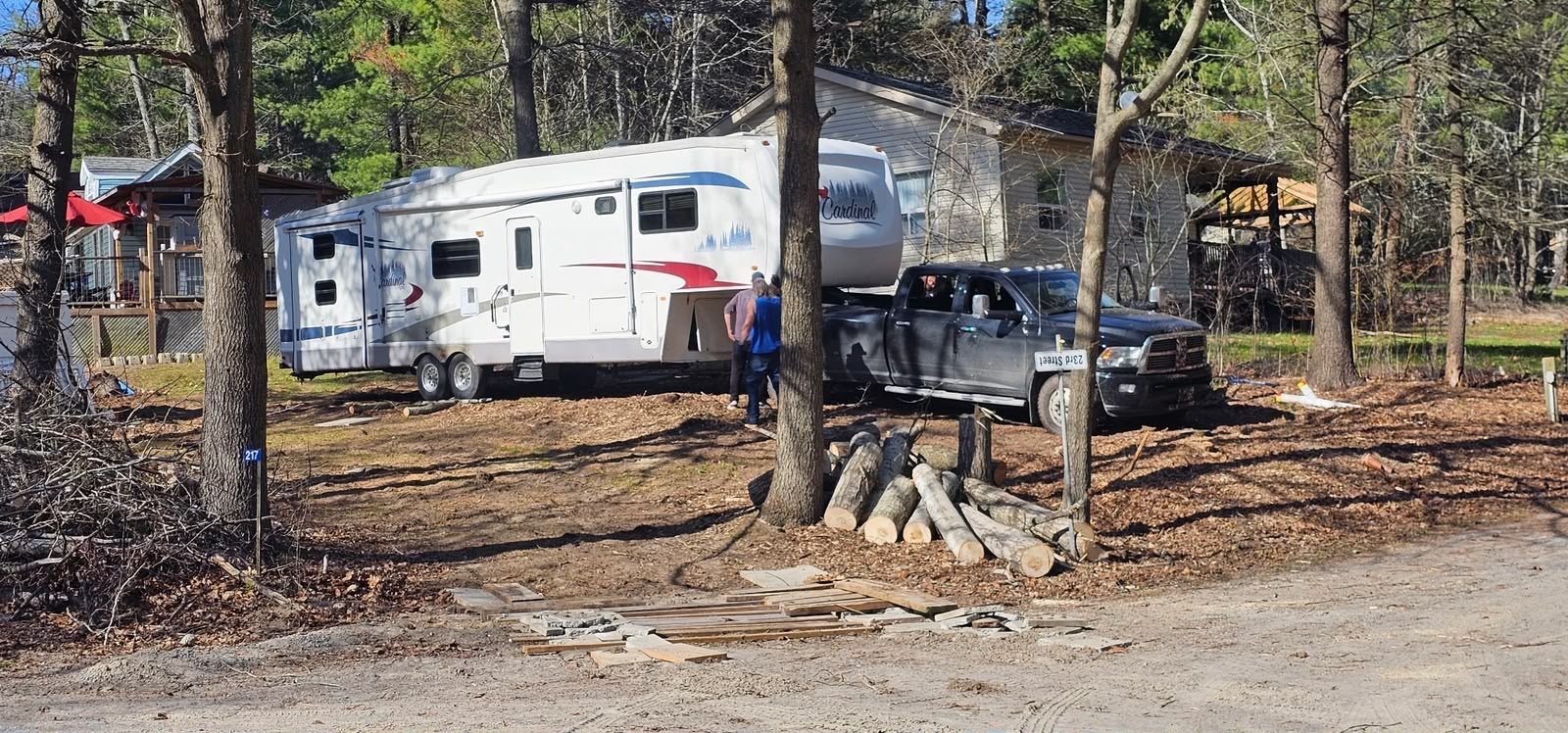
What we do here is the whole movement, not just the tow. Pull off the site, transport, and set down level and blocked properly for a winter of freeze thaw cycles. A unit dropped on soft ground in October and left until April is the classic way to find a door that will not close in the spring, and the fix in April costs more than doing it right in October.
The comparison worth running before you commit to another season is simple arithmetic. Take the seasonal rate at your park, add what a move and store costs, and set that against what you actually used the site for last year. For a Frankford seasonal that arithmetic depends on a number the City publishes inconsistently, which is why we made a point of it above. Full detail on rates and what is included is on the storage page.
Renting instead of owning
Some of the people who call us about moving a unit out of Quinte are really asking whether they should own one at all. If the site fee, the storage, the insurance and the tow add up to more than a handful of weekends is worth, renting is the honest answer and we would rather say so.
We rent as well as tow, and the delivered rental is the version that makes sense around the Bay of Quinte: we bring the unit to the site, set it up level, and collect it at the end. No storage problem in October, no half load date to plan around in March, no permit conversation. Details on the rentals page.
How to book a Quinte move
The sequence that works, in order, and it is the same whether you are in Belleville or Madoc.
- Tell us the two addresses and the unit. Make, model year, length, and whether it is a travel trailer, fifth wheel, park model or mobile home. Length and width decide whether the job is inside the legal envelope or needs a permit, and that decides the price more than distance does.
- Tell us the dates you are working with. If either end is a seasonal site with a removal deadline, say so first. Those dates are fixed and everything else moves around them.
- We check the calendar against half load season. March and April are the constraint in this region, and the answer is different in each of the six municipalities on this page. We work that out before we quote, not after.
- We check the route and the permits. Municipal permits where the route needs them, provincial where the load needs them, and the current restricted and exempt road lists checked against the actual route rather than against last season's copy.
- We confirm the ground at the destination. Soft shoreline ground and shallow Shield rock need different blocking, and knowing which one we are dealing with before the truck is loaded is what keeps the job to one visit.
- You get a fixed price before we book. Not a range, and not a number that grows on the day.
| Phone | (647) 961-9257 |
| transport@kawartharvrentals.ca | |
| Hours | Monday to Saturday, 7:00am to 7:00pm. Sunday closed, by appointment only. |
| Based in | Beaverton, Ontario |
| CVOR | 204-617-206 |
| Equipment | 30 foot gooseneck |
We are a family run operation working out of Beaverton, and the person who answers the phone is the person who drives the truck. That is a real limit on how many jobs we can take in October, and it is also the reason nothing gets handed off to a subcontractor you never spoke to.
What we guarantee, in plain words
If a unit we set up shifts or moves because of our workmanship, we come back and redo the job at no charge. Weather and ground conditions are outside that, and we say so up front.
We are stating the limit as clearly as the promise, because a guarantee that pretends to cover everything is not a guarantee, it is marketing. If we block a unit badly and it shifts, that is ours and we come back and redo it at no charge. If the ground heaves through a wet freeze thaw cycle, or water undercuts a pad, or a spring thaw turns a compacted pad into soup, that is weather and ground, and it is not covered.
The reason that distinction is drawn where it is: we control the blocking, the load spread and the setup. We do not control what the ground does over a Quinte winter. What we can do, and what we do do, is assess the ground before we set a unit down and tell you honestly when a site is going to give you trouble. A crew that never mentions the ground is not being confident, it is being quick.
Where every fact on this page came from
Everything above came from a primary source we fetched and read. Where we could not read a source, we said so in the body text rather than filling the gap. Below is where to check us.
Province of Ontario
- Highway Traffic Act, R.S.O. 1990, c. H.8, for the statutory framework behind reduced load periods and oversize loads. We link it rather than quote it: the e-Laws reader is JavaScript driven and would not yield verifiable text to us, so no clause of the Act is quoted anywhere on this page.
- Ministry of Transportation oversize and overweight permit material, for the legal maxima, escort and marking requirements, blackout periods and permit fees set out above.
City of Belleville
- Determine if a building permit is required, for the deck test, the 10 m² and 15 m² thresholds, the ADU, pool, sign, tent and farm building items, and the Building Services contact.
- Building permits, checked term by term for park model, mobile home, manufactured home and trailer. None is present.
- Zoning by-law consolidation page, which now carries the by-law number and a direction to contact planning rather than a downloadable PDF.
- Consolidated Zoning By-law 2024-100, third party hosted, for the section structure that refutes the existence of a section 16.22 and places Motor Vehicles in Yards at 15.22.
- Property Standards By-law 2025-157, third party hosted, for the quoted sections 3.1, 3.2 and 3.3. The City publishes no PDF of this by-law on its own site.
- City of Belleville transportation, roads and parking pages, for the lane kilometre and signal figures, the overnight parking rules, Traffic By-law 12967 and Council Resolution 336-2022.
City of Quinte West
- Decks, for the quoted deck sentence and the Building Services address, phone, Ontario One Call and conservation authority numbers.
- Sheds and detached garages, for the 15 m² enlargement bullet and the roof overhang sentence.
- Building permits, checked for park model and mobile home. Neither is present.
- Zoning by-law page and the consolidated By-law 14-86, for section 1.15, the Section 3 definitions of Mobile Home and Park Model Home, and the table of contents placing section 5.10. The consolidation cover reads "Consolidated to By-law #26-009".
- City of Quinte West half load, restricted road, oversized load permit, winter parking, roads and parks material, and the fees and charges by-law, for the dates, fees, road lists and Frankford figures above.
Municipality of Centre Hastings
- Building and renovating, for the two contradictory shed items, the processing times, the secondary residence item and the Chief Building Official contact. No fees are published there.
- Zoning By-law No. 2002-10, for the quoted definitions 3.141 Park Model Trailer, 3.160 Recreational Travel Trailer and 3.119 Mobile Home.
- Municipality of Centre Hastings half load and public works material, for the March and April dates and the road figures above.
Municipality of Tweed
- Building services, for the permit lists, the $200 administration fee sentence, the $700 refundable deposit sentence and the boat port item.
- Land use by-laws index, which references By-law 2022-12 on trailer regulation. The enacted zoning by-law 2012-30 and the trailer by-law PDF both have no machine readable text layer, which is why neither is quoted here.
Township of Stirling-Rawdon and the BISB
- Building and renovating permits, for the BISB membership sentence and the inspection booking number. These are on this page, not in the deck guide PDF, and our earlier note attributing them to the PDF was wrong and is corrected here.
- 2025 BISB flyer, cross checked against an identical copy hosted by Madoc. There is no 2026 edition; this is the current one the township links.
- Zoning By-law 320-03, from which we could read only as far as section 5.3.1.
- Township of Stirling-Rawdon half load and oversize permit material, for the exempt roads, the by-law numbers and the section 122 reference above. Building By-law 38-2026 is linked by the township but has no extractable text, so no fee figure from it appears here.
Madoc Township and Hastings County
- Madoc Township public works material, for the road, bridge and culvert inventory in the table above, which is the one local inventory on this page whose components add up to its own total.
- Hastings County publishes no roads department page we could locate, which is stated in the body text rather than worked around.
Parks, waterway and conservation authorities
- Parks Canada Trent-Severn Waterway material, for the bridge clearance figures and the Lock 1 chamber dimensions. Those clearances are vessel headroom, not road height limits, as set out above.
- City of Quinte West parks and Frankford Tourist Park pages, for the address, hours, washroom season, removal deadline and maintenance instruction.
- Ontario Parks RV camping, for the system wide trailer size bands and campground road guidance, which are system wide statements and are not attributed to any individual park here.
- Individual Ontario Parks pages for Silent Lake, Bon Echo, Frontenac and North Beach, for the site counts, group limits and day use status above.
- Quinte Conservation material for Vanderwater Conservation Area, for the address, the camping prohibition, the sunrise to sunset hours, the motorized vehicle restriction and the paid parking requirement.
Two notes on method
First, every regulatory fact on this page was re-checked against its primary source immediately before the page was written, not taken from an earlier research file. Where the live source disagreed with our notes, the live source won and the disagreement is recorded in the page source. Two facts we had previously listed as unavailable turned out to be published after all, and they are on the page now because of that pass.
Second, we link only URLs we actually fetched and confirmed. Where a source is named in the lists above without a link, it is because we read it but are not confident enough in a durable address for it to send you to a link that may already have moved, which happened to us twice while writing this page. Municipal websites reorganise constantly. If a link above is dead by the time you read it, the department name and the by-law number in the body text are enough to find the current copy, and that is deliberate. The same method is applied on every page under our service areas.