
The Peterborough area we cover
Kawartha RV Transport & Services moves RVs, park models, mobile homes, decks and sheds throughout Peterborough, Keene, Buckhorn and Apsley, and everywhere in Peterborough County in between. We are a family run outfit based in Beaverton, Ontario, at the north end of Durham Region, and Peterborough is one of the areas we work in most. Local tows start at $400, we tow up to 30,000 lb on a 30 foot gooseneck, we carry Ontario CVOR 204-617-206, and there is no deposit to book a date.
Peterborough is not one jurisdiction, and that is the single most useful thing to understand before you book anything on wheels here. The City of Peterborough runs its own streets and its own by-laws. Peterborough County runs over 700 kilometres of county road around it, with depots in Buckhorn, Douro, Havelock, Millbrook, Selwyn and Apsley. The Ministry of Transportation runs Highways 115, 7 and 28. And then the townships, Otonabee-South Monaghan around Keene, Selwyn around Bridgenorth, Lakefield and the Buckhorn side, North Kawartha around Apsley, and Trent Lakes on the other side of Buckhorn, each set their own zoning, their own building permit thresholds and, in several cases, their own half load dates.
Those four layers do not agree with each other. A park model that can be set up without a building permit in one place needs one twenty minutes up the road. A route that is legal in July is closed to a loaded truck in March. We read all of it for this page so you do not have to guess, and we say plainly where a municipality publishes nothing rather than filling the gap with a neighbour's number.
The roads we use to reach you
Coming from Beaverton the practical routes into Peterborough are Highway 7 across the top of Durham, or south and east through Kawartha Lakes. Peterborough County confirms three provincial highways in its boundaries: Highway 115, Highway 7 and Highway 28, all maintained by the Ministry of Transportation. Everything else is County or township.
The county roads that matter most for the villages people ask us about, taken from the County's own published roads list, are these. County Road 23 is Buckhorn Road, running through Trent Lakes and Selwyn. County Road 29 is Lakefield Road, which becomes Queen Street and Bridge Street in Lakefield. County Road 18 is Chemong Road, becoming Ward Street and the 8th Line of Smith through Selwyn. Around Keene, County Road 35 is Keene Road, County Road 34 is Heritage Line and Serpent Mounds Road, and County Road 31 is Hiawatha Line. Up around Apsley, County Road 504 is Burleigh Street, County Road 52 is Jack Lake Road, County Road 54 is Balmer Road and County Road 56 is Northey's Bay Road.
One correction worth making, because we hear it a lot: Highway 36 through Buckhorn is not a provincial highway. The County lists only 115, 7 and 28 as provincial, and lists 36 as a County road in Trent Lakes. It matters because the permit office and the road authority are different depending on which it is.
Township road networks, for scale
Selwyn Township alone maintains 320 kilometres of road inside its own jurisdiction, on top of the eleven county roads that pass through it and Highway 28, which the Ministry of Transportation owns and maintains. Otonabee-South Monaghan splits its published roads page into township roads, county roads and a separate section for Highways 7 and 28. When you tell us your address, the useful detail is not just the number, it is whose road it is.
Peterborough County also publishes a Share the Road notice covering farm equipment through April and May and again from October to December, noting that most farm equipment travels below 40 km/h and carries an orange triangular slow moving vehicle emblem. Those are exactly the months we are busiest, and a loaded gooseneck cannot pass a combine on a county road the way a car can. It is one of several reasons our arrival windows here are honest ranges rather than exact times.
Half load season, city and county
Half loads, also called reduced load or spring weight restrictions, are seasonal limits municipalities put on their roads while frost is coming out of the ground. The City of Peterborough explains the reason in its own notice: the restrictions protect roadways during the spring thaw, when pavement structures have reduced load bearing capacity because of freeze and thaw conditions. It is not bureaucracy. Loaded trucks genuinely destroy soft roads in March.
For us it is the single most common reason a spring booking date moves. During a reduced load period a route that is fine in July can be closed to us. Sometimes there is a legal alternate and the job goes ahead with a longer drive. Sometimes there is not, and the honest answer is that the move waits until the signs come down.
- The City and the County are not the same season. The City published March 1 to April 30 for 2026 and lifted on May 1. The County publishes its window as typically March 1 to April 30 but explicitly weather dependent, and in 2026 the Township of North Kawartha reported the County implementing on March 2.
- Townships set their own again. Selwyn publishes March 1 to May 1 on all township roads every year, with a note that the timeline may be adjusted for road conditions. North Kawartha published a start of March 9 for township roads in 2026.
- The City does not publish a weight figure. Its notices use the term half loads and cite By-law No. 12-044, along with a published list of designated streets. The 5 tonnes per axle figure belongs to the County.
- Signs are the mechanism on County roads. The County states that load restriction signs are displayed on County roads affected by its Reduced Load By-Law.
- Provincial overweight permits go void in the same window. Ontario 511 publishes the seasonal load period for Southern Ontario as March and April.
Half load dates by road authority
This is the comparison we needed and could not find anywhere, so we built it. Everything below comes from the road authority's own published pages, checked in July 2026. Where an authority does not publish a per axle figure, the table says so instead of borrowing a neighbour's. Treat it as a planning aid and confirm the current year before you rely on it, because these dates move every single year.
| Road authority | Published window | Per axle limit as published | Stated authority |
|---|---|---|---|
| City of Peterborough | March 1 to April 30, 2026. Lifted May 1, 2026 | Not published as a weight | By-law No. 12-044 |
| Peterborough County | Typically March 1 to April 30, weather dependent | 5 tonnes | Highway Traffic Act s.122 |
| Township of Selwyn | March 1 to May 1 every year, may be adjusted | Not published as a weight | Township roads page |
| Township of North Kawartha, township roads | 2026 notice: began March 9, 2026, no end date given | 5 tonnes | Township public notice |
| Township of North Kawartha, standing pages | March 1 to May 1 each year, except County Road 620 | Not published as a weight | Township roads pages |
| Otonabee-South Monaghan | Nothing published on its roads page | Not published | Not published |
| Provincial highways, Southern Ontario | March and April, overweight permits void | Set by the Ministry | Ontario 511 |
North Kawartha, read the notice not the web page
North Kawartha's own site says two different things. Two standing pages state that load restrictions run March 1 to May 1 on all municipal and county roads except County Road 620. The 2026 public notice states that township restrictions began March 9, 2026, and that County restrictions took effect March 2, 2026 on County Roads 504, 620, 54, 52 and 56, which includes 620. We are not going to pretend to know which is current in any given year. If you are moving anything heavy around Apsley in March or April, read the township's posted notice for that year and call the roads department. That is what we do.
The same caution applies around Keene and Buckhorn for a different reason. County Roads 2, 23, 34, 35 and 36, which are the main Keene and Buckhorn corridors, do not appear in the County's published reduced load table at all. We do not know from the published material whether that means they are unrestricted or simply not listed, so we will not tell you either way. We check before we route a loaded truck through there in March.
What the province sets, and what the township sets
The rule everybody trips over is that half load dates are local, not provincial. Section 122 of the Highway Traffic Act sets the default reduced load limit at 5,000 kilograms per axle on a designated highway during a reduced load period, and then hands the calendar to the municipality: the authority with jurisdiction over a highway may by by-law designate the date on which a reduced load period starts or ends. That is why the City, the County, Selwyn and North Kawartha can all be running different dates at the same time on roads that touch each other.
The same Act sets the dimensions that decide whether a load is oversize at all. Width is capped at 2.6 metres. Height is capped at 4.15 metres, with 4.3 metres for certain prescribed configurations. A combination of vehicles is capped at 23 metres overall. There is a specific provision that no recreational vehicle may exceed 12.5 metres in length on a highway, with an allowance up to 14 metres where prescribed requirements are met. Section 110 is the permit power: it lets the Ministry or a municipality issue a permit for a load that exceeds those limits, lets them require security, lets them limit the route and the time of day, and requires that the original of the permit be carried in the vehicle. Fines under both sections run from $200 to $20,000.
The practical version, for somebody with a trailer on a lake site north of Buckhorn: a normal travel trailer is a normal legal load and none of this applies. A park model is where it starts to. A wide mobile home section is where it definitely does.
Oversize permits in Peterborough
Two separate offices issue oversize permits in this area, plus the province. Which one you need depends on whose road the load travels, and a single trip from a county lake site into the city can need both.
| Permit | Fee as published | Notice required | Authority cited |
|---|---|---|---|
| City of Peterborough, Oversize Load permit | $172.00, paid by credit card before issue | At least 5 business days | Highway Traffic Act s.110 and City By-Law No. 93-25 |
| Peterborough County, single move | $50.00 | 5 business days | County Oversize and Overweight Load Permit |
| Peterborough County, expedited single move | $85.00 | Less than 5 business days | County Oversize and Overweight Load Permit |
| Peterborough County, single move over 63,500 kg | $75.00 | 10 business days | County Oversize and Overweight Load Permit |
| Peterborough County, expedited over 63,500 kg | $100.00 | Less than 10 business days | County Oversize and Overweight Load Permit |
| Peterborough County, annual | $250.00 first vehicle, $25.00 each additional | Not stated | County Oversize and Overweight Load Permit |
| Provincial highways 115, 7 and 28 | Set by the Ministry | Set by the Ministry | Ministry of Transportation |
The County also publishes dimensional categories on its application. Category I covers loads under 11 feet, which is 3.35 metres, wide and under 14 feet, which is 4.26 metres, high. Category II extends the width to under 12 feet, or 3.65 metres, but restricts the move to daylight hours only with no weekends or holidays. The County's own condition on the permit is blunt and worth repeating: the permit must be carried in the vehicle when moving a load. That mirrors section 110 of the Act.
At township level, we found no published oversize or overweight load permit for Selwyn, North Kawartha or Otonabee-South Monaghan. Selwyn publishes an entrance permit, which is a different thing: it applies when a new entrance onto a township road is requested, or when work, replacement or an addition is made to an existing one. If you are creating a new driveway to get a unit onto a property, that is the permit to ask about.
Say it plainly
We do not run oversize permits ourselves. When a job needs them, we bring in a contractor who specialises in that work and they handle all of it: the permits, the routing and the escorts. You still deal with us, and we still stand behind the job. We would rather tell you that than take a permit job we are not set up for and learn something expensive on your unit.
When an escort becomes necessary
The City of Peterborough publishes its escort thresholds on the permit application itself, which is unusually clear compared to most municipalities. An escort is required if width exceeds 4 metres or if length exceeds 36.76 metres. A separate escort requirement applies if height exceeds 4.87 metres. Those numbers are well past anything a travel trailer or a normal fifth wheel reaches, which is the reassuring part: if you are having a standard RV moved in Peterborough, escorts are not part of your job.
Where they do come up is wide mobile home sections and the larger park models. That is the same territory as the permits, and the same answer applies: it goes to the specialist contractor, and we coordinate it rather than improvise it. For contact, the City publishes a Construction Contract Administrator line at 705-742-7777 extension 1832 for oversize load questions.
Park models and mobile homes by township
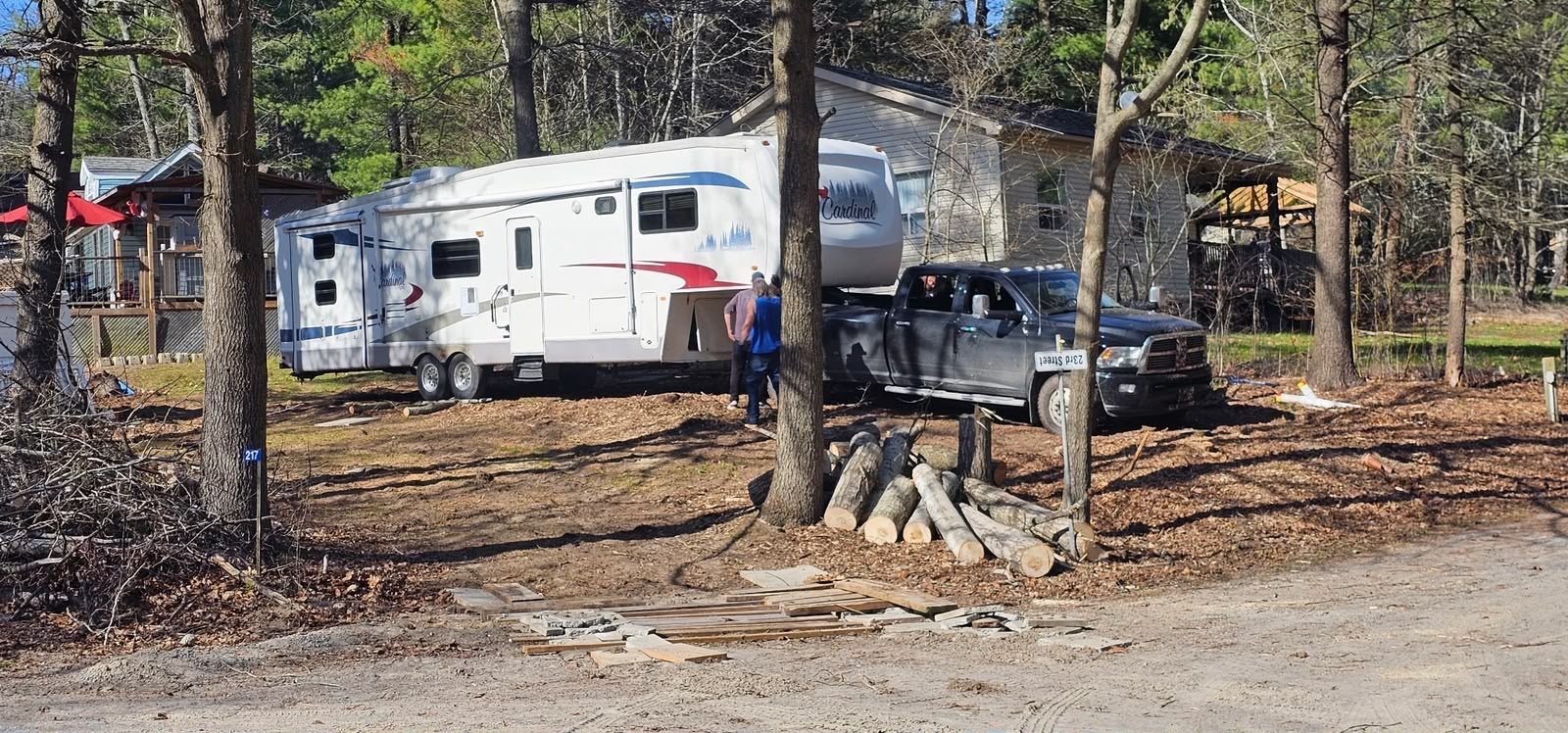
If you are buying a park model for a seasonal site in Peterborough County, the question that will cost you money is not how it gets there. It is whether your township requires a building permit to put it down. The answers are not the same, and they are not guessable.
- Otonabee-South Monaghan, around Keene. The township's published building permit guide lists mobile homes and park model trailers in approved locations by zoning as requiring a building permit.
- Trent Lakes, the west side of Buckhorn. Building permits are required for the installation of all park model trailers. Building permits are not required to set up or move a recreational vehicle. Trent Lakes also states that manufactured homes require a permanent foundation and are therefore not permitted in any Tourist Commercial Zone, which is the zoning most trailer parks sit in.
- City of Peterborough. We could not find any published City position on park models or mobile homes at all, on either the building permits page or the zoning page. We are not going to invent one. Ask the City directly.
- Township of Selwyn. No published statement on park model placement itself in the documents we could reach, although Selwyn does publish detailed trailer park rules for the structures around a unit.
- North Kawartha, around Apsley. No published statement on park models or mobile homes found.
- Peterborough County itself. The County does not administer zoning. Its own page states that the township is responsible for all aspects of the zoning by-law and is the best source for zoning information.
Note also that Buckhorn straddles the Selwyn and Trent Lakes boundary. The park model permit rule we can quote is Trent Lakes', and it does not automatically apply to the Selwyn side of the village. When somebody tells you "the rule in Buckhorn is", ask which side of the line the property is on. Our mobile home and park model moving page covers how we handle the units themselves.
Decks, sheds and add on rooms by township
We move decks and sheds as well as trailers, and around here the deck usually comes up in the same conversation as the unit, because seasonal sites get rebuilt as a package. The permit thresholds are township by township, and again they do not match.
| Municipality | Shed or accessory building | Decks |
|---|---|---|
| City of Peterborough | Permit over 15 m2, which is 161 sq ft. Shed exempt only if not over 15 m2, one storey, not attached, storage only and no plumbing | Permit always required, including floating decks and same size rebuilds |
| Otonabee-South Monaghan | Permit for all accessory structures greater than 10 m2, which is 108 sq ft | Permit for open decks and porches, and for replacement of a deck |
| Township of Selwyn | No permit for a building 10 m2 or less unless used for habitation or plumbed. No permit for a utility shed not over 15 m2 | Permit required for open decks and porches. Any addition to a home or cottage needs one regardless of size |
| North Kawartha | No permit for a single storey detached storage shed under 15 m2 with no plumbing, ancillary to a principal building | Detached decks trigger a permit above 10 m2 |
| Trent Lakes | Accessory structures including storage sheds require a permit and are permitted alongside a park model trailer | Decks, porches and sun rooms require a permit |
Inside trailer parks specifically, the rules tighten. Selwyn's trailer park deck guide states that add on rooms and manufactured canopies of any size, and decks larger than 10 square metres, are considered structures and require building permits, while decks built at grade, meaning 8 inches or less from grade to the top of the deck, are subject to the size and setback criteria but do not require a permit. Selwyn also allows one accessory structure per site provided it does not exceed 8 square metres, with maximum lot coverage of 35 per cent counting the trailer, the deck and the accessory structure together.
Otonabee-South Monaghan publishes its own park deck thresholds: a permit is needed if the deck or landing will be 10 square metres or greater in area, or 304.8 millimetres, which is one foot, or greater above grade, or adjacent to an exit door no matter the size. Its guide adds that permits are required for all types of construction including wood stoves. The City of Peterborough publishes a set of foundation exemption criteria for floating decks, under 600 millimetres in height, not attached to any structure, not supporting a roof and not more than 55 square metres, but is explicit that those criteria exempt the foundation and not the permit. A building permit is still required for a floating deck in the City, and for reconstructing a deck at the same size.
None of that is us giving building advice. It is us telling you which office to phone before we show up with a tractor and a set of straps. Our deck and shed moving page explains the moving side.
Bridges, swing bridges and the Trent-Severn
Peterborough is a canal city, and that has a real effect on routing. Parks Canada owns and operates infrastructure on the Trent-Severn Waterway that carries City streets, including the Warsaw Road Swing Bridge, which is a twin to the Maria Street Swing Bridge and was originally constructed in 1956. Parks Canada has been carrying out a full replacement of that steel swing bridge structure. The McFarlane Street Bridge over the waterway was fully closed to motor vehicles, cyclists and pedestrians for redecking in October 2025, with the published alternates being Hunter Street East, Maria Street and Parkhill Road East.
In the County, Parks Canada lists the Douro Dam at Lock 24, the Sawers Creek Dam at Lock 25 and the Burleigh Falls Dam, where pedestrian access across the dam was closed and set to remain closed through construction.
Two things we will not tell you
First, we could not find any published weight or height restriction for any of those Trent-Severn crossings, so we do not quote one. Second, and this catches people out: the clearance figures published for the Trent-Severn Waterway are marine clearances, meaning how much room a boat has passing underneath. They are not road height limits for a vehicle driving across. Anyone quoting a waterway clearance at you as a truck route limit has read the wrong table.
We also could not find any published list of load posted or weight restricted bridges from either the City or the County, so there is no bridge weight claim on this page. When a route has a question mark on it, we drive it first.
Provincial parks near Peterborough
We deliver into and collect out of provincial parks and public campgrounds regularly, and the useful thing to know is that not every park near Peterborough takes a trailer at all. Two of the closest take none.
| Park | Camping | What is published |
|---|---|---|
| Emily Provincial Park, Omemee | Yes, trailer friendly | Ontario Parks names Emily as the camping park for the Peterborough area. Hilltop, Hill and Circle campgrounds take everything from tents to large trailers, many with electrical hookups. 170 electrical sites, 9 RV pull through, 303 campsites total. 2026 season May 8 to October 13 |
| Silent Lake Provincial Park, north of Apsley on Highway 28 | Yes, limited electrical | Granite Ridge has a small number of electrical sites that are reservable and fill quickly. 160 campsites total, 125 car camping, 40 electrical, 35 walk in, 2 trailer dump and fill stations. Season May 8, 2026 to March 28, 2027 |
| Kawartha Highlands Provincial Park | Backcountry only | 121 backcountry campsites reached by canoe route and portage, 9 backcountry access points, 4 boat launches. Not an RV destination |
| Petroglyphs Provincial Park, Woodview | None | Day use only. Ontario Parks states there are no overnight camping facilities and points campers to Silent Lake or Lake St. Peter |
| Mark S. Burnham Provincial Park, east of Peterborough | None | Day use only, no overnight camping facilities |
| Serpent Mounds Provincial Park, Keene | Not listed as available | Listed as Cultural Heritage, 135.12 hectares, established 1957, with facilities shown as not available. Do not plan on camping here |
Two honest limits on that table. First, no trailer length limit is published for any of these parks. Ontario Parks publishes system wide reservation brackets of up to 18, 25, 32 and over 32 feet, and notes that a few parks cannot accommodate trailers over 32 feet, but it does not say which. If your unit is long, call the park before you book the site, not after. Second, Emily is physically in the City of Kawartha Lakes at Omemee rather than in Peterborough County, even though Ontario Parks markets it as the Peterborough area park. If you are heading there, our Kawartha Lakes page covers the road rules that actually apply on the way in.
Ontario Parks also publishes a general warning that park roads can be narrow and winding and that larger RV owners should check site access. We would put that more strongly: on a wooded park loop, the branches are the problem long before the corners are.
Seasonal parks and lake sites
A large share of what we do around Peterborough is not provincial parks at all. It is private seasonal parks and lake sites: Chemong, Buckhorn, Stony, Clear, Jack Lake, Chandos, the Otonabee River sites, the Rice Lake shore around Keene and Hiawatha. Those are where the real work is, and where a tractor trailer would never get in.
What makes them difficult is consistent. Lanes are narrow and were laid out before units got this big. Corners are set by trees that have grown thirty years since the park opened. Sites back onto water, so there is often only one direction to approach from and no room to correct. Hydro and cable lines cross the lane at heights nobody measured. Older sites have decks, sheds and add on rooms built right to the property line, which means the unit has to thread past somebody else's structure, not just your own.
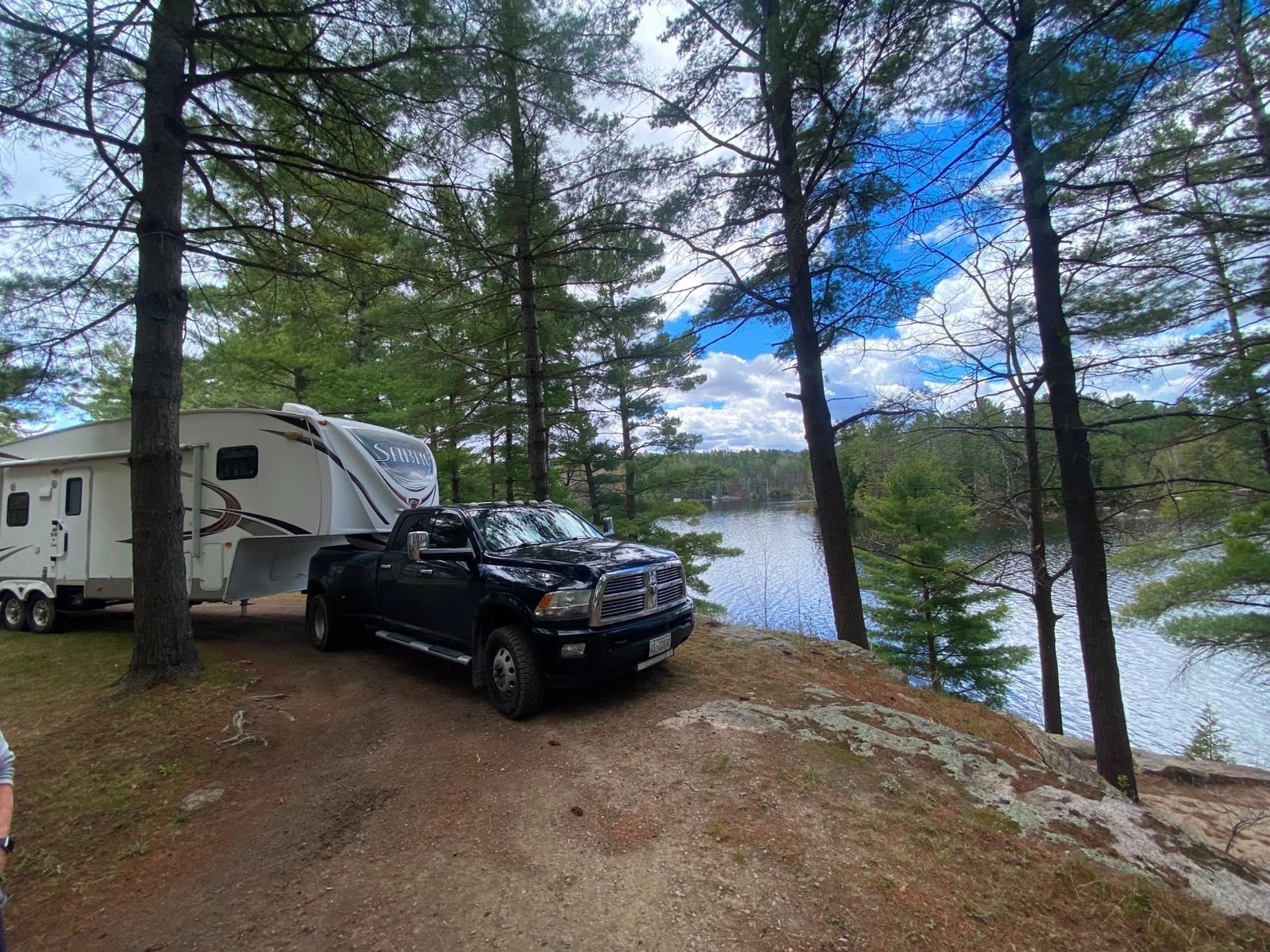
A one ton dually with a 30 foot gooseneck is the right tool for this. It turns tighter than anything bigger, it can be backed by somebody watching the corners on foot, and it does not need a wide staging area to get set up. What we ask for in return is accurate information before we come. Photographs of the entrance, the worst corner, the overhead lines and the site itself save everybody a wasted trip.
Private and unassumed roads
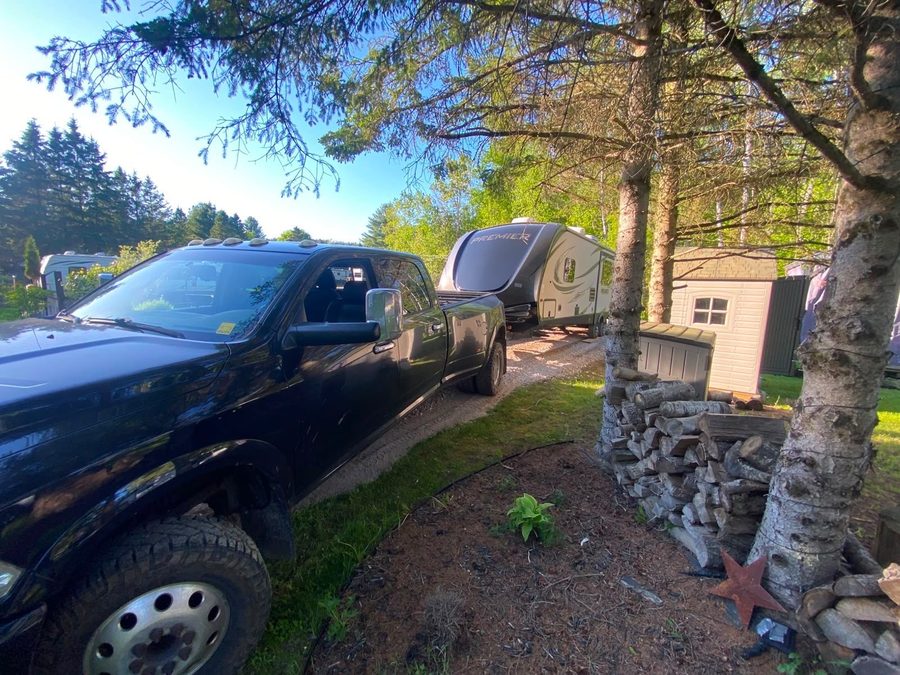
Cottage country around Peterborough runs on private roads, and they change two things about a move.
The first is who is responsible. Otonabee-South Monaghan states it directly: people who own property on private roads are responsible for the maintenance and upkeep of those roads. North Kawartha states its own version, that the township does not remove trees from private roads. There is no municipal crew coming to fix a rutted lane, grade a soft shoulder or cut back a branch that has dropped over the entrance since last season. If a private road gets chewed up by a loaded truck in spring, the road association pays.
The second is which rules govern. A municipality's half load by-law applies to municipal roads. On a private road the road association's own rules may apply instead, and some of those are stricter than the municipality's, with lower posted weights or outright spring closures. Before you book a March or April date on a private road, ask your road association what they allow. We would much rather have that conversation before we load than at the top of your lane.
We are also more cautious about going in when the ground is soft, regardless of what anybody allows. A one ton dually and a loaded trailer will leave marks on a saturated gravel lane, and those marks become the road association's problem and then yours. Waiting three weeks is usually cheaper than the repairs.
What access looks like around here
Peterborough County ground is not uniform, and the difference matters when a unit has to be set level and left there.
- Shallow soil over limestone. Common through the county. Solid to sit on, but you cannot drive a pin or dig a footing where the rock is close to surface, and water runs across the top of it rather than draining down.
- Sand near the lakes. Drains beautifully, holds nothing. Blocking wants a wider footprint here or it works its way down over a season.
- Fill on older seasonal sites. Decades of added material, often uncompacted, often with organic matter in it. This is where the settling complaints come from, and it is why we spend time on the blocking rather than just dropping the unit and leaving.
- Spring gravel. North Kawartha grades and re-gravels township gravel roads in spring and early summer and applies calcium chloride to select roads for dust control. A freshly graded soft road in April behaves differently under a loaded axle than the same road does in July.
What we do in the Peterborough area
The same six services we run everywhere, with the same trucks and the same guarantee.
- RV and trailer transport. Travel trailers, fifth wheels, toy haulers and campers, moved between homes, dealerships, storage and seasonal sites. Local tows start at $400. We tow up to 30,000 lb on a 30 foot gooseneck.
- Mobile home and park model moving. Heavier, wider and less forgiving than an RV, with a different permit picture in every township on this page.
- Levelling and blocking. Setting a unit level and keeping it there on limestone, sand or fill. Around Peterborough this is half the job.
- Deck and shed moving. Seasonal sites get rebuilt as a package. We move the deck and the shed as well as the unit.
- RV storage. Outdoor storage on a fenced property from $85 to $125 a month depending on size, with towing in and out.
- RV rentals. Our own units, delivered and set up on your site.
Levelling and blocking on Kawartha ground
A trailer that is not level does not just feel wrong. Doors bind, slides stop sealing, the fridge loses efficiency because absorption units want to be level to circulate properly, and the frame carries stress it was not designed to carry. On a seasonal site where a unit sits for years rather than nights, the ground underneath it is doing the work, and Kawartha ground is not consistent from one site to the next.
We block units with the load spread properly rather than stacked on the smallest footprint that will fit, we check level along the frame rather than off a countertop, and we come back and redo the job at no charge if a unit we set up shifts because of our workmanship. Weather and ground conditions are outside that, and we tell you so up front rather than after the fact. The levelling and blocking page goes through the method in detail.
Storage when the site is not ready
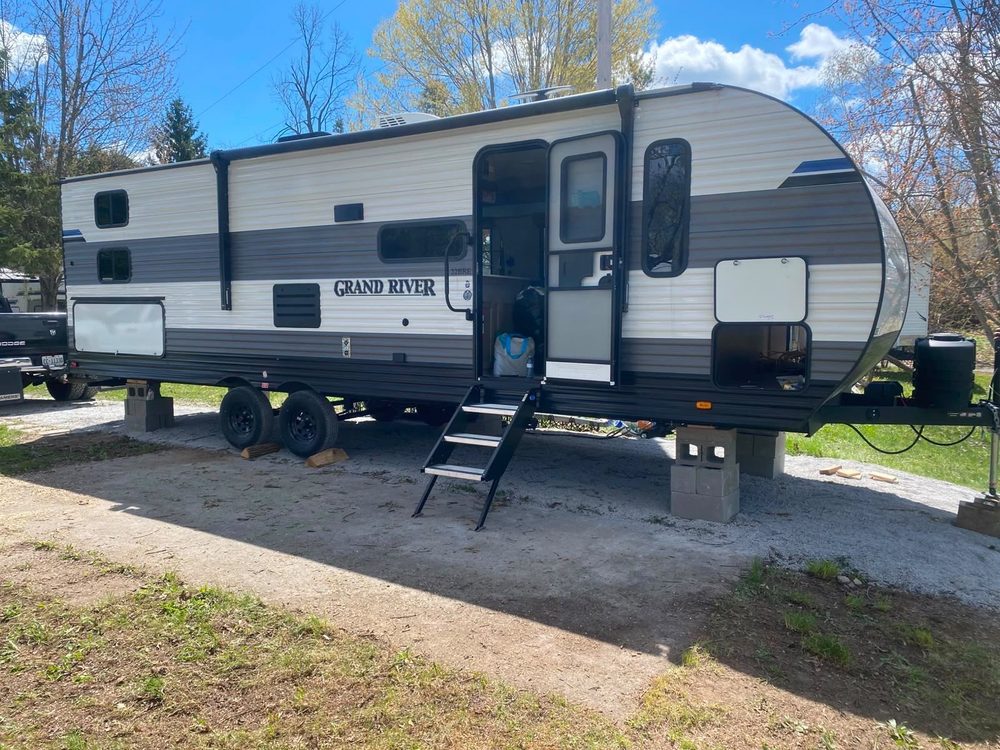
Half of the storage calls we take from this area are timing problems rather than storage problems. A build runs late. A sale closes in March. A seasonal park has not opened yet. Half loads are on and the county road into the site is closed to a loaded truck for another six weeks.
Outdoor storage on our fenced property runs $85 to $125 a month depending on the size of the unit, and we can tow the unit in and back out again in spring, so it is one call rather than three. If you are weighing storage against leaving a unit on a site over winter, our Ontario winter storage checklist goes through what actually causes damage over a Kawartha winter, and the storage page covers the yard itself.
What a Peterborough move costs
Local tows start at $400. A longer or more involved move is quoted on the job, and quotes are free with no deposit to book. The things that actually move the number here are not what people expect.
- Access, not distance. A short move into a tight seasonal lane off Buckhorn Road can cost more than a longer straight run down Highway 115, because the time is in the manoeuvring, not the driving.
- Whether the unit is ready. Jacks that will not retract, a flat trailer tire, a site that has to be cleared first, blocking still under a unit that nobody removed. Every one of those adds time.
- Half load season. If a route is closed and the legal alternate is longer, the job costs more, or it waits.
- Whether a permit is involved. Park models and mobile homes carry permit costs on top of the tow, and the permit fee goes to the City or the County, not to us.
- Levelling and blocking at the far end. Setting a unit level on prepared ground is quick. Setting it level on a site that needs work first is not.
Our Ontario RV transport cost guide breaks the pricing down properly across the province.
When to book
April, May, September and October are the weeks everything moves in this area, and they fill first. Spring bookings also have to work around half load season, which closes routes for roughly two months and is set differently by the City, the County and each township. Midsummer and midwinter usually have more room in them.
There is no deposit to book, so holding a date early costs you nothing and costs us nothing to move if your plans change. Our hours are Monday to Saturday, 7:00am to 7:00pm. Sunday closed, by appointment only.
How to get the quote right the first time
Send four things and we can nearly always give you a firm number without a site visit.
- What it is. Type and length of the unit, and whether it is a travel trailer, fifth wheel, park model or mobile home. A make and model is even better.
- Where it is now. The pickup address, and whose road it is on if you know: city street, county road, township road or private lane.
- Where it is going. The drop address, and whether the site is ready or needs levelling and blocking.
- Photos. One of the unit, one of the way in including the worst corner and any overhead lines, and one of where it has to end up. Those three photos answer more questions than any description does.
Text or email works. The contact page has every way to reach us, and our guide to preparing an RV for transport covers what to do before we arrive.
Our 30 day guarantee
If a unit we set up shifts or moves because of our workmanship, we come back and redo the job at no charge. Weather and ground conditions are outside that, and we say so up front. That is the whole of it. It is a workmanship guarantee, not a weather guarantee, and we would rather be clear about the limit than write something broad we cannot honour when a site floods in April.
We are fully insured and we carry Ontario CVOR 204-617-206. If a seasonal park, a dealership or a township office wants proof of insurance before we come on site, ask and we will send it ahead. More about how we work.
Nearby areas we also cover
Peterborough sits in the middle of most of our territory, so a lot of jobs here start or end somewhere on this list.
Beyond those we also work in Barrie, Muskoka, Collingwood and Wasaga Beach, and we take long distance work across Ontario and into the rest of Canada. If your pickup is here and your drop is somewhere else entirely, that is a normal job for us.