
The Port Perry and Scugog area we cover
Kawartha RV Transport & Services moves RVs, park models, mobile homes, decks and sheds throughout the Township of Scugog, including Port Perry, Caesarea, Blackstock, Seagrave, Greenbank, Nestleton and the Lake Scugog shoreline. We are a family run outfit based in Beaverton, Ontario, a short run west of the Township. Local tows start at $400, we tow up to 30,000 lb on a 30 foot gooseneck, we carry Ontario CVOR 204-617-206, and there is no deposit to book a date.
Scugog is a genuinely different job from the rest of Durham Region, and anyone who has towed here knows it within about ten minutes. Down in Oshawa and Pickering the hard part is a suburban driveway with a car parked across the street. Up here the hard part is the road itself. The Township is responsible for roughly 413 kilometres of local, collector and minor arterial road, including 16 bridges and eight culverts, and a large share of that network is gravel rather than asphalt.
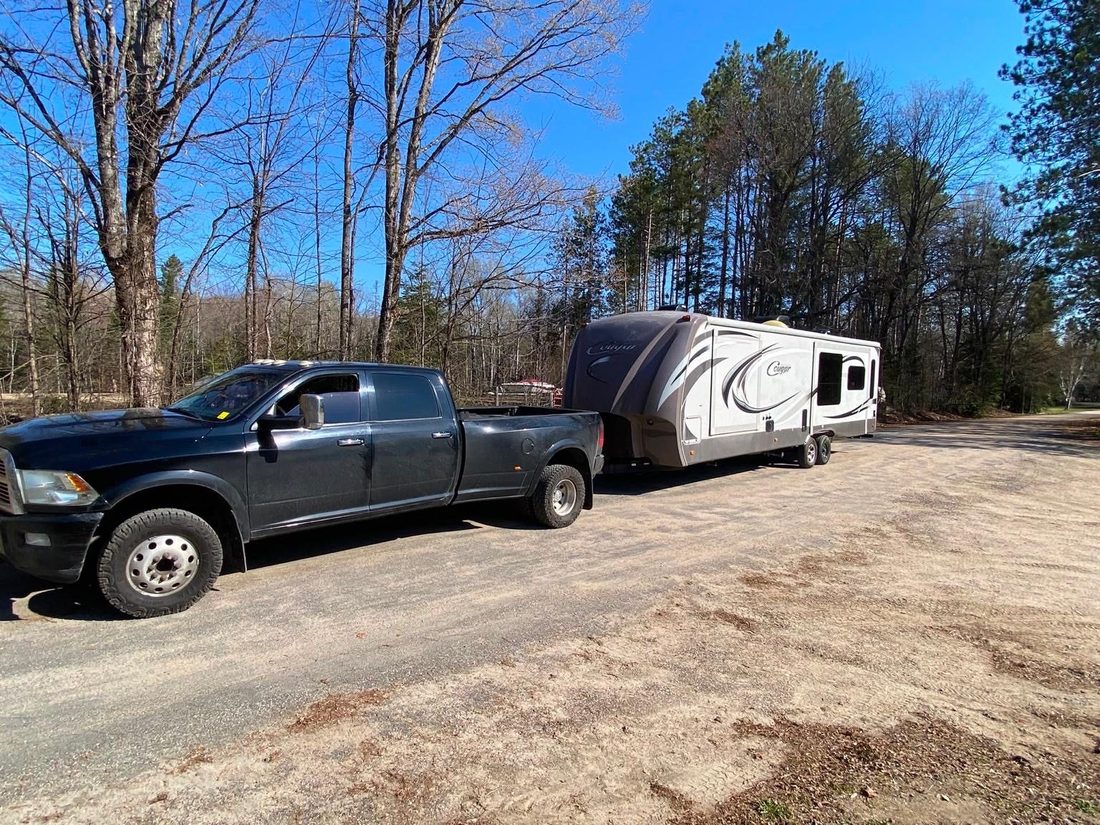
The other thing that makes Scugog its own page is the layering of authorities. The Township restricts and permits on its own roads. The Region of Durham runs a separate set of dates and a separate permit system on nine regional roads that cross the Township. The Ministry of Transportation holds Highway 7/12 and Highway 7A. Three authorities, three sets of paperwork, and a single job can touch all three inside twenty minutes of driving.
This page sets out what each of them actually publishes, with the source named. Where the Township has not published something, that is written out plainly rather than filled in with a neighbour's number. There are four places on this page where the honest answer is that the figure is not published, and the biggest of them is the one people most want answered. We have left all four in.
413 kilometres of road, and how much of it is gravel
Start with the number, because it frames everything else. The Township's own transportation master plan states that Scugog is responsible for approximately 413 kilometres of local, collector and minor arterial roads, including 16 bridges and eight culverts. That is a large network for a township of this size, and it is spread across a lot of open agricultural land, a long lake shoreline and a scatter of hamlets.
A meaningful part of that network is gravel. The Township publishes a dedicated road maintenance page confirming that gravel roads require routine grading in order to keep the surface in good condition, and that magnesium chloride is used for dust control on gravel roads. Neither of those statements gets published about an asphalt network. They tell you what the Township is actually maintaining out there.
For an RV owner this matters in three specific ways, and none of them are obvious until the truck is on the road.
- Grade and crown. A gravel road is crowned harder than pavement so it sheds water. A long fifth wheel on a heavily crowned road sits at an angle you do not notice in a pickup, and it is the reason a unit can drag at the rear on an approach that looked flat.
- Loose surface on a hill. Traction on fresh gravel is not the same as traction on asphalt, and a loaded gooseneck on an uphill turn onto a soft shoulder is where a job goes wrong. We would rather back down and take a longer route than push a hill that is not going to hold.
- Dust and visibility. Magnesium chloride helps, but a dry summer stretch of gravel with an oncoming truck is a genuine visibility problem when you are 60 feet long and cannot stop quickly.
None of that is a reason not to do the work. It is the reason we ask for photographs of the last stretch of road, not just the driveway, before we quote a Scugog job. Two photographs, one down the road toward the property and one back the other way, answer more questions than a ten minute phone call.
Why a soft gravel road stops a job that a highway would not
This is the single most useful thing on this page for anyone planning a spring move in Scugog, and it comes straight from the Township rather than from us.
In a public service announcement about gravel road maintenance, the Township explains the mechanism in plain language: as frost leaves the ground, gravel roads become saturated and soft, and this thaw period weakens the road base. It goes on to say that many gravel roads are in poor condition following a harsh winter, that if grading is done too early equipment can damage the underlying structure rather than improve it, and that not all roads are yet in proper condition to grade. It even asks residents to reduce speeds on gravel roads to help protect both vehicles and the road surface.
Read that as a haulier and it says something specific. The seasonal weight restriction is the legal constraint. The condition of the road is the physical one, and the two do not always line up. A road can be legally open and still be the wrong place for a loaded gooseneck on a given week in April.
The rule we work to
If we look at an approach and think a loaded truck is going to rut it, sink into it or tear the shoulder off it, we will tell you and we will move the date. That is not us being difficult. A rutted gravel road is a bill somebody pays, and the person who lives on it has to drive it all summer. Since there is no deposit on our bookings, moving a date costs you nothing.
The practical version of this for customers is simple. If your unit has to come off a gravel road, aim for after the middle of May or before the middle of March. If it has to happen in between, tell us early, send photographs, and expect the date to have some give in it.
Weight restriction season in Scugog
Weight restrictions, also called half loads or reduced loads, are seasonal limits a road authority puts on its roads while frost is coming out of the ground. Under frost a road is stiff. As it thaws from the top down, meltwater is trapped above still frozen material and the road loses a large part of its load bearing capacity for several weeks. A truck that does no harm at all in July will genuinely break a soft road in March.
Here is what the Township of Scugog has actually published, year by year.
| Season | As announced by the Township | Per axle limit as published | What actually happened |
|---|---|---|---|
| 2026 | Starting Monday, March 9, 2026, until approximately May 31, 2026 on a tentative basis | Maximum of five tonnes per axle, in accordance with the Township of Scugog Traffic By-law | Lifted as of May 1, 2026, four weeks earlier than the tentative end date |
| 2025 | Starting Saturday, March 1, 2025, in effect until approximately May 31, 2025 | Maximum of five tonnes per axle, in accordance with the Township of Scugog Traffic By-law | Township stated that weather conditions determine the actual end to the enforcement season |
Two things stand out when you put the years side by side. The announced start moved by more than a week between 2025 and 2026, so there is no fixed calendar date to plan around. And in 2026 the restrictions came off a full four weeks before the tentative end date the Township had announced in its March notice. That is good news for anyone waiting on a May move, and it is also a warning: the tentative end date is genuinely tentative in both directions.
The working conclusion for a customer is that March and April are the constrained months in Scugog, that the back half of May is usually clear but not guaranteed, and that the only reliable source for the current year is the Township's own notice. We check it. We do not quote last year's dates as though they were live.
The by-law says February, the notices say March
This is the kind of detail most transport companies would skip, and it is exactly the kind of detail that decides whether a March job is legal.
The news notices say the restrictions are imposed in accordance with the Township of Scugog Traffic By-law. Go and read the by-law they are citing, 23-22, and section 22.3 says something wider. It provides that where authorized signs are displayed, and subject to the provisions of the Highway Traffic Act, there shall be a reduced load period in effect from the first day of February to the 31st day of May inclusive, in each and every year, and that no person shall on any affected highway operate or draw any vehicle having a weight which is in contravention of the Highway Traffic Act.
Two differences from the notices matter.
The window is wider. February 1 to May 31 is the by-law period. March 9 to May 1 was the 2026 announced and actual season. The by-law is the legal frame; the notice is the operational season inside it. The operative trigger in the by-law text is the display of authorized signs, so signage is what makes a given road restricted on a given day.
The by-law states no tonnage. Section 22.3 does not contain a five tonne figure at all. It defers to the Highway Traffic Act. The five tonne number that everyone quotes, including the Township's own news notices, traces back to section 122(1) of the Highway Traffic Act, which provides that during a reduced load period no commercial motor vehicle or trailer, other than a public vehicle or a vehicle referred to in subsection (2), shall be operated or drawn upon any designated highway where the weight upon an axle exceeds 5,000 kilograms.
So the five tonne figure is real and it is provincial. It is simply not written into the section of the Township by-law that the notices point at. We are spelling this out because a permit conversation goes better when everyone knows which document the number actually lives in.
Two provincial details worth carrying with it. Section 122(2) sets a higher 7,500 kilogram figure for a narrow set of two axle vehicles, including tankers carrying heating fuel, trucks carrying livestock feed and vehicles carrying live poultry. Section 122(4) exempts several classes outright, including vehicles used in highway maintenance by a municipality, milk transport, fire apparatus, municipal waste collection and public utility emergency vehicles. An RV on a gooseneck is in none of those categories, so neither exception helps a transport job.
Durham regional roads through Scugog, a second set of dates
Scugog is inside Durham Region, and the Region restricts its own roads on its own schedule. Nine regional roads run through the Township, and they carry most of the through traffic, so this is not an academic distinction.
The Region's weight restriction season page states that the restrictions affect vehicles heavier than 5,000 kilograms or five tonnes per axle, that they are enacted under the authority of the Highway Traffic Act and Regional By-law 26-2018, and that most public utility and emergency vehicles are exempt. It confirms that the 2026 spring weight restrictions on roads under the Region's jurisdiction ended at 12:01 a.m. on Friday, May 1.
One date the Region does not publish
The Region's page gives the 2026 end date and does not give a 2026 start date. A separate release states a March 1 start but carries no publication year, so we cannot tell which year it describes. Since Scugog, Oshawa, Pickering and Clarington all independently published a March 9, 2026 start, it is likely the Region's season started around then too. Likely is not published, so this page does not state it as a fact. If your route uses a regional road in early March, that is a call to the Region at 311 rather than a guess.
The regional roads that cross Scugog, as named in the Region's own roads list and the Township's winter operations page, are Regional Road 2 at Simcoe Street, Regional Road 6 at Saintfield Road, Regional Road 7 at Island Road, Regional Road 8 at Reach Street, Regional Road 19 at Shirley Road, Regional Road 21 at Goodwood Road, Regional Road 23 at Lakeridge Road, Regional Highway 47 and Regional Road 57.
Look at that list against a map of the Township and the point lands. Island Road runs from Highway 7A down to Hood Drive and Carnegie Beach Road, which is the Caesarea side of the lake. Reach Street connects Port Perry across to Uxbridge. Simcoe Street runs south toward Oshawa. If your unit is coming off the lake and heading anywhere, it is almost certainly getting onto a regional road at some point, which means the Region's dates apply to part of your route even if the Township's do not.
Whose road are you on
This is the table we work from ourselves. It answers the question that actually decides the permit.
| Road | Authority | Who issues the oversize permit |
|---|---|---|
| Highway 7/12 and Highway 7A | Province of Ontario, Ministry of Transportation | Ministry of Transportation, valid on King's highways only |
| Regional Roads 2, 6, 7, 8, 19, 21, 23, 47 and 57 | Region of Durham | Region of Durham online permit portal, ten business days |
| All remaining public roads in the Township | Township of Scugog | Township of Scugog, through Permit Central. Fee in Schedule E of the Fees and Charges By-law |
| A road under seasonal weight restriction | Whichever authority owns it | Separate from the oversize permit. An exemption letter is required if applicable |
| A private lane, a seasonal park road or a shared lakeshore access | The owner or the park | Nobody issues a permit. You need the owner's permission and honest photographs |
The Township's own winter operations page is the cleanest published statement of this split. It says the Ministry maintains Highway 7/12 and Highway 7A, which it names as Scugog Street, that the Region of Durham maintains Regional Roads 2, 6, 7, 8, 19, 21, 23, 47 and 57, and that the Township maintains all remaining public roads. That jurisdiction list is written for snow clearing, and it is equally the map of who issues your permit.
Highway 7A is independently confirmed as provincial by a Ministry notice the Township republished about a culvert replacement, which describes the culvert crossing Highway 7A in Manchester, approximately 150 metres east of Highway 12, and notes westbound traffic being redirected from Highway 7A to Scugog Line 6. That is a Ministry project on a Ministry road, which settles the jurisdiction question.
Oversize and overweight permits on Township roads
The Township publishes its position clearly on the road permits page: an oversize or overweight permit is required for any vehicles travelling on Township roads when the dimensions or weight of a vehicle exceeds the normal limits permitted by legislation.
The legal authority sits in section 3.6 of Traffic By-law 23-22, which provides that the Director or designate is authorized to issue permits for the movement on highways under the jurisdiction of the Township of heavy vehicles, loads, objects or structures which are in excess of the dimensional limits set out in section 92 of the Highway Traffic Act or the weight limits set out in Part VII of that Act.
Applications go through the Township's Permit Central portal. The contact details, if you would rather speak to a person first, are the Township of Scugog at 181 Perry Street, Port Perry, Ontario L9L 1A7, phone 905-985-7346, email mail@scugog.ca.
The fee, and why we will not quote it
The Township's road permits page does not print a dollar figure. It says the fees for this permit can be found in Schedule E of the Fees and Charges By-law. We could give you a neighbouring municipality's number, and it would be wrong, because permit fees vary widely across this region. So the honest answer is that the Township publishes the fee in a schedule rather than on the page, and we confirm the current amount as part of arranging the permit for your job.
The regional permit, and the exemption letter people miss
If your route touches any of the nine regional roads, and in Scugog it almost always does, there is a second permit.
The Region of Durham requires a permit for a commercial vehicle carrying a load larger or heavier than the maximum limits in the Highway Traffic Act. Its published oversize triggers are wider than 2.6 m, higher than 4.15 m, or longer than 23 m. Applications go through an online portal and the Region asks you to allow ten business days to process. Some permits require a security deposit with a minimum of $1,000, and if the weight exceeds Highway Traffic Act limits you must submit a weight distribution diagram.
The requirement most people miss is on the application itself. Applicants have to check the load restricted roads list, and an exemption letter is required if applicable. That is worth reading twice, because it means the two systems are joined: an oversize permit does not, by itself, get you onto a road that is under seasonal weight restriction. If your route crosses a restricted road during the season, the restriction has to be dealt with separately, and the Region tells you so at the application stage rather than at the roadside.
Ten business days is also not padding. A security deposit and a weight distribution diagram both take time to assemble. This is the real argument for calling us about a spring move in February rather than in the last week of March.
What a provincial permit does and does not cover
Highway 7/12 and Highway 7A are provincial, and the province is explicit about the limits of its own paperwork.
Ontario's oversize and overweight permit page states that you will need a permit if the dimensions or weight of your vehicle and load combined exceed the limits set out in the Highway Traffic Act, and then states two things that matter enormously in a township like this one. Oversize and overweight permits are valid for Ontario's King's highways only. And if you want to drive on municipal roads, you may be required to get additional permits or permission directly from that municipality.
Put that against the geography of a typical Scugog job. A park model coming off a seasonal site near Caesarea leaves on a Township gravel road, joins Island Road, which is Regional Road 7, and then meets Highway 7A, which is provincial. Three authorities, and a Ministry permit covers exactly one of the three legs.
There is one provision in the Act worth knowing about here. Section 110(4) contemplates a permit issued by the Ministry covering the movement of a vehicle or load over highways under the jurisdiction of more than one authority. Whether that route is available and appropriate for a particular move is a question for the Ministry, and we are not going to promise it in advance. The reliable working assumption in Scugog is that each authority is asked separately.
The provincial limits underneath all of it
Every municipal permit rule in this region is built on top of the same provincial dimensions. It is worth knowing them, because they tell you immediately whether your unit is a permit job at all.
| Limit | Highway Traffic Act figure | Section |
|---|---|---|
| Maximum width | 2.6 m | 109(1) |
| Maximum length, single vehicle | 12.5 m | 109(6) |
| Maximum length, combination of vehicles | 23 m | 109(7) |
| Maximum length, semi trailer | 14.65 m | 109(10) |
| Maximum length, bus or recreational vehicle | 12.5 m, or up to 14 m where prescribed requirements are met | 109(11) and 109(11.1) |
| Maximum height | 4.15 m, or 4.3 m for prescribed configurations | 109(14) and 109(14.1) |
| Fine range for an oversize contravention | Not less than $200 and not more than $20,000 | 109(15.1) |
One subtlety in that table is genuinely useful to RV owners and almost nobody knows it. Section 109(6) sets 12.5 m as the maximum length for a single vehicle, and section 109(6.1) then provides that subsection (6) does not apply to a fire apparatus, a trailer, a bus, a recreational vehicle or a road service vehicle. So a towed travel trailer or fifth wheel is not caught by the 12.5 m single vehicle rule at all. What governs a towed unit is the 23 m combination limit in section 109(7), measured across truck, hitch and trailer together.
A motorhome is the opposite case. Section 109(11) provides that no bus or recreational vehicle shall exceed 12.5 m in length on a highway, with section 109(11.1) allowing up to 14 m where prescribed requirements are met. So a self propelled unit has a hard length ceiling that a towed one does not.
Two more provisions belong on every permit job. Section 110(5) makes clear that a permit does not relieve the mover of liability for damage to the highway. And section 110(6) requires that the original of the permit be carried in the vehicle. Not a photograph of it on a phone: the original. The fine range under section 110(7) for moving without the required permit runs from a minimum of $200 to a maximum of $20,000, which is a striking spread and a good reason to have the paperwork sorted in advance rather than at the roadside.
When an escort is required on a regional road
Escorts are the part of an oversize move that turns a scheduling problem into a budget problem, so it is worth knowing where the line actually sits.
The Township of Scugog does not publish escort thresholds for its own roads, and we are not going to invent them. What is published, and what applies to the regional roads crossing the Township, comes from the Region of Durham: its escort triggers are a load longer than 45.75 m or wider than 5.00 m. Below those figures the permit stands on its own.
Read that against a real unit and the picture calms down quickly. A travel trailer or fifth wheel built to the common highway width sits under 2.60 m and is not a permit job on width at all. A park model or a mobile home somewhere in the 3 m to 3.9 m range across its widest point is a permit and no escort. You have to be moving something genuinely unusual, a double wide section or a very wide commercial structure, before escort thresholds start applying. In practice we book far more permits than escorts.
If your move is unusual enough that an escort is a real possibility, that conversation has to include the Township as well as the Region, because the Township has published nothing on the subject and silence is not permission.
Keeping an RV at your house in Scugog
This is the question we get most often from Scugog residents, and it is the one where we have to be most careful, because the Township's answer is written down in a document we could not open.
We are not lawyers and this is not legal advice. What follows is what Scugog has published, attributed, with the gaps marked plainly. Confirm with the Township before you rely on any of it.
Section 4.36, and the gap we are not going to fill in
Scugog Zoning By-law 14-14 contains a section written specifically for this question. It is section 4.36, titled Trailers, Motor Home Vehicles and Campers. Two neighbouring sections are relevant too: 4.34, Trailer or Mobile Home Parks, and 4.35, Truck, Bus and Coach Bodies. We confirmed all three headings from the by-law's own table of contents.
The gap, stated plainly
We could not retrieve the text of section 4.36. Repeated fetches of both the 2023 and the 2025 office consolidations returned only through Part 3, the definitions, and a further attempt made while this page was being written returned an explicit notice that Part 4 was not available. So this page publishes no Scugog figures for how many units you may keep, which yard they may sit in, what setback applies, what height or length is allowed, or whether there is a seasonal window. Not because we did not look, and not because we could not find something plausible to write, but because guessing at a zoning provision is how people end up with an order to comply. Section 4.36 is the section you need. Get it from the Township at 905-985-7346, or ask for it by name at 181 Perry Street in Port Perry.
We also checked the Township's Public Nuisance By-law 51-22 to see whether it covered trailers or RVs on private property. It does not. That is a confirmed absence rather than a gap, and it means section 4.36 really is the operative text, alongside the property standards rules below.
What Scugog does publish: the ground under the unit
One part of this question is published clearly, and it is a part that catches a surprising number of people out. It is in Property Standards By-law 16-15, as amended by by-law 28-25.
Section 2.06(3) provides that where any vehicle is being parked or stored for any period of time, the area where it is being parked or stored shall be maintained with proper ground cover, including gravel, asphalt and concrete, but does not include grass, dirt or vegetation of any kind.
Section 2.02(1)(d) comes at the same point from the other direction. It provides that vehicles, motor vehicles or any of their component parts, whether operational or not, shall not be stored even temporarily on any organic area of any property. The words "even temporarily" are doing real work in that sentence.
Put the two together and the practical rule in Scugog is that a trailer parked on the lawn is a property standards issue regardless of how long it has been there, and a trailer parked on gravel, asphalt or concrete is not. For a lot of rural Scugog properties this is easily solved with a gravel pad, and it is one of the more common reasons we get asked to reposition a unit a few metres onto a prepared surface.
The by-law also deals with units that are not roadworthy. Section 2.02(1)(c) treats inoperative vehicles and their component parts as prohibited unless necessary for the operation of a lawfully situated business on the property. Section 2.02(3) then carves out an exception for inoperative vehicles being privately renovated, repaired or restored by their owner, where they do not exceed two per property, are not stored even temporarily on any organic area, are shielded from public view, and are not used for the storage of any materials.
If you have a project trailer sitting in the yard, that is the section that applies to it, and the four conditions in it are cumulative rather than alternatives.
Mobile home, park model, travel trailer: three different things
Scugog's zoning by-law draws a line that catches people out, and it is worth knowing which side of it your unit sits on before you ask the Township anything.
Section 4.13 of Zoning By-law 14-14 defines a mobile home as a single dwelling that is designed to be mobile, and constructed or manufactured to provide a permanent residence for one or more persons in accordance with CSA Standard Z240, but expressly does not include a park model home dwelling, travel trailer or tent trailer, or a trailer otherwise designed.
That single sentence separates three things that owners use interchangeably in conversation. A CSA Z240 mobile home is a dwelling in the by-law's eyes. A park model is not a mobile home under this definition. A travel trailer is not either. Since different sections of a zoning by-law attach to different defined terms, the classification can change which rules apply to your unit and which department you should be talking to.
For our part it changes the job less than you would think. We move all three, and the equipment question is about weight, width and height rather than about what the by-law calls it. But when you phone the Township, using their word for your unit will get you a better answer than using yours.
Building permits and the 15 square metre line
If we are moving a shed along with the trailer, or you are building something once the unit is set, the threshold is the first thing to establish.
Scugog's building permits page states that a permit is required for building any structure with an area of more than 15 square metres, which is 161 square feet, under O. Reg 451/22, and that structures less than 15 square metres do not require a permit under the same regulation.
The Township's homeowner guide restates the same threshold in a form you can actually measure against: construction or alteration of any structure over 15 square metres in area, for example a structure with outside dimensions greater than about 3.87 m by 3.87 m. It also adds the caveat that matters most, which is that all structures must still comply with zoning requirements.
That last line is the one to hold onto. Permit exempt is not the same as allowed. A 14 square metre shed needs no building permit in Scugog and can still be in the wrong place under the zoning by-law, in the wrong setback, or over the lot coverage. The two systems are separate and you have to satisfy both.
Scugog's 15 square metre threshold is worth comparing to its neighbours, because it is on the generous side. Oshawa, Clarington and Pickering all publish 10 square metres for accessory structures. Whitby publishes 15 square metres, but only for a shed accessory to a dwelling, and 10 square metres for anything else. Scugog's line is the Building Code exemption applied straight, which makes it one of the simpler thresholds in the region to work with.
Decks, where Scugog publishes no threshold at all
Here is a genuine difference between Scugog and every neighbouring municipality on this site, and it goes the cautious way.
Most municipalities around here publish a deck threshold. Oshawa exempts a deck on a house with no roof above it that is not more than 600 mm above ground level. Whitby requires a permit for a deck over two feet in height. Clarington requires one for decks larger than about 10 square metres and all decks attached to a dwelling more than 0.60 m above grade.
Scugog publishes none of that. Its building permits page simply lists building a deck among the things that require a permit, with no area figure and no height above grade figure attached.
We are not going to import a threshold from a neighbour and put a Scugog label on it. The safe working assumption in this Township is that a deck needs a permit until the Township tells you otherwise, and the way to find out is to ask them. If we are moving a deck or a shed for you in Scugog, this is a question we will raise before the job rather than after it.
Temporary trailers, and what the Building By-law actually says
People often ask whether placing a park model or a mobile home on a Scugog property needs a building permit. We looked specifically for a published Township answer to that and did not find one. What we did find is adjacent and worth stating for what it is rather than stretching into an answer it does not give.
Section 4.19 of Building By-law 18-24 addresses temporary dwellings and trailers used during construction of a new dwelling. It permits them for the duration of construction or up to nine months, and it provides that any trailer being used as a temporary dwelling shall have an approved sewage pump contract.
Schedule A of the same by-law, in its list of minor non residential structures, carries a line for temporary prefabricated trailers, each, at a flat fee of $471.80.
Read carefully, both of those are about a trailer used as a temporary dwelling while something is being built. Neither of them tells you whether a park model set on a seasonal site or a mobile home placed as a permanent residence needs a permit in Scugog. That question is not answered on any page we could find, and it is genuinely a question for the Township's building department rather than for a transport company's website.
What we can tell you is the transport side, which is entirely within our control. We move park models and mobile homes regularly, we handle the oversize permits on the roads involved, and we set the unit level and blocked at the far end. The building permit question at the destination is yours and the Township's, and we would rather flag it early than have it stop a job on the day.
Camping near Scugog, and the park that is not there
This one surprises people, so we checked it properly against the Ontario Parks locator rather than assuming.
There is no provincial park in the Township of Scugog, and none on Lake Scugog. For a township with a large lake in the middle of it and a strong cottage tradition, that is counterintuitive, and it means camping in Scugog itself happens on private and municipally run grounds where access rules come from the operator rather than from a published by-law.
The nearest provincial parks with camping are these.
| Park | Where | Car camping sites | Electrical | RV pull through | Maximum trailer length |
|---|---|---|---|---|---|
| Darlington | 1600 Darlington Park Road, Bowmanville | 321 | 135 | 100 | Not published |
| Emily | 797 Emily Park Road, Omemee | 300 | 170 | 9 | Not published |
Darlington is the easier of the two for a large unit, and by a wide margin. Ontario Parks describes camping across three campgrounds, Lakeside, Cliffside and Hilltop, states that all of the sites in Lakeside offer electrical service as do a number in Cliffside and Hilltop, and says there are sites to accommodate all types of camping equipment from tents to large RVs and trailers. One hundred pull through sites is the number that makes the difference: a pull through means you never have to back a fifth wheel into a treed site.
Two cautions. Darlington's two group campsites do not permit trailers, so a group booking is not a way around a busy weekend with a large unit. And neither park publishes a maximum trailer length, which is not the same thing as saying anything fits. Ontario Parks lets you reserve by trailer size across the system in bands of up to 18, 25 and 32 feet and over 32 feet, and notes that a few parks cannot accommodate trailers over 32 feet. Book by your real length, including the hitch, rather than your hopeful one.
If you are heading north instead, Balsam Lake is the other park in reach, and we cover it on the Kawartha Lakes page. Darlington and the rest of Durham Region are covered in more detail on the Oshawa and Durham Region page.
Lakeshore lots, Port Perry streets and the run to the highway
The physical job in Scugog splits into three quite different kinds of site, and knowing which one you have tells you most of what a quote will look like.
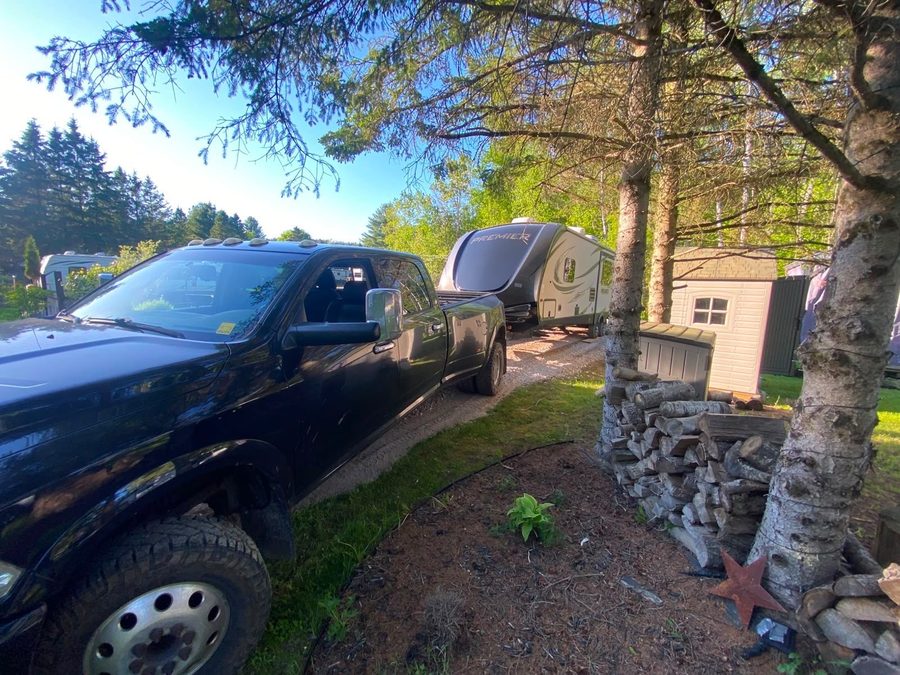
Lakeshore and seasonal lots. This is the classic Scugog job. A narrow access, mature trees on both sides, a slope down toward the water, and a unit that has been sitting long enough that the deck, the skirting and sometimes a shed have grown around it. The truck work here is slow and careful rather than difficult, and the honest constraint is usually turning room rather than weight. Send photographs of the approach and the tightest point and we can tell you before we come whether the unit walks out under its own hitch or needs repositioning first.
Port Perry residential streets. Older parts of town have the narrow street and short driveway problem you get anywhere with heritage housing stock, plus on street parking that does not clear itself. A one ton dually with a gooseneck is far more manoeuvrable than a tractor trailer, which is why this work is possible at all on a residential street, but we still need somewhere to swing the truck.
Rural and agricultural properties. Usually the easiest for turning room and the hardest for surface. A long gravel or dirt lane onto a farm property is fine in August and can be genuinely impassable in April, which brings you straight back to the thaw section above.
The run out to the highway is short from almost anywhere in the Township, which is one of the reasons Scugog jobs tend to sit at the lower end of our pricing. Highway 7/12 and Highway 7A carry you west and south quickly, and the 401 is a straightforward run down Simcoe Street or Highway 12. The distance is rarely what makes a Scugog job expensive. Access is.
Winter, and what the plow schedule tells you
Plenty of our Scugog work happens in the off season, storage runs in November and back out again in April, and the Township's published winter maintenance standards are genuinely useful for planning one.
| Road class | Township clearing standard |
|---|---|
| Arterial roads and EMS locations | 12 hours from when the snow reaches 8 cm depth |
| Class 4 roads, collector roads and designated bus routes | 16 hours from when the snow reaches 8 cm depth |
| Class 5 and 6 roads and local roads | 24 hours from when the snow reaches 10 cm depth |
Read that as a haulier and it says something practical. If your property is on a local road, which most rural Scugog properties are, the Township's own standard allows up to 24 hours from a 10 centimetre snowfall before that road is cleared. A loaded gooseneck on an uncleared rural road is not a job we will attempt, so a storm on Tuesday can reasonably push a Wednesday job to Thursday even though the highways are perfectly clear.
That is not a criticism of the Township. Those are normal standards for a rural municipality with 413 kilometres of road to cover. It is simply a scheduling fact worth building into a winter booking, and the reason we would rather agree a flexible window with you in January than a fixed hour.
When a Scugog booking actually moves
Four things move a date here, and only two of them are on a calendar.
Weight restrictions. March and April are the constrained months, and because the Township and the Region run separate dates, a route can be legal on one leg and not on another.
Road condition, which is not the same thing. The Township's own thaw warning is the reason a legally open gravel road can still be the wrong place for a loaded truck in the third week of April.
Permit lead times. Ten business days at the Region, plus whatever the Township process takes, plus time to assemble a security deposit or a weight distribution diagram where the load requires them.
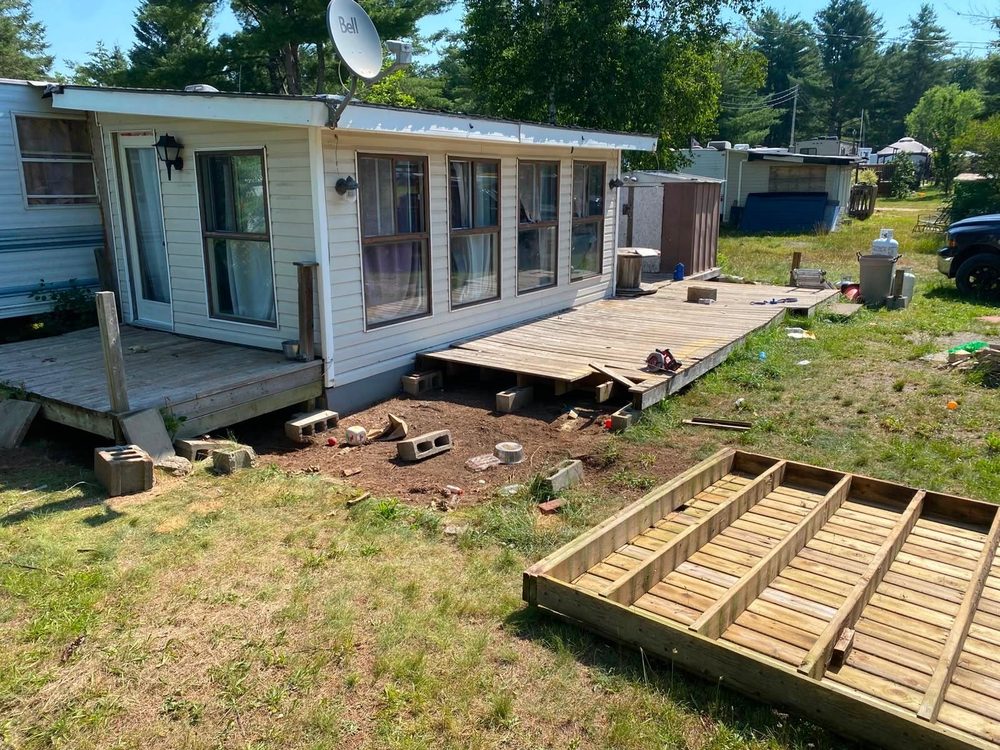
Site readiness. A pad that is not down, a deck that is not off, a gate that is too narrow, a seasonal park that has not signed off on the move. In Scugog the deck is the one that comes up most, because so many units here have had one built around them.
None of those is a reason to panic. All four are reasons to call earlier than you think you need to. There is no deposit to hold a date with us, so booking early costs you nothing and buys you room.
What we do around Port Perry and Scugog
Six services, all run by the same family with the same trucks. Most Scugog jobs are one of the first three.
- RV transport. Travel trailers, fifth wheels, toy haulers and campers, moved between homes, dealerships, storage and seasonal sites. Local tows from $400.
- Mobile home and park model moving. The permit heavy end of the work, and where the Township and regional oversize processes both come into play.
- Levelling and blocking. Setting a unit level and properly supported once it is where it needs to be, backed by the 30 day workmanship guarantee.
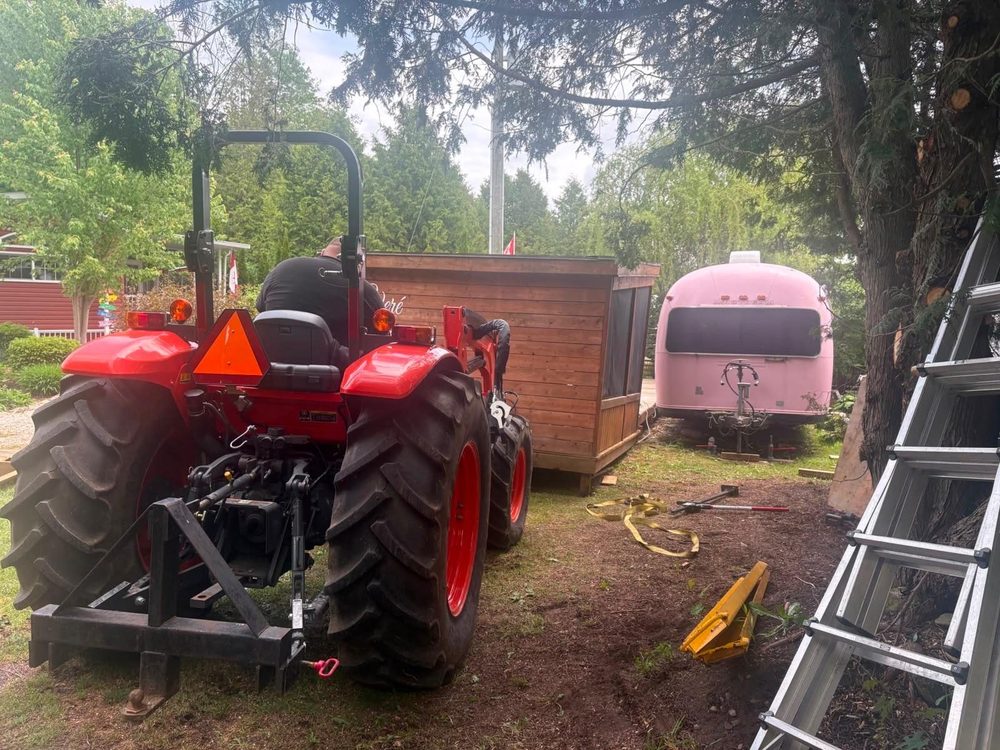
- Deck and shed moving. Lifting and relocating decks and sheds whole, on the same visit where we can. Common on Scugog seasonal sites.
- RV storage. Outdoor storage on a fenced property, $85 to $125 a month depending on size, with tow in and tow out.
- RV rentals. Delivered and set up on your site, so you are not towing it yourself.
Levelling and blocking on Scugog ground
Levelling in Scugog is mostly a question of what is underneath, and there is more variation here than in a subdivision.
On a proper gravel pad or a poured slab the job is straightforward and the result holds. On the soft ground of a lakeshore lot, on organic soil near a shoreline, or on a rural site where the pad is really just the flattest bit of yard, it is a different exercise. A unit that reads dead level in May can walk on you by August if the ground under one corner is holding water.
We block on stable, load spreading material, we check level along the frame rather than off the floor, and we say so when the ground under the unit is the actual problem rather than the blocking. That last part is the honest bit of the job. It is also where the property standards ground cover rule earlier on this page becomes useful for a completely different reason: gravel under the unit is both what the by-law wants and what the blocking wants.
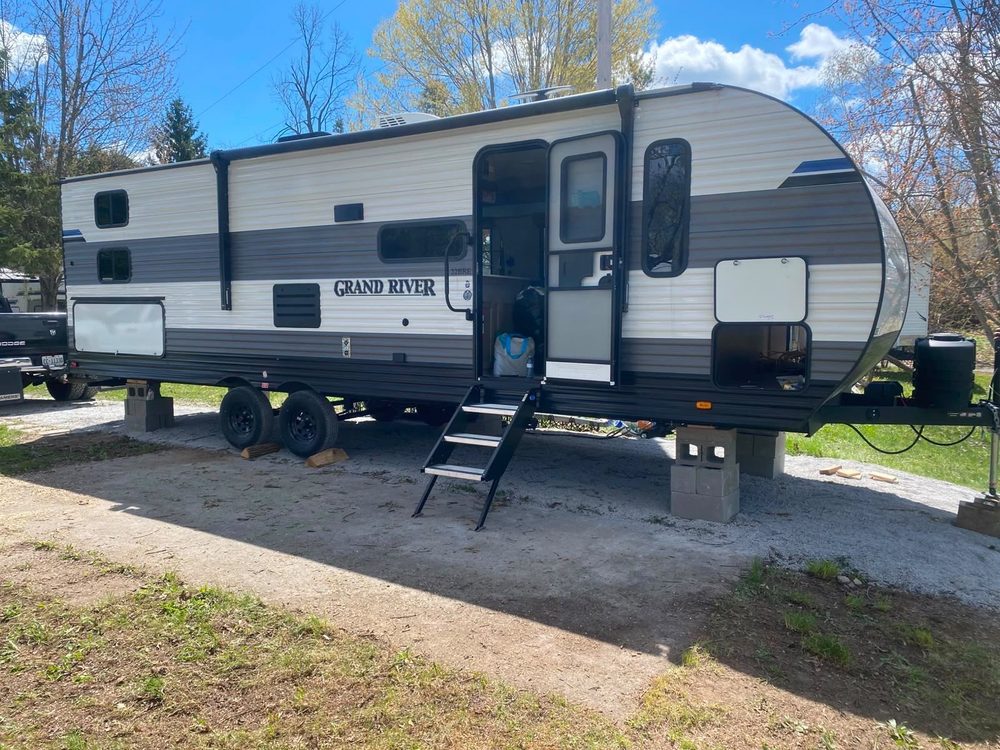
The levelling and blocking page goes through the method properly, including exactly what the guarantee does and does not cover.
Storage when the lot will not take it
There are two reasons a Scugog unit ends up in storage, and they are different from the reasons in a city.
The first is the season. A seasonal site that closes in October leaves the unit needing somewhere to be until spring, and towing it home to a property that has nowhere to put it just moves the problem.
The second is the surface. The property standards rule is clear that a stored vehicle needs gravel, asphalt or concrete under it and not grass, dirt or vegetation. On a lot of rural and lakeshore properties, building a pad big enough for a 30 foot fifth wheel is a real project, and storage elsewhere is simply cheaper than solving it.
Our outdoor storage runs $85 to $125 a month depending on size, on a fenced property, and we can tow the unit in at the end of the season and back out again in spring so you never have to hitch it yourself. Details are on the RV storage page, and the winter storage checklist covers what to do to the unit before it sits.
What a Scugog move costs
Local tows start at $400. A short Scugog run, a seasonal site to a storage yard, a driveway to a dealership, a lot to a lot inside the Township, generally sits near the low end because the distances are genuinely short.
What moves a Scugog quote up is rarely mileage. It is these, roughly in order of how often they come up:
- Access. A narrow treed approach, a lakeshore lot with no turning room, or a unit that has to be repositioned before it can be hitched properly.
- Surface. A soft gravel or dirt lane that needs matting, a slower approach, or a different week entirely.
- Permits. An oversize load that needs both a Township permit and a regional permit for the same trip, with the regional lead time attached.
- What is attached. A deck, a shed, skirting or utilities that have to come off before the unit can move, and often go back on afterwards.
Levelling and blocking is quoted separately at $799 for a full set up, and storage runs $85 to $125 a month depending on size. There is no deposit to book. The RV transport cost guide breaks the pricing down across the whole of Ontario if you want the full picture before you call.
When to book
The busiest weeks around Scugog are late April into June, when everything that waited out the restriction season and the thaw goes at once, and then September into late October when the seasonal sites close and the storage runs start. If you want a specific week in either of those windows, three to four weeks of notice is realistic.
If your move is oversize, work backwards from the permit rather than from the calendar. Ten business days at the Region, plus the Township's own process, plus whatever time it takes to assemble a security deposit or a weight distribution diagram where the load requires one. That is the real lead time and it is longer than most people assume.
Out of season, in midwinter or the quiet part of summer, we can often be there inside a week, with the winter clearing caveat above attached. There is no deposit, so there is no cost to booking early and no penalty if the date has to shift.
How to get the quote right the first time
The more of this you can tell us up front, the closer the first number will be to the final one.
- Both addresses, and whether the road at each end is Township, regional or provincial. If you are not sure, say so and we will work it out. It decides which permit office is involved.
- Make, model and year of the unit. Or the length, width and height and a rough weight if you have it. Width is what usually decides whether it is a permit job.
- Photographs of the road, not just the driveway. In Scugog the approach road matters as much as the site. One shot down the road toward the property and one back the other way.
- Whether there is a deck, shed, skirting or utilities attached. On Scugog seasonal sites this is the most common thing that changes a job, and we would rather plan it than discover it.
- Your date, and how much it can move. A firm closing date is a different job from a flexible one, especially between March and the middle of May.
Send it all through the contact page or call and we will talk it through. We would rather spend ten minutes on this than turn up to a job that cannot be done that day.
Our 30 day guarantee
If a unit we set up shifts or moves because of our workmanship, we come back and redo the job at no charge. Weather and ground conditions are outside that, and we say so up front.
It covers our workmanship for 30 days. If a unit we levelled and blocked shifts or moves because of how we did the job, we come back and redo it at no charge. What it does not cover is weather and ground conditions, and we would rather tell you that before the job than argue about it afterwards.
In Scugog that distinction earns its keep. A lakeshore lot with high water in spring, a rural pad on organic soil, or a site where the frost comes out unevenly will move a unit no matter how carefully it was blocked. When we think that is the situation, we say so at the time and we write it down, so nobody is surprised in August.
Nearby areas we also cover
Scugog sits between four of our other service areas, so a job that starts here very often ends somewhere on this list.
Beyond those we also work in Muskoka, Collingwood and Wasaga Beach and the Quinte area, and we take long distance work across Ontario and into the rest of Canada. A unit coming off a Caesarea seasonal site and going to a lot four hours north is a completely normal job for us.