
What levelling and blocking actually is
Levelling and blocking is setting a trailer, park model or mobile home dead level and building the support underneath it that carries its weight into the ground. Kawartha RV Transport & Services does this across Ontario from $799 as a local flat rate, we supply the materials, and we do the plumbing and levelling together because doing them in the wrong order strains everything you just connected.
We level units we moved and units we have never touched. Re-levelling an existing setup is a service on its own, and it is one of the most common calls we get in spring. Work is backed by a 30 day workmanship guarantee, we run under Ontario CVOR 204-617-206, and we carry $2 million in liability with $150,000 in cargo coverage.
Almost nobody calls us because they want their trailer levelled. They call because a door will not latch, a slide-out has started dragging, or the fridge is not keeping up any more. Those are all the same problem wearing different clothes, and the problem is that the unit is not sitting true.
Levelling is the least glamorous thing we do and probably the one that saves owners the most money. Nobody photographs blocking. Nobody shows their neighbour the shims. But the difference between a unit that was set properly and one that was dropped and left is not visible on day one and is extremely visible by year three, and by then it is in the frame.
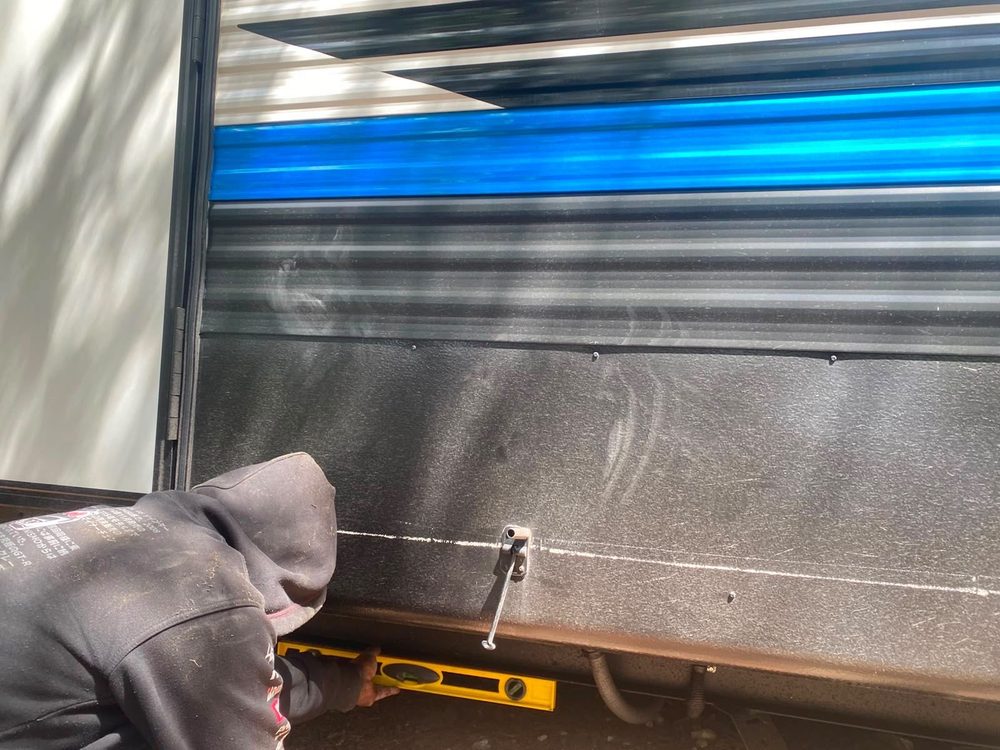
Why a unit that is out of level costs you real money
A trailer or park model is a box built on a steel frame, and that frame is designed to be carried evenly. When it is not, the weight has to go somewhere, and it goes into a twist that runs the length of the unit. Everything bolted to that frame then has to live with the twist.
The thing that makes this expensive is that it is gradual. A unit does not go out of level and immediately break. It sits slightly wrong for a season, then another, and the damage accumulates in the parts of the unit that were built to specific tolerances: the door frames, the window frames, the slide-out mechanisms, the plumbing runs. By the time a symptom is obvious enough to call somebody about, the cause has been at work for a while.
Not levelling properly is the single most common mistake we see, and it is worth being blunt about what it damages: the frame, the slide-outs and the plumbing. Those are the three most expensive systems in the unit. The levelling job that would have prevented it is a flat rate.
Travel trailer, fifth wheel, park model or mobile home
The principle does not change between them. The execution changes a lot. What varies is how many support points the unit needs, how big the pads under those points have to be, and how much work the ground needs before anything sits on it.
Travel trailers
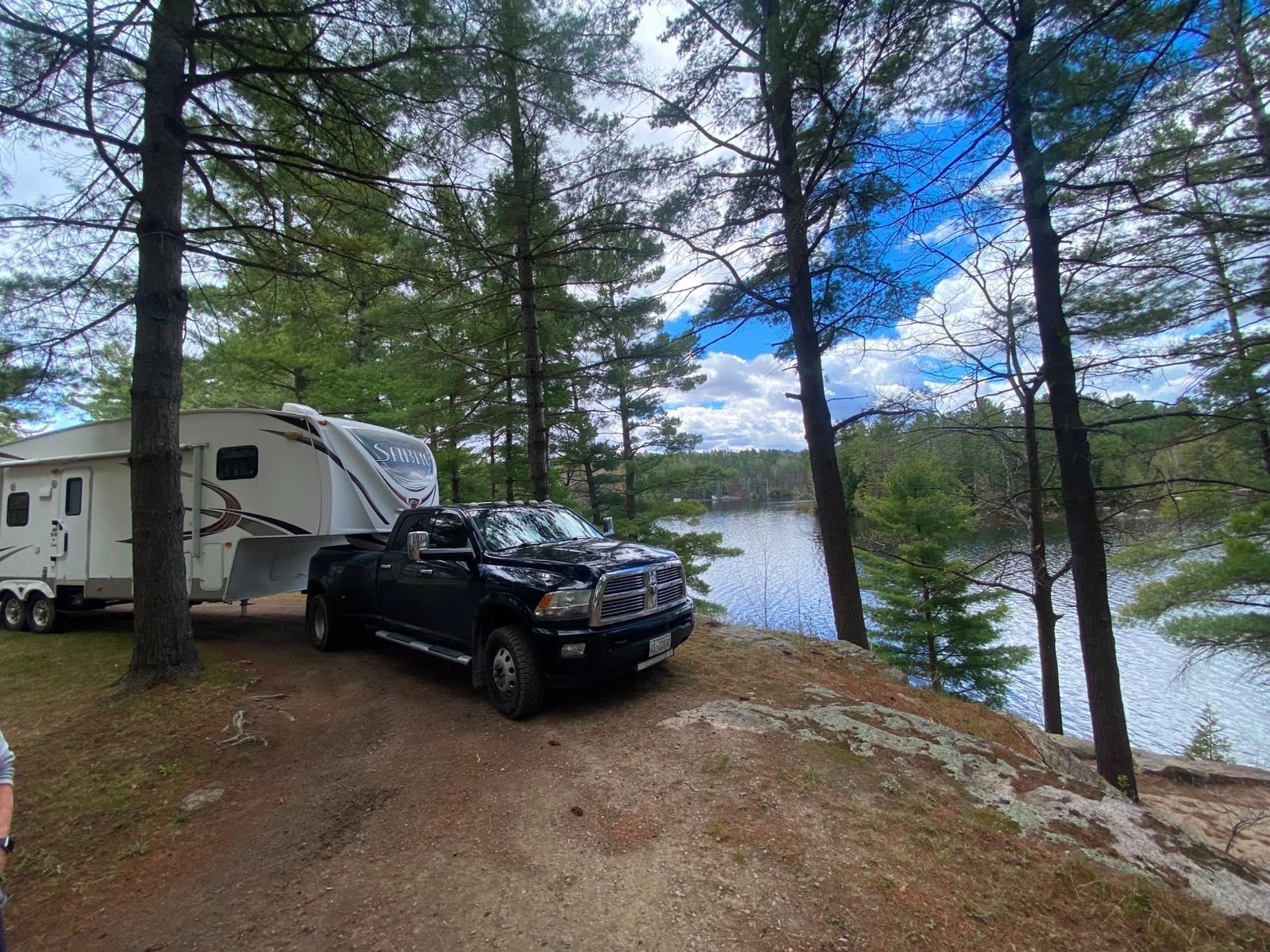
The lightest and shortest of the four, and the one most people attempt themselves. It still has its suspension under it, the front is carried at the tongue, and it needs the fewest support points. That does not mean it needs none. A travel trailer parked on a site for a season is carrying its weight somewhere, and it should be carrying it on blocking under the frame rather than on four stabiliser jacks and a hope.
Fifth wheels
A fifth wheel carries a bigger share of its weight at the front end than a travel trailer does, and once it is unhitched that weight has to go somewhere. For a weekend, the landing gear does the job it was built for. For a season on a site, we put blocking under the frame so the nose is sitting on support rather than spending the winter on the legs.
Park models
The big ones, and the ones where this work matters most. A park model is long, heavy and, once it is placed, usually not going anywhere for years. It gets the most support points of anything we set, and the ground work under it gets the most attention, because the load arriving at each pad is the highest. This is also the category where owners are least likely to spot a problem early, because a park model looks so solid that it is hard to believe it has moved.
Single wide mobile homes
Set on piers under the main beams, skirted almost every time, and treated as permanent from the first day. On these, levelling, skirting and plumbing are effectively one job rather than three, and we quote them that way. There is more on that on our park model and mobile home moving page.
The refrigerator problem, and why it is the early warning
Most trailers and park models run an absorption refrigerator. It has no compressor. It works by circulating a liquid through a sealed system driven by heat, and that circulation depends on gravity, which means it depends on the unit being level.
This is not folklore. Dometic's own operating manual for its RV refrigerators states plainly that for optimal cooling performance, an absorption refrigerator must be level. It also states that if the refrigerator operates in a noticeable out of level condition for several hours, loss of cooling performance will occur.
The same manual gives a usefully practical standard for how level is level enough: the RV does not need to be perfectly level, but there should be no noticeable sloping of the floor or walls. That is a test you can run yourself, today, without any tools. Stand in the middle of your unit and look along the floor.
Worth knowing
Levelling matters when the unit is parked and running, not while it is going down the road. Nobody expects a fridge to be level on the 401. It is the hours it spends sitting on a site that decide whether the cooling unit lives a long life or a short one.
A fridge that is not keeping up is often the first thing an owner notices, well before a door sticks. If yours has quietly gotten worse over a couple of seasons and nothing else has changed, check whether the unit is still sitting where it was set.
What twist does to the frame, the doors and the slide-outs
The frame
The frame is the part you cannot repair cheaply. Steel that is held in a twist for years takes a set. Once it has, levelling the unit afterwards does not necessarily bring everything back, because the frame is no longer the shape it was built as. This is the reason we push people to check in spring rather than wait for a symptom.
Doors and windows
Doors and windows are hung to a square opening. Twist the frame and the opening is no longer square, so the door no longer fits it. That shows up first as a latch that needs a shove, then as a door that will not stay shut, then as a seal that no longer seals, which is how water gets in. Water in a wall is the beginning of the most expensive repair in the trailer.
Slide-outs
A slide-out runs on rails and needs the opening to be true to move without binding. When the unit is out of level, one side of the mechanism is doing more work than the other every time it goes in or out. Slide-out motors and gear are not cheap, and they tend to fail on the weekend you are trying to use the unit rather than at a convenient moment.
Plumbing, drains and what winter does
Drains have no pump. They work on fall, which is a polite way of saying they work because water runs downhill. A unit that sits low at the wrong end has drain lines that no longer empty themselves, so water sits in them.
In summer that means slow drains and traps that do not seal properly, which is where smells come from. In an Ontario winter it means something worse. Water that stays in a line is water that freezes, and water that freezes expands and splits fittings. Owners discover this in May, when they turn the water on and find out where the split is.
This is why we do plumbing and levelling as one job. The sequence matters: block it, level it, connect the plumbing to a unit that is already sitting where it will stay, then check the level again once it has settled onto the blocks under its own weight. Plumbing first and levelling second means every joint you made has been pulled on.
If your unit is going to sit outside through the winter, the levelling is part of the winterising. Our winter storage checklist for Ontario covers the rest of it.
Skirting, and why it depends on the level line
Skirting closes the gap between the bottom of the unit and the ground. It does three useful things and one thing people expect of it that it cannot do.
What it does: it takes the wind out from underneath the floor, which is exactly where the water lines and the tanks run. It stops blowing snow packing in under the unit over a winter. And it keeps animals from deciding that the warm, sheltered space under your trailer is available accommodation, which they will, every time, if you let them.
What it does not do is turn an exposed water line into a protected one. Skirting is not insulation and it is not a heated space. It reduces what the underside of your unit is exposed to. It does not make February stop happening. Anyone telling you otherwise is selling skirting.
The reason it belongs on a levelling page is that skirting is cut to a line, and that line is the bottom edge of a unit that is sitting where it is going to stay. Skirt a unit before it has settled onto its blocking and the line moves out from under your work. So the order is: block it, level it, let it take its own weight, plumb it, then skirt it.
It works the other way round as a diagnostic too. Gaps opening up at one end of a skirt that used to fit are one of the clearest signs a unit has shifted, and they are visible from outside without crawling under anything. If your skirting has started to look wrong at one corner, the skirting is probably not the problem.
How blocking is actually done
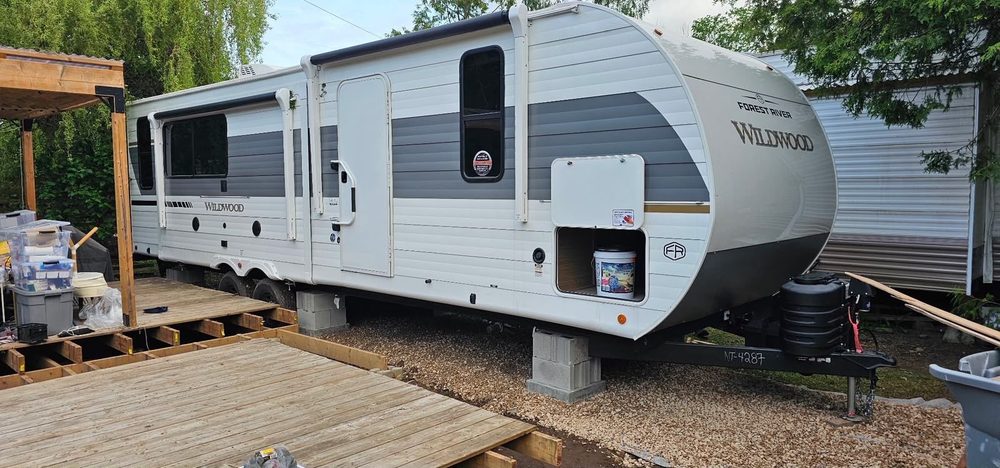
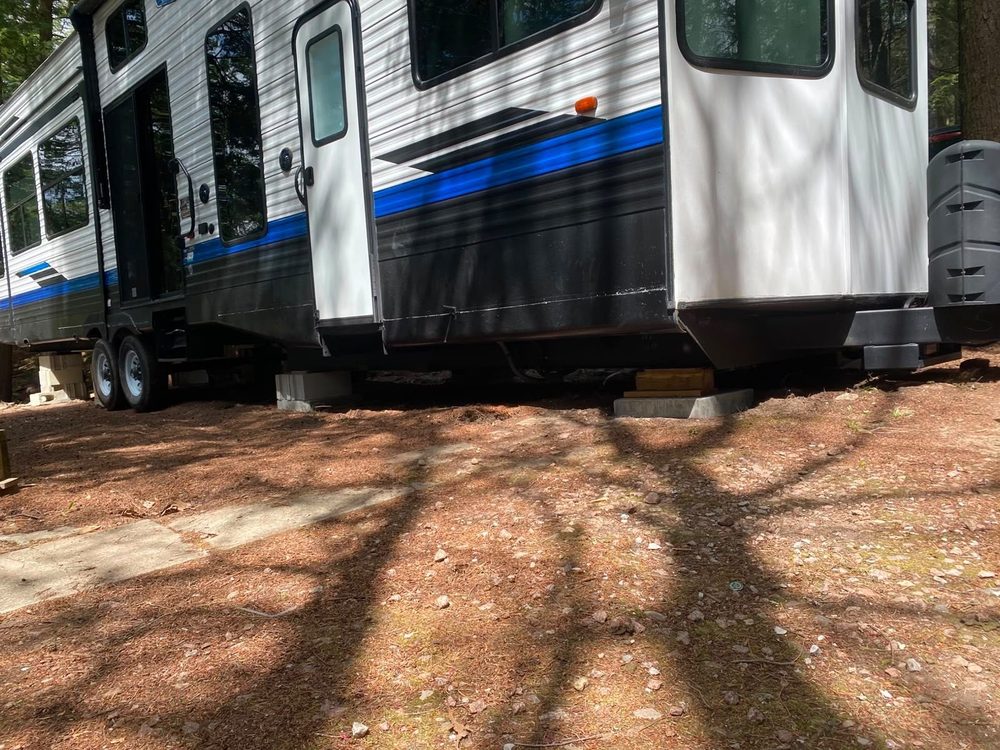
Blocking is the stack of supports between the frame and the ground. Its job is to carry the weight of the unit and spread it into the ground over enough area that the ground can take it.
Two things decide whether blocking works. The first is where it goes. Blocking belongs under the frame, at the points the frame was built to be carried at. Put it somewhere else and you are not supporting the unit, you are pushing on it. The second is how much of it there is. Too few points and the weight concentrates. Enough points, properly spaced, and the frame stays straight.
We supply the materials. That matters more than it sounds, because a lot of the bad blocking we find under units is bad because somebody used what was on hand: a stack of loose patio stones, scrap lumber on end, a couple of cinder blocks laid the wrong way up. Those work until the day they do not, and they usually stop working under load and out of sight.
- Support under the frame at the designed carry points, not wherever the ground happens to be flat
- Enough support points that no single stack is carrying a disproportionate share
- Stacks built plumb and square, so the load runs straight down through them
- Proper pads underneath, sized so the ground can carry what is on top of them
- Shimmed tight, so the unit is actually sitting on the blocking rather than hovering near it
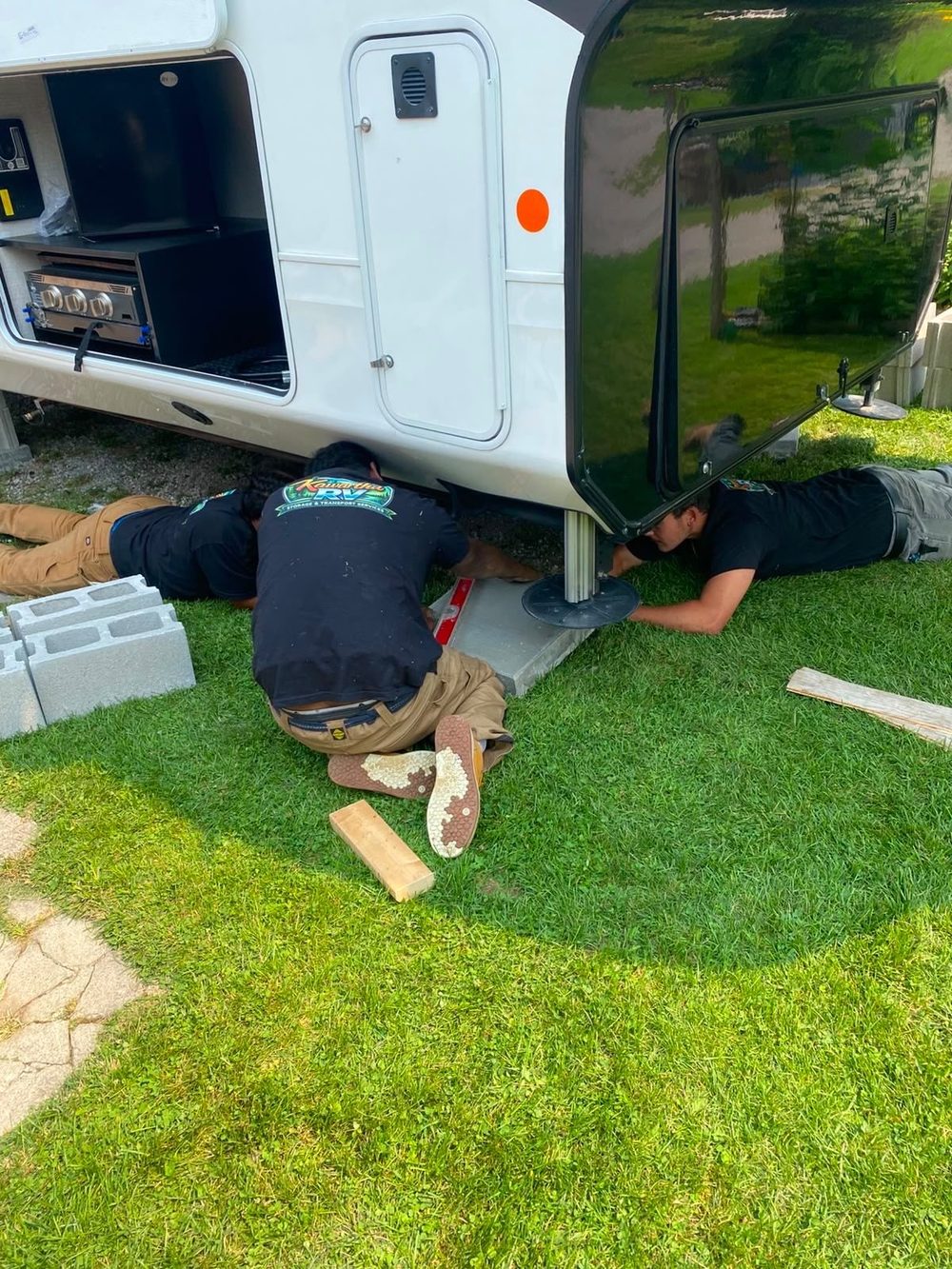
Side to side first, then front to back
There are two directions to get right, and the order they are done in is not arbitrary.
Side to side comes first. The only way to correct a unit that leans is to change the height of one entire side, and that means changing the blocking on that side. Doing it moves the front to back reading as well, so there is no point setting front to back and then discovering you have to undo it. Side to side, then front to back, every time.
Front to back comes second, and it is the easier of the two, because it is adjusted at one end rather than along a whole flank. It is also the one most owners are already doing without thinking about it, because it is the direction the tongue jack moves.
Where we put the level
On the frame. Not on the countertop, not on the kitchen floor, not on the top of the fridge. The frame is the part being carried and the part that takes the damage when it is carried wrong. Counters get shimmed when the unit is built and floors move over the years, so a level sitting on a countertop is telling you something accurate about the countertop and very little about the trailer.
Why one reading is not enough
A level sitting at one end of a unit tells you about that end. It will happily read true while the far end is an inch low, because a long unit can sag and twist along its length without either end looking wrong on its own. That is what the string line is for. Run it down the frame and the sag shows up as daylight in the middle, which no spirit level parked at the tongue is ever going to find.
Then we check it again after it has settled onto the blocking under its own weight, because a unit that is set and a unit that has taken its own weight are not always in the same place. Checking once means checking the wrong one.
The ground under the blocks
Blocking spreads weight. It does not invent bearing capacity that is not there. If the ground under the pad cannot carry the unit, no amount of blocking on top of it changes that, it just changes how long it takes to find out.
Ground that gives us trouble is ground that is soft, ground that has recently been disturbed or filled, and ground that drains toward the unit rather than away from it. Fill in particular is a common one on newer seasonal sites: a pad that was cut and filled last season has not consolidated yet, and it will settle under load in a way that undisturbed ground will not.
Drainage is the quiet one. Water running under a pad softens what the blocks are sitting on, and it does it slowly enough that nobody connects the puddle in April to the door that started sticking in July. If the ground falls toward where the unit sits, that gets sorted out before anything goes on top of it.
Site prep is part of what we do rather than something we hand back to you. If we look at a site and it needs work first, we will say so, and we would far rather have that conversation before the move date than on it.
Stabiliser jacks are not levelling equipment
This is the most common misunderstanding in the whole trade, and it is an easy one to fall into, because the jacks are right there and they go up and down.
Scissor jacks and stabiliser jacks are built to stop the unit rocking once it is already level and already carried on its own suspension or on blocking. They are stabilisers. Their job is to take the wobble out when you walk across the floor. They are not built to lift the unit and they are not built to carry it for a season.
When people use them as levelling gear, two things happen. The load goes into the frame at points that were never meant to carry the whole corner of a trailer, and the jack itself takes a load it was not rated for. Neither of those fails immediately. Both of them fail eventually, and the frame damage is not reversible.
Rule of thumb
If the unit is going to sit somewhere for a season or longer, it should be sitting on blocking under the frame, with the jacks doing nothing but stopping the wobble. If you are using the jacks to hold a corner up, the unit is not levelled, it is propped.
Re-levelling a setup that is already in place
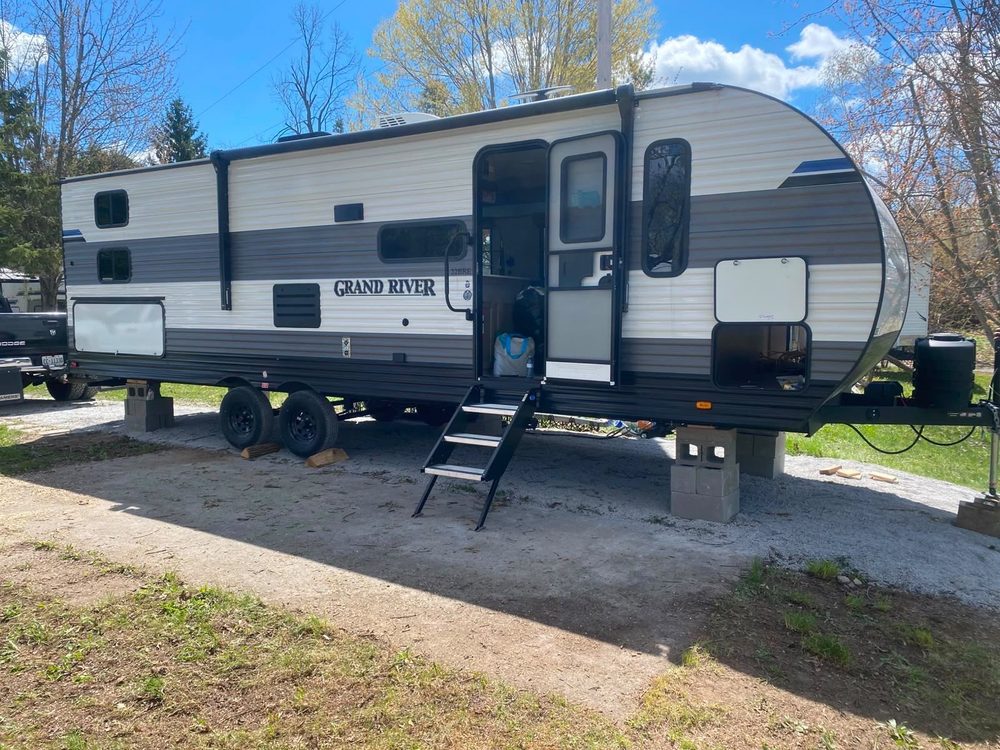
You do not need to have hired us to move it. Re-levelling existing setups is its own service and a large share of what we do.
Units move. That is not a failure of the original install, it is what happens when something heavy sits on Ontario ground through a winter. The ground freezes, it heaves, it thaws, it settles, and it does none of that evenly across a pad. A unit that was dead level in October is often measurably out by May.
When we come out to re-level, we check it properly rather than by eye: a level on the frame rails in both directions and a string line down the length of it, so we can see what has actually moved rather than guessing from the door that is sticking. Then we adjust the blocking, bring it back true and check it again once it has settled.
Caught early, this is straightforward work. Caught late, after a frame has been sitting twisted through several seasons, we can still bring it back level but we cannot promise everything comes back with it. That is a real limitation and we would rather say so than let you find out.
How to tell your unit has gone out of level
None of these need tools. Any one of them is worth a phone call.
- A door that has started catching. The latch needs a lift, a shove or a pull it never used to need.
- A door that swings. Open it and let go. If it moves on its own, the unit is telling you which way it leans.
- A window that binds in one corner. Especially a window that used to slide fine.
- Cupboard doors that will not stay shut, or drawers that creep open on their own.
- A slide-out that drags, sounds different, or is slower on one side than it used to be.
- A fridge that has quietly stopped keeping up when nothing else about it has changed.
- Visible gaps where the skirting meets the ground that were not there last year.
- Water that will not drain the way it used to, or a sink that gurgles.
The simplest home check is the one from the fridge manual: stand inside, look along the floor and along the walls, and see whether there is a slope you can notice. A marble on the floor works too, and costs nothing.
The spring check, and why it is worth doing
Every spring, before you start using the unit, walk around it and look at four things: whether the blocking is all still in contact and none of it has tipped, whether the ground around the pads has moved or washed, whether the doors and windows work the way they did in the fall, and whether the skirting still meets the ground the way it used to.
If anything on that list has changed, get it looked at before the season rather than during it. Ontario winters do this to units every year. It is normal. What is not normal is leaving it for three years and then wondering why the slide-out died.
For people who have us out anyway to bring a unit back from storage in spring, adding a level check to that trip costs almost nothing, because we are already there with the gear.
Seasonal park sites and private land are different jobs
A lot of our levelling work is on seasonal park and resort sites around the Kawarthas and Durham. The rest is on private land. The unit can be identical and the job still runs differently.
On a seasonal site
The pad is usually already there and has usually held something before, which tells you a lot about how it behaves. Services are already run to the site, so the plumbing connection points are fixed and the unit has to end up where they are. Neighbours are close on both sides, which limits how much room there is to swing gear and means the approach matters as much as the site itself. We are used to working inside a laid out park with units left and right, and we plan the approach before the truck rolls rather than improvising it in front of an audience.
Most parks also have their own rules about who is allowed to work on site, and a good number want proof of insurance before you get through the gate. We carry $2 million in liability, $150,000 in cargo coverage and $150,000 in non-owned trailer coverage, and we run under Ontario CVOR 204-617-206. Ask and we send it, without anyone having to chase us for it.
On private land
You decide where the unit goes, which is the freedom and also the catch. There may be no pad yet at all, so site prep is a genuine part of the job rather than a formality. Drainage is nobody's problem but yours, and it is the one that quietly decides whether the setup holds. Access can be harder than a park or much easier, and it is worth a photo before we quote either way.
What is the same in both cases is the method: support under the frame at the right points, pads sized for what the ground can carry, side to side then front to back, and a second check once it has settled.
What levelling and blocking costs
Levelling and blocking starts at $799 as a local flat rate. Flat rate means a price, not a meter running while somebody works. We supply the blocking materials within that.
| What changes the price | Why |
|---|---|
| Distance from our base | The $799 flat rate is for local work. Further out is quoted per kilometre or per job, whichever is fairer. |
| Size and weight of the unit | A 24 foot travel trailer and a 40 foot park model need different amounts of support. |
| Condition of the ground | A prepared gravel pad is one job. Soft, sloped or freshly filled ground needs work before anything sits on it. |
| Plumbing and skirting | Usually done at the same visit, quoted with the levelling. Cheaper together than as two trips. |
| Access | Room to work matters. A site we can get gear into is faster than one we cannot. |
| Whether we are already there | Adding levelling to a move we are already doing is the cheapest way to get it done. |
No deposit. You pay when the job is finished, by cash, credit card, debit or e-transfer. Quotes are free.
Doing it yourself, honestly
Plenty of people level their own units and do a decent job of it. If you are going to, the things that matter are the ones above: support under the frame at the right points, enough of them, proper pads sized for the ground, and jacks used for stabilising rather than lifting. Check with a level on the frame in both directions, not by eye, and check again a week later once it has settled.
Where it stops being a sensible DIY job is when the unit is large, when the ground is questionable, when it has to come up significantly to get level, or when you would be working alone under something heavy. A park model is not a travel trailer. There is a real difference between shimming a corner and lifting a 40 foot unit, and the second one is not a job to learn on.
The other honest point: if the levelling is going to be wrong, it is cheaper to have paid the flat rate than to pay for a slide-out mechanism and a door reframe two years later. That is not a sales line, it is just what the repair bills look like.
Booking, and what to expect on the day
We usually need 24 to 48 hours of notice. Same day and emergency work is available when we can fit it, so if something has gone wrong, call and ask. Spring and fall are our two busiest stretches by a distance, so if your dates are fixed, get in early.
When you call or email, these are the things that let us price it accurately first time:
- What the unit is: make, model, year and rough length if you know it
- Where it is, and what the ground is like under it
- Whether it is currently blocked, and what it is blocked on
- Photos of the unit, the pad and the approach
- What symptoms you are seeing, if any
- Whether you want plumbing, skirting or site prep done at the same time
On the day we check what is there, set or reset the blocking, bring the unit level in both directions, do the plumbing if that is part of the job, and check the level again after it has settled. Then we walk it with you before we leave. Reach us at (647) 961-9257 or transport@kawartharvrentals.ca. Our hours are monday to Saturday, 7:00am to 7:00pm. Sunday closed, by appointment only.
Our 30 day guarantee, and what it does not cover
The guarantee, in plain words
If a unit we set up shifts or moves because of our workmanship, we come back and redo the job at no charge. Weather and ground conditions are outside that, and we say so up front.
We are specific about this on purpose. What we control is the workmanship: where the blocking went, how it was built, whether the unit was actually brought true and whether the plumbing was connected to a unit that had already settled. If any of that is why a unit shifts within 30 days, we come back and redo it and you pay nothing.
What nobody controls is the ground and the weather. A seasonal pad is not a frost depth foundation and was never built as one. Ground freezes and heaves, then thaws and settles, and it does not do it evenly across a site. A wet autumn changes what the soil under a pad will carry. Any installer who tells you their setup is immune to that is either not thinking about it or counting on you not to ask.
The real answer to ground movement is not a longer guarantee, it is the spring check and re-levelling when it needs it. Small job every year, or a large one every five. We would rather sell you the small one.
Where we do this work
We are based in Beaverton, Ontario, which puts us within easy reach of the Kawarthas, Durham Region, Simcoe County, Northumberland and the run north into Muskoka. Levelling work tends to stay closer to home than transport does, simply because the flat rate is a local rate, but we go where the work is.
Not sure whether you are inside our normal range? Our service areas page has the detail, or just call and ask. If we cannot get to you we will say so rather than string you along.