
What our storage actually is
Kawartha RV Transport & Services offers outdoor winter RV storage on a fenced property in Beaverton, Ontario, at $85 to $125 a month depending on the size of the unit. It is outdoor seasonal storage rather than an indoor or heated building, and we say that at the top of the page rather than in the fine print.
We can tow the unit in at the end of the season and tow it back out in spring, quoted separately from the monthly rate. Units are set down on proper support and brought level rather than left where the truck stopped. There is no deposit, payment is by cash, credit card, debit or e-transfer, and we run under Ontario CVOR 204-617-206 with $2 million in liability and $150,000 in cargo coverage.
Most of this page is not about our lot. It is about the five months your unit is going to spend not moving, and what decides whether it comes out in April the way it went in. Storage is the easy part. Preparation is the part that costs people money, and almost none of that money gets spent in the winter. It gets spent in the spring, on a split fitting or a dead battery or a set of tires that has been sitting in the sun on 20 psi since October.
So we have written this the way we would tell you on the phone. The business details are here, and then there is a long, sourced walk through everything worth doing before a recreational vehicle sits still through an Ontario winter. Where a manufacturer or a regulator has published a number, we have used theirs and linked it. Where nobody credible has published one, we have said so rather than making one up.
What it costs
$85 to $125 a month, by size. That is the whole pricing structure and there is nothing hidden behind it.
A small travel trailer sits near the bottom. A large fifth wheel or a park model sits near the top, because it occupies more of the property and because getting it in and out of a spot takes more room and more time. If you tell us the length and the type, we will tell you the number before you commit to anything.
| What you are paying for | What it means |
|---|---|
| Monthly rate | $85 to $125, set by the size of the unit. Quoted before you book. |
| The property | Fenced, outdoor, in Beaverton, Ontario. Not indoor and not heated. |
| Setting the unit | Blocked and levelled on arrival, included rather than extra. |
| Tow in | Quoted separately. Local tows start around $400 within 45 km. |
| Tow out | Separate booking in spring. Tell us the date when you book the storage. |
| Deposit | None. Cash, credit card, debit or e-transfer. |
The two things people forget to price are the two ends. Getting the unit to the lot and getting it home again are transport jobs, not storage, and they are quoted as transport. If you are towing it yourself both ways then storage is the only number you need. If you want us to handle it, the RV transport page covers how that side is priced and what changes it.
What we can take
Travel trailers, fifth wheels, hybrids, pop ups, toy haulers and the general run of towable recreational vehicles. If it tows, it almost certainly fits.
Park models and mobile homes are a size conversation rather than a yes or a no. We move them constantly, and there is a full page on park model and mobile home moving, but storing one takes considerably more of the property than a 24 foot trailer does, so it depends on what is available when you ask. Send the length and the width and we will give you a straight answer.
What we will tell you honestly is when a unit should not go into storage at all. A trailer with a soft floor, an active roof leak or tires with sidewall cracking is not going to improve over five stationary months. Storing it just moves the problem to April and adds five months of water getting in. If we can see something like that when we pick it up, we will say so. What you do about it is your call, but you will hear it from us first.
Getting it here and back out
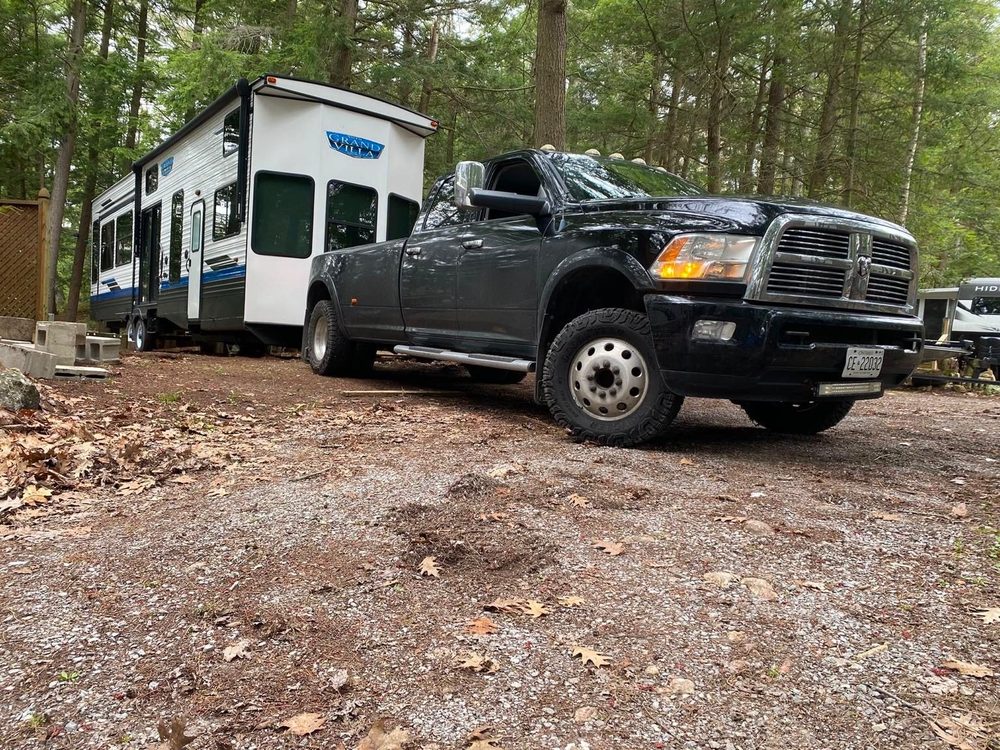
We run three one ton duallys and a 30 foot gooseneck, and we have moved in the region of 1,800 trailers over five years. Towing your unit in at the end of the season and back out in spring is the normal way people use this service, particularly the ones whose trailer has been sitting on a seasonal site since May and has not been on a highway in months.
The seasonal site pickup is its own small skill. Those sites are usually tight, often wooded, and frequently have a deck, a shed and a fire pit arranged around the trailer by somebody who never expected it to leave. Threading a dually and a trailer out of that without touching anything is most of the job. Wooded, tight and remote sites are normal work for us rather than an exception, which is worth knowing before you assume yours is impossible.
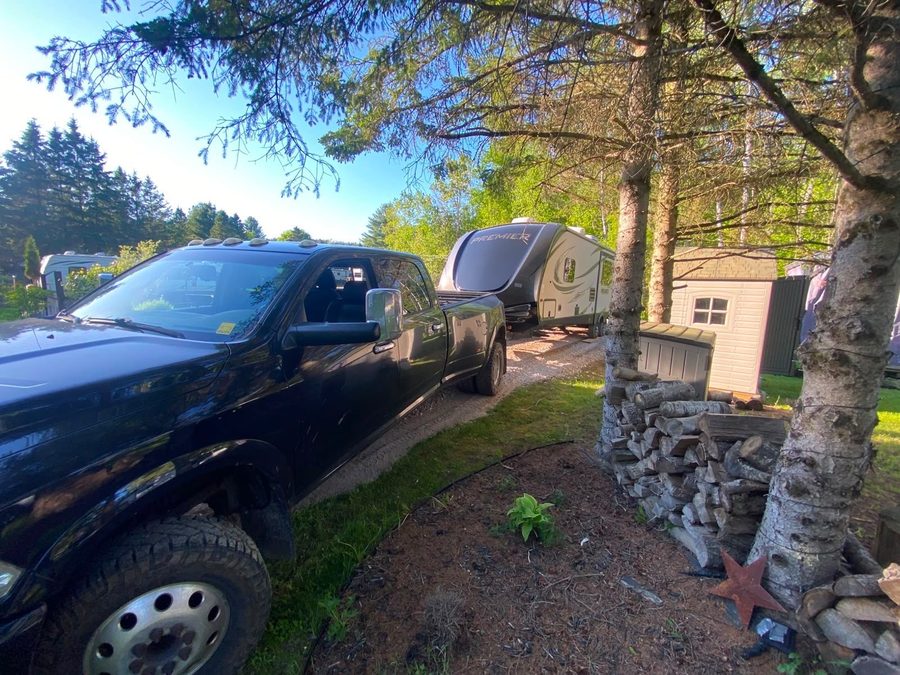
Practical things that make the pickup go smoothly: have the unit unblocked or tell us it is not, have the propane closed off, have the site clear of the things that accumulate around a trailer over a summer, and have the tires holding air. If any of that has not happened we can do it, but it is an added charge and it is time on the day. Ten minutes of your attention in September saves an hour of ours in October.
Coming back out in spring runs the same way in reverse, with one difference: the ground. See the spring section below, because it is the single most common reason a requested date gets moved.
When to book
Usually 24 to 48 hours of notice, and same day or emergency work is available when we can fit it in.
That is the general answer, and for most of the year it holds. Fall and spring are the exceptions. Seasonal parks close on the same weekends, everyone decides on the same Saturday that the trailer needs to be gone, and the two or three weeks either side of that are the busiest of our year. The same thing happens in reverse in May.
If your dates are fixed by a park closing date, book as far ahead as you can and give us both ends at once. Telling us in October that you want it back the first week of May costs you nothing and puts you at the front of a queue that gets long.
Outdoor versus indoor, honestly
Indoor heated storage is better for the unit. That is true and we are not going to argue with it. It is also several times the price, there is not much of it in this part of Ontario, and it books out early.
What outdoor storage actually costs the unit is exposure: ultraviolet light on the roof and sidewalls, freeze and thaw cycles working on every seal, snow load, and weather sitting on the tires. Every one of those is manageable, and the rest of this page is essentially a list of how. A properly winterized, properly covered, properly blocked unit outdoors comes through an Ontario winter perfectly well. Thousands of them do it every year in this region.
What outdoor storage does not forgive is skipped preparation. Indoors, a half winterized unit often gets away with it, because the building never drops below freezing. Outdoors it does not get away with anything. That is the real difference between the two, and it is worth understanding before you choose on price alone.
The honest summary
Outdoor storage plus proper preparation beats indoor storage plus laziness, comfortably. Outdoor storage plus laziness is the expensive option, and the bill arrives in spring.
Storing it at home instead
Plenty of people park the trailer beside the house and that is a perfectly reasonable thing to do, if you have the room and if your municipality allows it where you want to put it.
That second condition catches people out, so it is worth stating properly. In Ontario, zoning by-laws are passed by local municipal councils, and Ontario's own citizens' guide to land use planning lists what those by-laws control: how land may be used, where buildings and other structures can be located, lot sizes and dimensions, parking requirements, building heights and densities, and setbacks from the street. Parking requirements are in that list, and by-laws are local, which is why the rule at your cottage is not necessarily the rule at your house. We are not going to tell you what your municipality says. We are telling you that it is a municipal question with a municipal answer, and a phone call to your local office settles it.
The practical considerations are simpler. Is the ground firm enough to carry the unit for five months without one corner sinking? Is it somewhere you can get a truck in and out of in April, when the driveway is soft? Is it out from under the branch that comes down in an ice storm? Is it in the way of your own snow clearing all winter? Those questions decide most home storage, and the ones that go wrong usually go wrong on the first and the last.
If the answer is that home works, store it at home. We would rather tell you that than sell you a spot you do not need.
Winterizing, the short version
Here is the whole thing in one list, and then the sections that follow go through the parts where a manufacturer or a regulator has published something specific worth knowing.
- Water out. Drain the fresh tank, the water heater and the lines, then run RV antifreeze through what remains.
- Tanks empty and flushed. Grey and black both, and do not leave the black valve open all winter.
- Battery full, then disconnected. Charged to full, taken off every load, and topped up periodically.
- Propane closed. Cylinder valves shut, cylinders left outdoors and upright.
- Fridge empty, clean and propped. Use the door position that holds the gap open.
- Tires at placard pressure. Not eyeballed. Checked with a gauge, before it sits.
- Roof and seals looked at. Before the snow, not after.
- Slides in, awning in, vents closed. Nothing left extended for five months.
- Food out, soft goods out. Everything a mouse would consider dinner or bedding.
- Cover on, if you are covering it. A real cover, not a poly tarp.
None of that is exotic and none of it takes a specialist. It takes an afternoon. The reason we have written it all out is that the failures we see in April are almost never sophisticated. They are one line from that list that somebody meant to do.
Water lines and antifreeze
This is the one that actually splits things. Water expands as it freezes, and a closed fitting full of water in January is a fitting that opens itself.
The order matters. Drain first, then add antifreeze, and the reason is in the manufacturer's own instructions rather than in folklore. Recochem, a Canadian manufacturer, states that its undiluted plumbing antifreeze provides burst protection down to minus 50 degrees Celsius, and in the same breath warns that care should be taken to drain as much water as possible from the plumbing system before adding it, because dilution caused by water remaining in traps and pipes reduces the level of burst protection. In other words, antifreeze poured into a system still holding water is not doing what the label says it does. It has been watered down by you.
Recochem's RV waterline product is guaranteed to minus 60 degrees Celsius, is described as non toxic and alcohol free with a biodegradable formula, and is intended for the waterlines and pipes of motor homes and recreational vehicles, as well as cottages, boats and septic systems. The same company notes its plumbing antifreeze is formulated for plastic piping and is not for engine cooling systems, boilers, solar systems or heat pump loops. Read the jug you actually bought. They are not all the same product and they are not interchangeable with the pink stuff in your radiator.
Burst protection is not the same as freeze protection
Manufacturers are careful with that phrase and so should you be. Burst protection is about the pipe not splitting. It does not promise the liquid stays perfectly fluid at that temperature. A system that reads as protected to a low number can still have slush in it on a cold night and be completely fine, which is exactly what the wording is designed to describe.
The steps themselves are ordinary. Drain the fresh water tank. Drain the water heater, and bypass it before you push antifreeze through so you are not filling a 30 litre tank with it. Open the low point drains. Blow the lines out if you have the compressor and the fitting for it. Then pump antifreeze through until it comes out of every tap, hot and cold, plus the shower, the outside shower if the unit has one, and the toilet. Finish by pouring some into every drain trap so the water sitting in the P trap is not water any more.
Tanks, traps and the forgotten bits
Grey and black tanks get dumped and flushed properly before the unit sits, and then the valves get closed. Leaving the black valve open all winter is a habit some people carry over from being on a seasonal site with a permanent hookup, and in storage it just means the tank is open to whatever wants to come up it.
The items that get missed are always the same ones, because they are the ones not on the main run of pipe. The outside shower. The toilet valve and its internal water line. The water filter housing, which holds a surprising amount. The washing machine connection on the units that have one. Any icemaker line. Each of those is a small dead leg full of water, and a small dead leg full of water splits exactly the same way a big one does.
Traps deserve their own mention. A P trap is designed to hold water permanently, which is its whole function. Antifreeze poured down each drain replaces that water and the trap keeps doing its job without freezing. This is not optional. It is the most commonly skipped step on the entire list and it is thirty seconds per drain.
Batteries over an Ontario winter
More stored units come out in spring with a dead battery than with any other single fault, and the mechanism behind it is worth understanding because it explains why a battery that was fine in October is a paperweight in April.
Lead acid batteries self discharge while sitting. They do it whether or not anything is connected. Rolls Battery, a Canadian manufacturer, publishes the rate: roughly 10 to 12 percent per month at 25 degrees Celsius for standard flooded models, and 20 to 25 percent per month for its advanced formulation models, with the note that the rate slows as ambient temperature drops and rises when it gets warmer.
Now put that together with what happens to a discharged battery in the cold. Rolls states that a battery discharged to 50 percent state of charge may have its electrolyte freeze when temperatures reach minus 20 degrees Celsius or below. U.S. Battery puts the same idea from the other end: a fully charged flooded battery has a freezing point below minus 80 degrees Fahrenheit, while a discharged battery has a freezing point of 20 degrees Fahrenheit or higher. That is the entire problem in two sentences. A full battery is effectively unfreezable in an Ontario winter. A flat one freezes on an ordinary cold night, and a frozen case does not come back.
| What the manufacturers say | Source |
|---|---|
| Charge to full before storage | Rolls Battery and U.S. Battery both |
| Standard flooded self discharge, roughly 10 to 12 percent a month at 25 C | Rolls Battery |
| Electrolyte may freeze at minus 20 C if discharged to 50 percent state of charge | Rolls Battery |
| Discharged battery freezing point 20 F or higher; fully charged below minus 80 F | U.S. Battery |
| Best practice for unattended storage is full charge then disconnect from all loads | U.S. Battery |
| Refresher charge every three months in storage | Rolls Battery |
| For seasonal properties, disconnect the bank and top up every 60 days | Rolls Battery |
| Check electrolyte levels and add distilled water as needed | Rolls Battery |
| AGM should be kept at a high state of charge throughout storage | U.S. Battery |
The practical routine that falls out of all that: charge it to full, disconnect it from every load rather than trusting the battery disconnect switch to catch everything, put it somewhere cool and dry, and give it a top up charge on a schedule you will actually keep. Rolls says three months for general storage and 60 days for seasonal property use, so somewhere in that window. Set a phone reminder, because the failure mode here is not a decision, it is forgetting.
One more that comes from Rolls' seasonal property guidance and is easy to miss: discharged batteries are prone to freezing in cold temperatures, and damage to battery cases and cells from that is not covered under warranty. Which is to say the manufacturer has already told you who pays.
Propane cylinders
This is the section where the intuitive answer is the wrong one. People want to take the cylinders off and put them in the garage for the winter, where they feel looked after. Do not.
Propane in Ontario is regulated by the Technical Standards and Safety Authority, and the TSSA guidance on propane transportation and storage is unambiguous. Never store propane cylinders indoors or in a garage. Store them upright, and protect them against tampering, unauthorized movement, dropping or impact that could result in a leak or fire. Keep them at least one metre, three feet, from any building opening, sidewalk or air intake. Do not store them close to operational heaters or near smoking areas. Safeguard stored cylinders with tamper proof, vehicle proof protection such as a locked cage or a fenced in area. And never store more than twenty five 20 pound cylinders together.
Read that list against a trailer sitting on a storage lot with its cylinders upright in the A frame rack, valves closed, on a fenced property, well away from any building. That configuration lines up with the guidance rather better than a garage does. Which is the practical point: the cylinders are already stored the way they are supposed to be stored. Close the valves, leave them where they are.
If you do take them off
They still go outdoors, still upright, still away from building openings and air intakes, and still secured. The TSSA rules do not change because the cylinder came off a trailer. What changes is that a cylinder standing loose on a driveway is easier to knock over than one strapped into a rack, which is why we generally leave them on.
The fridge, and the door gap
An absorption fridge sealed shut for five months grows things. Manufacturers know this, which is why the fix is built into the door hardware rather than left to your imagination.
Dometic's operating manual for the RMD8501, RMD8505, RMD8551 and RMD8555 absorber refrigerators covers the relevant points directly. If the refrigerator is to be taken out of service for an extended period of time, close the onboard shut off valve and the cylinder valve. The door lock has a position where, if the door is shut in that position, a small gap is nevertheless kept open to prevent formation of mildew. And before starting the refrigerator up again, Dometic recommends cleaning it inside, repeated at regular intervals.
So the winter routine is: empty it completely, wipe it out, close the gas off at the shut off valve and at the cylinder, and shut the door into the ventilation position rather than latching it properly closed. That gap is the entire difference between opening it in April to a clean fridge and opening it to something that has to be scrubbed twice.
The same manual is also where the well known levelling requirement lives, and it applies to storage in a way people do not expect. Dometic tells you to park the vehicle level, particularly when starting the refrigerator up. A unit that sat all winter at an angle is a unit whose fridge is being asked to start up out of level, which is a bad first day back. It is one more reason a stored unit gets blocked properly rather than parked. The levelling and blocking page goes through the method.
Tires, flat spots and sunlight
Tires are the part of a stored RV that quietly ages the most, and there is good manufacturer information on this that almost nobody reads.
Flat spotting
Michelin describes flat spotting as the nylon in the tire taking a set to the flat shape where it has been resting, and specifically notes that it happens when a tire sits for a long period, and in the transition from a warm tire to a cold tire. Cold climates are listed as a contributor, which is relevant to every unit stored outdoors in Ontario.
Two useful things from the same source. First, most flat spotting is temporary: Michelin says achieving normal highway speeds for over 20 minutes will relax most of it. So the wobble on the first drive of the season is often not damage, it is a tire warming up and remembering its shape. Second, an underinflated tire is more susceptible to developing a flat spot during storage, which makes tire pressure the single highest value thing on this list. Michelin's own recommendation is to keep tires inflated to placard pressure, away from heat and away from chemical exposure.
Michelin also states that it has no data verifying that tire cradles help reduce flat spotting. We are passing that on because people spend money on them, and the manufacturer is being straight about the evidence. Permanent flat spotting is described as rare, associated with long storage while loaded and over-inflated at fairly high temperatures, or with a wheel locking during severe braking.
Sunlight, ozone and age
Continental publishes guidance for storing tires that is worth reading honestly rather than selectively. Continental says tires should be kept somewhere cool, dry and moderately ventilated, out of direct sunlight, and specifically says not to store them in the open air even under a protective covering. It notes that ultraviolet rays and the sun's heat wreak havoc on rubber, and lists ozone sources to keep tires away from, including generators, compressors, furnaces, switches, sump pumps and central vacuum cleaners.
Here is the honest part. That guidance is written for loose tires taken off a vehicle and put on a shelf. A recreational vehicle stored outdoors cannot meet it, and nobody is going to pull four tires off a fifth wheel every October. We are not going to quote a manufacturer at you and then pretend our own service satisfies it. What that guidance does tell you is precisely why tire covers exist and why they are one of the better small purchases for outdoor storage: they are the only practical way to take the ultraviolet exposure out of the equation.
On age, Continental notes that a properly stored unused car tire up to five years old can still be sold as new, and recommends replacing tires over ten years old. RV tires very often time out before they wear out, because the unit does 2,000 kilometres a year and sits for the rest of it. Check the date code on the sidewall. If it is old, storage is not what killed it, but storage is where you will notice.
Roof, seals and snow
Do the roof inspection in the fall, not in the spring. A seal that has opened up over the summer will spend five months letting snowmelt into a wall cavity, and the damage is done long before anybody notices a stain on a ceiling panel.
Go over every penetration: vents, the air conditioner, the antenna, skylights, the refrigerator vent, and every run of lap sealant along the seams and the edges. What you are looking for is cracking, lifting, gaps and anything that has gone chalky and hard. Dicor, which makes a large share of the sealants and membranes on North American RV roofs, recommends periodic cleaning of a rubber roof at least four times a year using a medium bristle brush. Going into storage is an obvious one of those four, because a clean roof is also the only way to actually see the sealant you are inspecting.
On snow, we will tell you what we know and stop there. We have not found a published snow load figure from any RV manufacturer or any authority that we would be willing to put on a page as fact, so we are not going to invent one. What we will say from experience is that letting a heavy wet snow load sit on a roof for weeks is not something anyone recommends, and that far more roofs get damaged by people clearing snow badly than by the snow itself. If you are going to clear it, use something soft and push it toward the edges rather than scraping across the membrane, and do not walk on parts of the roof that were not built to be walked on. A puncture in a membrane you were trying to protect is a miserable way to end a Saturday.
Two related notes. Bring the slide-outs in, because an extended slide is a flat roof with a seal along every edge and no reason to be out there. And close the roof vents, including the one over the bathroom that nobody remembers, because a vent left cracked open is a direct path for snow.
Covers, tarps and shrink wrap
A proper RV cover and a hardware store poly tarp are different products doing different jobs, and the difference is not marketing.
Cover manufacturers design for two problems at once: keeping weather and ultraviolet light off the outside, and letting moisture escape from the inside. Classic Accessories describes its own covers in exactly those terms, with air vents combined with quick drying fabric to help with wind stress and inside moisture, breathable panels or air vents to prevent moisture from becoming trapped, and ultraviolet resistant fabric that blocks harmful rays.
A solid poly tarp does the first job and actively fails the second. It traps humidity against the roof and the sidewalls, so the unit spends the winter in its own microclimate, and everything that grows in damp gets a chance it would not otherwise have had. In wind, a tarp moves, and a moving tarp with grit under it works like sandpaper on gelcoat and decals over five months. We have picked up units in spring where the tarp did visibly more damage than the winter would have.
So: a fitted, breathable, ultraviolet resistant cover is a good purchase. No cover at all is an acceptable choice, and plenty of units winter fine uncovered with the seals in good order. A tarp is the worst of the three options and it is the one that feels thriftiest, which is why it is so common.
If you cover it
Pad the sharp corners first, because that is where covers wear through. Make sure it is properly tensioned so it cannot flap. And put it on a dry unit, not a wet one. Sealing moisture in under a cover is the one way to make a good cover behave like a bad tarp.
Mice and other winter tenants
A stored RV is a dry, sheltered, undisturbed box, which is exactly what a mouse is shopping for in October. This is not an exotic problem, it is the most predictable one on the list, and it is almost entirely preventable at the preparation stage.
Take out everything edible. Not most of it, all of it, including the things that do not feel like food: pasta, sugar, coffee pods, pet food, and the emergency chocolate bar in the drawer. Take out soft goods that make good bedding, so bedding, towels, cushions and paper. Then go around the underside with a light and look for the openings where plumbing and wiring pass through the floor, because that is the usual route in rather than the door.
There is a related point from Dicor's own guidance that is easy to miss: they advise staying away from cleaning products that smell fruity or flowery, because those scents attract wildlife. It is a small thing that people do to themselves without realising, cleaning the unit thoroughly with something pleasant smelling right before locking it up for five months.
What you use for deterrence is your business and there is a great deal of confident, unsourced advice online about which scent works. We are not going to add to it, because we have not found a source we would stand behind. Sealing the openings and removing the food are the two things that are not in dispute.
Blocking on a storage site
A unit in storage gets set down properly rather than left where the truck stopped, and that is included in the monthly rate rather than an extra.
The reason is that five stationary months is a long time for a load path. A unit sitting with its weight concentrated on one jack, or with one side of the frame carrying more than the other, will take a slow twist. It shows up in doors that will not latch, in slide-outs that stop running square, and in the cabinetry inside. None of it is dramatic and all of it is annoying, and it is entirely avoidable by putting the weight where the frame expects it.
There is a fridge reason too, covered above: Dometic want the vehicle level, particularly when the refrigerator is being started up. A unit that has sat crooked all winter is a unit whose fridge starts its season out of level.
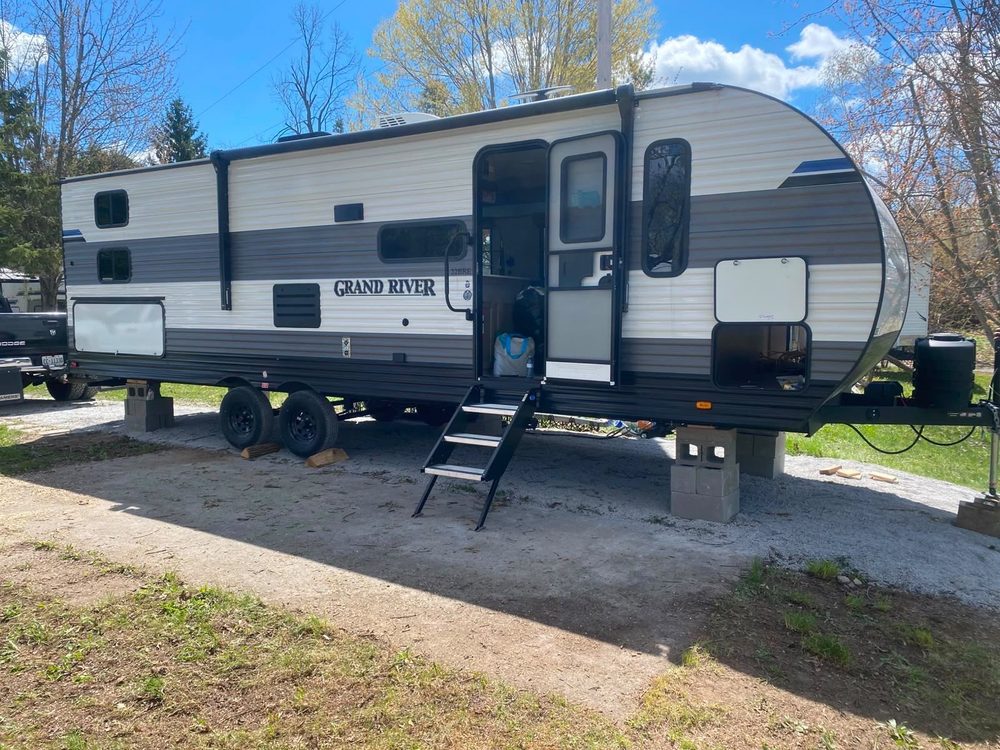
The full method, including what we use, where the blocking goes and why we do not rely on stabilizer jacks to carry weight, is on the levelling and blocking page.
Insurance, said plainly
We carry $2 million in liability, $150,000 in cargo coverage and $150,000 in non-owned trailer coverage, and we operate under Ontario CVOR 204-617-206. That is real coverage and it is what protects your unit while it is hooked to our truck.
Storing a unit on our property is not the same thing as insuring it, and we are not going to blur the two. Your RV should be covered by your own policy the same way it is when it is parked at your house or on a seasonal site, and what your policy does over the winter is a conversation with your insurer rather than with us.
What we would suggest is having that conversation before the unit goes in, not after something happens. Tell them it is going into outdoor seasonal storage, tell them roughly where and for how long, and ask what changes. Some people reduce coverage over the winter because the unit is not moving. Whether that is right for you depends on your policy and your situation, and we are movers rather than insurance advisors. Ask the people who wrote the policy.
Getting to your unit in February
You can come and get something out of it. Give us notice and we will arrange it.
What it is not is a self serve yard with a keypad and a plowed aisle to every unit. It is a working property, and in February the limiting factor is usually snow and ground conditions rather than permission. A unit that is easy to walk up to in November may be behind a bank of snow in January.
The way to avoid the problem entirely is to think about it in October. Anything you might want over the winter comes out before the unit goes in. Every year somebody realises in December that the good folding chairs and the fishing gear are in a trailer forty minutes away behind two feet of snow. It is a solvable problem, but the solution is a cardboard box in your garage.
Spring, and what happens next
The tow out is booked the same way the tow in was, with the same 24 to 48 hours of notice, and the same warning about the spring rush. Everybody wants the May long weekend.
The one variable that is genuinely out of everyone's hands is the ground. A storage lot in early spring is soft, and pulling a heavy unit across soft ground is how you get ruts, spinning duallys and a unit that has to be winched. We will move a date rather than force it, and if we tell you that the week you picked is too early, that is the reason. It costs a few days. Forcing it costs considerably more.
Before you tow away, walk around it. Check the tire pressures with a gauge and bring them to placard before it rolls, for the reason Michelin gives: an underinflated tire is the one that flat spots, and a tire that has been low all winter should not do a highway run on the way home. Look at the tires themselves for cracking. Look at the roof and the seals in daylight. Then de-winterize properly: flush the antifreeze out of the system, sanitize the fresh water side, reconnect and recharge the battery, open the propane and check for leaks, and run the fridge up on the level before you load food into it, which is what Dometic asks for.
The winter storage checklist goes through both ends of this in list form if you want something to print and tick off.
What goes wrong over a winter
Five things account for most of what we see in the spring, and none of them are sophisticated.
- The battery was left connected. It self discharged over months, went flat, then froze. Manufacturer guidance is explicit that a discharged battery freezes at ordinary winter temperatures and that the resulting case damage is not a warranty matter.
- The system was not fully drained before the antifreeze went in. The label said one thing, the diluted reality in the pipe said another, and something split. Recochem's own instruction to drain first exists precisely because of this.
- A trap or a dead leg got missed. Usually the outside shower, the toilet line or the water filter housing. The main run was done perfectly and one small branch was not.
- A tarp was used instead of a cover. Trapped damp all winter, or moved in the wind and wore through the finish, or both.
- The unit sat out of level on inadequate support. Doors that will not close, slide-outs that will not run true, and nobody quite sure when it happened.
The pattern across all five is the same: it is not the winter that does the damage, it is a step that was skipped in October and only becomes visible in April. Which is the reason this page is as long as it is.
Our 30 day guarantee
If a unit we set up shifts or moves because of our workmanship, we come back and redo the job at no charge. Weather and ground conditions are outside that, and we say so up front rather than in the fine print.
On a storage site that distinction is worth spelling out, because the ground under a stored unit goes through an entire freeze and thaw cycle while the unit sits on it. If blocking was set badly and the unit shifts because of how we set it, that is ours and we will come and fix it. If the ground itself heaves and settles over a winter, which is what ground in this part of Ontario does, that is not a workmanship failure and no honest company would pretend it was.
The practical answer to ground movement is not a longer guarantee. It is a look at the unit in the spring before it moves, which is part of the tow out anyway.
Where we pick up from
The storage property is in Beaverton, Ontario. The pickups come from a long way around it, because most people storing with us are moving a unit off a seasonal site or out of a driveway somewhere else in central Ontario and having us bring it in.
We are on the road Monday to Saturday, 7:00am to 7:00pm, with Sunday by appointment. Here is where we regularly work, and each of these goes to a page about that area.
If your town is not on that list, ask anyway. The service areas page has the full picture, and the answer is usually yes.