
The Kawartha Lakes area we cover
Kawartha RV Transport & Services moves RVs, park models, mobile homes, decks and sheds throughout the City of Kawartha Lakes, including Lindsay, Bobcaygeon, Fenelon Falls, Omemee, Kirkfield, Coboconk and Dunsford. We are a family run outfit based in Beaverton, Ontario, which sits on the western edge of Kawartha Lakes, so this is neighbourhood work for us. Local tows start at $400, we tow up to 30,000 lb on a 30 foot gooseneck, we carry Ontario CVOR 204-617-206, and there is no deposit to book a date.
Kawartha Lakes is unusual among the places we work, and it is worth understanding why before you book anything. It is a single tier municipality. There is no county council sitting above it and no separate lower tier township underneath it. One administration runs roughly 2,700 centreline kilometres of road, which the City itself puts at around 5,400 lane kilometres, across an area that includes towns, farmland, hundreds of kilometres of lake shoreline and a great many private lanes.
For a transport job that is mostly good news. One road authority means one set of load restriction dates and one permit office, rather than the four layer puzzle we have to untangle in Peterborough County. But it also means the City is stretched across an enormous network, and the practical difference between a paved municipal road in Lindsay and a seasonally graded gravel lane off a lake is much larger here than the single label "City road" suggests.
The other thing worth saying at the top: on several questions people expect a hard number for, the City of Kawartha Lakes does not publish one. We say so on this page instead of borrowing a neighbouring municipality's figure and presenting it as local. Where a number exists and is published, it is here with the source named. Where it is not, that is written out plainly too.
Highways, county roads and 2,700 kilometres of municipal road
Three provincial highway corridors run through the City and are owned and maintained by the Ministry of Transportation: Highways 7 and 7A, Highway 115 and Highway 35. Those are the routes we use for most of the distance on a Kawartha Lakes job, and they are the only roads here where a provincial oversize permit is the right permit.
Highway 35 is also the corridor most likely to be under construction when you book. The Ministry has been working on widening Highway 35 from two lanes to four or five lanes between Highway 7 and Thunder Bridge Road, inside the City. On a normal car trip that is an inconvenience. Towing a wide unit through an active construction zone with shifted lanes and reduced shoulders is a different proposition, and it is one of the reasons our arrival windows here are honest ranges rather than exact times.
Beyond the provincial highways, the network is municipal. County Road 48 runs out to Kirkfield and is the address road for Balsam Lake Provincial Park. CKL Road 8 connects to West Street in Bobcaygeon. We are deliberately not publishing road numbers for Bobcaygeon and Fenelon Falls beyond those, because we could not verify them against an official City or provincial source. You will find numbers for both towns on hobbyist road wikis. They may well be right. They are not sourced well enough for us to put our name to them.
What "City road" actually covers here
The same authority that maintains a signalised street in downtown Lindsay also maintains gravel lake roads that receive only seasonal grading and an annual gravel application, and road allowances signed as Unassumed or Unimproved. When you give us a pickup address, the useful detail is not just the number on the sign. It is whether the last two kilometres are paved, graded gravel, or something a road association looks after.
Load restrictions in Kawartha Lakes
Load restrictions, also called half loads or reduced loads, are seasonal limits a road authority puts on its roads while frost is coming out of the ground. Under the frost, a road is stiff. As it thaws from the top down, meltwater gets trapped above still frozen material and the road loses a large part of its load bearing capacity for several weeks. A loaded truck that does no harm at all in July will genuinely break a soft road in March.
For us, this is the single most common reason a spring booking date moves. During a reduced load period a route that is fine in summer may be closed to us. Sometimes there is a legal alternate and the job goes ahead with a longer drive. Sometimes there is not, and the honest answer is that the move waits until the restrictions come off.
Kawartha Lakes imposes its restrictions under By-Law 2022-190, and it applies them on roads throughout the municipality rather than on a published list of designated streets. That is a meaningful difference from how some neighbouring municipalities handle it. In Peterborough, for instance, the City publishes a list of designated streets and the restriction attaches to those. Here, the starting assumption during the season is that the restriction is on.
The 2026 season, and why there is no published end date
For 2026 the City imposed load restrictions on roads throughout the municipality effective 12:00am on Thursday March 5, 2026. It lifted them effective 12am on Saturday May 2, 2026. In 2025 the start was 12:00am on Tuesday March 4.
What matters more than either of those dates is the wording the City uses about the end of the season. Its notice says road conditions are monitored continuously and restrictions will be lifted when conditions permit. There is no scheduled end date. The May 2 lift in 2026 is a historical fact about one year, not a rule you can book against. A cold, late spring pushes it out. That is why we will not confirm a firm date for a late April move on a soft road here until the notice is actually up.
| Road authority | Published 2026 window | Per axle limit as published | Stated authority |
|---|---|---|---|
| City of Kawartha Lakes | From 12:00am March 5, 2026. Lifted 12am May 2, 2026. No scheduled end date published | Not published | By-Law 2022-190 |
| City of Peterborough | March 1 to April 30, 2026. Lifted May 1, 2026 | Not published as a weight | By-law No. 12-044 |
| Peterborough County | Typically March 1 to April 30, stated as weather dependent | 5 tonnes per axle | Highway Traffic Act section 122 |
| Township of Scugog | From March 9, 2026. Lifted May 1, 2026 | Five tonnes per axle | Traffic By-law 23-22 |
| Region of Durham | Ended 12:01am Friday May 1 | 5,000 kilograms or five tonnes per axle | Regional By-law 26-2018 |
| County of Simcoe | March 1 to April 30 | 5 tonnes per axle | Consolidated Traffic By-law No. 7098-24 |
| City of Barrie | March 1 to April 30 | Five tonnes, 5,000 kg, per axle | Traffic By-law 2020-107 |
That table is on this page for one reason. A Kawartha Lakes job very often does not stay in Kawartha Lakes. A unit going from a Bobcaygeon site to a Barrie dealership crosses three or four road authorities and each one of them sets its own dates, its own by-law and, where it publishes one at all, its own weight. Dates and figures change year to year, so confirm the current year before you count on any of them.
The axle weight number nobody publishes
This one deserves its own section because we get asked it constantly and because the honest answer is unusual.
The City of Kawartha Lakes does not publish a kilogram or tonne per axle figure for its load restrictions. It is not on the Roads and Parking page, not in the 2026 notice, not in the 2025 notice, and not in the City's own Public Works roads operations presentation. The notices name By-Law 2022-190 as the authority and stop there. The full text of that by-law is not published as a readable page.
You will hear five tonnes per axle quoted around the Kawarthas constantly, and it is genuinely the published figure for several nearby road authorities, as the table above shows. It may well be the figure in By-Law 2022-190 as well. But we could not verify it from a City of Kawartha Lakes source, so we will not print it as a Kawartha Lakes fact. If the exact number matters to your load, get it from the City's Roads Operations group directly rather than from anybody's website, including ours.
Why we bother making this distinction
Because the consequence of being wrong lands on the person who moved the load, not on the website that told them the number. A restriction breach under section 122 of the Highway Traffic Act is a real charge with real penalties, and "a transport company's website said five tonnes" is not a defence. Where a figure is published we cite it and name the source. Where it is not, we say so and point you at the office that has it.
Two Bobcaygeon streets restricted all year
Most people think of half loads as a spring problem. In Kawartha Lakes there are two stretches of road where they are not.
- Front Street West, Bobcaygeon, from Main Street to the west end.
- West Street, Bobcaygeon, from Front Street West to North Street at CKL Road 8.
The City lists both under half load restrictions on its Roads and Parking page, separately from the seasonal notices, and when it lifts the seasonal restrictions each spring it adds that roads with permanent restrictions remain in effect. If your unit is sitting on or has to come off either of those streets, that restriction is in force in July and October just as it is in March. It is worth raising at the quote stage, because it changes the route rather than the price, and a route change on a wide unit is better planned than discovered.
The reduced load exemption, and when it is worth applying
Here is something Kawartha Lakes offers that several of its neighbours do not, and that almost nobody we speak to knows about.
The City states that permits to exempt an activity from reduced load requirements may be issued where staff review and confirm there is no risk of damage to municipal infrastructure. You apply for it through the same Oversize and Overweight Load Trip Permit used for oversize moves, on the City's Permit Central portal, and there is a non refundable application fee.
Read the wording carefully, because it is doing real work. This is a discretionary decision made after staff assessment, not a fee you pay to opt out. Staff have to satisfy themselves there is no infrastructure risk on your specific route. On a paved municipal road with good structure the answer may be yes. On a soft gravel lake road in the third week of March, do not plan your season around it.
Our honest advice: it is worth an application when a move genuinely cannot wait, such as a closing date that will not move or a dealership delivery with a hard deadline. It is not worth building a spring schedule on. Most years the simpler answer for a seasonal move is to book for after the restrictions come off, which is exactly why our April and May calendar fills first.
Oversize and overweight permits through Permit Central
The City of Kawartha Lakes issues its own oversize and overweight permits, and since June 3, 2024 it has issued them exclusively through an online portal called Permit Central. There are two products: an Oversize and Overweight Load Annual Permit, and an Oversize and Overweight Load Trip Permit, the latter covering both single trips and reduced load exemptions.
We do not publish a fee for either, because the City does not publish one. The Roads and Parking page refers to a non refundable application fee without naming an amount, and the amount sits behind the portal. Anyone quoting you a Kawartha Lakes permit fee off a website has got it from somewhere other than the City.
For a standard travel trailer or fifth wheel none of this applies. That is a normal legal load behind our truck and needs no permit at all. Permits enter the picture when a load exceeds the dimensions the Highway Traffic Act allows, which in practice means park models and wide mobile home sections. We do not run oversize permits ourselves. When a job needs them we bring in a contractor who specialises in that work, and they handle the permits, the routing and the escorts.
Whose road are you on
The most useful thing you can tell us at the quote stage, after the size of the unit, is whose road each end of the job sits on. It decides which permit office is involved, whose load restriction dates apply, and sometimes whether the job is possible at all in the month you want it.
| Where the load travels | Who has authority | How permits are handled |
|---|---|---|
| Highways 7 and 7A, 115, 35 | Ministry of Transportation of Ontario | Provincial oversize and overweight permit. Valid for King's Highways only |
| City of Kawartha Lakes roads | City of Kawartha Lakes | Permit Central portal. Annual permit or trip permit, exclusively online since June 3, 2024 |
| Reduced load exemption on a City road | City of Kawartha Lakes | Oversize and Overweight Load Trip Permit. Discretionary, non refundable fee |
| Peterborough County roads, heading east | Peterborough County | Separate County oversize and overweight permit |
| City of Peterborough streets | City of Peterborough | Separate City permit under Highway Traffic Act section 110 and City By-Law No. 93-25 |
| Private or unassumed lane | The owner or the road association | No permit. Permission, and often a conversation about spring weight limits |
Ontario is explicit that a provincial permit does not cover municipal roads. Its own wording is that oversize and overweight permits are valid for Ontario's King's Highways only, and that if you want to drive on municipal roads you may be required to get additional permits or permission directly from that municipality. On a park model move that comes up Highway 35 and then turns onto a City road to reach a lake site, that is two permit authorities on one trip.
Park models and mobile homes in Kawartha Lakes
We move both, and they are a different job from an RV. Park models and mobile homes are heavier, wider and far less forgiving, and the questions that decide the job are as much about planning and building as about towing. Mobile home and park model moving is its own service with its own page.
On the permit side, here is where Kawartha Lakes sits. The City publishes nothing specific to park models, mobile homes or manufactured homes. Its building permits page lists guides and portals for houses, renovations, decks and garages or sheds, and directs project types that are not listed to the building department. So we do not state a City rule, because there is not one published to state.
What does exist is provincial guidance, and it belongs to Ontario rather than to the City. Ontario's own material on tiny homes says that any structure on wheels can be considered a building if it is located on the same spot for a period of time, especially if it is connected to services such as water, sewage and electricity, has exterior stairs to get in and out, and is fixed or anchored to the site, and that in that case you may need a building permit and the structure must meet certain Building Code requirements. It then adds the part people forget: this generally does not apply to recreational vehicles and campers that are towed, and in short, if you can drive it or it needs a licence plate, it is likely not a building.
That is a test, not a rule
Notice that the provincial guidance turns on permanence, servicing, anchoring and whether the thing is plated. It is deliberately conditional. It does not say a park model always needs a permit, and it does not say one never does. Anyone who flattens it into a simple yes or no is guessing. The only reliable answer for a specific unit on a specific site in Kawartha Lakes comes from the City's building department, and it is a much cheaper phone call before you buy than after.
The City's general position on timing is clear enough though: no work shall commence until a permit has been issued. If your site needs one, that sequencing matters to us as well, because it decides whether we are delivering onto a prepared pad or parking a unit somewhere while paperwork catches up.
Sheds, decks and the two numbers people get wrong
Seasonal sites almost never involve only the trailer. There is a deck, usually a shed, sometimes an add on room, and when a site gets rebuilt all of it moves. So the thresholds matter to us as much as to you.
| Structure | What the City publishes | Practical read |
|---|---|---|
| Shed up to 15 m2, about 161 sq ft | No permit required, provided it is not more than one storey, is not attached to a building or any other structure, is used only for storage ancillary to a principal building on the lot, and has no plumbing | All four conditions, not any one of them |
| Accessory building over 10 m2, about 107 sq ft | Requires a building permit if it does not meet the City's definition of a shed | This is the test that catches bunkies, workshops and anything with a sink |
| Deck more than 600 mm, about 24 inches, above finished grade | Building permit required | Measured finished grade to finished deck surface |
| Deck 600 mm or less and not supporting a roof | Published as exempt in the City's deck construction guide | Confirm with the building department. See the caution below |
| Any deck | Must comply with the Ontario Building Code and the Zoning By-Law | Zoning applies even where a permit does not |
| Park model, mobile home, manufactured home | Nothing published by the City | Ask the building department. Provincial guidance is conditional |
The two shed numbers, 10 square metres and 15 square metres, look like a contradiction and are reported as one constantly. They are not. They are two different tests in the same City document. Over 10 square metres triggers a permit unless the structure meets the four part shed definition, and if it does meet that definition the exemption runs all the way to 15 square metres. Read them together or the rule reads as broken.
On the deck exemption, one honest caution. The 600 mm figure comes from a City deck construction guide whose filename carries a 2004 date, and the City also publishes a newer deck guide that states no threshold at all. The 600 mm rule matches the standard Ontario Building Code exemption so it is very likely still current, but it is not confirmed by a document carrying a recent date. Confirm it with the building department before you build to it.
Centennial Trailer Park and what municipal park rules look like
Kawartha Lakes owns and operates its own trailer park, Centennial Trailer Park, and it publishes the park rules. We are flagging it here not because most of our customers are in it, but because it is a rare public example of exactly the kind of park rule set that decides what we can and cannot do on a seasonal site. Private parks across the Kawarthas run similar rules and mostly do not publish them.
- Age limits on incoming units. New travel trailers entering the park, whether a new customer or a trailer swap out, must be less than 10 years old. New cottager style models, again new customer or swap out, must be less than 17 years old. That rule alone decides whether a unit can be delivered before anybody talks about access.
- A published deck cap. One deck, maximum 40 feet in length, not to exceed the length of the trailer including the tongue.
- A published shed cap. One storage shed, not to exceed 100 square feet, with a height not exceeding 8 feet.
- No permit level construction at all. Any construction requiring a permit under the Ontario Building Code will not be allowed. That is stricter than the municipal building rules, not a restatement of them.
- Written approval to move anything. Registered residents must request in writing to the park supervisor for consideration and approval before movement, alteration, improvement, construction, or an addition such as a deck or exterior shed.
That last one is the one that catches people, and it is the reason we ask early whether your site is in a park and whether the office knows we are coming. We have had jobs where the truck was booked, the unit was ready and the only missing piece was a written approval nobody had asked for. If you are in a park of any kind, municipal or private, get the approval in writing before you book us, not on the morning.
Locks 32 to 36 and the Trent-Severn through town
Five Trent-Severn Waterway lockstations sit within the City of Kawartha Lakes, and they shape the road network more than people expect. Water crossings are where a road network narrows, and a narrow crossing is where a wide unit gets interesting.
- Lock 32, Bobcaygeon, at 15 Bolton Street. The City notes that Bobcaygeon is the first lock ever constructed along the Trent-Severn Waterway. Parks Canada notes that a metal truss swing bridge provides access to the island created by the canal cut.
- Lock 33, Lindsay, at 3 King Street, described by the City as an essential link between the communities of Kawartha Lakes and located just minutes from downtown Lindsay.
- Lock 34, Fenelon Falls, at 3 Colborne Street, in what the City calls the Jewel of the Kawarthas.
- Lock 35, Rosedale, situated between Balsam and Cameron Lakes.
- Lock 36, Kirkfield, one of the two highest lift locks along the Trent-Severn Waterway.
In practice the locks matter to us for traffic and geometry rather than for rules. Bobcaygeon and Fenelon Falls in July are busy, tight and full of pedestrians, and a swing bridge is a swing bridge. We would rather move a wide unit through either town early on a weekday than at two in the afternoon on a long weekend, and we will say so when we quote.
Bridges, swing bridges and one number not to misread
Two honest statements about bridges here, and one warning.
First, the City of Kawartha Lakes publishes no list of load posted bridges that we could find. Its construction and closures page carries no bridge weight limits and defers to Municipal 511 for road closures, and its roads operations presentation contains no bridge or culvert load data. That does not mean no posted bridge exists anywhere in 2,700 kilometres of road. It means we will not publish a bridge weight claim we cannot source, and that on an unusually heavy move the route gets checked rather than assumed.
Second, none of the Parks Canada lockstation pages for Bobcaygeon, Lindsay or Fenelon Falls publishes a vehicle weight limit, height limit, road restriction or seasonal road closure.
Warning: the Lindsay 3.7 metre figure is not a road clearance
The Parks Canada page for Lock 33 in Lindsay mentions a fixed bridge with a 3.7 metre, 12 foot, clearance. That is a marine navigation clearance. It is the space under the bridge for boats passing beneath it on the water. It is not a height limit for a vehicle driving across the bridge, and it would be very easy, and completely wrong, to repeat it as a towing restriction. We have seen the same mistake made with Trent-Severn clearance figures further east. If you are working out whether a tall unit fits somewhere, use posted road signage and the Highway Traffic Act height limits, not marine charts.
Balsam Lake, Emily and where you cannot camp
Provincial park work is a real part of our season, and Kawartha Lakes has both the largest nearby option and one park that people plan around by mistake.
| Park | Camping | As published by Ontario Parks | Trailer length limit |
|---|---|---|---|
| Balsam Lake, Kirkfield | Yes | 515 campsites total, 213 electrical, 62 RV pull through, 1 trailer dump and fill station | Not published |
| Emily, Omemee | Yes | 303 campsites total, 170 electrical, 9 RV pull through, 1 trailer dump and fill station | Not published |
| Indian Point | No. Camping is prohibited | No visitor facilities. Water access from Balsam Lake | Not applicable |
| Kawartha Highlands | Backcountry only | 121 backcountry sites. Car camping, RV pull through and trailer dump stations all listed as not available | Not applicable |
Balsam Lake, at 2238 County Road 48 in Kirkfield, is the biggest camping option in the municipality and Ontario Parks describes it as having a range of campsites with and without electricity for tents and RVs. It also has six radio free, pet free walk in sites, which are not relevant to a trailer but are worth knowing about if you are booking around noise.
Emily, at 797 Emily Park Road in Omemee, publishes the single most useful sentence about large units of any park in this part of Ontario: its Hilltop, Hill and Circle campgrounds offer many large, private and grassy sites that can accommodate various types of equipment ranging from tents to large trailers, with many sites offering electrical hookups. The Cedars campground is private tent only sites and non electrical, so it is not somewhere to plan a trailer delivery.
Neither Balsam Lake nor Emily publishes a maximum trailer length, on the camping page or the facilities page. We will not invent one. What we will say is that the Ontario Parks reservation system generally lets you filter sites by trailer size, and that if you are close to the edge of what a site will take, the reservation system is the place to check, not a transport company's website.
Indian Point is the one people get wrong. It is water access from Balsam Lake, there are no visitor facilities, and camping is prohibited. Do not build a trip around it. Kawartha Highlands is backcountry canoe camping, administered from Bancroft, and sits outside the City entirely.
Seasonal roads and the November to May window
Kawartha Lakes treats seasonal roads as an operational category, and the shape of it tells you a lot about what a winter or early spring delivery to a lake road actually involves.
The City runs a defined winter window from November 1 to May 1 for services on seasonal roads, and asks residents on private seasonal roads receiving winter collection to make sure the road is plowed and sanded as required. On its own network, winter plowing is tiered: roads are plowed based on traffic volume, with the highest volume roads getting the highest level of service. And the City is direct about what a gravel road looks like in winter, describing snow pack, hard packed snow on a roadway, as the condition that can be expected on gravel roads.
- Snow pack is not a defect, it is the standard. On a gravel lake road in February, hard packed snow is what the City expects to be there. That is fine for a car and a real consideration for a loaded gooseneck on a grade.
- Plowing priority is not about your road, it is about volume. A quiet lake road is not neglected, it is simply further down a published order. After a storm, that order decides when we can get in.
- Some roads get seasonal grading only. The City's roads operations material identifies seasonal spring, summer or fall grading service and annual gravel application for parts of the network. A road graded in spring behaves very differently under a loaded axle in the first week after grading.
- On a private seasonal road, winter access is the residents' job. If your road is plowed by an association or by residents, that is who decides whether we can reach you in January, not the City.
None of that makes winter work impossible. We do it. It makes winter work worth a conversation first, and it is why we ask about the last two kilometres rather than the postal code.
Unassumed, unimproved and private roads
A large share of the lake sites we serve here are not reached by a road the City maintains at all. The City is upfront about this: publicly accessible road allowances owned by the municipality may be signed as Unassumed or Unimproved, and it maintains a policy, CP2017-010, setting out the minimum standards an unassumed or private road must meet before the municipality will consider assuming it.
What that means practically is that "it is a City road allowance" and "the City looks after it" are two different statements, and the sign at the end of the road is often the only thing that tells you which one applies. On an unassumed or private lane, nobody at the City is deciding whether we can drive on it in April. The road association or the owner is.
- Ask your road association about spring weight limits. Many private lanes around these lakes run their own spring restrictions, sometimes stricter than the City's, sometimes an outright closure. That conversation is much better had before we load than at the top of your lane.
- Overhead branches are the most common surprise. A lane that has been fine for a pickup for fifteen years can be too tight for a 13 foot 6 unit, because nothing has been trimmed in fifteen years.
- Turning space at the far end decides the price. If we cannot turn, we are backing a loaded gooseneck out, and that is slow work.
- Soft ground is our call as well as yours. A one ton dually and a loaded trailer will leave marks on a saturated gravel lane, and those marks become the association's problem and then yours. Waiting three weeks is usually cheaper than the repairs.
What the ground is like around these lakes
Where a unit ends up sitting matters more than how it got there, because the ground is what holds it for the next several years.
- Shallow soil over limestone. Common through this whole area. Solid to sit on, but you cannot drive a pin or dig a footing where the rock is close to surface, and water runs across the top of it rather than draining down.
- Sand near the shoreline. Drains beautifully, holds nothing. Blocking wants a wider footprint here or it works its way down over a season.
- Fill on older seasonal sites. Decades of added material, often uncompacted, often with organic matter in it. This is where almost every settling complaint we get comes from, and it is why we spend the time on blocking rather than dropping the unit and leaving.
- Freshly graded gravel. A road or pad graded and re gravelled in spring behaves differently under a loaded axle than the same surface does in August, before it has been compacted by a season of traffic.
What we do across Kawartha Lakes
The same six services we run everywhere, with the same trucks and the same guarantee.
- RV and trailer transport. Travel trailers, fifth wheels, toy haulers and campers, moved between homes, dealerships, storage and seasonal sites. Local tows start at $400. We tow up to 30,000 lb on a 30 foot gooseneck.
- Mobile home and park model moving. Heavier, wider and less forgiving than an RV, and the one category where permits and building departments genuinely enter the picture.
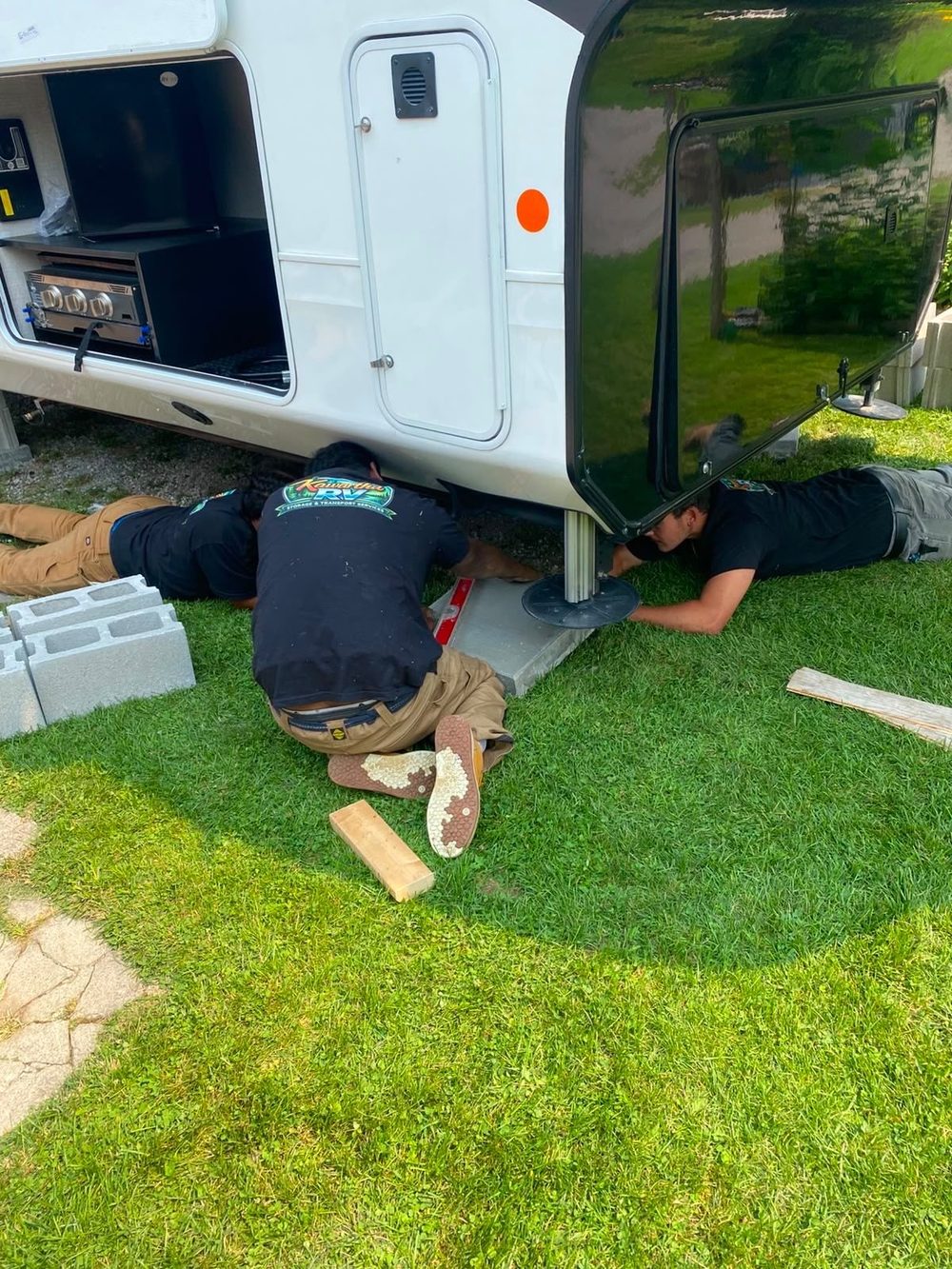
- Levelling and blocking. Setting a unit level and keeping it there on limestone, sand or fill. On a lake site this is most of the job.
- Deck and shed moving. Seasonal sites get rebuilt as a package. We move the deck and the shed as well as the unit.
- RV storage. Outdoor storage on a fenced property from $85 to $125 a month depending on size, with towing in and out.
- RV rentals. Our own units, delivered and set up on your site.
Levelling and blocking on lake ground
A trailer that is not level does not just feel wrong. Doors bind, slides stop sealing properly, absorption fridges lose efficiency because they need to be level to circulate, and the frame carries stress it was not designed to carry. On a seasonal site where a unit sits for years rather than nights, the ground underneath is doing the work, and around these lakes the ground changes from one site to the next.
We block units with the load spread properly rather than stacked on the smallest footprint that will fit, we check level along the frame rather than off a countertop, and we come back and redo the job at no charge if a unit we set up shifts because of our workmanship. Weather and ground conditions are outside that, and we tell you so up front rather than after the fact. The levelling and blocking page goes through the method in detail.
Storage when the road or the site is not ready
A good share of the storage calls we take from Kawartha Lakes are timing problems rather than storage problems. A build runs late. A sale closes in March. A park has not opened yet. Or the load restrictions are on and there is no realistic way onto the site for another seven weeks.
Outdoor storage on our fenced property runs $85 to $125 a month depending on the size of the unit, and we can tow the unit in and back out again in spring, so it is one call rather than three. If you are weighing storage against leaving a unit on a lake site over winter, our Ontario winter storage checklist goes through what actually causes damage over a Kawartha winter, and the storage page covers the yard itself.
What a Kawartha Lakes move costs
Local tows start at $400. A longer or more involved move is quoted on the job, quotes are free, and there is no deposit to book. The things that actually move the number here are not always the obvious ones.
- Access, not distance. A short move into a tight lane off a lake road can cost more than a longer straight run down Highway 35, because the time is in the manoeuvring, not the driving.
- Whether the unit is ready. Jacks that will not retract, a flat trailer tire, blocking still under a unit nobody removed, a site that has to be cleared first. Every one of those adds time.
- Load restriction season. If a route is restricted and the legal alternate is longer, the job costs more, or it waits. On a City road during the season, waiting is usually the sensible answer.
- Whether a permit is involved. Park models and mobile homes carry permit costs on top of the tow, and the permit fee goes to the City or the province, not to us.
- Levelling and blocking at the far end. Setting a unit level on prepared ground is quick. Setting it level on a site that needs work first is not.
- Park approval. Not a cost, but a schedule risk. If the park needs written approval and it is not in hand, the day gets rebooked.
Our Ontario RV transport cost guide breaks the pricing down properly across the province.
When to book
April, May, September and October are the weeks everything moves around here, and they fill first. Spring bookings also have to work around the load restriction season, which in Kawartha Lakes starts in early March and has no published end date, so the back half of it is genuinely uncertain until the City lifts it. Midsummer and midwinter usually have more room in them.
There is no deposit to book, so holding a date early costs you nothing and costs us nothing to move if your plans change. Our hours are Monday to Saturday, 7:00am to 7:00pm. Sunday closed, by appointment only.
How to get the quote right the first time
Send four things and we can nearly always give you a firm number without a site visit.
- What it is. Type and length of the unit, and whether it is a travel trailer, fifth wheel, park model or mobile home. A make and model is better still.
- Where it is now. The pickup address, and whose road it is on if you know: City road, provincial highway, or a private or unassumed lane.
- Where it is going. The drop address, whether the site is ready or needs levelling and blocking, and whether it is inside a park with its own rules.
- Photos. One of the unit, one of the way in including the worst corner and any overhead lines or branches, and one of where it has to end up. Those three photos answer more questions than any description does.
Text or email works. The contact page has every way to reach us, and our guide to preparing an RV for transport covers what to do before we arrive.
Our 30 day guarantee
If a unit we set up shifts or moves because of our workmanship, we come back and redo the job at no charge. Weather and ground conditions are outside that, and we say so up front. That is the whole of it. It is a workmanship guarantee, not a weather guarantee, and we would rather be clear about the limit than write something broad we cannot honour when a lake site floods in April.
We are fully insured and we carry Ontario CVOR 204-617-206. If a park office, a dealership or a road association wants proof of insurance before we come on site, ask and we will send it ahead. More about how we work.
Nearby areas we also cover
Beaverton sits on the western edge of Kawartha Lakes, so most of our territory is within an easy run of a job here.
Beyond those we also work through Northumberland, the Quinte area, Collingwood and Wasaga Beach, and we take long distance work across Ontario and into the rest of Canada. If your pickup is on a lake here and your drop is somewhere else entirely, that is a normal job for us.