
The Barrie area we cover
Kawartha RV Transport & Services moves RVs, park models, mobile homes, decks and sheds throughout the City of Barrie and the surrounding County of Simcoe, from the Kempenfelt Bay waterfront out to the south end industrial roads and north toward Oro-Medonte and Orillia. We are a family run outfit based in Beaverton, Ontario, on the east shore of Lake Simcoe, which puts Barrie at the other end of the same lake. Local tows start at $400, we tow up to 30,000 lb on a 30 foot gooseneck, we carry Ontario CVOR 204-617-206, and there is no deposit to book a date.
Barrie is an unusual place to haul into, and the reason has nothing to do with the roads themselves. It is a single tier city sitting inside, but not part of, the County of Simcoe. Every direction you leave it in, you cross a jurisdictional line within a few minutes. The city runs one set of seasonal weight rules on its own streets. The County runs a different set, built on the opposite logic, on the roads that surround the city on every side. Both use the same window and the same weight limit, and they still do not mean the same thing.
That is why this page reads the way it does. Most RV transport pages for a city like Barrie would say "we serve Barrie and area" and give you a phone number. What actually decides whether your unit moves on the date you booked is narrower: which body owns the last stretch of road in front of your lot, what that body allows on it in the month you picked, whether your unit is wide enough to need a permit, and how many of those authorities the route touches between the two ends. We have gone through the City of Barrie's by-laws and permit pages, the County of Simcoe's traffic by-law and reduced load documents, the province's seasonal load listings and Ontario Parks' own park pages, and written down what they actually say. That includes, deliberately, the places where they contradict each other and the places where they say nothing at all.
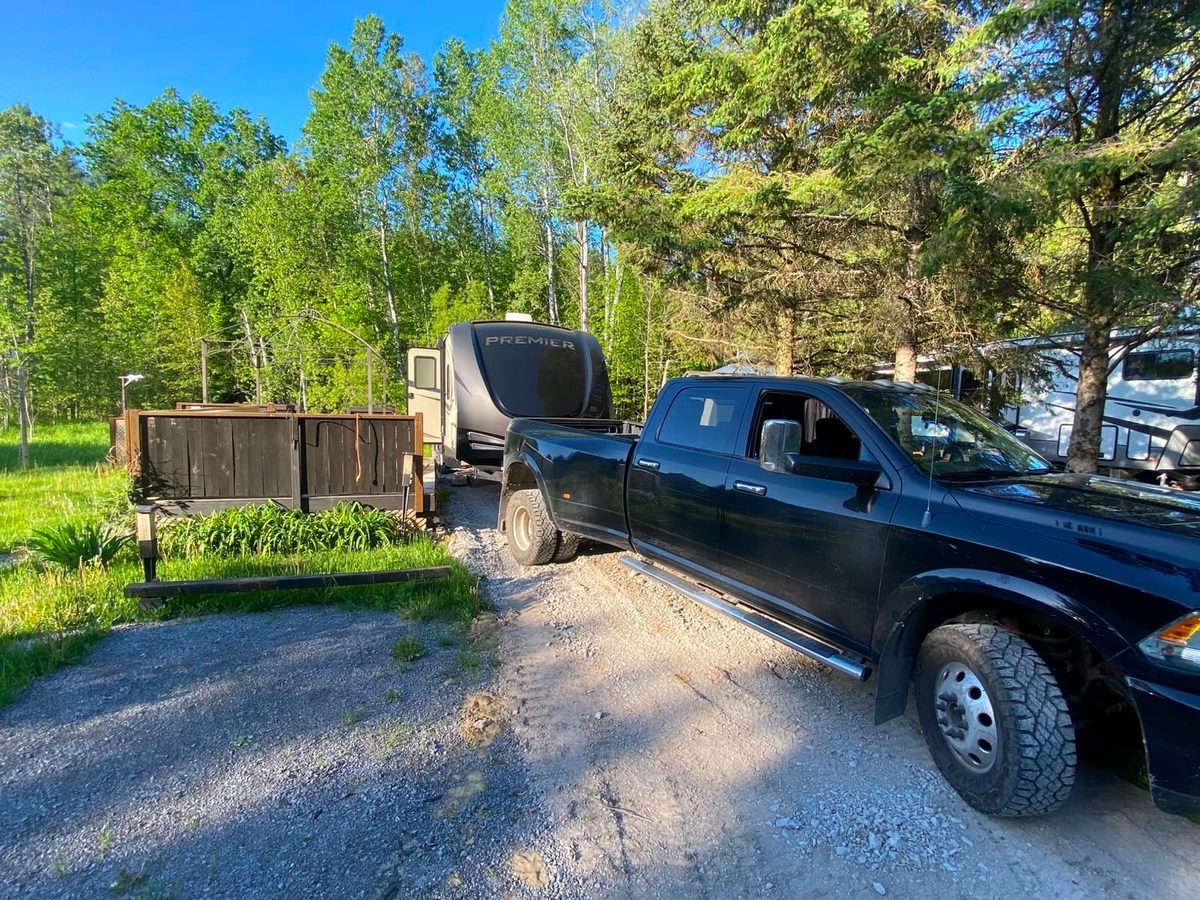
The areas we run into regularly in and around Barrie: the Allandale and south end neighbourhoods, the Painswick and Holly areas, Ardagh, Sunnidale, the Kempenfelt Bay waterfront, Little Lake, Georgian Drive and the north end, plus the surrounding County communities of Innisfil, Stroud, Lefroy, Alcona, Oro-Medonte, Shanty Bay, Hawkestone, Springwater, Minesing, Midhurst, Angus and Thornton. If your address is reachable by a truck with a loaded gooseneck behind it, we work there.
Barrie is not in the County of Simcoe
Start here, because almost every other fact on this page depends on it, and because a surprising number of people who have lived in Barrie their whole lives have never had a reason to think about it.
The County of Simcoe puts it in its own words on its about page: the cities of Barrie and Orillia, although separate politically and administratively from the County, are geographically and economically part of the County. The same page states that the Corporation of the County of Simcoe is comprised of sixteen towns and townships. Barrie is not one of them. It is a separated city, which is the formal Ontario term for a municipality that sits geographically inside a county but governs itself as a single tier.
Look at a map and Barrie is a hole in the middle of the County. Drive out of the city on any road and you land in County territory: Innisfil to the south, Springwater to the west and north west, Oro-Medonte to the north and east. The city limit is not a formality. It is the line where one road authority's rules stop and another's begin.
Why a mover cares
Because the paperwork follows the road authority, not the destination. A move from a Barrie driveway to a seasonal site twenty minutes outside the city is one trip in your head and two regulatory regimes in ours. We check both before quoting, which is why we ask for the exact address at each end rather than the town.
The ten Barrie roads with load restrictions
The City of Barrie explains its own reasoning clearly. The City applies load restrictions to various roads within the municipality, during spring thaw annually, to protect the road while the frost is coming out of the ground. That is the City's own description on its oversize load permit page, and it applies from March 1 to April 30.
The rule attached to it is a weight per axle rule rather than a total weight rule. The permit page states that during that period no commercial motor vehicle weighing over five tonnes, which is 5,000 kilograms, per axle is permitted to operate on identified roads. The City's Load Restricted Roads document carries the same sentence in the singular, referring to the identified street. The wording differs slightly between the two pages, the substance does not.
Here is the list the City publishes, with the limits at the boundaries it names:
| Road | From | To |
|---|---|---|
| Miller Drive | Sproule Drive | North limit |
| Edgehill Drive | Ferndale Drive | Miller Drive |
| Salem Road | County Road 27 | Huronia Road |
| McKay Road | County Road 27 | Huronia Road |
| Veterans Drive | Salem Road | South city limit |
| Huronia Road | Salem Road | South limit |
| Lockhart Road | Huronia Road | 20th Sideroad |
| Mapleview Drive East | Prince William Way | 20th Sideroad |
| St. Paul's Crescent | Yonge Street | Yonge Street |
| 20th Sideroad | Big Bay Point Road | Lockhart Road |
Ten roads. That is the whole list. Everything not named on it is unrestricted as far as the City's spring thaw programme is concerned, which is a materially different position from most of the municipalities we work in.
Why that list is concentrated in the south end
Read the endpoints rather than the road names and a pattern falls out of the list on its own. Seven of the ten entries name County Road 27, Huronia Road, Salem Road, 20th Sideroad or the south city limit as one of their two boundaries. That is not an interpretation of the City's intent, it is arithmetic on the City's own published list, and we are stating it as arithmetic rather than as a claim about why Barrie chose those roads.
What it means for you is practical. If your address is in the Painswick, Holly or south Allandale area, or on the edge of the city toward Innisfil, the odds that a spring move touches a restricted road are meaningfully higher than they are in the north end or downtown. Salem Road, McKay Road, Veterans Drive, Huronia Road, Lockhart Road, Mapleview Drive East and 20th Sideroad between them cover a lot of the south end grid.
The north end is not untouched. Miller Drive and Edgehill Drive are both on the list, and St. Paul's Crescent runs off Yonge Street. But the weight of the list sits south, and if you are booking a March or April move from that part of the city it is worth telling us the street early rather than late.
The rule we work to
Before we quote a Barrie job in the spring we look up the actual street, not the city. If the address sits on one of the ten roads above, or if the route to it has to use one, the conversation changes from scheduling to routing and permitting, and that conversation needs to happen before the date rather than the morning of.
What five tonnes per axle actually measures
People hear "five tonnes per axle" and picture a scale under the trailer. That is not what is being measured, and the distinction decides whether your move is routine or a paperwork job.
The limit applies to the axles of the vehicle on the road, which in our case means the truck and the loaded trailer together, axle by axle. Five tonnes is 5,000 kilograms, or roughly 11,000 lb, on each individual axle. An empty one ton dually is comfortably under that on every axle. The same dually with a heavy fifth wheel or a park model on the gooseneck behind it is a different calculation entirely, because a large share of the load transfers onto the truck's rear axle and onto the trailer's own axles. That is the point at which a perfectly legal truck on a normal road becomes an over limit vehicle on a restricted one.
Two consequences follow, and they are the two that come up most often on the phone. First, the same unit can be movable on one route and not on another on the same day, because the constraint is the road rather than the trailer. Second, a smaller unit is often movable on a restricted road when a larger one is not, which is why we ask for the make, model and loaded weight rather than accepting "a travel trailer" when we quote a Barrie address in March.
It is also why we would rather do the paperwork than dodge the road. A five tonne per axle posting is a threshold, not a prohibition. The legal way over it is a permit or exemption from whoever owns the road. What we will not do is put a loaded gooseneck onto a posted road and hope nobody is looking, because in Ontario the liability for road damage sits with the carrier, and because the roads on that list are on it for a reason the City has stated in writing.
The County of Simcoe does it the opposite way
Cross the city limit and the whole logic inverts.
The County of Simcoe's reduced load restrictions document sets the period as March 1 to April 30 and the limit at 5,000 kilograms per axle, the same window and the same weight Barrie uses. What is different is the structure. The County does not publish a list of restricted roads. It imposes the reduced load restriction across its road system and then publishes a schedule of the segments that are exempt from it.
In the current consolidated traffic by-law, section 5.9.3 sets the 5,000 kilogram figure. Section 5.9.4 sets out a 7,500 kilogram exemption category. Section 5.9.8 deals with carrying capacity, using a 1,000 kilogram figure and a 5 kilogram per millimetre of tire width calculation. Section 5.9.9 exempts specific classes of vehicle outright: ambulance, police, fire, waste removal, public utility emergency vehicles and milk transport. Schedule 15 then lists the named County road segments that are exempt from the restriction, and it lists them for the full year, January 1 to December 31.
| Question | Inside Barrie | On County of Simcoe road |
|---|---|---|
| What is published? | A list of restricted roads | A list of exempt segments |
| Default for an unlisted road | Not restricted | Restricted |
| Period | March 1 to April 30 | March 1 to April 30 |
| Limit | 5,000 kg per axle | 5,000 kg per axle |
| Question to ask | Is my road on the list? | Is my road off the list? |
Same window, same weight, opposite default. If you take one thing from this page, take that table.
Two systems, one trip
Here is why the inversion matters rather than being a piece of trivia.
Barrie is surrounded. There is no direction you can leave the city in without entering County territory or getting onto a provincial highway. So a spring move that starts at a Barrie address and finishes at a seasonal site in Innisfil, Oro-Medonte or Springwater does not stay inside one system. It starts under a positive list, where you check whether your street is named, and it finishes under a blanket restriction, where you check whether your street is exempted. Two different questions, asked of two different documents, about one twenty five minute drive.
The failure mode is predictable and we see it every spring. Somebody checks Barrie's list, does not find their street on it, concludes correctly that the Barrie end is fine, and assumes that settles the matter. It does not settle the County end, because on County road the absence of your street from a list means the opposite of what it means inside the city.
This is Barrie's version of a problem we run into all over this part of Ontario, where a short trip crosses more regulatory boundaries than it does municipal ones. On the Georgina and Sutton page the same issue shows up as two different restriction calendars running at once. Around Barrie it is one calendar and two opposite structures.
Which County by-law is the current one
We are publishing this because the County's own documents do not agree with each other, and because the sensible thing for a reader to do about that is know it exists rather than get caught by it.
The County's standing reduced load restrictions document, the one linked above and marked as updated April 2023, cites the authority for the restriction as Simcoe County Consolidated Traffic By-Law #6609. The current consolidated traffic by-law is 7098-24, and it is the one that contains the section numbers set out above. So the County has a live public document pointing at a by-law number that has since been superseded.
We are not going to resolve that for you, because it is not ours to resolve. What we will say is which document we worked from: the sections we quote are from 7098-24, the current consolidated by-law, and the March 1 to April 30 period and the 5,000 kilogram figure appear in both. If you need to cite chapter and verse for an insurer, a lawyer or a site owner, phone the County and ask them to confirm the by-law number in force on the date of your move. That is a five minute call and it is worth making.
The one posted bridge in the County schedule
Bridge postings are the thing people worry about most and the thing that is hardest to find published anywhere. Around Barrie we can tell you exactly one thing with a source behind it.
Schedule 17 of the County's consolidated traffic by-law deals with bridge weight limits, and it contains a single entry: structure 000301, McKinnon at Concession 4 in Sunnidale, five kilometres north of County Road 90, posted at 5 tonnes.
One entry. That is the whole schedule. We want to be careful about what that does and does not tell you. It tells you the County has one posted structure in that schedule. It does not tell you there are no other load posted bridges anywhere in the area, because city structures, township structures and provincial structures are not in the County's schedule at all. If your route crosses a smaller bridge on a township road, the posting on the sign at the bridge is the authority, and the sign wins over anything published anywhere.
What we do about bridges
On any heavy move we route around unknown structures rather than gambling on them, and where a posting exists we treat the sign as final. There is no version of this job where guessing about a bridge is the cheap option.
The roads we deliberately do not write about
A short section, and an honest one.
Immediately outside Barrie you can be on County of Simcoe road, on a provincial highway, or on a road belonging to one of the County's member municipalities: the Town of Innisfil, the Township of Springwater, the Township of Oro-Medonte, the Township of Essa and others. County rules apply to County roads. They do not automatically apply to a township's own local roads, and each of those municipalities can pass its own reduced load by-law.
We have not read those by-laws, so we are not going to summarise them. Publishing a confident paragraph about Innisfil's or Oro-Medonte's local road restrictions on the strength of the County document would be exactly the kind of plausible sounding guess this page exists to avoid. What we do instead is check the specific road for the specific job, with the municipality that owns it, before we commit to a date.
If your destination is a local road in one of those townships and your move is in March or April, tell us early. The answer is usually easy to get. It is just not one we can get in advance for every road in the County and print here.
Ontario 511, and what it will not tell you
Ontario runs a public seasonal load restriction listing at Ontario 511, and it is a genuinely useful page as long as you understand what is on it.
It publishes provincial designations. Southern Ontario's designated periods cover March and April, with Northern Ontario running March, April and May, and the dividing line described as running along the Severn River to Regional Road 169 and continuing east toward Arnprior. Barrie sits south of that line. The listing also carries three numbered schedules with their own end dates, running to April 30, May 31 and June 30 respectively.
Here is the part worth knowing. At the time we wrote this page, all three of those schedules read "None at this time", and the raw forest products freeze up period was recorded as no longer in effect for all areas, with the listing last updated in June 2026. In other words the provincial listing was empty.
An empty provincial listing does not mean the roads around Barrie are unrestricted. Ontario 511 lists provincial designations. The City of Barrie's ten road list and the County of Simcoe's blanket restriction are municipal, and they do not appear there at all. We mention it because we have had the conversation more than once: somebody checks 511, sees nothing, and reasonably concludes there is nothing to check. The municipal restrictions live somewhere else.
Section 122 of the Highway Traffic Act inside Barrie
Where does a city get the power to weigh your axles in the first place. Barrie answers that directly in its Traffic By-law 2020-107, at section 6.10, which provides that where appropriate signs have been erected and are on display, section 122 of the Highway Traffic Act, R.S.O. 1990, c. H8 shall apply to highways within the City of Barrie.
Two things follow from the way that is drafted. The first is that the provincial reduced load provision is the underlying authority, and the municipal by-law is the mechanism that switches it on locally. The second is the condition attached to it: where appropriate signs have been erected and are on display. Signage is written into the operative clause.
We looked for a standalone City of Barrie reduced load by-law with its own number and did not find one. The authority we can source is section 6.10 of the Traffic By-law, plus the City's published list of ten roads. If a City of Barrie reduced load by-law exists under a separate number, we could not locate it, and we would rather tell you that than invent a citation.
For completeness, and because people ask: we also looked at whether Barrie holds any special municipal power over long vehicle combinations. The provincial statute text was not retrievable from the province's own e-Laws site when we checked, so we could not verify it. Rather than publish something we could not read for ourselves, we have left it out entirely. If long combination vehicles are relevant to your move, that question belongs with the Ministry of Transportation.
The City of Barrie oversize load permit
Barrie issues its own oversize load permit, and unlike a lot of municipalities in this part of Ontario it publishes the conditions in enough detail to be useful before you apply. This is genuinely good practice on the City's part and it makes our job easier.
The short version of who needs one: in Ontario a load becomes oversize when it exceeds the ordinary legal envelope, and for most RV work the number that trips it is width. A unit over 2.6 metres wide is oversize. Most travel trailers are under that. Most park models and mobile homes are not. Height and length matter too, and on some units they bind before width does.
We treat the permit as part of the job rather than as your homework. We work out whether the unit needs one at quote time, apply if it does, and build the route around the conditions attached to it. What follows is what those conditions actually are, because a permit is not a blanket permission and the restrictions inside it are the part that changes the schedule.
The dimensions the Barrie permit covers
The City publishes maximum dimensions for the permit on its oversize load permit page. We have re-typeset them as a table rather than reproducing the City's own formatting, because the source page uses dash separated ranges and this site does not use those characters anywhere.
| Dimension | Maximum under the Barrie permit |
|---|---|
| Width | 3.7 metres |
| Height | 4.5 metres |
| Length | 25 metres |
| Weight | As per the Highway Traffic Act |
Read the weight row carefully, because it is the one that surprises people. The City does not set its own weight ceiling for the permit. It defers to the provincial statute. So a Barrie oversize permit is genuinely a dimension permit, and if your load is also overweight, that is a separate provincial question rather than something the City permit answers.
For context on what those numbers mean in practice: 3.7 metres is a little over 12 feet, which covers most park models and a good many single wide mobile homes but not all of them. 4.5 metres is a bit under 15 feet, which is generous for RV work. 25 metres of overall length is long enough that very few RV moves come near it, since that is truck and trailer combined.
The measurement we ask you for
Width at the widest point of the unit, including anything permanently attached that sticks out: awning rails, slide out boxes, gutters, a bay window. Not the brochure figure. The brochure figure is usually the body width, and the number that decides your permit is the physical widest point on the road.
The hours the permit does not cover
This is the condition that reshapes schedules, and it is worth reading before you pick a date.
The City states that the permit is not valid at any time from one half hour after sunset, to one half hour before sunrise. That is a daylight only permit, and in Ontario that means the usable window is very different in March than it is in July. On top of that, the City restricts the weekday peak periods, keeping permitted loads off the road in the morning window running from 6:30am to 9:00am and the afternoon window running from 4:00pm to 6:00pm.
| Window | Permitted move? |
|---|---|
| One half hour before sunrise to 6:30am | Yes |
| 6:30am to 9:00am, weekdays | No, weekday peak |
| 9:00am to 4:00pm | Yes |
| 4:00pm to 6:00pm, weekdays | No, weekday peak |
| 6:00pm to one half hour after sunset | Yes |
| Dark hours | No, permit not valid |
Stack those together on a weekday in late March and the practical working window is roughly nine in the morning to four in the afternoon, with a short shoulder either side depending on the sunrise and sunset times for the day. Seven hours, and everything including hitching, the drive, positioning and unhitching has to fit inside it.
That is why we ask about your date early on a permitted move, and why we would rather do a wide unit on a Saturday or a Tuesday in June than on a Friday in March. It is also why "we will be there in the afternoon" is not a thing we say about a permitted load in Barrie. The afternoon has a hard edge on it.
Insurance and the signing officer letter
The City publishes what it wants to see with the application, and the insurance requirement is specific enough to be worth setting out.
| Requirement | Amount |
|---|---|
| Motor Vehicle Liability Insurance | $2,000,000.00 |
| Comprehensive General Liability Insurance | $2,000,000.00 |
| Total insurance | $4,000,000.00 |
| City of Barrie named as | Additional insured |
The City also asks for a letter from the company naming the individual who has been designated as signing officer. That is an unusual requirement and it is one of the reasons we would rather handle the application than hand it to a customer. It is a carrier side document, not a homeowner side one.
None of this is your problem when we do the job. We mention it because occasionally a customer has already started an application, or a site owner has asked them to produce one, and it helps to know what the City is actually going to want. It also explains why an oversize move cannot be arranged the day before. Documents have to be assembled and submitted, and the City has to process them.
The City's Right of Way group is the contact for this permit, at engineering.rowap@barrie.ca and 705-739-4210, with a fax line at 705-739-4260.
What the Barrie permit costs
Barrie prices this in its Fees By-law rather than on the permit page, which is why the figure is hard to find. It sits in Schedule E, under the heading for oversized moving permits.
| Permit type | 2025 | 2026 |
|---|---|---|
| Per permit | $113.73 | $119.19 |
| Annual permit | $454.86 | $476.70 |
Two notes on those numbers, both of which matter more than the numbers themselves. First, the Fees By-law states that it is updated annually, and shows the 2026 figures as effective May 1, 2026. So the figure that applies to your move is the one in force on the day, and by the time you read this there may be a newer schedule. Second, Schedule E does not state how HST is treated on these amounts. We are not going to tell you whether the fee is inclusive or exclusive of tax, because the document does not say and guessing about somebody else's tax treatment is not a service.
Notice the ratio, though, because it tells you something useful about how the City expects the permit to be used. An annual permit is priced at four times a single permit. For a one off park model move that is irrelevant. For anyone moving multiple wide loads in and out of Barrie across a season, the arithmetic changes at the fifth move.
The County permit, and the page we could not read
If your route uses County of Simcoe road for an oversize load, the County has its own permit process. We would like to set out what it costs and what it requires, the same way we have done for the City, and we cannot.
The County's permits and fees page did not serve readable content on either of the two occasions we tried, once during research and again when we re-checked every source immediately before writing this page. The page redirects in a way that returns no text to read. That is a limitation on our side of the screen rather than a statement about the County, and it is entirely possible the page works perfectly in an ordinary browser.
What we are not going to do is fill the gap. We will not quote you a County oversize permit fee, a processing time or a document list on the basis of what other counties charge, because that is exactly the kind of confident sounding invention that gets people into trouble on the day. If your move needs a County permit, we contact the County and get the current answer, and we tell you what they say.
Where this leaves you
Inside Barrie we can tell you the fee, the dimensions, the hours and the insurance before you commit. On County road we tell you that a permit process exists, that we will handle it, and that we will come back to you with the County's own numbers rather than an estimate. That is a less satisfying answer and it is the accurate one.
Highways 11, 27 and 90 through Barrie are city streets
This is the section that changes how people think about routing through Barrie, and it comes straight out of the City's own by-law schedule.
Schedule 13 of Barrie's Traffic By-law is titled through highways and through streets, and it designates the highways that run through the city. Three appear: Highway 11, Highway 27 and Highway 90. What is striking is where the schedule says they run.
| Highway | Where Schedule 13 routes it inside Barrie |
|---|---|
| Highway 11 | Enters at the south limit on Yonge Street, runs along Yonge Street from the east side of Burton Avenue, and exits along Penetanguishene Road at the north city limits |
| Highway 27 | Enters at the south limit on Essa Road, runs along Essa Road from the north side of Bradford Street, with separate northbound and southbound provisions on Dunlop Street and Bayfield Street, ending on Bayfield Street at the north limit of the city |
| Highway 90 | Dunlop Street West, from the east side of Highway 400 to the west limit of the city |
Read the road names in that right hand column. Yonge Street. Burton Avenue. Penetanguishene Road. Essa Road. Bradford Street. Dunlop Street. Bayfield Street. Those are city streets with traffic lights, driveways, on street parking and pedestrian crossings. A route described as "Highway 11 through Barrie" or "Highway 27 through Barrie" is, inside the city limits, a route through downtown Barrie on ordinary urban roads.
For a wide load that is the whole ballgame. Urban streets bring overhead wires, signal masts, boulevard trees, parked vehicles and turning radii that a rural highway alignment does not. It is also the reason the City's permit carries weekday peak restrictions at all: the roads the permit governs are the roads everybody else is commuting on.
We plan wide load routes through Barrie on the assumption that a highway designation tells us nothing about the physical road. The road tells us about the road.
Highway 400 and the Essa Road interchange
Highway 400 is the spine of everything that moves through this part of Ontario, and it deserves its own section for a specific reason: it is not in Schedule 13.
We want to be precise about that, because our own research notes originally got it wrong and we caught it on a re-check. Highway 400 does not appear in Barrie's Schedule 13 as a designated through highway. It appears once, as a reference point inside the Highway 90 entry, which describes Dunlop Street West running from the east side of Highway 400 to the west limit of the city. That is a landmark, not a designation. Highway 400 is a controlled access provincial freeway under the Ministry of Transportation, which is why it is not in a municipal through street schedule at all.
What the City does publish about Highway 400 is construction. Its Essa Road interchange project page describes significant roadwork on Highway 400 between Harvie Road and Tiffin Road, and states that the project was led by the Ministry of Transportation. The same work appears in the province's Southern Highways Programme, listed as bridge replacement and interchange improvements at the Essa Road overpass in Barrie.
The practical point for an oversize move is that the Essa Road corridor is also Highway 27's route into the city under Schedule 13. When a load has to come off Highway 400 and into Barrie on a permit, the interchange it uses and the condition of that interchange are part of the route plan, not background detail. We check current construction before we finalise a wide load route rather than on the morning of the move.
A correction about Highway 26
A short section correcting something we see repeated, including in material that ought to know better.
Highway 26 does not appear anywhere in Barrie's Schedule 13. It is not a designated through highway in the City of Barrie. The confusion is understandable, because Highway 26 is a real and well known route in this part of Simcoe County, and because Springwater Provincial Park's address is on it, listed as 1331 ON-26 in Minesing. That places Highway 26 in the area west and north west of the city. It does not put it through Barrie.
We are flagging it because a route plan built on a wrong highway assumption is worse than no route plan, and because on a wide load in an urban grid the difference between "the road I expected" and "the road that is there" is measured in wires and tree limbs.
Parking a trailer on a Barrie residential street
This is the single most asked question we get from Barrie customers, and it is asked in a panic, usually the night before a delivery. The short answer is that Barrie has a rule about it, the rule is narrower than most people assume, and the reason it is narrower is a definition buried in the front of the by-law rather than anything in the rule itself.
The operative section is section 4.17 of the City of Barrie Traffic By-law 2020-107. It reads: "No person shall stop, stand or park a large motor vehicle or a trailer on any street in any residential zone unless it is at the time being used to make a delivery or to provide a service."
Read that carefully, because every word in it is doing work. It applies to streets, not driveways. It applies in residential zones, not everywhere. It catches two categories of vehicle and only two: a large motor vehicle, and a trailer. And it carries a built in exception for a vehicle that is at that moment making a delivery or providing a service, which is the clause our truck sits inside while we are actually working on your unit.
What this means on the day of a move
While we are hooked up, positioning, or working, we are making a delivery or providing a service and section 4.17's exception is what covers the truck and the trailer at the curb. What it does not cover is a trailer left standing on a Barrie residential street overnight, or for a weekend, waiting for someone to come and deal with it. That is the situation the section is written to stop, and it is the situation we plan every Barrie move to avoid.
The two definitions that decide who section 4.17 catches
Section 4.17 does not define its own terms. Both of the categories it names are defined at the front of the by-law, and both definitions change the practical answer.
Section 1.21 defines the first: "Large Motor Vehicle" means any motor vehicle having a registered gross vehicle weight greater than 4,500 kilograms. That is a registration threshold, not a size threshold. It does not ask how long the vehicle is or how much it happens to weigh on the day. It asks what gross vehicle weight the vehicle is registered at. A large Class A motorhome can sit above that number and a smaller Class C can sit below it, and the two look far more similar parked on a street than their registrations do on paper.
So if you are asking whether your motorhome is caught by section 4.17 through the large motor vehicle limb, the honest answer is that it depends on your registered gross vehicle weight, and you can read that off your own ownership faster than anybody else can guess it for you. Above 4,500 kilograms registered, it is a large motor vehicle for the purposes of this by-law. Below it, it is not, and it would have to be caught some other way or not at all.
| By-law term | Where it is defined | The test it applies |
|---|---|---|
| Large Motor Vehicle | Traffic By-law 2020-107, s. 1.21 | Registered gross vehicle weight greater than 4,500 kilograms |
| Trailer | Traffic By-law 2020-107, s. 1.46 | Drawn upon a highway by a motor vehicle, with a list of express exclusions |
| The prohibition itself | Traffic By-law 2020-107, s. 4.17 | No stopping, standing or parking on a residential zone street, delivery and service excepted |
The word that is missing from the definition of trailer
The second definition is the interesting one, and it is the reason we wrote this page rather than pointing Barrie customers at a generic answer.
Section 1.46 defines "Trailer" as a vehicle that is at any time drawn upon a highway by a motor vehicle, and then lists what that word does not include. The excluded list is: an implement of husbandry, a mobile home, another motor vehicle, any device or apparatus not designed to transport persons or property that is temporarily drawn, propelled or moved on the highway, and a side car attached to a motorcycle. The definition closes by saying a trailer is a separate vehicle and not part of the motor vehicle drawing it.
A mobile home is expressly excluded from the by-law's own definition of a trailer. Section 4.17 prohibits parking a large motor vehicle or a trailer. A mobile home is not a motor vehicle at all, and the by-law's definition of trailer says in terms that it is not a trailer either. On the face of the text, section 4.17 as drafted does not reach a mobile home through the word "trailer".
Do not read that as permission
We are describing what the by-law says, not telling you a mobile home may sit on a Barrie street. Enforcement questions belong to the City, and other rules, other by-laws and the Highway Traffic Act do not stop existing because one definition is drafted the way it is. A mobile home parked on a residential street is also a physical obstruction of a kind that generates its own problems long before anybody opens a by-law. What this fact actually does is tell us something useful about scheduling: on a mobile home move the constraint that matters is the route and the destination pad being ready, not this section.
The reason we care is that a travel trailer and a mobile home are treated as the same object by most people planning a move, and Barrie's own by-law treats them as different objects. If you have a travel trailer, section 4.17 is squarely about you. If you have a mobile home, the section that everyone quotes at you is not the section that governs your situation, and you should be asking the City about your situation rather than accepting a second hand answer built on the wrong word.
The 6.5 metre paid parking rule
There is a second Barrie parking rule that catches RVs, and it has nothing to do with residential zones. Section 5.5 of the same Traffic By-law deals with paid parking generally, and it closes with this sentence: "No vehicle of greater than 6.5 meters shall be parked in any Paid Parking Zone designated for parking of vehicles at an angle to the sidewalk, curb or boulevard."
The rest of section 5.5 matters too if you drive something long. It requires a vehicle parked at a meter or in a municipally owned or operated lot to be parked within the space marked out for it, and it allows a vehicle that exceeds the length of a single designated space to use a maximum of two spaces, provided payment is made for both. It then says no vehicle shall occupy more than two parking spaces under any circumstances, and that a vehicle using two must be parked wholly within the limits of those two spaces. So a long truck can legitimately buy two spaces. It cannot buy three.
Six and a half metres is roughly twenty one and a half feet. That is shorter than a great many travel trailers, shorter than almost every fifth wheel, and shorter than a lot of pickup trucks once you measure honestly rather than from the brochure. The rule is aimed at angle parking specifically, which is a geometry problem more than a weight problem: a vehicle longer than the stall's depth sticks its tail into the travelled lane no matter how carefully it is parked.
Practically, this rules out the downtown angle parking stalls for a tow vehicle with anything hitched behind it, and it often rules them out for the tow vehicle on its own. It is not a rule that changes how we do a job, because we do not park a loaded gooseneck in a paid downtown stall. It is a rule worth knowing if you were planning to run an errand in the middle of moving your own unit across town.
One more note on Barrie's time limited parking. Section 4.4.1 of the by-law deals with time limited parking by pointing at Schedule 3 rather than by stating a number of hours in the section itself. That means the answer to "how long can I leave it there" is location specific and lives in a schedule, not in a single sitewide figure. We are not going to invent a number for you. The City is the right place to ask about a specific street.
Storing an RV at your house in Barrie
Here is where we have to be straight with you, because the honest answer is more useful than a confident wrong one.
We went looking for the City of Barrie's rule on storing a recreational vehicle on residential property. Which yard it can sit in. How far from the lot line. Whether there is a seasonal window. How many units you may keep. Those are the rules that most Ontario municipalities publish, often in the zoning by-law, and they are the rules that decide whether a customer's own driveway is a legal home for the unit between seasons.
We checked the City of Barrie Zoning By-law 2009-141, the Traffic By-law, the Yard Maintenance By-law 2011-107 and the Property Standards By-law 2011-138. We did not find a residential recreational vehicle storage provision in any of them. No yard location rule. No setback for a stored RV. No seasonal window. No maximum number.
What we are not saying
We are not telling you that you can park an RV anywhere on your Barrie property because no rule exists. We are telling you that we could not find the rule in the by-laws we read, and that an absence in the documents we could reach is not the same as permission. Site specific zoning provisions, subdivision agreements, easements and homeowner association rules all sit outside the by-laws we checked. Before you commit to storing a unit at a Barrie address for the winter, call the City and ask them directly about your property. That is a five minute phone call that settles it properly.
Compare that with the municipalities right next door to Barrie, where we have found and published clear front yard cutoffs and storage windows on our other area pages, and you can see why this page reads differently. We write what the source says. Where the source says nothing, we say that instead of filling the gap.
What the Zoning By-law does say
The Zoning By-law is not silent on recreational vehicles generally. It is silent specifically on storing one on a residential lot. Two provisions in it do matter to RV owners.
Section 4.3.2(a) reads: "No trailer or recreational vehicle shall be used for living, sleeping or housekeeping purposes within the City of Barrie except where such trailer is located in a licensed trailer camp." That is a use rule, not a storage rule. It does not say the unit cannot be there. It says nobody can live in it, sleep in it or keep house in it unless it is in a licensed trailer camp.
This is the provision that quietly answers the question people ask us in a roundabout way, usually phrased as whether a relative can stay in the trailer for a few weeks while the basement is being finished. Inside the City of Barrie, on the wording of section 4.3.2(a), the answer to that is no unless the unit is in a licensed trailer camp. It is worth knowing before you build a plan around it.
The by-law's own definition of a recreational vehicle sits at section 3.2 and is broad: a boat, a trailer, any trailer used or capable of being used for the storage or transportation of a recreational vehicle, and any motorized device used or intended to be used for recreational purposes. Broad enough that a boat trailer and a travel trailer land in the same definitional bucket, which is worth remembering if you have both on one property.
The 4,500 kilogram commercial vehicle rule
The other Zoning By-law provision worth knowing is section 4.3.1(j), which prohibits the parking and storage of commercial vehicles in excess of 4,500 kilograms gross vehicle weight, or those designed specifically for commercial, industrial or agricultural purposes, within the Residential, Environmental Protection, Institutional and Open Space Zones.
Note the number. It is the same 4,500 kilograms that the Traffic By-law uses for a large motor vehicle, which is a rare piece of consistency between two separate Barrie by-laws and makes the threshold easier to remember. Note also the word doing the work here: commercial. This provision is about commercial vehicles, and a privately owned motorhome is not a commercial vehicle because it is heavy.
Where this touches us rather than you is on our side of the job. Our truck is a commercial vehicle, and a residential zone in Barrie is not somewhere a commercial vehicle over that weight is stored. That is one more reason our equipment goes home at the end of the day rather than sitting in a customer's driveway overnight waiting for a second trip. We plan Barrie jobs to be finished, not paused.
| Provision | By-law | What it prohibits |
|---|---|---|
| s. 4.3.2(a) | Zoning By-law 2009-141 | Living, sleeping or housekeeping in a trailer or RV outside a licensed trailer camp |
| s. 4.3.1(j) | Zoning By-law 2009-141 | Parking or storing commercial vehicles over 4,500 kg in Residential, EP, Institutional and Open Space zones |
| s. 4.2.1.9 | Zoning By-law 2009-141 | Accessory structures occupying any part of a required front, side or rear yard |
| Residential RV storage | Not found | No yard, setback, seasonal or quantity rule located in the by-laws we read |
The 72 hour rule people ask us about
Customers ask us, fairly often, whether Barrie has a 72 hour rule for a trailer sitting on the street or in a driveway. Some Ontario municipalities do have a rule shaped roughly like that. We are not going to tell you Barrie is one of them, because we went looking for it and did not find it.
What we found instead is the structure described above: a residential street prohibition in section 4.17 that has no time component at all, and a time limited parking regime in section 4.4.1 that hands the actual limits to a schedule rather than stating a citywide number of hours. Neither of those is a 72 hour rule, and neither of them turns into one because a neighbour said it did.
If somebody has quoted you a specific number of hours for Barrie, ask them which section it comes from. If they can name it, we would like to know, because we will read it and update this page. If they cannot, treat it the way we do: an unsourced number is not a rule, and the City can give you the real answer for your street in one phone call.
Building permits for decks, sheds and accessory structures
A large share of our Barrie work is not the RV at all. It is the deck in front of it, the shed beside it, or the platform underneath it. Barrie publishes a clear list of what needs a building permit, and it is worth reading before you build rather than after.
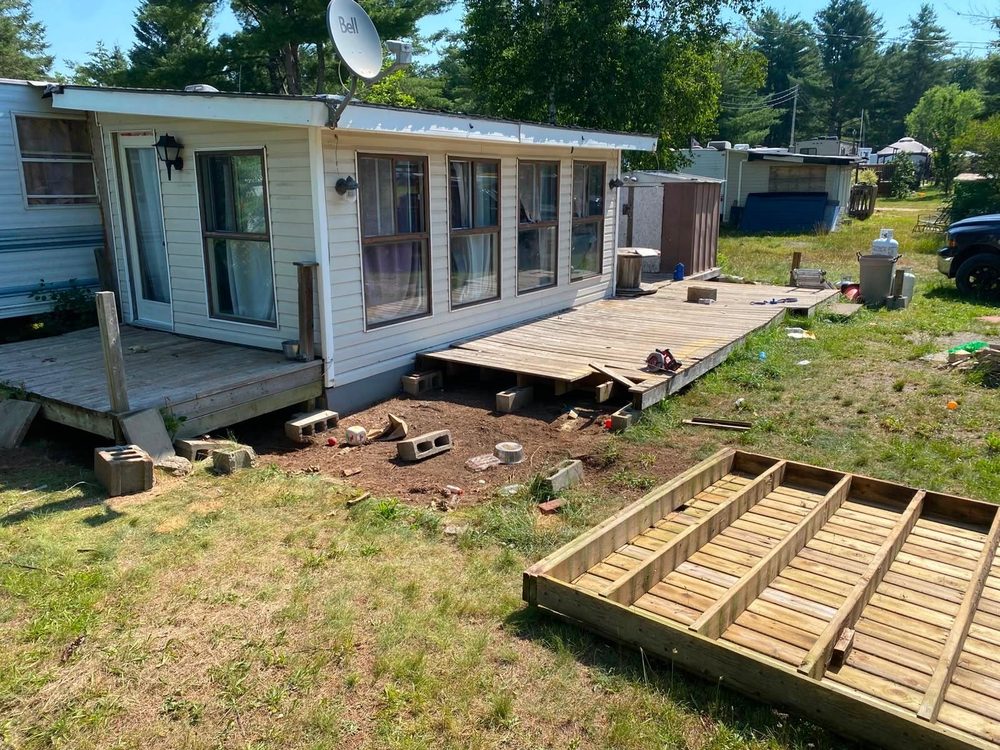
From the City's residential permits guidance, a permit is required to construct or demolish a deck regardless of size where it is attached to a building or adjacent to an egress door, to construct a porch or balcony regardless of size, to construct or demolish an accessory structure such as a garage, gazebo or deck greater than 10 square metres, and to construct or demolish a detached accessory shed exceeding one storey in height or greater than 15 square metres.
A permit is not required to construct or demolish a deck under 10 square metres in area that is not attached to a building and not adjacent to an egress door, or to construct or demolish a standalone building under 10 square metres with no plumbing.
The two conditions on the deck rule matter more than the size figure. A deck of any size needs a permit if it is attached to the building or if it sits next to an exit door. Only a deck that is both freestanding and clear of an egress door gets to be measured against the 10 square metre line at all. We see people build to the size and forget the attachment.
Ten square metres, then fifteen square metres
Barrie uses two different thresholds and it is easy to conflate them. A general accessory structure, which the City's own list exemplifies with a garage, a gazebo or a deck, needs a permit above 10 square metres. A detached accessory shed gets a more generous line and needs a permit above 15 square metres, or if it exceeds one storey in height.
| Structure | Permit threshold | Other trigger |
|---|---|---|
| Deck attached to a building or adjacent to an egress door | Any size | Attachment or egress proximity is the trigger, not area |
| Deck, freestanding and clear of an egress door | Over 10 square metres | Under that, no permit |
| Porch or balcony | Any size | Regardless of size |
| Accessory structure such as a garage or gazebo | Over 10 square metres | |
| Detached accessory shed | Over 15 square metres | Also if it exceeds one storey in height |
| Standalone building with no plumbing | Over 10 square metres | Under that and unplumbed, no permit |
| Tents | Over 60 square metres | Also any tent within 3 metres of a building |
Barrie states the imperial equivalents as 108 square feet for the 10 square metre line and 162 square feet for the 15 square metre line. Both are rounded up. Ten square metres is 107.64 square feet and fifteen is 161.46. If your build lands within a square foot of the line, work to the metric number, because the metric number is the one in the rule and the imperial figure is a convenience conversion.
The City's temporary structure permit guidance covers the tent side, exempting tents with an aggregate area less than 60 square metres and spaced more than 3 metres apart, and structures occupying an area less than 10 square metres. It describes typical temporary structures as tents, stages and bleachers, which tells you the page is aimed at events rather than at a seasonal site, but the thresholds are the thresholds.
One zoning provision overlays all of this. Section 4.2.1.9 of the Zoning By-law says accessory structures shall not occupy any part of a required front, side or rear yard except as provided elsewhere in the by-law. A structure can be under every building permit threshold and still be in the wrong place. Size and location are two separate questions, and passing one does not answer the other. Our deck and shed moving page covers the physical side of relocating an existing structure, which is often the cheaper answer to a placement problem than tearing it out.
Park models and mobile homes, where Barrie says nothing
The words "park model" and "mobile home" do not appear on the City of Barrie permit pages we read. There is no Barrie specific statement telling you whether a park model set on a Barrie property needs a building permit. We looked for it. It is not there in the material we could reach.
The province does address the general question, on the Ontario tiny home building permit page, and the framing it uses is the useful one. Ontario writes that a tiny home can be on wheels, and that any structure on wheels can be considered a building if it is located on the same spot for a period of time, especially if it is connected to services such as water, sewage and electricity, has exterior stairs to get in and out, and is fixed or anchored to the site. Where that applies, the province says you may need a building permit and the unit must meet certain Building Code requirements.
The province then draws the line the other way: this generally does not apply to recreational vehicles and campers that are towed, and in short, if you can drive it or if it needs a licence plate, then it is likely not a building.
Read the province's page for what it is
That page is about tiny homes. The words "park model" and "mobile home" do not appear anywhere on it. We are citing it because it is the clearest published provincial statement of the on wheels versus building test, and because the factors it lists, namely time in one spot, service connections, exterior stairs and anchoring, are exactly the factors that describe a park model on a seasonal site. We are not citing it as a ruling about park models, because it does not make one. The Chief Building Official at the City of Barrie is who decides this for a specific unit on a specific property, and that is the call to make before the unit arrives rather than after.
The practical version we give Barrie customers is this. A travel trailer you tow away every fall is a vehicle by every test on that page. A park model that has been on the same pad for four years with water, sewer, hydro, a deck and skirting is sitting a long way toward the other end of the same test. Where your unit falls is a question for the City, and it is a much cheaper question to ask before we set it than after.
Bass Lake Provincial Park
Barrie itself has no provincial park inside the city limits. The provincial park camping that Barrie customers actually use sits just north, and it is Bass Lake Provincial Park at 2540 Bass Lake Sideroad East, Orillia. It is a 247 hectare park established in 1957, with 182 campsites of which 90 are electrical, and it can be reached at 705-326-7054. The published 2026 operating season runs May 8, 2026 to October 13, 2026.
The park has one trailer dump and fill station. That single number is worth planning around on a changeover weekend, because one station serving 182 sites means a queue at the times everybody leaves.
Bass Lake is laid out as four campgrounds: Lakeview, Eastside, Cedar and Hilltop. If you are booking with a unit that needs power, the electrical picture is specific and it is not the same across all four. Ontario Parks states that Eastside Campground is a fully electrical campground, and that Hilltop features both electrical and non electrical campsites. Every campground has access to washrooms, and three of the four have a shower building inside the campground. Lakeview is a non electrical campground with a fully serviced washroom and shower building. Cedar has vault washrooms and no shower building of its own. Hilltop uses Eastside's shower building. Eastside's campsites 5 and 6 are barrier free and reservable.
| Bass Lake Provincial Park | Published figure |
|---|---|
| Address | 2540 Bass Lake Sideroad East, Orillia, ON L3V 6H2 |
| Phone | 705-326-7054 |
| Size | 247 hectares, established 1957 |
| Campsites | 182 total, 90 electrical |
| Campgrounds | Lakeview, Eastside, Cedar, Hilltop |
| Trailer dump and fill stations | 1 |
| 2026 season | May 8, 2026 to October 13, 2026 |
On the recreation side, Ontario Parks describes the shallow, clear water as making Bass Lake good for swimming, lists a 2.8 kilometre trail whose first 500 metres is paved and accessible, and notes canoe and kayak launching from shore or dock with rentals available at the park store. None of that changes how a trailer gets delivered, but it is why the park fills, and a full park is a park with narrow internal roads and no room to turn around.
Springwater Provincial Park, day use only
Springwater Provincial Park comes up in Barrie conversations because it is close, it is well known, and people assume they can camp there. Ontario Parks states plainly that this is a day use only park, and the park page directs anyone looking to camp to consider Earl Rowe or Bass Lake instead. The park describes itself as a day use park for family picnics, open year round.
Springwater is at 1331 ON-26 in Minesing, west and north west of Barrie, phone 705-728-7393. It is 193 hectares, established in 1958, with roughly 12 kilometres of hiking trails. Every camping category on the park's own page shows as not available.
Why we spell this out
We have had more than one call that began with a plan to have a trailer delivered to Springwater. There is nowhere at Springwater for a trailer to be delivered to, because there is no camping there. Knowing this before you book a unit saves a conversation that is no fun for anybody. If the plan was Springwater, the two nearest provincial alternatives named by Ontario Parks itself are Earl Rowe and Bass Lake.
Maximum trailer length, and the number nobody publishes
The question we are asked most about park delivery is the maximum trailer length a site will take. For Bass Lake, Ontario Parks does not publish a park specific maximum trailer or RV length, and it does not publish individual site dimensions. We are not going to invent either one.
What does exist is a system wide booking convention. Camping sites across Ontario Parks can be reserved by trailer size, in categories running up to 18 feet, up to 25 feet, up to 32 feet, and over 32 feet. That is a reservation category applied across the whole system, not a Bass Lake rule, and it tells you how the booking engine sorts sites rather than what will physically fit on the one you picked.
Ontario Parks also notes system wide that park roads can be narrow and winding. That is the constraint we actually plan around, because the limiting factor on a park delivery is almost never the site itself. It is the corner two hundred metres before the site, the tree on the inside of that corner, and whether there is anywhere to reposition if the first approach does not work. Phone the park at the number above and ask about the specific site before you commit to a unit that is near the top of its category.
Getting a load into and out of Barrie
Barrie is easier to reach than almost anywhere else we work and harder to move through than its map suggests. Highway 400 runs straight through it, which is why every conversation about a Barrie move starts with the assumption that access is simple. Then the load comes off the highway and lands in a grid of city streets where the province's highway numbers are painted onto municipal roads, and the simple part is over.
The three provincial highway numbers that appear in Barrie's Schedule 13 as designated through highways run on city streets. Highway 11 runs as Yonge Street, Burton Avenue and Penetanguishene Road. Highway 27 runs as Essa Road, Bradford Street, Dunlop and Bayfield. Highway 90 appears as Dunlop Street West from the east side of Highway 400 to the west limit of the City. Highway 400 itself is not a designated through highway in that schedule, because it is a controlled access provincial freeway rather than a city street carrying a highway number.
The practical consequence is that a wide load leaving Highway 400 for a Barrie address is immediately on an urban arterial with signals, overhead wires, boulevard trees, transit stops and turning radii that were designed for buses rather than for a park model on a gooseneck. Route planning for Barrie is street by street, and it is done before the truck is loaded.
Because Barrie is a separated city sitting inside the geography of the County of Simcoe without being part of it politically or administratively, any move that starts or ends outside the city crosses between two road authorities with two different approaches to load restrictions. That is covered in detail above, and it is the single most common reason a Barrie route takes longer to plan than the drive itself takes to complete.
When a Barrie booking actually moves
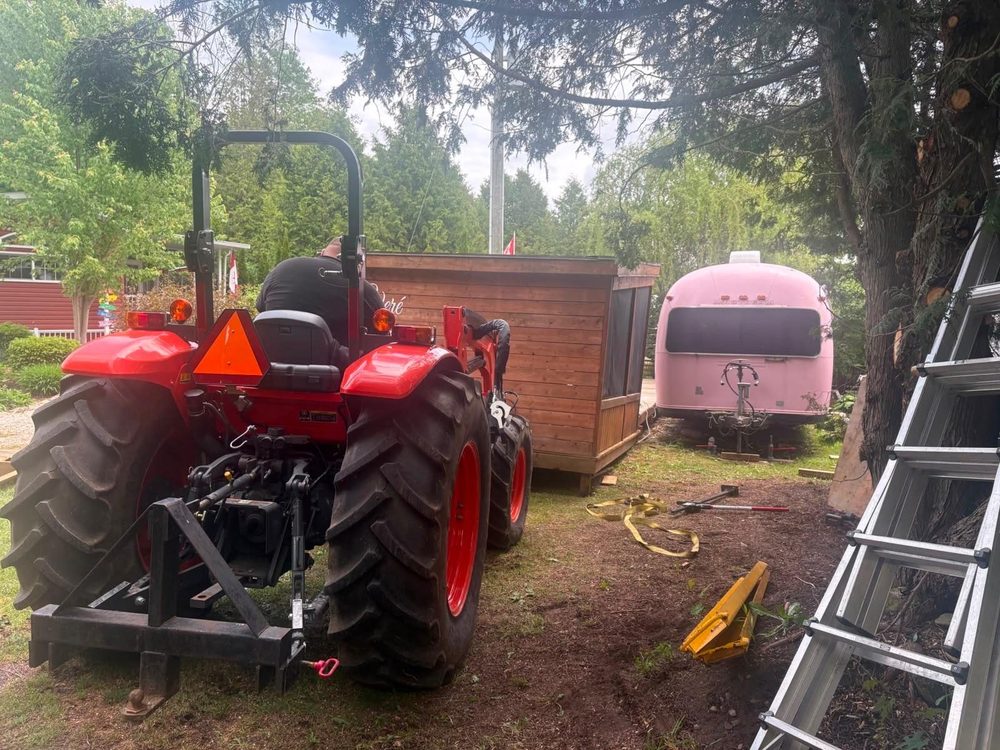
Three separate calendars decide when a Barrie job can happen, and they do not line up with each other.
The first is the half load window. Barrie applies load restrictions during spring thaw, and both the City and the County of Simcoe run March 1 to April 30 at five tonnes per axle. Inside Barrie that bites on ten named roads. Outside Barrie it applies across the County system with a schedule of year round exemptions. A move planned for late March that touches either is a move that needs its route checked rather than assumed.
The second is the permit clock. A City of Barrie oversize load permit is not valid from one half hour after sunset to one half hour before sunrise, and the weekday peak periods of 6:30am to 9:00am and 4:00pm to 6:00pm are also outside it. In practice that leaves a working window in the middle of the day, and on a short winter day that window is genuinely short. We book the day around the permit rather than booking the day and hoping the permit fits.
The third is the destination's own season. If the unit is going to a provincial park, Bass Lake's published 2026 operating season runs May 8 to October 13, and nothing arrives before the gate opens. Seasonal sites and private parks set their own dates, and we have had trips rescheduled because the park's water was not on yet.
| Calendar | Window | What it constrains |
|---|---|---|
| Half loads, City and County | March 1 to April 30 | Five tonnes per axle, route dependent |
| Barrie oversize permit hours | Daylight only, outside weekday peaks | Half hour after sunset to half hour before sunrise excluded; 6:30am to 9:00am and 4:00pm to 6:00pm excluded |
| Bass Lake 2026 season | May 8 to October 13, 2026 | Delivery into the park |
| Our hours | Monday to Saturday, 7:00am to 7:00pm. Sunday closed, by appointment only. | When we can be on site |
What we do around Barrie
Six services, all run by the same family with the same trucks, and all available anywhere in the City of Barrie and out into the County beyond it.
- RV transport. Travel trailers, fifth wheels, toy haulers, tent trailers and motorhomes that cannot drive themselves. Driveway to driveway, dealer to site, site to storage, storage to site. Up to 30,000 lb on a 30 foot gooseneck, local tows from $400.
- Park model and mobile home moving. The permit heavy end of the work. These units are usually over 2.6 metres wide, which is the width that triggers an oversize permit almost everywhere, and the Barrie permit covers width up to 3.7 metres. Once you are over standard width you are in the permit system on both sides of the city line. We handle the permits and the routing.
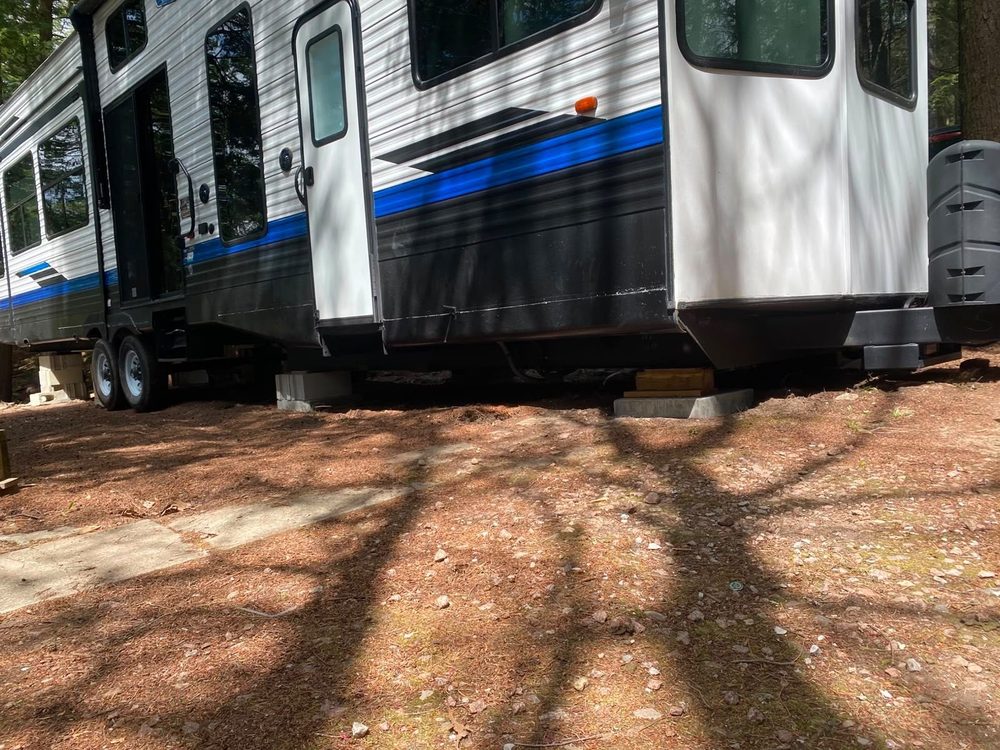
- Levelling and blocking. $799 for a full set up. Getting a unit level and keeping it level through a freeze and thaw cycle, which in Simcoe County is the whole of the problem.
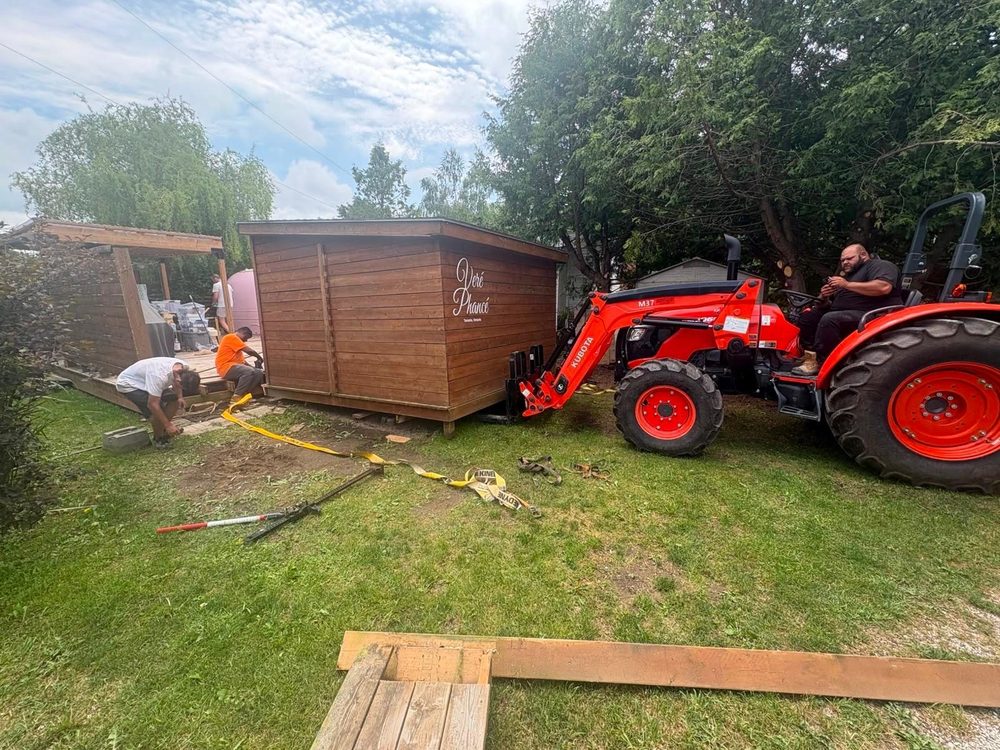
- Deck and shed moving. Moving a deck or shed out of the way so a unit can come out, and putting it back after. Also full deck removal and rebuild. Worth reading alongside Barrie's permit thresholds above, because a deck that has to be rebuilt in a different place is a deck that has to satisfy section 4.2.1.9 in its new place.
- RV storage. $85 to $125 a month depending on size, which is the practical answer when a Barrie property has nowhere the unit can sit or when you would rather not find out the hard way whether it can.
- RV rentals. Delivered and set up on a site of your choosing. For Barrie customers that usually means a seasonal site, a family property or a park rather than a city driveway.
If this is your first time moving a unit, the guide to preparing an RV for transport covers what to do to the unit before we arrive, and it applies whether we are the ones moving it or not.
Levelling and blocking on ground that freezes
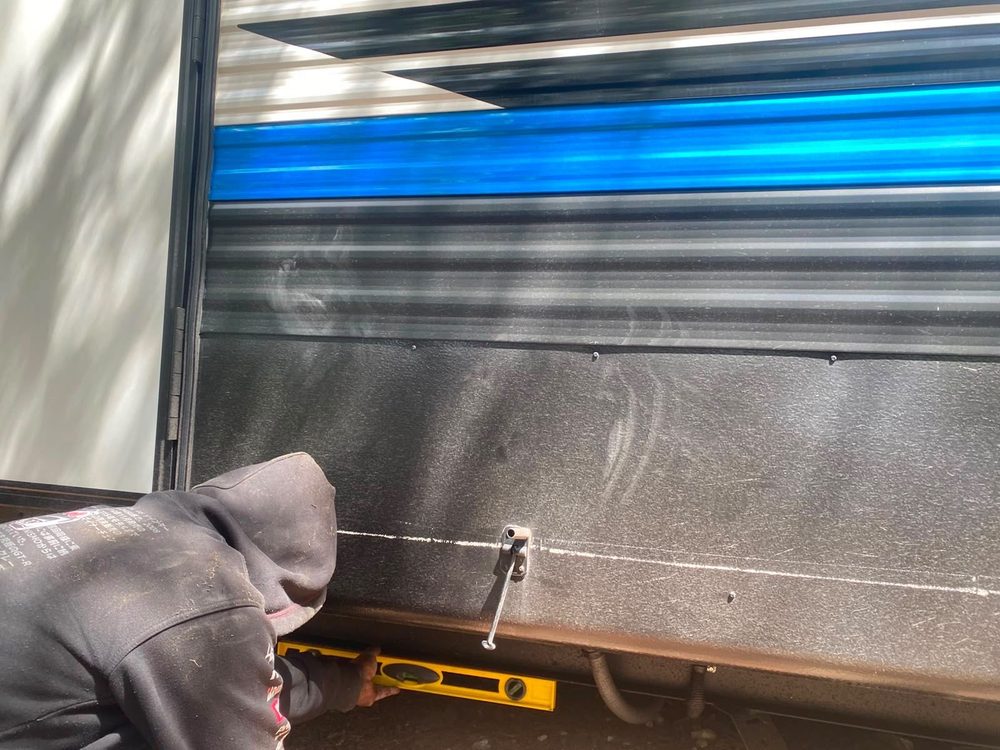
Levelling is not a five minute job at the end of a delivery, and pretending otherwise is how units end up with doors that stop closing. We charge $799 for a full set up, quoted separately from the tow, and that is the number for getting a unit properly blocked, levelled and sitting on load paths that will still be there in the spring.
The reason the spring matters is the same reason Barrie and the County both close roads to heavy axles from March 1 to April 30. Frost comes out of the ground unevenly. Ground that carried a unit perfectly through January can move as it thaws, and a unit that was level in October is not automatically level in May. That is a ground condition rather than a workmanship problem, and our guarantee says so honestly rather than pretending we control the weather.
What we do control is the blocking itself: how wide the load is spread, whether the frame is supported where it is designed to be supported, and whether the unit is level at the frame rather than level at the countertop. Those are the parts we stand behind.
Storage when the driveway will not take it
Storage is the answer to a specific Barrie problem. As set out above, we could not find a published City of Barrie rule governing residential RV storage, which sounds like freedom and is actually uncertainty. Uncertainty is a bad thing to build a five month plan on, and a stored unit that has to be moved in February is a unit being moved in the worst month of the year to move one.
We run storage at $85 to $125 a month depending on size. Details are on the RV storage page, and the winter storage checklist covers what to do to the unit itself before it sits through an Ontario winter. That checklist is the part people skip and then pay for in the spring, usually in plumbing.
What a Barrie move costs
Local tows start at $400. Levelling and blocking is $799 for a full set up. Storage runs $85 to $125 a month depending on size. There is no deposit to book a date. Maximum tow weight is 30,000 lb on a 30 foot gooseneck.
| Service | Price |
|---|---|
| Local tow | From $400 |
| Levelling and blocking, full set up | $799 |
| Storage | $85 to $125 a month depending on size |
| Deposit to book a date | None |
| Maximum tow weight | 30,000 lb on a 30 foot gooseneck |
Two Barrie specific costs sit outside our pricing and go to the City rather than to us. A City of Barrie oversize load permit is charged per permit or annually under Schedule E of the Fees By-law, at the figures set out earlier on this page. And if the route crosses into the County of Simcoe, the County has its own permit regime, whose fee we could not read from a published page and therefore do not quote. Where a permit is needed we tell you before the job, not on the invoice after it. The RV transport cost guide breaks the pricing down across the whole of Ontario if you want the full picture before you call.
When to book
Book earlier for Barrie than you think you need to, for three reasons that are all about paperwork rather than about our schedule.
First, if the load is oversize, the City permit requires documents you may not have to hand. Insurance of $2,000,000 plus $2,000,000 for a total of $4,000,000 with the City named as additional insured, and a letter from your company naming the individual designated as signing officer. Getting a certificate reissued with the City added is not a same day job at most brokers.
Second, we do not have a published City of Barrie processing time for an oversize load permit, and we are not going to guess one for you. What we do instead is start the permit conversation as soon as a job is booked rather than as soon as it is imminent.
Third, the March 1 to April 30 half load window compresses spring. Everybody who wanted a March move and discovered the restriction wants an early May move instead, and early May is also when seasonal sites open. If your move is flexible, moving it out of that fortnight is the cheapest scheduling decision available to you.
How to get the quote right the first time
A quote is only as good as the information behind it. For a Barrie job, these are the things that actually change the number, and having them ready turns a two call process into one call.
- The unit's real width. Not the model name, the measured width, and whether that measurement includes awnings, slide outs and anything else hanging off the side. Width is what decides whether a permit is in play at all.
- Both addresses. Where it is now and where it is going, in full. Barrie's ten load restricted roads and the County's whole system approach mean the route is a real question, and we cannot answer it from a postal code.
- Whether either end is inside the City limits. Barrie and the County of Simcoe are separate road authorities. A job that stays inside Barrie is one permit conversation. A job that crosses the line is two.
- What is in the way. Deck, shed, skirting, stairs, fence, low branches, hydro drop. If something has to come off before the unit can move, that is work, and it is better priced up front than discovered on the day.
- The date, and how firm it is. Anything landing between March 1 and April 30 gets its route checked against both restriction regimes before we confirm.
Call us at (647) 961-9257 or email transport@kawartharvrentals.ca. We are family run out of Beaverton, Ontario, an Ontario CVOR carrier, CVOR 204-617-206, and we would rather spend ten minutes on the phone getting the details right than send a truck to a job that was described to us wrongly.
Our 30 day guarantee
If a unit we set up shifts or moves because of our workmanship, we come back and redo the job at no charge. Weather and ground conditions are outside that, and we say so up front.
Plainly: if a unit we levelled and blocked shifts within 30 days because of how we did the job, we come back and redo it at no charge. Weather and ground conditions sit outside it, and given what a Simcoe County spring does to ground that has been frozen since December, that distinction is one we would rather state clearly up front than argue about later.
Nearby areas we also cover
Barrie is a city surrounded by a county it is not part of, which means almost every job that starts here ends somewhere else. If your move begins or finishes outside the City limits, these are the pages for the areas next door.