
Kawartha RV Transport & Services tows RVs, park models and mobile homes throughout Northumberland County, including Cobourg, Port Hope, Brighton, Colborne, Campbellford, Hastings, Baltimore, Grafton, Roseneath and Warkworth. Local tows start at $400. We run a one ton dually with a 30 foot gooseneck and we are a licensed carrier under CVOR 204-617-206. What makes Northumberland different from every other area we serve is not distance and it is not terrain. It is that eight separate road authorities have a say in whether your unit is allowed to move on a given day, and in the spring they do not agree with each other. One of them starts its half load season in the middle of February. One of them runs to May 1. Two of them publish no half load rule at all. This page sets out what each of them actually publishes, with the dates, the fees and the road lists written out, and it is honest about the places where the published record runs out.
The Northumberland area we cover
Northumberland County sits on the north shore of Lake Ontario between Durham Region and Quinte West, and Highway 401 runs the full length of it. For us it is a comfortable working distance. We are based in Beaverton and we already run the corridor daily for our Oshawa and Durham Region and Peterborough customers, so a Cobourg or Port Hope job is not a special trip and it is not priced like one.
The towns we move units in and out of most often are Cobourg and Port Hope on the lake, Brighton at the eastern end where the county meets Quinte West, Colborne in the middle, and Campbellford and Hastings up in the north where the Trent River runs. We also work the smaller places that do not show up on a highway sign: Baltimore, Grafton, Roseneath, Warkworth, Castleton, Bewdley, Gores Landing and the Rice Lake shoreline. If your site is on a private lane off a township road, that is normal here and it is not a problem, but it does change how we plan the job.
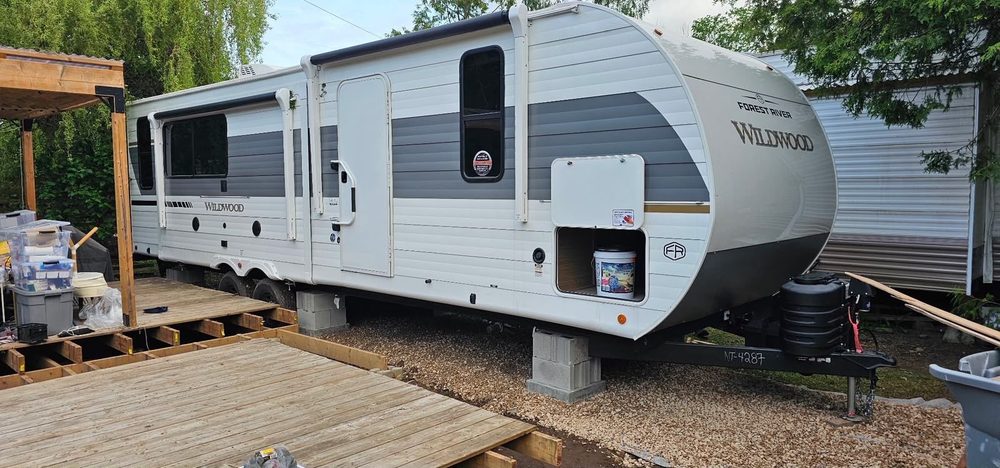
The work itself splits fairly evenly. Roughly a third is seasonal site work, moving units on and off the campgrounds and trailer parks around Rice Lake, the Trent and the lakeshore. Roughly a third is private property, a unit coming to or from a family lot. The rest is dealership deliveries, storage runs and the occasional park model or mobile home, which is a different job again and is covered on our mobile home and park model moving page.
Eight road authorities inside one county
This is the fact that governs everything else on this page. Northumberland County publishes a plain statement of who owns what: the County is responsible for County Roads and bridges, and the seven lower tier municipalities are responsible for local roads and sidewalks. Add the Ministry of Transportation, which owns Highway 401, and any given move here can cross three or four jurisdictions before it reaches the site.
The seven lower tier municipalities, as the County names them, are the Township of Alnwick/Haldimand, the Municipality of Brighton, the Town of Cobourg, the Township of Cramahe, the Township of Hamilton, the Municipality of Port Hope and the Municipality of Trent Hills. Each one sets its own spring load restrictions, its own overnight winter parking rules and its own permit fees, and none of them are obliged to match their neighbour.
Why this is not a technicality
A permit from one authority is worth nothing on another authority's road. The Ministry of Transportation says so in its own words: an oversize permit is valid for Ontario's King's highways only, and the carrier must contact the appropriate municipality to ensure compliance with the local by-laws. So a load that is legal the whole way down Highway 401 can become illegal the moment it leaves the 401 for a street in Cobourg, and legal again two concessions north on a County road. That is our problem to solve, not yours, but it is why we ask for the exact civic address at both ends before we quote.
What a half load restriction actually is
Every spring, as the frost comes out of the ground, the layers under a road lose their strength. Water that was locked up as ice turns back to liquid and cannot drain downward because the ground below is still frozen. The road surface looks the same and behaves completely differently. A loaded truck that would do nothing to that road in August will push ruts into it in March.
Road authorities respond by posting a reduced load period, universally called half loads. Northumberland County's own explanation is that Section 122 of the Highway Traffic Act provides the County with the authority to pass by-laws to restrict axle loading to a maximum of 5 tonnes per axle. Cobourg puts the engineering reason in plain language on its roads page: half load restrictions help protect roadways during the spring thaw, when pavement structures experience reduced load-bearing capacity due to freeze-thaw conditions. Hamilton Township is blunter still and says that during the spring thaw, Township roads become too soft to support fully loaded trucks.
Two things about that limit are worth understanding before you read the rest of this page. The first is that 5 tonnes per axle is a limit on the axle, not on the load. A tandem axle trailer at 9,000 lb sitting properly on its springs is not the problem; a badly balanced unit that puts most of its weight on one axle can be. The second is that the restriction applies to us as the carrier, and the penalty falls on us. Northumberland County states that vehicles exceeding the 5 tonne per axle load restriction must take alternate routes or will be subject to penalties. We do not ask a customer to absorb that risk and we do not quietly run a restricted road hoping nobody is looking.
The practical consequence is simple. If your unit is heavy and your dates fall in March or April, we will either route around the posted roads or we will tell you the honest answer, which is that the job is a May job. We would rather have that conversation in January. There is more on how weight and season affect what you pay in our Ontario RV transport cost guide.
Seven half load calendars, none of them aligned
Here is every published half load window in Northumberland County, side by side, exactly as each authority states it. This table is the single most useful thing on this page if you are trying to pick a moving date.
| Northumberland County | Signs usually posted between March 1 and April 30. The County adds that restrictions may be in effect earlier than March 1, and may also stay posted beyond April 30. |
| Town of Cobourg | Commercial vehicles restricted to half loads on designated streets starting Monday, March 2, 2026. Restrictions remain in place until the half load signs are removed in mid to late April, weather dependent. |
| Municipality of Port Hope | March 1 to April 30 each year, on all rural roads within the Municipality. |
| Municipality of Brighton | The roads page states March 1, 2026 until late April. A later news post states that beginning Friday, May 1, half load restrictions were lifted. |
| Township of Hamilton | Approximately mid February to mid April. |
| Municipality of Trent Hills | Every year from March 1 to May 1, on all roads under its jurisdiction, as per By-law 2002-9. |
| Township of Alnwick/Haldimand | No half load rule published on its public works and roads page. |
| Township of Cramahe | No half load rule published on its roads, public works or winter maintenance pages. |
Read that table again and notice what it means on the ground. On February 20 a load can be perfectly legal on a Cobourg street, legal on a County road, and already restricted on a Hamilton Township road two kilometres away, because Hamilton Township starts around the middle of February and nobody else does. On April 25 the reverse is true: Cobourg's signs may already be down, and Trent Hills is still posted for another week.
The single most useful sentence on this page
Northumberland County does not say the restriction runs March 1 to April 30. It says signs are usually posted between those dates, that restrictions may be in effect earlier than March 1, and that they may also stay posted beyond April 30. Cobourg is the same in different words: mid to late April, weather dependent. The calendar is not the rule. The sign is the rule. The County states plainly that load restrictions apply when the signs are displayed on the roadway. That is why we check the route before a spring booking rather than checking a date.
The 21 County roads that get posted
Northumberland County publishes the actual list. It introduces it by saying that reduced loads are in effect during this period on all, or a portion thereof, of each of the following County roads, and closes it by noting that each road is signed accordingly. Both halves of that sentence matter and we come back to them below. Here is the list, with the extent the County gives for each.
| Albert Street, Hastings | Bridge Street to Peterborough County boundary |
| County Road 8 | Burnbrae Road to Hastings County boundary |
| County Road 9 | Durham Region boundary to County Road 45 |
| County Road 10 | County Road 2 to Peterborough County boundary |
| County Road 15 | County Road 45 to County Road 18 |
| County Road 18 | Highway 401 to County Road 45 |
| County Road 21 | County Road 25 to County Road 30 |
| County Road 23 | Academy Hill Road to County Road 22 |
| County Road 24 | County Road 45 to County Road 25 |
| County Road 25 | County Road 22 to County Road 45 |
| County Road 26 | County Road 30 to County Road 41 |
| County Road 27 | County Road 25 to County Road 30 |
| County Road 29 | County Road 45 to Percy Boom Road |
| County Road 31 | King Street West to Lakeport West limit |
| County Road 33 | County Road 45 to 7th Line Road |
| County Road 35 | County Road 25 to County Road 30 |
| County Road 38 | 180 m east of Major Street to Hastings County boundary |
| County Road 41 | County Road 30 to Quinte West boundary |
| County Road 50 | Nelson Street to Peterborough County boundary |
| County Road 64 | Harbour Street to Quinte West Boundary |
| County Road 65 | County Road 2 to County Road 9 |
That is 21 entries. We count them out because an early pass at this page produced 23, and the difference was not a typo in the source, it was a machine miscounting a list. We went back and transcribed it road by road against the County's own page. Twenty one.
How to read that list before you book
Three things in the County's own wording change what the list means.
- "All, or a portion thereof." A road appearing on this list does not mean the whole road is posted. It means some or all of it is, within the extent given. County Road 18 is listed from Highway 401 to County Road 45, which is exactly the stretch a load coming off the 401 would want.
- "Each road is signed accordingly." The sign on the ground is the operative instrument. If a road is on this list and the sign is not up, the restriction is not in force, and if a road is not on this list but a sign is up, the sign wins.
- The extents are given as boundaries and named streets, not as kilometre marks. Several run to a county line: Peterborough County boundary on three of them, Hastings County boundary on two, Durham Region boundary on one and the Quinte West boundary on two. If your job crosses one of those lines it is worth telling us, because we then have to read the neighbouring county's calendar as well as this one. Our Kawartha Lakes and Belleville and Quinte West pages cover two of those neighbours.
The County's other road list, and why it is longer
Northumberland County publishes a second road list in a completely different place, on its snow plowing page, and almost nobody puts the two side by side. That page states the County maintains approximately 900 lane kilometres of County roads during winter operations, and that County roads are maintained in accordance with O.Reg. 239/02 Minimum Maintenance Standards for Municipal Highways, with Class 2 roads being the highest priority, having the most vehicles travelled, and Class 4 roads being lightly travelled.
The list that accompanies it names 30 County Roads with their winter class and, usefully, their local street name. That second column is the reason we reproduce it here: half the road names people actually use in Northumberland are not numbers.
| County Road 2 | Class 2 and 3 |
| County Road 2A | Class 4, Albert Street |
| County Road 8 | Class 3, Bridge Street, East and Centre Street |
| County Road 9 | Class 3, Ganaraska Road and Oak Ridges Drive |
| County Road 10 | Class 3 |
| County Road 15 | Class 3 and 4, Harwood Road |
| County Road 18 | Class 2, 3 and 4, Burnham Street North and Rice Lake Scenic Drive |
| County Road 20 | Class 2 and 3, Elgin Street and Brook Road North |
| County Road 21 | Class 4, Dundonald Road |
| County Road 22 | Class 3, Centreton Road |
| County Road 23 | Class 3 and 4, Lyle Street |
| County Road 24 | Class 4 |
| County Road 25 | Class 3, Big Apple Drive, Percy Street, Spring Street, Dominion Street and Cardinal Drive |
| County Road 26 | Class 3 and 4 |
| County Road 27 | Class 4, Morganston Road |
| County Road 28 | Class 2 |
| County Road 29 | Class 3 and 4, Mill Street and Church Street |
| County Road 30 | Class 2 and 3, Grand Road and Bridge Street West |
| County Road 31 | Class 4 |
| County Road 33 | Class 4, Merrill Road |
| County Road 35 | Class 3, Hastings Road |
| County Road 38 | Class 3, Front Street North |
| County Road 41 | Class 3 |
| County Road 42 | Class 4 |
| County Road 45 | Class 2 and 3, Baltimore Road |
| County Road 50 | Class 3 and 4, Queen Street |
| County Road 64 | Class 3 and 4, Prince Edward Street |
| County Road 65 | Class 4, Osaca Road |
| County Road 70 | Class 3, Dale Road |
| County Road 74 | Class 3 |
The service standards behind those classes are published too, and they are worth knowing if you are moving a unit in January rather than July. On a Class 2 road the County works to clear 5 cm of snow within 6 hours, to prevent ice formation within 8 hours and to treat an icy road within 4 hours. On a Class 3 road the trigger is 8 cm, cleared within 12 hours, with 16 hours for ice prevention and 8 hours for treatment. On a Class 4 road it is 8 cm within 16 hours, with 24 hours and 12 hours respectively.
Nine numbered roads on one list and not the other
We ran the two County lists against each other in a script rather than by eye, because that is the sort of comparison a person gets wrong. The result is clean in one direction and interesting in the other.
Every numbered road on the half load list also appears in the winter table. Nothing is posted for half loads that the County does not also plow. But the winter table is longer, and nine numbered County Roads are maintained in winter and do not appear on the half load list at all: County Roads 2, 20, 22, 28, 30, 42, 45, 70 and 74. Several of those are the busiest roads in the county. County Road 2 is the old lakeshore highway through Cobourg and Port Hope. County Road 45 is Baltimore Road, the main route north out of Cobourg. County Road 28 is a Class 2 road. County Road 30 runs north to Campbellford.
What we do and do not conclude from that
The obvious reading is that the County's arterial roads are built heavily enough that it does not need to post them in spring, which is consistent with them being the higher winter classes. That reading is plausible and we are not going to publish it as fact, because the County does not say it anywhere. What we do with the gap is purely operational: when a spring route can reasonably be built along County Road 2, 45, 30 or 28, we build it that way, and we still look at the signs when we get there.
The one entry we will not reconcile
There is a tenth road in that gap and it is a genuine ambiguity rather than a finding, so we are flagging it instead of resolving it.
The winter table lists County Road 2A as a Class 4 road with the alternate name Albert Street. The half load list contains an entry reading Albert Street, Hastings, from Bridge Street to the Peterborough County boundary, with no County Road number attached to it. Those may well be the same stretch of road. They may not be. The County does not state on either page whether they are, and there is no third page that connects them.
We are not going to guess, because the two possible answers point in opposite directions for a customer. If they are the same road, then County Road 2A is posted in spring and we route around it. If they are different roads, then County Road 2A is not posted and Albert Street in Hastings is. In practice we treat both as posted and plan accordingly, which is the conservative reading and costs a customer nothing. If your job is in or near Hastings and touches Albert Street, tell us and we will confirm it against the signs on the day rather than against a web page.
Cobourg posts six streets
The Town of Cobourg publishes its restricted streets by name, which is more than most municipalities this size do. Its notice states that commercial vehicles will be restricted to half loads on designated streets within the Town of Cobourg starting on Monday, March 2, 2026, and names six.
| Danforth Road | Starting 1 km east of Parkview Hills to Jarvis Road |
| Jarvis Road | Danforth Road to Elgin Street East |
| Stanton Road | South of Elgin Street East to dead end |
| Elgin Street East | Jarvis Road to Brook Road North |
| Workman Road | County Road 2 to Elgin Street East |
| Greer Road | Elgin Street East to Danforth Road |
Look at where those six are. They are all on the north and east edge of town, in the band between the built up urban grid and the Hamilton Township line. Cobourg's downtown streets are not posted. Neither is the corridor down to the waterfront and Victoria Park Campground. For most of our Cobourg work that is good news, because the majority of Cobourg RV jobs are either at the campground or on residential streets inside the urban area. The jobs that need a closer look are the ones on the properties out past Elgin Street East, where five of these six roads are, and the ones on Danforth Road, which is a long east to west connector.
Cobourg's end date is written the way we wish everyone would write it: restrictions remain in place until the half load signs are removed in mid to late April, weather dependent. That is honest. It is also unbookable, which is why a Cobourg job in the second half of April gets a phone call a few days ahead rather than a promise in February.
Why Cobourg started one day later than Brighton
This is a small thing and it tells you the notices are real rather than boilerplate. Brighton's start date for 2026 is Sunday, March 1. Cobourg's is Monday, March 2. Both notices name the day of the week, and we checked both against a calendar: March 1, 2026 did fall on a Sunday and March 2 did fall on a Monday. Cobourg started on the Monday because March 1 was a Sunday that year and the crews post signs on a working day.
It matters for exactly one reason. If you are moving a unit on the weekend of February 28 and March 1, 2026, you are on the right side of the line in Cobourg and on the wrong side of it in Brighton, thirty five kilometres east. That is the kind of detail that decides a booking, and it is the reason we read the individual notices rather than working from a general "March to April" assumption.
Port Hope restricts every rural road it owns
Port Hope takes the opposite approach to Cobourg. Instead of naming streets, it states that in an effort to reduce damage to its roads, it implements weight restrictions of five tonnes per axle, described as half loads, on all rural roads within the Municipality of Port Hope from March 1 to April 30 each year.
There is no list to read, and in a way that is easier: if the road is rural and it belongs to Port Hope, assume it is restricted for those two months. What Port Hope does not define anywhere we could find is where "rural" stops and urban begins. For the built up part of Port Hope along the Ganaraska we treat it as an urban street unless we are told otherwise; for anything north of the 401, in Canton, Osaca, Welcome, Perrytown, Campbellcroft or Garden Hill, we treat it as rural and restricted.
Port Hope also does something no other municipality here does. On the same page it tells you to visit Northumberland County to learn about weight restrictions on County roads that pass through the Municipality of Port Hope. That is exactly right and it is the two authority problem stated by an authority. County Road 9, which is Ganaraska Road, County Road 10, County Road 65 and County Road 74 all run through Port Hope, and Port Hope's own March 1 to April 30 window has nothing to do with them.
Brighton published two different end dates
Brighton is the one place in this county where the published record contradicts itself, and both halves of the contradiction are live on Brighton's own site right now. We are publishing both rather than picking one quietly.
- The roads page states that half load restrictions are in effect from March 1, 2026, until late April, and explains that the restrictions are put in place to help protect municipal roadways, as warmer temperatures during the spring thaw can increase the risk of road damage.
- The start notice states that half load restrictions will come into effect on Sunday, March 1, 2026.
- The lifting notice, on a page dated May 01, 2026, states that beginning that day, Friday, May 1, half load restrictions will be lifted, and repeats the thaw explanation in the past tense.
So the roads page says late April and the news post says the restrictions actually came off on May 1. Our reading is that the news post is the later and operative fact: an announcement made on the day the signs came down beats a general statement written before the season. But we are not treating Brighton as a firm April 30 county on that basis. For a Brighton booking in the last week of April we assume the restriction is still on and we confirm before we load.
The road list that exists only as a photograph
Brighton does publish its restricted road list. The link on the roads page is a single word, "here", and it points at a JPG image file. It is a photograph of a list, not a list.
That means we cannot read it programmatically, we cannot quote it, and we are not going to retype it from an image and risk transposing a road name onto a page that a customer will make a decision from. No Brighton road list appears on this page. If your job is in Brighton and it falls in the half load window, we open that image ourselves and read it before we quote, and if there is any doubt about a specific road we phone Brighton Public Works at 613-475-1162.
We would rather say this plainly than pretend the list is not there. It is there. It is just not in a form we are willing to copy.
Hamilton Township starts in the middle of February
The Township of Hamilton, which wraps around Cobourg on three sides and takes in Baltimore, Gores Landing, Bewdley, Camborne and the south shore of Rice Lake, publishes the earliest half load start date in our entire service area. Its roads page states that during the spring thaw, Township roads become too soft to support fully loaded trucks, and that to protect road conditions, weight limits are reduced to half loads, five tonnes per axle, from approximately mid February to mid April.
Mid February. Not March 1. That is two full weeks earlier than the County, Cobourg, Port Hope, Brighton and Trent Hills, and it covers a period when most people assume winter rules still apply and spring rules have not started.
The Rice Lake trap
A large share of the RV and park model work in this county happens on the Rice Lake shoreline, and a large share of the Rice Lake shoreline is in Hamilton Township. If you are moving a unit onto a Gores Landing or Bewdley site in late February, you are inside Hamilton Township's window even though every other calendar in the county is still clear. This is the single most common date mistake we see in Northumberland and it is worth a phone call before you commit to a weekend.
Hamilton Township also says its window is "approximately" mid February to mid April, which is the same weather dependent honesty Cobourg and the County use. It is not a date you can book against. It is a warning that the season here is longer than the county norm at both ends.
Alnwick and Haldimand publishes no half load rule at all
The Township of Alnwick/Haldimand covers Roseneath, Grafton, Centreton, Fenella and the north shore of Rice Lake. Its public works and roads page tells you that the Public Works Department is responsible for the sanding, salting and plowing of approximately 487 kilometres of Municipal roads, that the Ministry of Transportation is the road authority for Highway 401, and that the Township is not responsible for the maintenance of County Roads, Provincial Highways or Private Roads. It is a clear page. It contains no spring load restriction sentence, and we checked it twice specifically for one.
What it does publish is the longest winter parking prohibition in the county, which we come back to below.
Cramahe publishes none either
The Township of Cramahe, which takes in Colborne, Castleton and Morganston, is the second municipality here with no published half load rule. We checked its roads page, its public works page, its winter maintenance page and its parking page. Half load restrictions are absent from all four. So are oversize permits and road occupancy permits.
Cramahe does publish detailed winter material, including a Winter Operations Policy, and it publishes a traffic by-law, and none of it addresses spring load limits. The Township's number is 905-355-2821.
Trent Hills is the only one with a by-law number
The Municipality of Trent Hills, covering Campbellford, Hastings and Warkworth in the north of the county, publishes the tightest written rule of the eight. Its roads page states that every year, from March 1st to May 1st, the Municipality of Trent Hills enforces a reduced load period on all roads under its jurisdiction, as per By-law 2002-9.
Three things stand out. It is the longest municipal window in the county, a full two months running a day past the County's usual April 30. It applies to all roads under its jurisdiction, with no rural or urban distinction and no street list. And it is the only half load rule in Northumberland County with a by-law number attached to it on the page, which makes it the most defensible of the eight and the one we treat as least likely to move.
What Trent Hills does not publish is a tonnage. It says reduced load period and cites the by-law, but the five tonnes per axle figure that the County, Port Hope and Hamilton Township all state does not appear on the Trent Hills page. We do not assume it. Trent Hills also notes that the County of Northumberland is responsible for the speed limits on all County roads, and that within its boundaries it maintains 527 km of roads, of which 254 km are gravel, 225 km are surface treated and 48 km are paved. That gravel figure is not a throwaway: nearly half the roads in Trent Hills are gravel, and gravel behaves differently under a loaded trailer in April than pavement does.
What a missing rule does and does not mean
Two of the eight authorities on this page publish no half load rule. We want to be precise about what we are and are not saying there, because the wrong reading of it could cost somebody a road.
What we are saying is that we could not find a published half load restriction on Alnwick/Haldimand's or Cramahe's public pages, after checking multiple pages on each site. What we are not saying is that no restriction exists. A municipality can have a traffic by-law that authorises seasonal load limits without describing it on a web page, and a sign posted at the end of a concession road is legally effective whether or not anybody has written about it online.
Our rule for gaps
An absence of a published rule is an absence of a published rule. It is never a permission. On roads in Alnwick/Haldimand and Cramahe we run the same spring caution we run everywhere else in this county, we look at what is posted at the road, and if we see a sign we obey it. If you find a published rule for either township that we have missed, tell us and we will correct this page.
Oversize and overweight permits
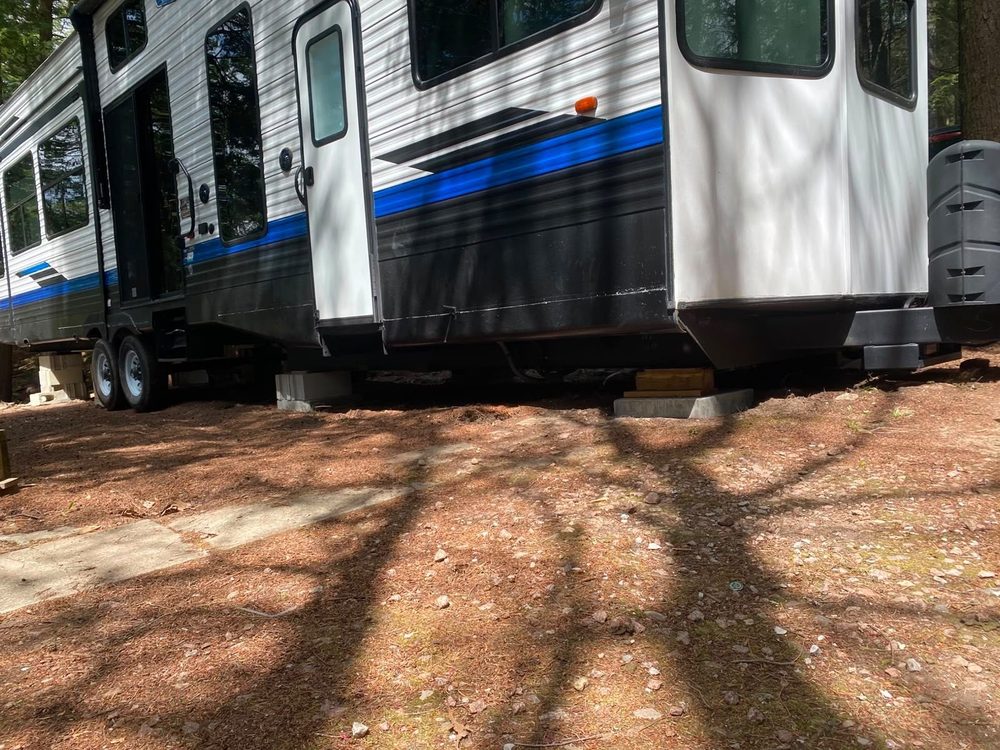
Half loads decide when a unit can move. Permits decide whether it can move at all, and on whose road. Most travel trailers and fifth wheels do not need a permit at all, because they fit inside the legal envelope. Park models and mobile homes almost always do, because they do not. That difference is the reason we split those into separate services and separate pages: standard towing on our RV transport page, and the oversize work on our mobile home and park model moving page.
The four provincial numbers that decide everything
The Ministry of Transportation publishes the legal maximums for a vehicle or load on a provincial highway, and every oversize conversation in Ontario starts by comparing your unit to these four figures.
| Maximum width | 2.6 m |
| Maximum height | 4.15 m |
| Maximum length, single vehicle | 12.5 m |
| Maximum length, combination | 23 m |
Measure your unit and compare. In practice the number almost everybody trips on is the first one. 2.6 m is 8 feet 6 inches. A typical travel trailer or fifth wheel is 8 feet or a little under and clears it comfortably. A park model is commonly 12 feet wide, which is 3.66 m, and is over the limit by more than a metre. A single wide mobile home is wider still. Height catches people occasionally, usually on a unit with air conditioners and antennas on the roof, and length is rarely the binding constraint on the sort of work we do.
How to measure so the quote is right the first time
Width is measured at the widest point of the load, not at the frame. That means slide out boxes, awning rails, roof overhangs and any trim that projects. Height is measured from the ground with the unit sitting on its own wheels or on the transport gear, whichever is taller, and it includes rooftop units. If you have the manufacturer's plate or the original spec sheet, send us a photo of it and we will work from that. If you do not, a tape measure and two photos are enough to tell us whether we are in permit territory.
The permit that stops at the King's Highway
This is the single most misunderstood point in Ontario oversize transport and the Ministry states it in one line: oversize and overweight permits are valid for Ontario's King's highways only.
The Ministry goes further and spells out the consequence. A permit grants the movement of overweight loads on highways under provincial jurisdiction, and municipalities may accept ministry permits or issue their own for highways under their jurisdiction. It adds that the carrier must contact the appropriate municipality or municipalities to ensure compliance with the local by-laws.
Read that against the eight authority map at the top of this page. A provincial permit covers Highway 401 through Northumberland County. It covers nothing else here. Not County Road 45 into Cobourg, not County Road 2 along the lake, not a Port Hope rural road, not a Brighton street, not the Hamilton Township concession that your Rice Lake site sits on. Every one of those is a separate authority with a separate decision to make, and the word "may" in the Ministry's sentence is doing a lot of work: a municipality is not obliged to accept a provincial permit.
Highway 401 runs the length of this county
Northumberland is unusual among the areas we serve in that the provincial highway is not an edge case here, it is the spine. Highway 401 enters from Durham Region west of Port Hope and leaves at the Quinte West boundary east of Brighton, and every town on this page is within a few minutes of an interchange. Alnwick/Haldimand names the Ministry explicitly as the road authority for Highway 401 in its own list of what it does and does not maintain.
For a legal width unit this is a gift. We can run the 401 the whole way and drop onto a municipal road for the last few kilometres, which keeps a Northumberland job fast and keeps the price down. For an oversize unit it means the permit picture is at its cleanest here: one provincial permit for the long haul, plus whatever the municipality at the destination requires for the last stretch.
It also means the half load question narrows considerably. Half loads do not apply on Highway 401. If the great majority of the route is the 401, then the spring restriction is a question about the last five or ten kilometres, not about the whole trip, and a job that looks impossible in March often turns out to be fine.
What the provincial permit costs and how long it takes
The Ministry publishes its fee schedule and its processing times, and both are worth planning around.
| Annual permit | $448.75 |
| Enhanced annual permit | $744.50 |
| Project permit | $291.75 |
| Enhanced project permit | Varies by number of trips |
| Single trip, oversize only | $66.25 |
| Single trip, overweight up to 120,000 kg and up to 100 km | $127.50 |
| Single trip, overweight 101 km to 500 km | $204.00 |
| Single trip, overweight over 500 km | $265.25 |
| Superload, over 120,000 kg | $714.00 |
| Special vehicle configuration | Varies |
The line that applies to nearly all of our park model work is the first single trip line: $66.25 for an oversize only single trip permit. Nothing we tow in Northumberland approaches 120,000 kg, so the overweight tiers and the superload figure are there for completeness rather than because we expect to use them.
Processing times matter more than the fee. The Ministry states that annual and project permits take up to 15 business days, that single trip permits take 5 business days, and that a superload takes at least 5 business days and up to 6 months in some cases. Fifteen business days is three calendar weeks. Five business days is a full week and it assumes nothing needs correcting.
Why we ask about oversize jobs a month out
Five business days for the provincial permit, plus whatever the destination municipality needs, plus the fact that Northumberland's spring window closes some routes for two months, is why a park model move booked with a week's notice in March is a harder conversation than the same move booked in January for June. It is not that we cannot do it. It is that the permit clock is not ours to speed up. The Ministry does not mention an insurance requirement in its permit fee material, but individual municipalities certainly do, and Port Hope's requirement is the steepest one in this county.
What each municipality charges
Here is every published municipal road permit fee we could find in Northumberland County, in one table. Blanks in this table are not zeros, they are gaps in the published record, and each one is explained in the sections that follow.
| Township of Hamilton, oversize load annual | $150.00 |
| Township of Hamilton, oversize load per trip | $50.00 |
| Township of Hamilton, road occupancy | $200.00 |
| Township of Hamilton, road cut | $200.00 fee plus $1,500.00 deposit |
| Township of Hamilton, work in right of way | $100.00 |
| Township of Hamilton, municipal consent | $50.00 |
| Township of Hamilton, entrance | $2,701.25 including deposits |
| Township of Hamilton, special event road use | $250.00, or $500.00 to $5,000.00 for filming |
| Municipality of Port Hope, road occupancy | $206.00 |
| Municipality of Trent Hills, road occupancy | $150.00 |
| Municipality of Trent Hills, road cut | $200.00 fee plus $1,000.00 deposit |
| Municipality of Trent Hills, close a road allowance | $600.00 plus $5,000.00 deposit |
| Northumberland County | Two oversize permits exist. No fee published. |
| Town of Cobourg | No road permit of any kind found published. |
| Municipality of Brighton | No road permit fee found published. |
| Township of Cramahe | No road permit found published. |
| Township of Alnwick/Haldimand | No road permit fee found published. |
The cheapest oversize permit we have found anywhere
Hamilton Township's oversize load permit is $150.00 for the annual and $50.00 per trip. Those are the lowest municipal oversize figures we have found anywhere in our service area. For comparison, the numbers on our Collingwood and Wasaga Beach page are $175.00 annual and $100.00 per trip in Collingwood and $232.00 annual and $116.00 per trip in Midland. Hamilton Township charges less than half the Midland single trip figure.
Hamilton Township also publishes the clearest description of what the two permits actually do, and one clause in it is more useful to an RV customer than the price is. Its annual permit is described as allowing the hauling of oversize and overweight loads during the period permitted, as defined by the Highway Traffic Act, that are within the specified maximum weights and dimensions permitted, and that are also subject to seasonal, fixed and temporary load restriction. Its trip permit is described as required for the transportation of a load that exceeds the limits prescribed in the Highway Traffic Act, on a specific day or days, on a specific route, that is not already allowed for by a current annual permit.
An annual permit does not lift half loads
That phrase, "also subject to seasonal, fixed and temporary load restriction", is the only place in Northumberland County where an authority states the relationship between the two systems in writing, and it is worth reading twice. Holding an oversize permit does not exempt a load from the spring restriction. The permit answers the width and weight question. The half load sign answers the season question. Both have to be satisfied at the same time, on the same road, on the same day. Anyone who tells you their annual permit gets them through half loads is wrong, and Hamilton Township is the municipality that says so.
What Hamilton Township does not publish is a dimension or weight threshold at which its permit becomes required, an insurance requirement, or a lead time. Its permits page defers to the Highway Traffic Act for the thresholds rather than restating them, which is defensible but means the provincial numbers in the table above are the ones to measure against. The Township's number is 905-342-2810.
The County owns 503 km of road and publishes no fee
Northumberland County states that each year it works to maintain and upgrade its 503 kms of road and 110 structures. Its road permits page offers two relevant permits: an Oversize/Overweight Annual Load Permit and an Oversize/Overweight Single Trip Permit, both applied for through an online portal.
And that is the whole of it. The County publishes no fee for either permit, no dimension or weight threshold that triggers them, no insurance requirement and no lead time. We looked for all four. This is not a case of us failing to find a buried PDF; the information is simply not on the page, and the County's approach appears to be that you apply and they tell you.
The other permits the County lists are an Entrance permit, a Setback Application, an Open Cut or Bore permit, a Special Event permit, a Permission to Enter Form and Municipal Consent. Of those only the Special Event permit carries any published condition: it requires liability insurance and must be submitted 6 weeks in advance. The County also notes that open cut of the road surface or shoulder of the roadway is not permitted between November and April, which is not an RV rule but tells you something about how it treats its roads in the cold months.
The County's transportation department can be reached at 905-372-3329 or toll free at 800-354-7050, and by email at transportationdept@northumberland.ca. For an oversize job on a County road we contact them directly rather than guessing at a fee, and we build the actual number into your quote once we have it.
Port Hope charges for the road, not the load
Port Hope publishes a Road Occupancy Permit at $206.00 and describes it as required for any work occupying municipal right-of-way or portions thereof, with a Traffic Control Plan in accordance with OTM Book 7. What Port Hope does not publish anywhere we could find is an oversize or overweight permit. Its road permits page offers a Road Occupancy Permit, an Entrance Permit and a Site Alteration and Fill Application, and no oversize permit is mentioned.
The Road Occupancy requirements are the most demanding in this county by a wide margin, and if a job needs one they change the shape of it:
- Insurance. A certificate of insurance with Commercial General Liability coverage of a minimum of $5 million, naming the Municipality of Port Hope as an additional insured. Five million is a serious number and it is the highest municipal insurance requirement on this page.
- A Traffic Control Plan in compliance with the Ontario Traffic Manual.
- A site diagram of the proposed occupancy.
- Written notification to affected property owners, residents and businesses.
- Parking arrangements confirmed through the Parking Enforcement Division.
To be clear about when that applies: a straightforward tow down a Port Hope street does not occupy the right of way in the sense this permit is aimed at. It is aimed at work that sits in the road. But a wide load that needs a lane closed, or a set that needs a crane or a truck parked across a street for an afternoon, is a different matter, and that is the permit and the insurance figure it lands in. Port Hope's public works number is 905-885-4544.
Trent Hills permits, and the one that is missing
Trent Hills publishes the fullest permit list of the seven lower tier municipalities, with actual dollar figures attached. Its Road Cut Permit requires a fee of $200 and a deposit of $1,000. Its Road Occupancy Permit requires a fee of $150. It also offers an Entrance Permit, an Emily Project Access Route permit, a 911 Sign permit, a Temporary Road Closure permit, and an Application to Close a Road Allowance at $600.00 with a $5,000 deposit.
What is not on that list is an oversize or overweight permit. Trent Hills, like Port Hope, publishes no such permit that we could find. Given that Trent Hills is the municipality with the longest half load window and by-law 2002-9 behind it, that is a notable gap rather than an oversight we would assume is meaningless, and it is another reason to phone rather than assume. Trent Hills has an after hours emergency public works line at 705-653-2610.
Cobourg publishes nothing road related at all
The Town of Cobourg is the largest municipality in Northumberland County and we could not find a single road permit published on its site. We checked three separate pages to be sure.
- The roads and sidewalks page. Half load information is there. Road occupancy permits, truck routes and right of way work are all absent.
- The applications, licences and permits page, which lists 19 different permits and licences ranging from births and deaths to lottery licences, itinerant vendors, refreshment vehicles, patios, filming, short term rental accommodations and sign permits. Not one of the 19 relates to roads.
- The winter control and snowplowing page, which carries parking rules but no permits.
Said carefully
We could not find a Cobourg road occupancy or oversize permit published. That is not the same as saying Cobourg has no such requirement. A town can require something through a by-law without advertising it on the permits index, and the 19 item list may simply be an index of what the public most often asks for. For an oversize job into Cobourg we phone 905-372-9971 and ask, rather than reading the absence as an answer. This is the same standard we apply to the two townships with no published half load rule.
The one posted bridge we could find
Bridges are the other structural limit on a route and they are usually invisible until you are looking at a sign. Northumberland County reports 110 structures across its road network. We searched for posted weight limits on all eight authorities and found exactly one published.
The Township of Hamilton published a load reduction notice for the Sackville Bridge on November 19, 2024, following a visual inspection conducted on August 22, 2024. The posted limits are:
| Single unit | 12 tonnes |
| Two unit combination | 22 tonnes |
| Train | 31 tonnes |
The Township states that existing posting signs will be updated accordingly, and that drivers are to be advised the weight limits will be strictly enforced. No detour route is published in the notice.
For scale: our truck and a loaded travel trailer is comfortably inside the two unit figure. A park model or mobile home move can approach it, and that is exactly the sort of load that would find the strictly enforced part. If your route touches the Sackville Bridge, tell us at quote time and we will plan around it rather than discover it. And because only one posted bridge appears in the published record for a network of 110 structures, we treat that as evidence about publishing practice rather than evidence about bridges.
Winter is a road authority question too
Most people think of the eight authority problem as a spring problem. It is a winter problem in exactly the same way, and the winter rules are stricter and better documented here than the spring ones. If you are moving a unit into storage in November or pulling it out in March, these are the rules that bite.
Four overnight parking rules and two blanks
Four of the seven lower tier municipalities publish a winter overnight parking prohibition, and no two of them agree on the dates or the hours. Two publish nothing. Here they are side by side.
| Town of Cobourg | November 1 to March 31, 2 a.m. to 7 a.m., on any major designated roadway or street. |
| Township of Hamilton | November 15 to April 15, 2:00 a.m. to 7:00 a.m. No vehicles, trailers, equipment or materials on Township roads or right of way. |
| Township of Cramahe | November 1 to April 15, 11:00 p.m. to 7:00 a.m., on any street or highway. Cited as By-Law 2007-31 Section 4(A)(9) on the web pages, and printed as By-law 07-31 on the by-law itself. |
| Township of Alnwick/Haldimand | November 1 to April 30, on any highway or portion thereof, under By-Law No. 137-2019. No hours published. |
| Municipality of Port Hope | No overnight winter parking restriction found on its snow plowing page. |
| Municipality of Brighton | No overnight winter parking restriction found on its snow removal page. |
Compare the four that do publish. Cramahe's prohibition starts at 11:00 p.m., three hours earlier than Cobourg's or Hamilton Township's, so a unit legally parked on a Cobourg street at midnight is illegally parked on a Colborne street at the same moment. Alnwick/Haldimand's runs a full six months, November 1 to April 30, which is the longest window in the county, and it publishes no hours at all, which read literally means the prohibition is not limited to overnight.
Cobourg adds two more rules on the same page that are easy to miss. There is no parking, at any time, on all cul-de- sacs and wide corners during the winter season, and parking is not permitted in areas where vehicles may obstruct snow removal. A cul-de-sac is exactly where a lot of people would think to leave a trailer for a night.
The one township that names trailers by name
Three of the four winter parking rules above talk about vehicles. Hamilton Township's talks about vehicles, trailers, equipment or materials, and it extends the prohibition to the road right of way, not just the travelled surface.
That wording is the difference between an argument and no argument. On a road where the rule says "vehicles", there is at least a conversation to be had about whether an unhitched trailer parked on the shoulder is a vehicle. In Hamilton Township there is not. A trailer is named, the right of way is named, and the window runs November 15 to April 15 between 2:00 a.m. and 7:00 a.m.
Given how much of the Rice Lake seasonal site work sits inside Hamilton Township, this is the rule most likely to affect an actual RV owner in this county. If a unit has to sit somewhere overnight in the shoulder season, it needs to sit on private property, not on the road allowance. That is one of several reasons people put units into covered and outdoor storage rather than leaving them at the site, and our Ontario RV winter storage checklist covers what to do to a unit before it sits.
Two provincial standards, cited on two pages
Here is a small discrepancy that we are reporting rather than resolving, because resolving it is a legal question and we are a transport company.
Northumberland County's snow plowing page states that County roads are maintained in accordance with O.Reg. 239/02, the Minimum Maintenance Standards for Municipal Highways. The Township of Cramahe's Winter Operations Policy T-2023-01 cites O. Reg 366/18 as the Provincial Maintenance Standards for Municipal Highways.
Both documents are live, both are published by the authority that operates under them, and each is internally consistent. We report each page's own citation and we do not adjudicate between them. What we take from it operationally is narrower and more useful: the standards are response time standards for the road authority, not guarantees to a road user. A Class 4 road cleared to standard can still be a road we will not put a loaded gooseneck on at seven in the morning.
Cramahe's own numbers under its policy are worth having alongside the County's. On a Class 3 road it works to 8 cm, with 12 hours to plow and 8 hours for ice. On a Class 4 road, 8 cm with 16 hours and 12 hours. On a Class 5 road, 10 cm with 24 hours and 16 hours. Class 6 appears in the application section of the policy with no timelines attached.
What a snowplow actually does to a booking
Northumberland County publishes one operational detail that explains more winter delays than any regulation does. It states that plows are dispatched as soon as it starts snowing, to clear the way for the community, and that snowplows only drive a maximum of 30 to 40 km per hour.
Do the arithmetic on that. A County road route that takes twenty minutes in summer takes an hour behind a plow, and you cannot pass it safely with a wide load. The County maintains approximately 900 lane kilometres in winter across three service classes, and Trent Hills alone maintains 527 km of road of which 254 km is gravel. Those are big numbers covered by a finite number of trucks.
This is why our winter answer on a Northumberland job is usually about the morning rather than the day. We would rather move a unit at eleven in the morning after the roads have been done than at seven, and we would rather move it the day after a storm than during one. Neither of those is caution for its own sake. A gooseneck with a park model on it does not stop the way an empty truck stops.
Permits for what goes beside the RV
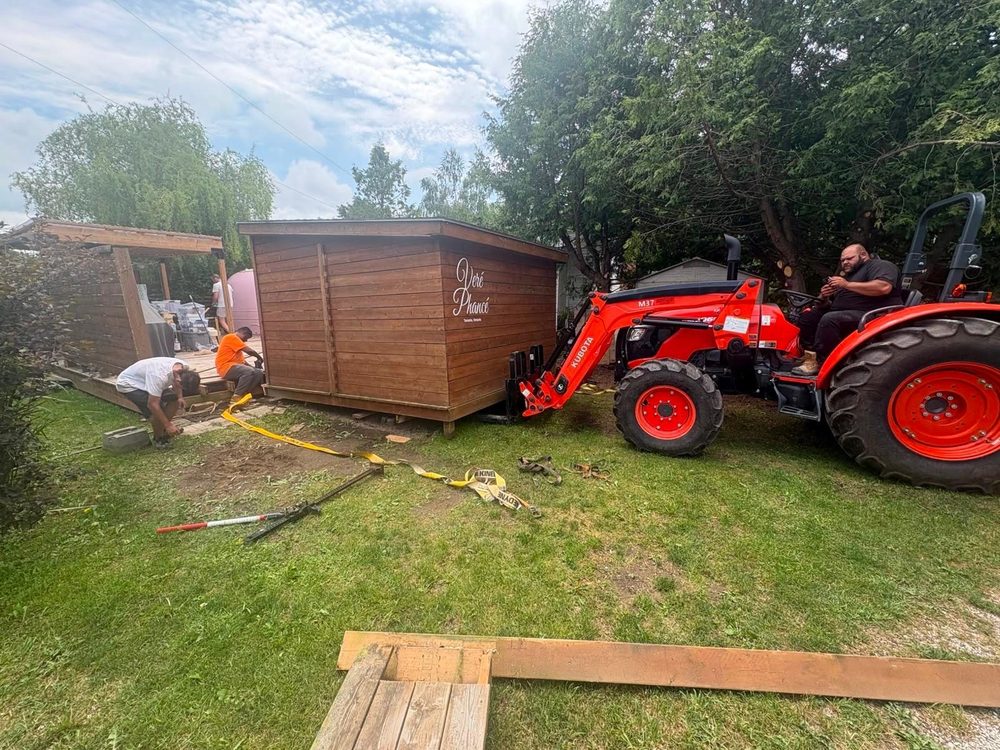
Most people who put an RV or a park model on a property in Northumberland eventually build something next to it: a deck, a shed, a gazebo, a bunkie. Those need permits, the thresholds are different in every municipality, and we get asked about them constantly because we also do deck and shed moving. The material below is what each municipality publishes. It is not advice, and the building department is always the right phone call before you build.
Cobourg draws the line at ten square metres
The Town of Cobourg states that under the Ontario Building Code Act, a building permit is required for the construction of an addition or alteration of any structure which results in a building area over 10 m². Ten square metres is about 108 square feet, or a shed a bit over 10 feet by 10 feet.
Cobourg publishes a list of 23 things that require a permit. The ones relevant to a site with an RV on it include a deck, a porch, an attached or detached garage or shed, a sunroom, a solarium, a carport, a septic system, and plumbing or drains. It also publishes a list of nine things that do not require a permit: an air conditioning unit or heat pump where no duct work is altered, a pool heater, painting and decorating, landscaping, fences other than swimming pool fences, asphalt roof shingling, eaves troughs, minor repair to masonry, and kitchen or bathroom cupboards where no plumbing is involved.
Cobourg has no separate shed threshold
We looked for one specifically, because most municipalities publish a shed size that is exempt and Cobourg's requires-a-permit list names sheds outright. A precision re-read of the page confirmed it: Cobourg publishes the 10 m² building area threshold and nothing shed specific. Read together, that means a shed over 10 m² in Cobourg needs a permit and there is no separate, more generous shed allowance. Compare that with Brighton below, where a shed gets 15 m² and a gazebo gets 10 m².
Cobourg applications go through Cloudpermit online. The Town publishes no processing timeline and no permit fee amounts on its building pages. Building and Planning can be reached at 905-372-4301 or 1-888-972-4301, and general customer service at customerservice@cobourg.ca.
The Cobourg deck guide
Cobourg publishes a Deck Design Guide dated March 2014 from its Building and Planning Department, and it is the most specific deck document any municipality in this county puts out. Two lines from it govern most seasonal site decks.
The guide defines a deck as a raised uncovered platform that is attached to a dwelling. And it states that a deck will generally require a building permit and will require protective guards if it has a walking surface greater than 24 inches above grade.
On guard heights the guide gives both metric and imperial figures, and two separate reads of the same PDF rendered the imperial conversions differently. The numbers are identical in metric and irreconcilable in typography, so we are giving the metric only: a guard of 900 mm where the walking surface is not more than 1,800 mm above finished ground level, and 1,070 mm otherwise.
Note the definition carefully. Cobourg's guide describes a deck attached to a dwelling, and it does not address freestanding decks. A great many seasonal site decks in this county are freestanding platforms beside a park model rather than structures attached to a dwelling, and the guide does not tell you how the Town treats those. That is a question for 905-372-4301, not for us and not for this page.
Brighton publishes the clearest list in the county
The Municipality of Brighton publishes the most complete and most usable building permit material in Northumberland County. It gives specific square footages with metric equivalents, which is exactly what somebody standing in a lot with a tape measure needs.
Brighton requires a permit to construct a new building, to build gazebos or pergolas over 108 square feet, which it gives as 10 square metres, to build sheds or garages over 161 square feet, given as 15 square metres, with or without plumbing lines and fixtures, to install an in-ground or above-ground pool, to renovate, repair or add on, to demolish or remove a building, to change a building's use, to create new or enlarged door and window openings, to build a garage, balcony, porch or deck or to enclose an existing deck, to excavate a basement or construct a foundation, to install life safety or fire suppression systems, to install or renovate plumbing, to finish a basement or convert a room to a bedroom, to erect temporary buildings including tents over 30 square metres, and to install solar panels attached to a roof.
Brighton's exemption list is equally specific. No permit is required for gazebos or pergolas under 108 square feet, for sheds or garages that are for storage uses only accessory to the principal building on the lot, under 161 square feet, only one storey in building height, not attached to any other structure and with no plumbing, for kitchen cupboards and counter tops with no plumbing modifications, for flooring on existing sub-floors, for interior and exterior trim and painting, for new exterior siding, for landscaping, for re-shingling a roof, for driveways, for a washroom vanity with no plumbing modifications, and for window and door replacement where the existing openings are not modified.
The four conditions on Brighton's shed exemption
Read the shed exemption again, because it is four tests and not one. Storage use only and accessory to the principal building. Under 161 square feet. One storey. Not attached to anything else. No plumbing. A 150 square foot shed that you have run a water line into fails the test even though it passes the size test, and so does a 150 square foot structure attached to the side of a park model. Brighton's building department is at 613-475-1162 extension 111.
One number in Brighton's list is worth flagging for anybody who runs events on a property: temporary tents need a permit over 30 square metres. On our Collingwood and Wasaga Beach page the equivalent Midland figure is 60 square metres. Brighton's threshold is half of it.
The thresholds side by side
Here is what each municipality publishes for the structures people actually build beside an RV. Where a municipality publishes nothing, we say so rather than filling the gap.
| Cobourg, any structure | Permit required over 10 m², roughly 108 sq ft. No separate shed threshold. |
| Brighton, shed or garage | Permit required over 161 sq ft, given as 15 m², and only if it also fails one of the four exemption conditions. |
| Brighton, gazebo or pergola | Permit required over 108 sq ft, given as 10 m². |
| Brighton, tent | Permit required over 30 m². |
| Brighton, deck | Permit required to build a garage, balcony, porch or deck, or to enclose an existing deck. No size threshold given. |
| Cobourg, deck guard | Guards required where the walking surface is greater than 24 inches above grade. |
| Port Hope | No requires or does not require lists, no thresholds and no timeline published on its building permits page. |
| Township of Hamilton | Fees published. No threshold list published. |
The practical effect of that table is that a 12 by 12 shed, at 144 square feet, needs a permit in Cobourg and does not need one in Brighton, provided it is single storey, detached, storage only and unplumbed. Thirty five kilometres apart, same shed, different answer. We mention it because seasonal site owners talk to each other and advice travels across municipal boundaries faster than the by-laws do.
What a deck or shed permit costs
Three of the seven municipalities publish building permit fees for accessory structures, and they use three different formulas.
| Brighton, residential accessory building, being a garage, carport, boathouse or shed | $1.10 per sq ft |
| Brighton, decks, chimneys, woodstoves, pools and other structures | $1.10 per sq ft |
| Township of Hamilton, deck, garage or other accessory structure up to 300 sq ft | Base fee $400.00 |
| Township of Hamilton, deck, garage or other accessory structure over 300 sq ft | Base fee $400.00 plus $0.81 per sq ft |
| Township of Hamilton, other permits | $230.00, which the Township notes includes prefabricated and engineered drop on site sheds |
| Port Hope, garage, carport, deck, porch or accessory building | $480.00 per structure up to 400 sq ft |
| Port Hope, the same structures over 400 sq ft | $1.20 per sq ft |
Brighton's fees come from By-law No. 023-2026, effective April 1, 2026, which is the only building fee schedule in the county that publishes both a by-law number and an effective date. Hamilton Township's building fee page publishes neither, and we specifically checked: a loose read of that page offered a by-law number that turned out to belong to an unrelated police false alarm fee line sitting elsewhere on the same schedule. We are not attaching it.
Run a 200 square foot deck through all three and the comparison is clean, because at that size every schedule gives a single unambiguous answer. Brighton charges $1.10 per square foot, which is $220.00. Hamilton Township charges its $400.00 base fee, because 200 square feet is inside the up to 300 square feet band. Port Hope charges $480.00, because 200 square feet is inside the up to 400 square feet band. Same deck, and the most expensive municipality costs more than twice the cheapest.
Above those bands we are not going to publish a total, and the reason is worth stating. Hamilton Township's line for a structure over 300 square feet reads as a base fee of $400.00 plus $0.81 per square foot, and it does not say whether that $0.81 applies to every square foot or only to the square feet above 300. Port Hope's line has the same shape. Those two readings give materially different numbers on a large deck, and neither schedule resolves it. Ask the building department for the actual figure before you budget, rather than trusting anyone's arithmetic including ours.
Park models and mobile homes
A large share of what we move in Northumberland is not a travel trailer. It is a park model going onto a seasonal site, or a mobile home going onto or off a private lot. Those two look similar from the road and they are not the same job at all, because the rules that decide whether the unit is allowed to sit where you want it are zoning rules, and zoning in this county is written seven separate times by seven lower tier municipalities.
Northumberland County's own who does what in government services page draws the line cleanly. The County handles County Roads and bridges, plumbing and septic inspections and the County Forest. Building permits and local roads belong to the lower tier. So the answer to whether you can put a park model at a given address never comes from the County. It comes from Brighton, or Cobourg, or Port Hope, or Hamilton Township, or Alnwick and Haldimand, or Cramahe, or Trent Hills, and they do not agree with each other.
What follows is what each of them actually publishes. Where a municipality publishes nothing, we say that too, because a blank is not a permission. Our side of the work is set out on the mobile home and park model moving page, and it is the same price and the same method here as it is on our Port Perry and Scugog or Georgina and Sutton work.
Brighton prohibits mobile homes in every zone
Brighton is the one municipality in our entire service area with a flat prohibition, and it is worth reading the heading before you read the clause. Section 4.4.1 of Brighton's Zoning By-Law 140-2002, in the January 2020 consolidation of the general provisions, is headed Mobile Homes Prohibited in all Zones. The clause under it says that no person shall locate or use a mobile home in any zone for the purposes of residential, commercial, industrial or institutional uses, temporarily or permanently, unless one of a short list of conditions is met.
Two phrases in that sentence do more work than people expect. The first is temporarily or permanently. A mobile home parked on a lot for one season while something else gets built is still a mobile home located in a zone. The second is in any zone. There is no rural exception, no agricultural exception and no waterfront exception written into the heading. The exceptions are written into the clause instead, and there are exactly three of them.
The three exceptions, including the one we nearly missed
Section 4.4.1 lifts the prohibition in three cases and no others.
- The use of a mobile home for those purposes is specifically indicated as a permitted use in a particular zone, or in a Special Zone Provision.
- A mobile home structure is temporarily used during construction of a main building or buildings on a lot.
- The use of a mobile home structure has been temporarily authorized for use as an emergency shelter where a dwelling or other building has been damaged by fire or natural disaster.
We are naming the third one deliberately, because our first pass at this by-law came back with only two. The clause runs onto a page break and the text we had ended on the word or. The third exception only appeared when the section was pulled a second time and read to the end. Had we published the two, this page would have been wrong in a way no reader could have caught, and somebody whose house had just burned down would have been told the wrong thing at the worst possible moment.
What that means for a booking
We are not a planning department and we do not give zoning opinions. What we do is ask, before we load, whether the destination is in Brighton and whether the unit is a mobile home rather than a park model or a travel trailer. If both are true, we ask you to confirm with Brighton's building department at 613-475-1162 extension 111 that the address is covered by a permitted use, a Special Zone Provision, or one of the two temporary exceptions. That call takes ten minutes. Moving a unit twice does not.
The sixty day habitation limit
The same set of Brighton general provisions carries a rule that catches travel trailers and motor homes rather than mobile homes, and it is the one most likely to affect an ordinary RV owner. No travel trailer or motor home shall be used for the living, sleeping or eating accommodation of persons within the Municipality for a period of more than 60 days within any calendar year, unless such use is specifically indicated to be a permitted use in the pertaining zone.
Read that carefully, because it does not say sixty consecutive days and it does not say sixty days per property. It says more than 60 days within any calendar year, within the Municipality. A licensed campground or trailer park is the obvious case where the use is specifically permitted in the zone, which is why a seasonal site operates normally. A trailer parked on family land for the summer is the case where the number starts to matter.
The same section prohibits something we have been asked about more than once. No truck, bus, coach or streetcar body shall be used for human habitation within the Municipality, whether or not it is mounted on wheels or on any type of temporary or permanent foundation. A converted bus is not a travel trailer under this by-law and does not get the sixty days.
Brighton's accessory building setbacks
If a shed or a deck is going in beside the unit, Brighton publishes the numbers, which is more than most of its neighbours do. Section 4.24.3 caps the maximum permitted height of any accessory building on a lot at 4.5 metres. Section 4.24.1 sets where it can sit.
| Setback | Brighton requirement |
|---|---|
| From the front lot line | The same front yard requirement that applies to the main building |
| From an exterior side lot line | The same exterior side yard requirement that applies to the main building |
| From an interior side lot line | Minimum 1.2 metres |
| From the rear lot line | Minimum 1.2 metres |
| From the main building | Never closer than 2.0 metres |
| From the high water mark | Residential units in detached accessory buildings not within 30 metres |
| Maximum accessory building height | 4.5 metres |
Decks get their own clause. Section 4.25 allows a deck not more than 1.8 metres above grade to project into a required rear yard a maximum distance of 3 metres, but not closer than 4.5 metres to the rear lot line. That 1.8 metre figure quietly does double duty in practice, because a deck built up to meet a park model door on a sloped Brighton lot can climb past it faster than people expect, and once it does, the encroachment allowance no longer applies.
We move decks and sheds as well as units, and the placement question usually gets settled at the same visit as the levelling. The deck and shed moving page covers how we lift and set them, and the levelling and blocking page covers the pad underneath.
What Port Hope charges to put a mobile home on a lot
Port Hope does not publish a mobile home prohibition, and it does not publish a mobile home permission either. What it publishes is a price. On the Municipality's fees and charges schedule, under Group C, new construction and additions to low density residential, there is a line for a mobile home at $2,565.00 per dwelling unit up to 1,500 square feet of floor area.
Two notes on that figure. It is a building permit fee, not a moving fee, and it has nothing to do with what we charge. And the up to 1,500 square feet qualifier is part of the published line, so a unit larger than that is not covered by the number as printed.
Port Hope's building permits page does not publish thresholds, a list of what does and does not require a permit, or a review timeline. We checked for all three specifically, because Brighton and Cobourg both publish that material and we expected to find it. The fee schedule is the only published number in that direction, which makes a call to 905-885-2431 less optional in Port Hope than it would be in a municipality with a fuller page.
The line we will not interpret
Hamilton Township's building and by-law fee schedule carries a line that reads Trailer Agreement, $53.00 per month. That is the whole line. The page does not say what a trailer agreement is, what trailer means for the purposes of that line, who needs one, how long one runs, or what happens at the end of it.
We are not going to guess. It would be easy to write a confident paragraph explaining that this is how Hamilton Township handles a unit sited on a lot during construction, and it might even be right, but nothing on the page says so. Anyone with a unit going into Hamilton Township should ask the Township directly at 905-342-2810 what the trailer agreement covers before assuming it does or does not apply to them.
There is a second line we are leaving out entirely. Port Hope's fee schedule was reported to us as carrying a licensing fee for trailers used for temporary accommodations, with a security deposit and set fines attached. We went looking for it on the live schedule twice, once broadly and once with a targeted read, and it was not there either time. It may have been removed, it may have moved, or it may never have been on that page. We do not publish figures we cannot see, so those numbers appear nowhere on this page.
Storing an RV on your own property
This is the most common question we get from Northumberland homeowners, and it is really three questions wearing one coat. Can the unit sit on the lot at all. How many units can sit there. And can anybody sleep in it. Each municipality answers those three in a different document, and two of the three biggest ones we could not answer honestly at all.
Brighton answers the habitation question through the sixty day rule above, and does not publish a general outdoor storage section for recreational vehicles in the general provisions we read. Hamilton Township answers a narrower question and answers it clearly: from November 15 to April 15, no vehicles, trailers, equipment or materials may be parked or placed on Township roads or right of way between 2:00 a.m. and 7:00 a.m. That is a road rule rather than a property rule, but it is the one that actually gets people ticketed, and Hamilton Township is the only municipality in this county that names trailers in it by name.
If the answer for your address turns out to be no, or turns out to be unreadable, that is what our outdoor winter storage yard is for, and the RV winter storage checklist covers what to do to the unit before it sits. We do the same thing for customers on our Oshawa and Durham Region and Peterborough pages, and the reasons are usually identical.
The Cobourg rule we could not read
Cobourg passed a new zoning by-law, By-law No. 066-2025, and it does contain a section on the outdoor parking and storage of recreational trailers, vehicles and boats. We pulled that section four separate times. We got three mutually incompatible answers about what it says, including on the question of how many units a residential lot is allowed to hold, which is the single thing most people want to know.
So we are not publishing it. Not a paraphrase, not a hedged version, not a generally speaking. A zoning limit we are three quarters confident about is worse than no zoning limit at all, because somebody would rely on it.
Three things from the same by-law we did confirm on two independent reads, and those we will state. The by-law carries its own definition of a recreational trailer, vehicle or boat, so the term is not left to ordinary usage. Clause 4.1.1(h) says that shipping containers, trailers or other mobile structures are not permitted as accessory buildings or structures unless they are specifically permitted by the by-law. And section 4.10(j)(ii), inside the home occupation provisions, prohibits the storage, repair, maintenance or towing of motor vehicles, recreational vehicles or engines as a home occupation.
Where to get the actual answer
Cobourg's building and customer service contacts are 905-372-4301, toll free 1-888-972-4301, and customerservice@cobourg.ca. Ask specifically about the recreational trailer, vehicle and boat parking and storage section of By-law No. 066-2025, and about the maximum number of units permitted on a residential lot. If they give you a written answer, keep it.
The Port Hope sections we could not read
Same problem, different municipality. Port Hope's Zoning By-law 20/2010 is reported to contain a section 4.38 covering travel trailers, recreational vehicles and campers, and a section 4.39 covering uses of lots without buildings. Both would bear directly on whether you can keep an RV on a Port Hope lot, and on whether you can keep one on a lot with no house on it.
We could not retrieve either section. A targeted read of the by-law came back with the exact answer that the sections were not in the retrieved text. That is not the same as the sections not existing, and we are not claiming they do not exist. It means we cannot see them, and we will not quote a by-law we cannot see.
Port Hope's building department is 905-885-2431. Ask for sections 4.38 and 4.39 of Zoning By-law 20/2010 by number, and ask which consolidation date you are being read from, because the version we found referenced was consolidated to August 2023 and by-laws move.
Presqu'ile Provincial Park
Presqu'ile is at 328 Presqu'ile Parkway in Brighton, K0K 1H0, and the park office number is 613-475-4324. It covers 982.00 hectares, it was established in 1922, and Ontario Parks classes it as a Natural Environment park. It is the largest single camping destination in this county by a wide margin, and it is the one park here whose published rules change how a move has to be scheduled.
| Address | 328 Presqu'ile Parkway, Brighton, ON, K0K 1H0 |
| Park office | 613-475-4324 |
| Size | 982.00 ha |
| Established | 1922 |
| Classification | Natural Environment |
| Day use season | January 1, 2026 to December 31, 2026 |
| Camping and roofed accommodation | April 24, 2026 to October 26, 2026 |
| Car camping sites | Over 300, in settings from shoreline to forest |
Read that camping opening date against the half load section higher up this page and a problem shows itself. Presqu'ile opens for camping on April 24, 2026. Brighton's roads page gives its half load period as March 1, 2026 until late April, and a Brighton news post dated May 01, 2026 recorded the restrictions being lifted. The park therefore opens for the season inside the window in which the municipality around it was still restricting axle loads.
That does not make the park unreachable, and we are not going to pretend we can settle it from a desk. Presqu'ile Parkway does not appear on the County's list of 21 posted roads. Whether it appears on Brighton's list we cannot say, because Brighton publishes its restricted road list only as a photograph, as set out earlier on this page. So the honest position is that a late April delivery into Presqu'ile has an unresolved question sitting in the middle of it, and the way to resolve it is a call to Brighton Public Works at 613-475-1162 before the date is set rather than after.
Eight campground loops, and which ones take an RV
Ontario Parks publishes this plainly: car camping at Presqu'ile is available in eight separate campground loops within the greater campground area, and all eight are open during the full camping season from late April to October and are serviced with comfort stations and water taps. What the park says about each loop is what decides whether a large unit belongs in it.
| High Bluff | Approximately 100 sites, most with electrical service. Many open, sunny sites that are popular for RVs. A few sites directly on the water. Wooded sites available. |
| Pines | Smallest campground, all electrical sites, situated among a Scots Pine forest. Popular for RVs. |
| Maples | Almost 50 non-electrical, spacious sites. |
| Lakeside | Non-electrical sites, with a few located right on the lakeshore. |
| Trails End | Almost all electrical campsites, close to the rocky shoreline. |
| Craigs | Non-electrical campsites, and radio-free. |
| Hidden Valley | Non-electrical sites. |
| Elmvale | Mostly non-electrical sites with a few having electrical service, plus six walk-in campsites along the shores of Lake Ontario. |
Two of the eight are described by the park itself as popular for RVs: High Bluff and Pines. That is the park's language rather than ours, and it is the most useful sentence on the entire camping page for anyone towing something large. Pines is also described as the smallest campground with all electrical sites, so the two descriptions together say that a big unit can get power there but should not expect much room around it.
The rest of the facilities picture, as published: there are four newer campground comfort stations plus one at the Owen Point Trail parking lot and one in the Beach 2 parking lot, and the park states that all comfort stations allow for barrier-free access to flush toilets and showers. Washers and dryers are available at the Maples comfort station, and fees apply. Two campsites in High Bluff, number 81 and number 83, have been outfitted as barrier-free. An accessible wheelchair is available for daily rental at the main gatehouse.
Two things Presqu'ile does not publish
We went looking for a maximum trailer length and for a trailer sanitation station, because those are the two questions we field most often about any park. Neither appears on the pages we read. That is not a statement that no length limit and no sanitation station exist. It is a statement that we could not find them published, and it means you should ask the park at 613-475-4324 before committing a long unit to a specific site number.
One trailer per site, and what it costs to break that
Ontario Parks publishes set fines, and several of them describe things a transport customer could do without ever realising an offence was available. These are the published amounts.
| Offence, as published | Set fine |
|---|---|
| Place more than one tent trailer, travel trailer or self-propelled camping unit on campsite | $95.00 |
| Place more than 3 pieces of shelter equipment on campsite | $95.00 |
| Fail to vacate and remove property from campsite on permit expiry | $95.00 |
| Unlawfully occupy campsite | $155.00 |
| Park vehicle in area not designated | $30.00 |
| Operate vehicle off roadway | $155.00 |
The first line is the one that changes our scheduling. One tent trailer, travel trailer or self-propelled camping unit per campsite. If you are swapping a unit at Presqu'ile, the old one has to be off the site before the new one goes on, and the two cannot sit there together while we shuffle them around. In practice that means two moves in sequence with a real gap between them rather than one truck doing both in an afternoon. It is a scheduling fact rather than a legal opinion, and it is far cheaper to know before the date than after the ticket.
Two further published lines bear on us directly. Motor vehicles may be operated on park roads only, and park roads are regulated by the Highway Traffic Act. That second half is not decoration. It means the vehicle rules that apply out on a County road apply inside the gate too, which is why we do not treat a park entrance as the end of the regulated part of a trip. And operating a vehicle off the roadway carries a $155.00 set fine, which is precisely the line a driver crosses when he decides to cut across grass to line a trailer up on a site.
The park also publishes that you are required to vacate and remove all property from your campground campsite or interior campsite by 2:00 p.m. on the date your permit expires, and that the maximum number of campers allowed per campground campsite is six persons, with nine on an interior campsite. That 2:00 p.m. line is the hard edge on an October pickup. If a permit expires on the 26th and we are booked for the 26th, we are working against a clock the park has already published, and we would rather book the 25th.
One thing we did not find: quiet hours. They are not on the pages we read. If your move needs a truck and blocking work at either end of the day, ask the gatehouse rather than assuming the usual convention applies.
Ferris Provincial Park
Ferris is at 474 County Road 8 in Campbellford, K0L 1L0, phone 705-772-9561. It covers 198.30 hectares, it was established in 1962, and it is classed as Recreational. Its published 2026 season runs May 8, 2026 to October 18, 2026.
The park publishes a short list of highlights, and because one loose read of this page came back to us as invented prose rather than the park's actual text, we are reproducing the list rather than describing it:
- Pedestrian suspension bridge over the Trent River Gorge
- Selection of wooded and open car and RV campsites
- Over 10 km of trails through forest and riverside settings
- Spectacular lookout over Ranney Falls
- Spring woodland wildflowers along Drumlin Trail
- Beautiful fall colours and vistas
On camping, the park publishes that Ferris offers car camping on over 150 sites in two campground loops, Valleyview and Bedrock. Valleyview Loop is set atop a forested drumlin, with some campsites providing a view across the Trent River Valley. The Bedrock Loop has some electrical campsites and is just a short walk to the playground and day use picnic areas. The camping page does not repeat the season dates, so the May 8 to October 18 figures above come from the park's main page rather than from the camping page.
The Ferris approach is a County road, and that changes the date
Ferris sits at 474 County Road 8. County Road 8 is on the County's posted list earlier on this page, given as restricted from Burnbrae Road to the Hastings County boundary, and the County's winter list gives the same road as Class 3 under the alternate names Bridge Street, East and Centre Street. So the reduced load period that governs the approach to Ferris is not Trent Hills' March 1st to May 1st. It is the County's, which is signed usually between March 1st and April 30th, and which the County explicitly warns may be in effect earlier than March 1st and may stay posted beyond April 30th.
What we cannot tell you is whether the park's own frontage falls inside that posted extent, because the County qualifies its entire list with the words all, or a portion thereof. Campbellford is on that road. Whether the specific stretch outside the park gate is signed is a question for the sign itself, and for the County at 905-372-3329 or 800-354-7050. A May 8 opening weekend delivery is very probably clear of it. An April run to place a unit before opening is the one worth asking about, and it is the reason we ask for the destination address rather than the park name.
Campbellford sits close to the eastern edge of the county, and a load coming from the east is often better planned off our Belleville and Quinte West page, because County Road 41 and County Road 64 both run to the Quinte West boundary and both are on the posted list.
Peters Woods Provincial Nature Reserve
Peters Woods covers 349.00 hectares, was established in 1976, and is classed as a Nature Reserve. Ontario Parks places it in Northumberland County about 20 kilometres northeast of Cobourg. It is day use only. The published facilities are minimal: a parking lot, a trail and vault privies. Visitors are asked to stay on the foot trails to prevent trampling the vegetation and compacting the soil.
We include it for one reason. It shows on maps as a provincial park in the middle of our service area, and people reasonably assume that a provincial park means camping. This one has none, and there is nothing here for a transport customer at all. If somebody tells you they have a site at Peters Woods, they have the wrong park, and that is worth sorting out before a truck is dispatched rather than after it arrives at a trailhead.
Victoria Park Campground in Cobourg
Victoria Park Campground is the municipal campground in Cobourg, at 138 Division Street, and it is the only in-town camping option in this county that we found published. It has 70 trailer sites, both seasonal and transient, with water and hydro hookups at 30-amp, and some sites offering sewer as well. Cobourg's tourism page carried the notice that the campground is open for the 2026 season.
| Published rate | Nightly, plus HST |
|---|---|
| Tent site | $50.02 |
| Interior, hydro and water | $55.57 |
| Interior, hydro, water and sewer | $58.91 |
| Waterfront, hydro and water | $70.02 |
| Waterfront, hydro, water and sewer | $74.47 |
| Trailer pump-out | $27.79 |
Check-in begins at 2:00 p.m. and check-out is by 11:00 a.m. Those two times bracket a three hour window in the middle of a changeover day, and if a unit is going in or coming out on that day, the window is the whole job. Contact is 905-373-7321, toll free 800-224-7504.
A seasonal site at a municipal campground is the most common Northumberland destination we get asked about, and the reason is straightforward. It is somewhere to keep a unit that is not your own driveway, which sidesteps every zoning question set out earlier on this page. The trade is that the campground's own rules apply instead, and those are not published in the same detail as a provincial park's. If a seasonal site is what you are after rather than ownership, our RV rentals page covers the other side of that decision.
One figure is not published: a maximum RV length. If your unit is long, confirm it against the specific site number before we load, not after we arrive.
Northumberland County Forest
The County Forest is County property, neither municipal nor provincial, which puts it under the same body that owns the 21 posted roads and the 503 km network they sit in. Forest Services is responsible for managing approximately 2,225 hectares, which the County also gives as 5,500 acres. The forest has over 118 km of trails and over 100,000 visitors per year.
Here is the part that matters, and we want to be exact about it because it would be easy to be sloppy in either direction. The County Forest page does not mention camping, RVs, trailers or overnight stays at all. Not to permit them, and not to prohibit them. It simply does not address the subject. So we are not going to tell you camping is prohibited there, because the page we read does not say that, and we are not going to tell you it is allowed either.
What the page does publish is an events rule. Organizations wishing to hold special events in the County Forest must obtain a permit from Northumberland County and provide confirmation of liability insurance, and the special events permit must be submitted eight weeks prior to the event. Eight weeks is the longest published lead time anywhere in this county. It is longer than the County's own six week special event road permit, and considerably longer than any provincial permit timeline on this page. If a forest event is part of your plan, that eight weeks is the number that sets your entire schedule, including ours.
We do not deliver units into the County Forest. If a customer's destination turns out to be forest land rather than a titled lot, that is a conversation with the County before it is a conversation with us.
Getting a load in and out
Every authority in this county publishes how much road it owns, and setting those figures beside each other tells you more about access here than any description of the scenery would.
| Authority | Road network, as published |
|---|---|
| Northumberland County | 503 km of road and 110 structures |
| Trent Hills | 527 km: 254 km gravel, 225 km surface treated, 48 km paved |
| Alnwick and Haldimand | 487 km of Municipal roads |
| Brighton | Over 250 km of roads and 40 km of sidewalks |
Trent Hills is the figure worth sitting with. It owns more road than the County does, and 254 of its 527 kilometres are gravel against 48 paved, with surface treated making up the other 225. Put plainly, one municipality inside this county has more than five times as much gravel road as paved road, and gravel is the surface that behaves worst under a heavy axle in exactly the weeks the reduced load period covers. That is not a criticism of Trent Hills. It is the arithmetic of a rural township, and it is why a March or April booking east of Campbellford draws more questions from us than the same booking in Cobourg.
- The last hundred metres is the problem, not the highway. Highway 401 runs the length of this county and the ministry maintains it. The difficulty is never the 401. It is the concession road, the private lane and the turn into the site, and all three belong to somebody other than the province.
- Gravel is a season, not a surface. A gravel lane that carries a loaded gooseneck without complaint in August can be the reason a job gets postponed in April. We would rather move the date than the ditch.
- Overhead is what people forget. Height is 4.15 m before a provincial permit is needed, and a park model sits close enough to that figure that branches, wires and a low barn roof all become part of the route survey rather than scenery.
What we ask for is the civic address at both ends rather than the town, and a description of the last stretch of lane. A photograph of the turn from the road into the property answers more questions in ten seconds than a phone call does in ten minutes. Our guide to preparing an RV for transport lists what else to have ready, and the RV transport page covers what the truck itself can and cannot do.
Levelling and blocking on Northumberland ground
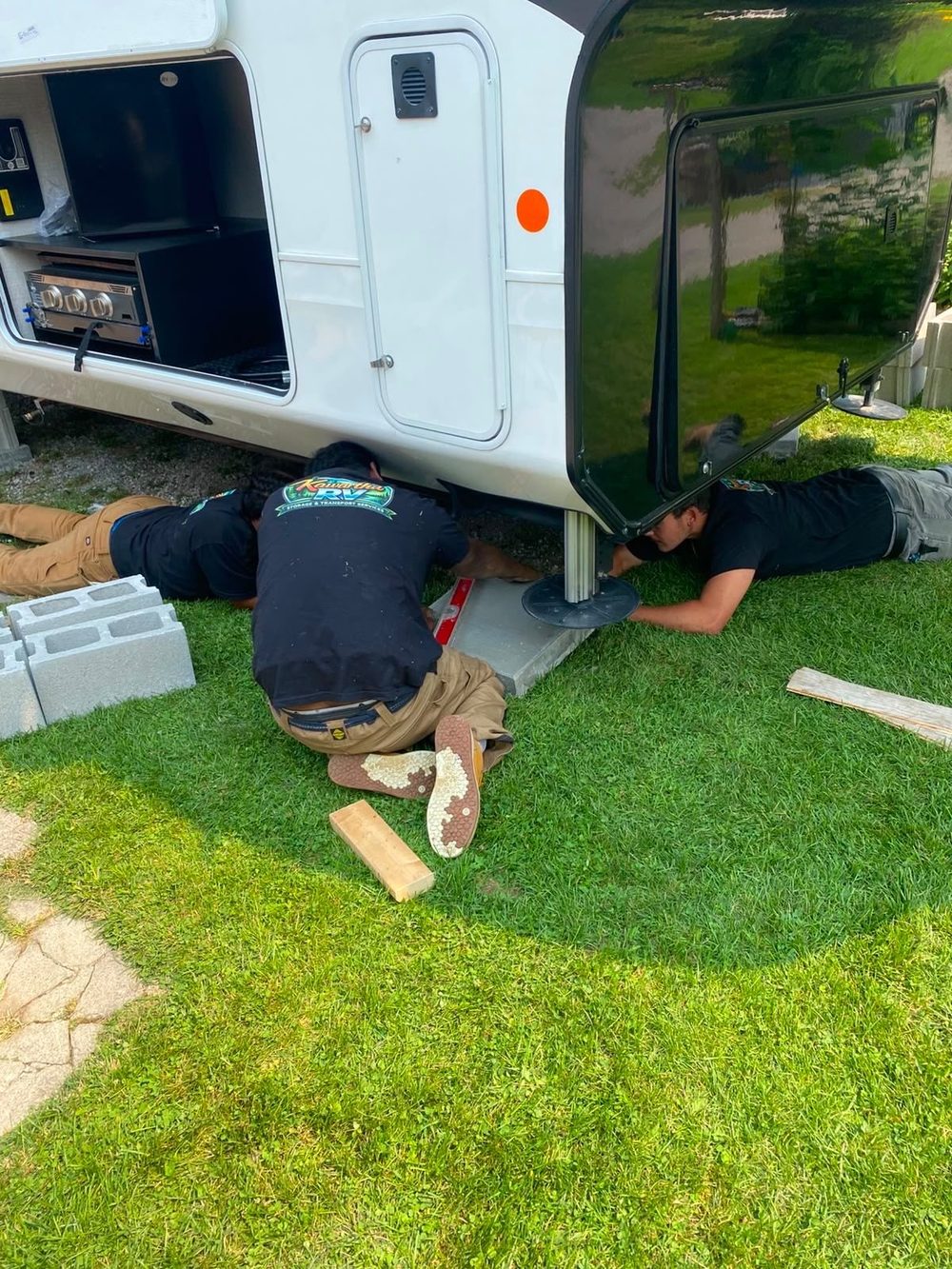
Levelling and blocking is a flat $799 for a full set up, and that price is the same here as everywhere else we work. It does not move because a site is awkward, and it does not move because the ground is difficult.
Here is what we are not going to do, and we would rather say it plainly than pad this section. We are not going to publish claims about Northumberland soil. A mover who tells you your lot is clay before he has stood on it is guessing, and this county gives you the counter-example in its own published material. Presqu'ile is a sand spit reaching into Lake Ontario. Ferris is built on a drumlin, and the park says so itself. Peters Woods is a nature reserve where the province specifically asks visitors not to compact the soil. Those three sit within an hour of one another and they are not the same ground. Your lot is its own case, and it gets looked at.
What we do instead of guessing is look. The blocking pattern, the number of points, how much material goes in and whether a pad needs building are decided on site, and they are decided before we quote rather than added to an invoice afterwards. Our levelling and blocking page sets out the method in full.
The one general thing worth saying is that a unit sitting on ground which freezes and thaws will move if it was blocked badly, and Northumberland freezes and thaws hard enough that eight separate road authorities post axle limits over it every spring. The reduced load period exists because of what happens under a road surface in March. The same physics is at work under your blocking. That is the argument for doing it properly the first time, and it is the same argument we make on our Muskoka page, where the ground is granite instead and the answer is still to look before quoting.
When a Northumberland booking actually moves
This is most of the page compressed into one table. Eight authorities, eight answers, and two of them blank.
| Authority | Published reduced load period |
|---|---|
| Hamilton Township | Approximately mid-February to mid-April |
| Northumberland County | Signs usually posted March 1st to April 30th, may be in effect earlier and may stay posted beyond. 21 named roads, 5 tonnes per axle. |
| Port Hope | March 1 to April 30, 5 tonnes per axle on all rural roads it owns |
| Brighton | March 1, 2026 until late April on the roads page. A news post dated May 01, 2026 recorded the lift. |
| Cobourg | Monday March 2, 2026 to mid- to late April, weather dependent. Six named streets. |
| Trent Hills | March 1st to May 1st, all roads under its jurisdiction, By-law 2002-9 |
| Alnwick and Haldimand | No half load rule published |
| Cramahe | No half load rule published |
The earliest published start in the county is Hamilton Township's, at approximately mid-February. The latest published end is Trent Hills', at May 1st, with the County reserving the right to leave signs up past April 30th. Take those two outer edges together and the restricted season across this county runs from roughly the middle of February to the beginning of May, which is about two and a half months. Nothing in between lines up with anything else.
So the practical advice is short. If your move can happen between May and the middle of February it is a simpler job, and we will tell you so. If it has to happen inside the window, we need the address at both ends before we can say whether it is a problem, because the answer depends entirely on which of these eight bodies owns the road in front of you and on which boundaries the route crosses. The two blanks are not permission, as set out earlier on this page. They are silence, and silence gets checked by telephone rather than assumed. We build this same table for every area we cover, and the Barrie page does it for Simcoe County if your move starts on that side.
What a Northumberland move costs
Our prices are the same everywhere we work. What changes here is distance from Beaverton and how many authorities the route crosses, and we would rather set that out than pretend one number covers every case.
| Service | Price |
|---|---|
| Local tow | From $400 |
| Levelling and blocking, full set up | $799 |
| Storage | $85 to $125 a month depending on size |
| Deposit to book a date | None |
| Maximum tow weight | 30,000 lb on a 30 foot gooseneck |
From $400 is a local tow. Cobourg, Port Hope and Brighton are not local to Beaverton, so a Northumberland job is priced on the actual run, and the honest version of that is that most work in this county sits above the starting figure rather than at it. Distance is the first reason and it is not the only one.
The second reason is the one this page has spent most of its length on. A move that stays inside one municipality is a simpler quote than a move which crosses from Hamilton Township into Cobourg onto a County road and back out again, because every crossing brings a different half load date, a different permit desk and in one case a different fee. We do not charge a line item for that. We do build it into the time we allow, because a route touching four authorities takes longer to plan than one touching a single authority.
Permit fees are not ours and we do not mark them up. If a load needs a provincial permit the ministry's published fee applies, and if it needs a municipal one, Hamilton Township's $50.00 per trip or $150.00 annual applies exactly as published. Those figures are set out in full in the permit sections above. Our RV transport cost guide for Ontario covers how our pricing works generally, and storage is priced separately again.
When to book
Nobody in this county publishes a lead time for an oversize permit. The province does, and two County permits do, and that is the entire published picture.
| Permit | Published processing time |
|---|---|
| MTO annual oversize or overweight | Up to 15 business days |
| MTO project permit | Up to 15 business days |
| MTO single trip | 5 business days |
| MTO superload | At least 5 business days, and up to 6 months in some cases |
| County special event road permit | 6 weeks |
| County Forest special events permit | 8 weeks |
| Any municipal oversize permit in this county | Nothing published |
Read that last row properly, because it is the useful one. Hamilton Township publishes a $50.00 per trip oversize fee and a $150.00 annual one, and publishes no lead time to go with either. Neither does the County for its two oversize permits, which are applied for through an online portal with no stated turnaround. That is not a complaint about anyone. It means the only safe assumption is that a municipal permit takes as long as it takes, and the way to find out is to call rather than to plan around a figure nobody printed.
The working rule we use is this. Outside the reduced load window with no permit needed, a Northumberland date is usually easy to find. Inside the window, or with a permit in the mix, three weeks is comfortable and one week is tight. If a superload is involved, the province's own words are up to 6 months in some cases, and that should be treated as a real number rather than as legal padding.
We do not take a deposit to hold a date. Booking early therefore costs you nothing, and it is the single cheapest thing you can do to protect a spring move in a county with eight road authorities in it.
How to get the quote right the first time
Six things. With these ready, the quote is usually one conversation instead of three.
- The civic address at both ends. Not the town, and not the park name. The address tells us which of the eight road authorities owns the last stretch. The town does not.
- Make, model, year and the width. Width against 2.6 m is the single question that decides whether a provincial permit enters the picture at all, and height against 4.15 m is the second.
- The date, or the range of dates. If it lands between the middle of February and the beginning of May, say so early, because that is the window where the answer depends on the route rather than the destination.
- A photograph of the turn into the property. The last hundred metres decides more jobs than the first hundred kilometres, and a photograph settles it faster than any description.
- Whether the unit is being set up or only dropped. Levelling and blocking is a separate $799 and it changes how long we are on site.
- Anything already known about the site. An existing pad, a septic bed, a well, a buried line, a neighbour's fence. None of these change the price. They change where the truck can go.
Call (647) 961-9257 or email transport@kawartharvrentals.ca. We are open Monday to Saturday, 7:00am to 7:00pm. Sunday closed, by appointment only. Our CVOR is 204-617-206, and you are welcome to check it before booking anything with us, or with anybody else.
Our workmanship guarantee
If a unit we set up shifts or moves because of our workmanship, we come back and redo the job at no charge. Weather and ground conditions are outside that, and we say so up front.
We want to be clear about where that line sits, because a guarantee which is vague is not worth having. If a unit we set up shifts or moves within 30 days because of how we did the work, we come back and redo it at no charge. If it moves because of weather, or because the ground itself moved, that sits outside the guarantee, and we say so here in full size rather than in small print at the bottom of an invoice.
The reason the line sits exactly there is written across this entire page. Northumberland ground moves every spring. Eight separate authorities post axle restrictions because of it, one of them starting in the middle of February. We can control our blocking pattern, our material and our method, and we stand behind all three without qualification. We cannot control a freeze-thaw cycle, and we are not going to promise you that we can.
Where every fact on this page came from
Everything above is sourced from a published page belonging to the authority that made the rule. No figure on this page came from a competitor's website, a directory listing or a summary of a summary. Here is the full list, so you can check any of it yourself. If a page has changed since we read it, the page wins and we want to know.
Northumberland County
- Roads and bridges, for the 21 posted roads, the 5 tonne axle limit, the March 1st to April 30th signing period, and the 503 km and 110 structures figures.
- Snow plowing, for the 900 lane kilometres, the road classifications, the Minimum Maintenance Standards timings and the 30 to 40 km/hr plough speed.
- Road permits, for the two oversize permits, the special event lead time and the transportation department contacts.
- Who does what in government services, for the division of responsibility between the County and its seven local municipalities.
- Northumberland County Forest, for the 2,225 hectares, the 118 km of trails and the eight week special events permit.
Cobourg
- Half load restrictions news post, for the six streets, the Monday March 2 start and the mid to late April end.
- Roads and sidewalks, and winter control and snowplowing, for the freeze-thaw wording and the winter parking and clearing rules.
- Applications, licences and permits, which is where we confirmed that none of the 19 listed permits relates to roads.
- Building and renovating, for the ten square metre threshold and the two lists.
- Deck Design Guide, March 2014, for the definition of a deck and the guard heights.
- Zoning By-law No. 066-2025, for the recreational trailer definition, clause 4.1.1(h) and section 4.10(j)(ii). This is also the by-law whose recreational vehicle parking section we could not read reliably and therefore refused to publish.
- Victoria Park Campground, for the 70 trailer sites, the hookups, the rates and the check-in and check-out times.
Port Hope
- Road permits, for the five tonne rural road restriction, the March 1 to April 30 period and the road occupancy requirements including the $5 million insurance condition.
- Fees and charges, for the $206.00 road occupancy permit, the accessory building and deck fees and the mobile home dwelling unit figure.
- Snow plowing and snow removal, for the priority classes and clearing times.
- Building permits, which is where we confirmed that no threshold list and no timeline are published.
Brighton
- Snow removal, for the Class 2 to Class 5 system, the 250 km of roads and 40 km of sidewalks, and the equipment count.
- Building permits, for the requires and does not require lists and the 30 square metre tent threshold.
- Planning and building fees, By-law No. 023-2026, for the $1.10 per square foot accessory building and deck rate.
- Zoning By-Law 140-2002, general provisions, for the mobile home prohibition and its three exceptions, the sixty day habitation limit and the accessory building setbacks.
Hamilton Township, Alnwick and Haldimand, Cramahe, Trent Hills
- Hamilton Township roads, for the mid-February half load start and the winter parking prohibition.
- Hamilton Township road and public works permits, for the $50.00 single trip and $150.00 annual oversize fees and the rest of the schedule.
- Hamilton Township building and by-law fees, for the deck and accessory structure bands and the trailer agreement line.
- Sackville Bridge load reductions, for the 12, 22 and 31 tonne posted limits.
- Alnwick and Haldimand public works and roads, for the 487 km network, the winter parking by-law and the absence of any half load rule.
- Cramahe parking by-law, which prints its number as 07-31 while the township's own web pages cite 2007-31.
- Trent Hills roads and transportation, for the March 1st to May 1st reduced load period, By-law 2002-9, the 527 km network breakdown and the permit list.
Province of Ontario
- Get an oversize or overweight permit, for every permit fee and processing time on this page, and for the sentence limiting those permits to King's highways.
- Guide to oversize and overweight vehicles and loads, for the 2.6 m width, 4.15 m height, 12.5 m single vehicle and 23 m combination figures, and for the instruction to contact the municipality directly.
- Highway Traffic Act. We link it because municipal pages cite it, and we have quoted section numbers only where a municipality named them. We could not render the statute text itself, so nothing on this page is quoted from the Act directly.
Ontario Parks
- Presqu'ile and its camping page, for the season dates, the eight loops, the facilities and the set fines.
- Ferris and its camping page, for the May 8 to October 18 season, the highlights list and the two campground loops.
- Peters Woods Provincial Nature Reserve, for the day use classification and the minimal facilities.
Two notes on method, because they explain some of the refusals above. Ontario Parks moved hosts, so pages found under the older address redirect, and every parks link here points at the current one. And detail on a provincial park lives on its camping sub-page rather than its main page, which is why a quick read of a main page can appear to contradict a campground fact. Where two reads of the same document disagreed, we dropped the fact rather than pick a winner, and we said so at the point where it would have appeared. You can see the same approach applied to every area we cover on our service areas page.